The Full Tilileak Document Dump

Screen Shot 2014-08-26 at 2.48.03 PM

Earlier this summer, dolphin advocate Russ Rector managed to use FOIA to secure the release from the National Marine Fisheries Service of all documents in their files related to the purchase and import of Tilikum, Haida (and her calf), and Nootka from Sealand of the Pacific to SeaWorld.

I’ve previously posted some of the documents, and analyzed them over on The Dodo (here, here, and here).

Today, with Russ’ permission, I have uploaded the rest to Scribd, so the full set is available for anyone to read and analyze (interesting tidbit: the cost to SeaWorld for all the permit work was $200).

I am sure there is plenty of additional info in the documents that is worth noting, so please feel free to comment and share your thoughts on anything that catches your attention. Of note, there are full necropsies and related analysis of the deaths of two SeaWorld killer whales, Kahana and Kenau, as well as SeaWorld’s full Marine Mammal Inventory Report from 1991. (I have had the necropsies analyzed by Dr. Jon Zern, a veterinarian, and will post his analysis in a separate post tomorrow morning).

Since these documents are all finally available thanks to Russ and his persistence, I have asked him for his thoughts on their significance. Here’s what he has to say:

The documents I obtained from National Marine Fisheries  Service (NMFS) after many years of requests and searching are going to be made public here for the first time. These documents are a wealth of information concerning marine mammals in captivity. The one thing that stands out to me is how Sealand, Sea World and the Canadian government all seemed to work together to mislead the National Marine Fisheries Service concerning a medical emergency at Sealand and the orca Tillicum, that did not exist. Yes, the animals were in a very bad situation created by a bunch of dumb people more interested in money than how the animals were treated and cared for. But there was no true medical emergency.

Before Tillicum killed the female trainer (Keltie Byrne) at Sealand there was no medical emergency, and suddenly after he killed her there was this medical emergency that everybody in the captive industry suddenly became aware of. My question is: why did this medical emergency only surface after he killed her, not before?

That in itself is very suspicious and proves to me that this was all about getting Tillicum–a sorely needed breeder–to Sea World no matter what they had to do or say.  Veterinarians of captive facilities and those beholden to the dolphin captivity industry wrote letters saying if he wasn’t moved to Sea World immediately he was going to die. This was a set up. SeaWorld, Sealand and the Canadian government said exactly what they needed to say to mislead NMFS into issuing the permit for the emergency transport. This shows me the permitting process at NMFS is broken and archaic and does not truly protect marine mammals as the Marine Mammal Protection Act mandates. This shows me the Marine Mammal Protection Act at this point in time is the Marine Mammal Facility Protection Act. In the coming days I will be asking NMFS and The Marine Mammal Commission to ask Congress for a full program review of the permitting process for the import and export of marine mammals to and from the United States.

These documents were kept secret for too long. That’s a problem. When we get so far downstream from any incident it becomes old news and seems to be ignored. That seems to be why the captivity industry lobbies government agencies and other captive facilities to make sure this sort of information doesn’t come to light at the appropriate time. These documents have spent 22 years waiting to be discovered by the public. It’s a lot of reading so go through them and see what you can find. Please contact me if you need any assistance please contact me at captivitykills@Comcast.net.

Russ Rector

Can Test Tube Meat Replace Dead Cows?

James McWilliams has his doubts:

David Steele, a molecular biologist and head of Earthsave Canadatells me that lab meat “is extraordinarily unlikely to work.” Tens of thousands of calves, he notes, “will have their hearts punctured … to collect the liter or so of serum that can be taken from them.” The claim that lab meat might be propagated with blue algae, he says, “is patently absurd” as “no one has accomplished anything close.” He also notes something so obvious I wish I had recalled it on my own: Cultured cells lack an immune system. As a result, according to Steele, “there will be a need for at least large doses of penicillin/streptomycin.” Preventing the spread of viruses within these cultures “would be a huge additional problem.” And as far as allergies go, who knows?

Daniel Engber, a science writer and editor at Slate, is equally downbeat about the future of cultured meat. He posted a piece earlier this month with a headline declaring lab meat to be “a waste of time.” Acknowledging the ecological and welfare implications of the technology, he highlights what strikes me as a critical point: Lab meat only seems to be “real” when it’s adulterated with food-like substances designed to “improve color, flavor, and mouthfeel.”

In this respect, there’s nothing novel to ponder about the slab of lab meat. It’s a heavily processed, fabricated food that’s essentially no different than the plant-based substitutes that are becoming increasingly popular. So, Engber justifiably wonders: “What’s the point?” After all, do cultured cow cells dressed up to look like real meat “really get us any closer to a perfect substitute for flesh than soy or wheat or mushroom?” Not a bad question, given that the market for lab meat would likely be the same market that currently eats Tofurky (myself included).

You know the meat industry will jump on that infection and allergy point, and scare the bejesus out of any consumer who is tempted to try lab meat.

But I think McWilliams’ point that processed lab meat is not really that different from processed soy gets to the most fundamental point, which I raised yesterday: if the choice it to simply move on from meat and cultivate a new diet and culture around delicious vegetarian and vegan cuisine,  or contort oneself in all sorts of complicated ways to try and find complicated and highly processed (and dubious) substitutes for meat, isn’t it um, easier, to simply go for the veggies?

I know, people will say meat is culture, our bodies crave animal fat, etc., etc., ad nauseum. And that it is not that easy to simply move humanity past meat. But what if eating test tube meat leaves you with a craving for the real thing? What if test tube meat has other health and environmental side-effects? That doesn’t sound like an easy solution either.

To me, the simplest approach–just stop thinking about meat and meat substitutes as food–is the most promising approach. I am amazed at how quickly my body and mind stopped craving meat. And in fact I now, through some strange evolution of my body and its senses, find meat actively unappealing. It just wasn’t that hard.

Do We Really Need To Reinvent Food?

There are two basic approaches to diminishing or eliminating the environmental, health and animal welfare impacts of easting animal protein.

One is to reinvent meat and animal protein by creating plant-based substitutes, and Kate Murphy in the New York Times takes a look at all the venture capital and brainpower that Silicon Valley is throwing into this approach:

Call it Food 2.0.

Following Steve Jobs’s credo that “people don’t know what they want until you show it to them,” a handful of high-tech start-ups are out to revolutionize the food system by engineering “meat” and “eggs” from pulverized plant compounds or cultured snippets of animal tissue. One company imagines doing away with grocery shopping, cooking and even chewing, with a liquid meal made from algae byproducts….

Venture capital firms like Kleiner Perkins Caufield & Byers, Closed Loop Capital, Khosla Ventures and Collaborative Fund have poured money into Food 2.0 projects. Backing has also come from a hit parade of tech-world notables including Sergey Brin of Google, Biz Stone of Twitter, Peter Thiel of PayPal and Bill Gates of Microsoft, as well as Li Ka-shing, Asia’s wealthiest man, who bought early stakes in Facebook and Spotify.

“We’re looking for wholesale reinvention of this crazy, perverse food system that makes people do the wrong thing,” said Josh Tetrick, the vegan chief executive of San Francisco-based Hampton Creek. His company has created an egg substitute using protein extracted from the Canadian yellow pea, incorporating it into Just Scramble, Just Mayo and Just Cookie Dough, which are starting to find their way onto grocery store shelves nationwide.

I’m pretty much down with anything that can help people move away from meat and animal protein. But replacing the flavor and texture of meat or dairy is very, very hard to do. I’ve tried most of the Food 2.0 alternatives that are for sale and while some aren’t revolting, or have a bland, neutral taste and feel, none taste anything like the thing they are trying to replace. And they are highly processed and packaged.

The second approach is to simply move on from meat and animal protein without trying to replace it. There is a world of good food out there that is all-natural vegan and vegetarian. When I went vegetarian, and then vegan,  I missed meat and I missed Half and Half in my coffee. I quickly discovered that there were no true substitutes, and that instead of vainly seeking to find a perfect substitute I would waste less time, and experience less disappointment, if I simply adopted new cuisines and recipes (Indian, Asian, Latino) that don’t rely on meat or animal protein. They are out there, folks. And they are delicious.

And you know what happened? I stopped missing meat and cream, and started craving two things: vegetables (though my wife can’t believe that I sometimes want to eat brussels sprouts for breakfast) and unprocessed food. And that makes eating pretty enjoyable and easy.

And sorry Silicon Valley: no Frankenfoods are required.

Tilikum At Sealand, Uncut

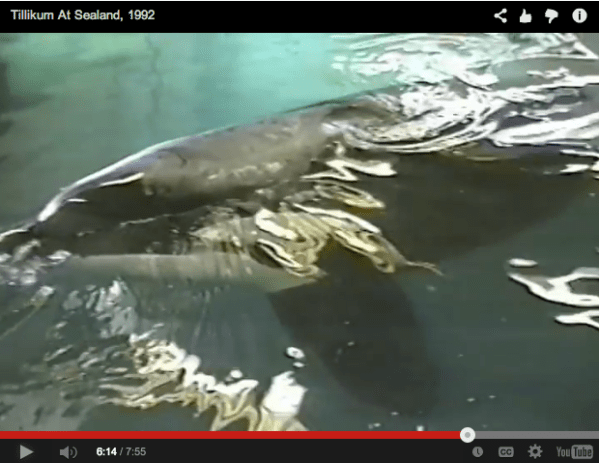
I’ve got a post over at The Dodo, featuring the newly released 8-minute video SeaWorld made at the end of 1991, showing Sealand and Tilikum’s circumstances there. The video was submitted to the National Marine Fisheries Service in support of SeaWorld’s application for an emergency permit to transport Tilikum to SeaWorld Florida. Boy, do I wish we had had this video when we were putting Blackfish together.

Screen Shot 2014-08-22 at 1.35.54 PM


This video, along with lots of other documents related to Tilikum’s purchase and transfer to SeaWorld, was prised loose from NMFS archives by dolphin advocate Russ Rector. I’ve looked at some of the interesting aspects of the documents here and here. But I haven’t begun to dig through every page of the FOIA dump Russ scored. So next week, with Russ’ permission, I’ll post the whole cache on Scribd so anyone can review them.

The Global Livestock Footprint

It’s pretty massive. According to National Geographic, only 55% of the world’s crop calories are consumed directly by people. Fully 36% of the world’s crop calories are used for animal feed. And since it takes 100 calories of grain to produce 12 calories of chicken, or 3 calories of beef, that’s not very efficient.

Here’s what it looks like:

With the global population expected to hit 9 billion by 2050, we have a very simple choice: we can destroy more forests and natural landscapes and put it to the plow or use it for grazing, or we can eat less meat. A lot less meat. And that doesn’t even account for the climate change impact of meat.
Animal Care KNOWS


seaworld-animal-care-employees

Over the past few years, the more I heard about the Animal Care staff at SeaWorld, the more I wanted to be able to hear their stories. They seemed to be involved in everything: births, deaths, rescues, illnesses, transports. If anyone could add texture to what we know about the lives of the animals at marine parks it was Animal Care workers.

Over the past ten months I have been speaking with three SeaWorld Animal Care veterans, who worked at SeaWorld Florida and SeaWorld Texas (I also spoke with a fourth, but for reasons never explained, he/she just dropped off the radar after telling me some amazing stories; sadly I couldn’t use them). Their tenures spanned a period from the late 1980s through 2006, and they had plenty of interesting and revealing tales to tell.

You can read them all here.

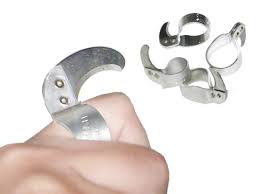
One of the most surprising and intriguing new revelations was supplied by Jim Horton, the most experienced of the trio. He told me about the existence of a ring knife, a small blade which slips over a finger and can be used to cut open and eviscerate a stillborn calf that is stuck in the mother’s birth canal. It is a procedure with a noble aim–to save the life of the mother. But if you imagine the experience of the mother–suspended in a sling or otherwise immobilized as a person inserts a hand up inside her vagina, eviscerates her dead calf, and starts pulling its internal organs out–it is at the same time grotesque.

Horton sent me a picture of what the ring knife he was describing looked like:

knife

SeaWorld’s Fred Jacobs confirmed the existence of this knife, and explained that the procedure in which it is used is called a “fetotomy.”

“Our veterinary medical care program is identical to that found in referral hospitals and veterinary medical teaching hospitals around the United States. We practice comprehensive medical and surgical care. That includes obstetrical care and, rarely, surgery to reduce fetal dystocia. The tools used for veterinary obstetrics are similar to those used in human medicine. The instrument you’re referring to is used in a procedure known as fetotomy.”

Horton told me he was pretty sure that a fetotomy was performed on the stuck, stillborn calf that killed Gudrun in 1996 (the calf was forcibly removed with the help of a winch, tearing Gudrun up, which led to her death days later). But he couldn’t 100% remember, in the chaos and stress of trying to save Gudrun’s life, actually seeing the calf being eviscerated.

Asked about Gudrun, SeaWorld’s Fred Jacobs would not confirm that the calf was eviscerated, but did note that instruments and procedures were used to try and help Gudrun pass the fetus:

“On rare occasions veterinarians have to help an animal pass a fetus. With very large animals like whales, elephants, rhinos, horses and cows, there are specifically designed veterinary obstetric instruments. The goal of any such procedure is to save the life of the mother and quickly ease any discomfort she would have as a result of the stillbirth. The tools used by SeaWorld are identical to those used by large animal veterinarians.”

Even more intriguing to me about the existence of this sort of knife was that it offers a potential explanation for something that has puzzled me for years: rumors and tips that the 2010 death of Gudrun’s daughter, Taima, also from a stuck stillborn, was especially bloody, and involved some sort of operation to try and remove the calf.

Some speculated that some form of modified Cesarean had been attempted. But that didn’t really make sense since it seems almost impossible that an orca mother could survive an intrusive operation so there would be little to gain.

However, an attempted fetotomy, especially if that is a procedure that SeaWorld uses to try and deal with fetal dystocia (as Jacobs acknowledges), could well explain what happened with Taima and her calf. We’ll have to wait for an eyewitness account, or a miraculous release of SeaWorld records, to know for sure. But it is an intriguing potential explanation to questions about Taima’s death have been a bit of a mystery.

Interesting Notes From The Virgin Captivity Summit

In February 2014, Sir Richard Branson, in response to criticism of Virgin Air’s involvement with tourism to marine parks, pledged that Virgin would no longer partner with organizations that take marine mammals from the wild. To develop that pledge, and Virgin’s business strategy going forward in a time of increased debate about the ethics of marine mammal captivity, Virgin convened a two-day summit in Miami, in June, so it could sit down with marine park industry representatives and animal welfare advocates to explore all the issues around marine mammal captivity.

It is rare for advocates on both sides of this issue to sit down face-to-face, and it is a reflection of Virgin’s weight and importance that it happened at all. It must have been been a very, shall we say, interesting discussion. And Virgin has just released a fascinating summary of the discussion.

How Virgin proceeds from the summit in refining and implementing Sir Richard Branson’s pledge will help set a standard for other businesses that are connected to the marine mammal captivity industry.

For now, and for the record, here are some of the key points and discussions from the Summit (highlights are mine):

John Racanelli (Balitmore’s National Aquarium): In an effort to understand the future “customer,” the National Aquarium was part of a larger consortium of U.S. Universities, zoological institutions, and government agencies that commissioned a nationwide study to understand public attitudes, perceptions and beliefs in the U.S.A. regarding aquariums. The ongoing survey has collected data over
eight years with annual sample sizes of up to 32,000 and asks respondents nationwide to rank levels of agreement with
a range of statements. The data are not publicly available, but John Racanelli did share some of the findings. The data
indicate a shift in attitudes, perceptions and beliefs regarding the value and appropriateness of holding cetaceans in
captivity and it becomes particularly pronounced for the Millennial generation, where the survey observed a material decline in the desire to see cetaceans in any kind of captive setting. 

Continue reading “Interesting Notes From The Virgin Captivity Summit”

TiliLeaks: Tilikum’s Traumatic Final Weeks At Sealand

Screen Shot 2014-07-23 at 12.14.51 PM

I’ve got a new post up at The Dodo, examining the set of documents from activist Russ Rector’s FOIA haul that relate to SeaWorld’s application to move Tilikum from Sealand to SeaWorld in January 1992 on an emergency basis. The documents (and some additional commentary I solicited from Steve Huxter, who managed SeaWorld’s killer whales at the time) add many troubling details to what we know about Tilikum’s sad experience at Sealand–most notably that before he was shipped to SeaWorld he was confined to Sealand’s tiny module for 17 days, with a noticeable impact on his health and mental attitude.

From the post, here is how Steve Huxter described what he observed:

In all his years at Sealand, I had never seen [Tilikum] so immobile in the module; he was listless at the surface all of the time. He floated for hours on the surface at the gate and facing the pool that held Haida, her calf, and Nootka. He seldom moved around and primarily only when he was offered food. For the first few days he ate well but his appetite seemed to fade and  there were times when we would give him food and he would simply let it slide out of his mouth and let it sink to the bottom of the module pool.

Read the full Dodo post here. I’ve embedded the full set of documents below, or you can read them here. They are worth reviewing because they contain lots of additional information about SeaWorld, Sealand and Tilikum.

For The Record: SeaWorld Pool Dimensions

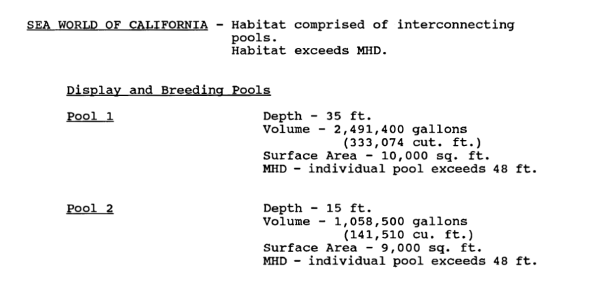
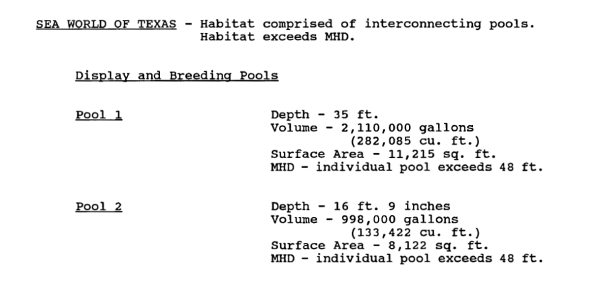
Okay, this is only for people who are deep, deep in the weeds. Every once in a while I get an email asking me for the sizes of SeaWorld’s pools. And I have never really had rock-solid information on the dimensions. So, apart from the insights into SeaWorld’s thinking about Tilikum, Haida, and Nootka contained in Russ Rector’s FOIA’d documents, I was glad to see that SeaWorld’s 1991 application to import and display Tilikum, Haida, and Nootka from Sealand included…..very detailed pool dimensions. So I have posted them below (I have left SeaWorld Ohio out since that is now closed).

One thing that jumped out at me from this section of SeaWorld;’s application is just how few killer whales SeaWorld had in 1991 (12, including Ohio), compared to the 29 they keep today (23 at SeaWorld parks, and 6 at Loro Parque).

So, for the record, here are the sizes of SeaWorld’s pools in 1991:

SWF Pool Sizes 1

SWF Pool Sizes 2

SWC Pool Sizes 1SWC Pool Sizes 2

SWT Pool Sizes 1SWT Pool Sizes 2

The Tili Files: SeaWorld’s Permit Application For Tilikum Reveals Complacency

Screen Shot 2014-07-16 at 5.18.11 PM

After years of persistent FOIA appeals, dolphin advocate Russ Rector has managed the very worthwhile feat of getting NOAA to release more than 1000 pages of documents related to SeaWorld’s purchase of Tilikum, Haida, and Nootka from Sealand Of The Pacific. I am going through them and posting some of the details and insights that the documents contain.

My first post, about the back and forth SeaWorld and NOAA had over how SeaWorld planned to deal with the fact that the three killer whales it was purchasing from Sealand had killed a trainer, is up at The Dodo.

SeaWorld’s take on whether Tilikum, Haida and Nootka’s behavior was normal, and whether SeaWorld was set to handle the three whales in the aftermath of Keltie Byrne’s death, doesn’t look so great in light of what followed with Tilikum’s life at SeaWorld. NOAA, which gets credit for pressing SeaWorld on the question of how it might deal with killer whales that had killed, was clearly not that impressed by SeaWorld’s complacency. Nevertheless, they ended up granting the permit.

You can download the full set of permit-related documents here, and I’ve also embedded them below: