Nightly Reader: Oct. 30, 2012

Apologies for the Hurricane Sandy-induced hiatus. Normal blogging resumes, starting now….

1) A Pox On Both Your Houses: Chris Hedges makes the case against casting your vote for EITHER Romney or Obama. I can’t resist posting the intro here:

The November election is not a battle between Republicans and Democrats. It is not a battle between Barack Obama and Mitt Romney. It is a battle between the corporate state and us. And if we do not immediately engage in this battle we are finished, as climate scientists have made clear. I will defy corporate power in small and large ways. I will invest my energy now solely in acts of resistance, in civil disobedience and in defiance. Those who rebel are our only hope. And for this reason I will vote next month for Jill Stein, the Green Party candidate, although I could as easily vote for Rocky Anderson of the Justice Party. I will step outside the system. Voting for the “lesser evil”—or failing to vote at all—is part of the corporate agenda to crush what is left of our anemic democracy. And those who continue to participate in the vaudeville of a two-party process, who refuse to confront in every way possible the structures of corporate power, assure our mutual destruction.

I actually did vote for Stein (voting by absentee ballot in Maryland). But I have to admit that I did so knowing that Obama is almost certain to win my state, Maryland. I agree with Hedges that neither Obama nor Romney are addressing the real issues. But, that said, there is a chasm between what they mean for America, and that is a chasm that matters. But Hedges has a point, regardless.

2) Orangutan Agony: There is no more poignant, or tragic, example of the conflict between the human agenda and the conservation agenda than the ongoing eradication of orangutan habitat (and orangutans) resulting from the inexorable expansion of palm oil plantations in Indonesia. Palm oil is a popular cooking oil in many poor parts of the world. But much of the demand for palm oil also comes from food processors who turned to it as an alternative to switching from trans fat. Lesson: every action, every choice, has consequences. Our responsibility is to understand what those consequences are beyond our own lives.

3) Oh, The Humanity: Speaking of food choices that don’t wipe out orangutans or involve animal suffering, here’s a handy website from Humane Farm Animal Care that you can use to find stores near you that sell Certified Humane food products. Yes, is dominated by Whole Foods locations. But it’s nice to be able to find a few other stores that care to carry Certified Humane products.

4) Picture Storm: We can’t forget Hurricane Sandy, the force of nature that just altered the lives of millions of Americans and the daily business of a nation. And a great collection of 54 pictures is the best way to convey the drama, power, and destruction. Here are just three:

Morgan PSA

The Free Morgan Foundation–in addition to Ingrid Visser’s report on Morgan’s life at Loro Parque–has released a PSA.

It takes an interesting angle, and asks people to think about orca captivity, and Morgan’s captivity in particular, from a human lens.

I don’t know enough about the Dutch court system to comment intelligently on what to expect from this hearing, and whether the facts of Morgan’s life at Loro Parque–as documented by Visser (PDF download here, and also vieweable as a Scribd embed here)–will figure in their thinking. Or whether the judges are mostly interested in reviewing the legal process which sent Morgan to Loro Parque.

But if the facts do end up weighing in the judges’ minds, then all credit to Visser and the Free Morgan Foundation for working so hard to get the facts out there.

The Case To Free Morgan

Next Thursday, Nov. 1, three Dutch judges will revisit last year’s decision to allow a rehabbing orca called Morgan to be shipped to Loro Parque in the Canary islands (instead of being released back into the wild).  The case is high profile, with Jean Michel Cousteau joining Morgan’s cause. But two of Morgan’s most persistent and dedicated advocates have been Dr. Ingrid Visser and Lara Pozzato of the Free Morgan Foundation.

In advance of the hearing, Dr. Visser has prepared and submitted a detailed brief arguing that Morgan’s life at Loro Parque is both detrimental to her welfare and in violation of the conditions under which she was sent to Loro Parque. It is both compelling and sobering, and you can read it right here.

Loro Parque, where trainer Alexis Martinez was killed in 2009, has long been a troubled environment for orcas. I urge you to read Visser’s full report for an extremely comprehensive look at Morgan’s life there, as well as visit the Free Morgan Foundation website for more details on Morgan’s history, and the current effort to free her.

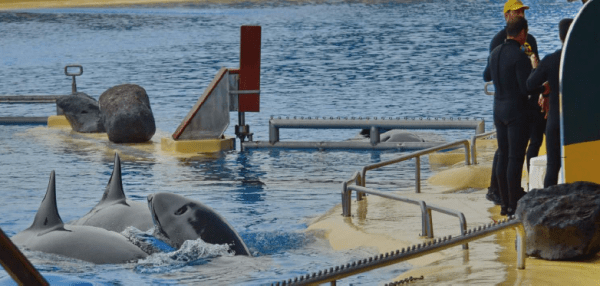
Here are some pictures included in the report, along with the captions describing what you are seeing:

Figure 6. Morgan (head out of water, on right) as she is rammed and pushed backwards by the two female orca, Skyla and Kohana. Note the amount of water being displaced as Morgan is forced backwards.

Figure 7. The full-frame photograph of Figure 6. Note the trainers standing to the right. During all the attacks recorded by the author the trainers were present, yet ignored them.

Figure 8. Skyla (female orca, left, obscured by gate) rams Morgan (right) and partially lifts her out of the water. NOTE: Morgan’s lower caudal peduncle is concave from force of ramming (at impact site). Water is displaced at impact site & on Morgan’s left (right of frame). Morgan weighs 1364 kg, requiring her be to hit with a substantial force, in order for her to be lifted out of the water this high.

Figure 11. During a training session, Morgan (partially obscured behind rail), rises out of the water in an attempt to avoid a bite from one of the two orca in the tank with her (Skyla and Kohana). This photo is one of a sequence of images, showing the open mouth and teeth progressed along Morgan’s body as she rose up and then slid down, to try to avoid the conflict.

Figure 23. Morgan exhibits a hypertrophic scar on her lower jaws, most likely a result of repeatedly banging her chin on the concrete walls. Such stereotypic behaviour can become self mutilating to the point where the subcutaneous injury can become painful and itchy. Further damage to Morgan’s rostrum through stereotypic behaviour inflicted on (2 July 2012). The trainers (on the day she inflicted these wounds and after they were inflicted) commanded her to push a ball repeatedly on the end of rostrum, in order to receive her allocated fish. Also note that the tips of Morgan’s teeth are being worn off from chewing on the concrete (also see Figure 24).

These are only a few of the pictures and diagrams. There is much, much more about Morgan’s life at Loro Parque in the report.

Shark Sanctuary

Sometimes the simplest ideas are the most powerful. If you want to stop shark fishing and finning, don’t muck around with caps, fisheries management, and licenses. Address the problam directly and ban commercial fishing.

That’s the approach the Marshall islands took when they created the world’s largest shark sanctuary. Almost two million square kilometers of protected waters and reefs, WITH (and this is key, obviously) enforcement.

But there’s always a difference between the vision and the implementation. So it’s worth checking in on how the sanctuary is working out one year in. So the Pew Environment Group, which has been intimately involved in this effort, takes a look.

I’d love to believe things are going so well. And I love the fact that some people are now calling for a Pacific Ocean sanctuary. But I wonder what is happening with poaching. And “non-commercial” shark fishing. And commercial fishing of other species and bycatch. There is so much money in shark finning that there is always the danger that it will find a way to overcome, evade, or sneak through loopholes, in any sanctuary.

But those are challenges of implementation, and can be addressed with greater vigilance and funding. The essential point remains: sanctuaries are an immensely simple and powerful idea. And can do more to preserve and steward fish populations than any other approach.

Nightly Reader: Oct. 25, 2012

Calling All Thinkers: We could definitely use some big ideas, some counter-conventional arguments, some original thinking. One way to get inspired is to read some bold thinking from the past.


Marine Mammal Protection
: Sure, it could use an update. But the Marine Mammal Protection Act has achieved a lot. Here are 40 facts for its 40 years of existence (plus: a pretty great marine mammal photo gallery).

Polar Bear Possibilities: It looks grim, but can we save polar bears? Yes, says the world’s greatest polar bear researcher (and we need to if we want to save ourselves).

BONUS VIDEO: Watch Earthlings, a documentary about human dependence on–and abuse of–animals.

Reap The Whirlwind

Uh-oh. Scary…

….but beautiful:

What Is NOC, The “Talking” Beluga, Really Saying?

NPR jumps in with a nicely done story that includes more detail on NOC’s history, and how researchers came to believe he was mimicking human speech (the audio version of the story is here).

Here’s some useful backstory:

But a white whale at San Diego’s National Marine Mammal Foundation did something very different. NOC (pronounced Nocee), as he was called, lived in an enclosure in the San Diego Bay. Biologist Sam Ridgway was there one day when divers were swimming nearby. “This one diver surfaced next to the whale pen and said, ‘Who told me to get out?’ And the supervisor said, ‘Nobody said anything.’ ”

A curious Ridgway started recording NOC. And what he heard was quite strange: It had the cadence and rhythm of human speech. No words were distinguishable, but the sounds were eerily “right.” Ridgway laid out audiograms of NOC’s chatter, and they showed that the rhythm and pitch were different from NOC’s normal sounds: They were, in fact, very similar to human speech. NOC had lowered the pitch of his sounds several octaves below normal, into the range of human speech at 300-400 hertz.

Ridgway says there’s no reason to think NOC understood speech; he was just mimicking humans he’d heard. From where? “I think it was from divers using underwater communication equipment,” he says.

The story (scroll down) also includes audio links that let you listen to an ordinary beluga vocalization, and then compare it to a recording of NOC. There is a striking difference.

Here is the same audio, released by the National Marine Mammal Foundation:

And you can watch NMMF’s Sam Ridgway appearance on The Today Show here.

The more I think about this, the more I think the excitement and interest over NOC is emblematic of what troubles me about marine mammal captivity and research.

First: NOC’s vocalizations are like ear candy to humans, who love the idea that any animal might mimic a human (see endless YouTube videos). But what educational or research value do the recordings of NOC really hold? If it was important research or information you would presume Ridgway would have published it before decades had passed.

Second: If NOC was truly mimicking humans (maybe he was psychotic; maybe he was ill; maybe he was just bored and messing around with his vocalizations to distract himself; who really knows?) it’s important to remember that he was doing so only because he was in a situation where he was spending his life in their company. It would be far more interesting, and meaningful, if wild cetaceans adapted their vocalizations for human consumption, which is what Denise Herzing and her Wild Dolphin Project are hoping to see. In any case, I’d much rather see research on real wild beluga vocalizations. That would teach us something about belugas as they really are. And that is the sort of knowledge that is important it we really care about beluga populations and their future.

Third, the media splash, and the publication of this research is really another form of beluga exploitation. Do any of the media outlets really care about NOC and belugas? Did anyone ask serious questions about Ridgway’s research program, and history with the Navy? Not really. It was a 5-minute distraction for people driving home in traffic or sitting around with the television on.

There is an upside, though, I think. For better or worse, humans aren’t very good at stepping outside their own lives and human frame of reference. They care about things they can connect with. So hearing NOC vocalizing in a pattern that sort of sounds like it has human rhythm probably had millions of people thinking of belugas in a positive way.

Now, I know this is basically the core of the marine park argument in favor of captivity, and marine mammal shows. And I hasten to add that I don’t think that it–or NOC’s media splash–justifies captivity. You can achieve a lot, if not more, of that sort of connection through seeing and hearing wild animals, whether in nature or on film. And there’s no real justification for taking away an intelligent, social animal’s freedom, no matter what good you claim you are achieving. But it’s just to say that NOC’s unusual vocalizations, whatever they were when he made them all those years ago, at least cry out for a serious evaluation of the human relationship to marine mammals, and the issue of marine mammal research and captivity. And that would be a good thing.

Nightly Reader: Oct. 24, 2012

Cost Of Coal: Searing look at the impact coal mining and coal power has on the environment and communities, from the Sierra Club.


California Cap & Trade
: If Washington, DC won’t act to reduce carbon emissions, California isn’t going to sit around and do nothing.


Right(s) Whales
: Why whales are like people, and why they should have rights like people.


NIGHTLY READER BONUS VIDEO:

Planet Ocean: Sea Shepherd’s Paul Watson explains what his work is all about.

Plastic (Not) Fantastic

If you think humanity is getting ready to trash the Arctic Ocean, now that the Arctic ice is receding and the oil companies are getting ready to go to town with their drilling rigs, you don’t have it quite right. Because we are already trashing the Arctic Ocean, and a recent study revealed that its floor is littered with human debris:

Bremerhaven, 22nd October 2012. The seabed in the Arctic is increasingly strewn with litter and plastic waste. As reported in the advance online publication of the scientific journal Marine Pollution Bulletin by Dr. Melanie Bergmann, biologist and deep-sea expert at the Alfred Wegener Institute for Polar and Marine Research in the Helmholtz Association. The quantities of waste observed at the AWI deep-sea observatory HAUSGARTEN are even higher than those found in a deep-sea canyon near the Portuguese capital Lisbon.

For this study Dr. Melanie Bergmann examined some 2100 seafloor photographs taken near HAUSGARTEN, the deep-sea observatory of the Alfred Wegener Institute in the eastern Fram Strait. This is the sea route between Greenland and the Norwegian island Spitsbergen. “The study was prompted by a . When looking through our images I got the impression that plastic bags and other litter on the seafloor were seen more frequently in photos from 2011 than in those dating back to earlier years. For this reason I decided to go systematically through all photos from 2002, 2004, 2007, 2008 and 2011,” Melanie Bergmann explains.

The result was the realization that the amount of trash on the sea floor has about doubled over the past decade. Not good, because here is the consequence:

Melanie Bergmann is unable to determine the origin of litter from photographs alone. However she suspects that the shrinking and thinning of the Arctic sea ice may play an important role. “The Arctic sea ice cover normally acts as a natural barrier, preventing wind blowing waste from land out onto the sea, and blocking the path of most ships. Ship traffic has increased enormously since the ice cover has been continuously shrinking and getting thinner. We are now seeing three times the number of private yachts and up to 36 times more fishing vessels in the waters surrounding Spitsbergen compared to pre-2007 times,” Melanie Bergmann says. Furthermore, litter counts made during annual clean-ups of the beaches of Spitsbergen have shown that the litter washed up there originates primarily from fisheries.

The main victims of the increasing contamination of the seafloor are the deep-sea inhabitants. “Almost 70 percent of the plastic litter that we recorded had come into some kind of contact with deep-sea organisms. For example we found plastic bags entangled in sponges, sea anemones settling on pieces of plastic or rope, cardboard and a beer bottle colonised by ,” Melanie Bergmann says.

When sponges or other suspension feeders come into contact with plastic, this may cause injuries to the surface of their body. The consequence: the inhabitants of the sea bed are able to absorb fewer food particles, grow more slowly as a result, and probably reproduce less often. Breathing could also be impaired. Furthermore, plastic always contains chemical additives, which have various toxic effects. “Other studies have also revealed that plastic bags that sink to the seafloor can alter the gas exchange processes in this area. The sediment below then becomes a low oxygen zone, in which only few organisms survive,” Melanie Bergmann says.

Plastic, and what to do about it is an ungodly difficult problem. It permeates every part of our lives and it is so pervasive that it is almost impossible to Continue reading “Plastic (Not) Fantastic”

Climate Lies (And What’s Behind Them)

I’m not sure I can watch this, because it will only remind me of how corrupted our politics and media are. And I already know that there has been a consistent and cynically self-interested campaign to create doubt about climate change in a sadly gullible public.

Given that success, I can see why Gov. Romney and President Obama were too pusillanimous to raise climate change during their debates (though I can’t applaud them for political cowardice). But what excuse do moderators Jim Lehrer, Candy Crowley, and Bob Schieffer have for never raising the single most important threat on the planet?

Anyhow, maybe a President Romney shouldn’t try to kill Big Bird. Because PBS’s Frontline has done what always has to be done: laid out the detailed narrative of how climate change deniers have succeeded (probably beyond their most hopeful dreams) in confusing and delaying action on global warming. Here’s the teaser:

And here’s the whole thing. You can also watch the it on PBS’ website, which has lots of other related videos and articles.

See it and weep. And then get mad. And then take action.