Inside SeaWorld: Waterwork And Protocols For Working Killer Whales After Dawn

With OSHA and SeaWorld headed back to Judge Welsch’s court in January to discuss the timing and specifics of the abatement of the dangers OSHA identified in its 2010 citations of SeaWorld Florida, I thought it would be interesting to take a look at what protocols SeaWorld has been using to define how trainers should interact with killer whales since Dawn Brancheau was killed in February 2010.

The protocols will presumably be a part of the January hearing. And what comes out of that hearing–what Judge Welsch decides regarding SeaWorld’s desire for more time to work out a comprehensive abatement plan and what he does in response to OSHA’s contention that SeaWorld has not been adequately abating the dangers and needs to be in compliance–could have a big impact on what SeaWorld’s killer whale shows will look like in the coming year and beyond, particularly if Welsch decides that the practices that are in place right now are not adequate protection for trainers.

Moreover, as a backdrop to the approaching abatement hearing, SeaWorld continues to move steadily forward in its waterwork desensitization program. I reported over the summer that SeaWorld was going to initiate waterwork desensitization in its medical pools, where the floors can be raised. And I also pondered SeaWorld’s potential strategy and timeline for trying to restore waterwork to its shows. That waterwork desensitization has now progressed to the point where the med pool floors have been left completely down, so that both killer whales and trainers are not beached or standing, but swimming. In California, for example, at least four whales (including Orkid) have been in the med pool, and held under control on a hand target, while a trainer floats nearby. In Texas, they have had Tuar, for one, conduct a perimeter swim past a floating trainer. SeaWorld management has told trainers it will not conduct waterwork in a pool that doesn’t have a rising floor. That makes me wonder whether and when SeaWorld Florida might consider moving waterwork desense and training to G pool (which is where the first rising floor was installed).

But back to the January abatement hearing. To set the context, here are some excerpts from Judge Welsch’s ruling last May upholding OSHA’s citations of SeaWorld:

As with Tilikum, the Secretary proposes that for performances, SeaWorld either install physical barriers between its trainers and killer whales, or require its trainers to maintain a minimum distance from the killer whales. This proposed abatement is technologically feasible; SeaWorld has been using it since February 24, 2010. SeaWorld has banned waterwork with its killer whales during performances, and trainers perform drywork from behind barriers.The proposed abatement is also economically feasible. SeaWorld did not argue that performing drywork from behind barriers or banning trainers from waterwork during performances affected it economically. SeaWorld’s killer whales, including Tilikum, have continued to perform in shows at Shamu Stadium without the presence of trainers in the water with them. Trainers perform drywork from behind barriers or at a minimum distance.

Later in his ruling he writes:

Prohibiting waterwork and using physical barriers and minimum distances eliminate the trainers’ exposure to the recognized hazard of working with killer whales. Proximity to the killerwhales is the factor that determines the risk to the trainers. Dr. Duffus stated, “The fundamental fact with captivity is the proximity. . . . The fact of the matter is simple proximity. . . If you’re close to a killer whale, they can potentially inflict harm” (Tr. 851).

Welsch, as far as I can tell, never defines a minimum distance the trainers should maintain if they are not separated from a killer whale by a barrier. But he clearly seems to believe that maintaining some sort of gap is both proper and feasible abatement. OSHA’s view seems to be that the minimum distance should be whatever distance is required to keep trainers safe. What that distance is, and what Judge Welsch believes it needs to be, presumably is something that the January hearing might clarify.

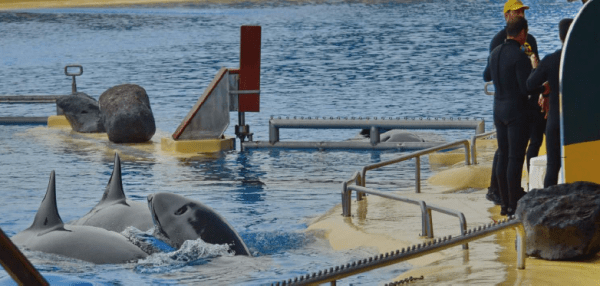
What Welsch might not know as the hearing approaches is that despite his apparent belief that SeaWorld trainers have EITHER been working from behind barriers during shows since February 2010 OR maintaining a minimum distance , the reality is not quite so clear-cut; that in fact there continue to be plenty of instances in which SeaWorld trainers have direct contact with the whales during drywork, with no barrier and no minimum distance. The Side By Side segment of the SeaWorld One Ocean show, for example, regularly features trainers rubbing down, and hugging, whales on the slideout.

Here’s a sequence from an August 2012 show at SeaWorld Florida:

This is from an October 2012 show, also at SeaWorld Florida.

So what are the protocols that trainers follow for such interactions? Interestingly, it is not at all clear that the OSHA citations and Judge Welsch’s ruling had Continue reading “Inside SeaWorld: Waterwork And Protocols For Working Killer Whales After Dawn”

How Marine Mammal Trainers (Would Like To) See Themselves

Just shared this on my Facebook page, and can’t resist posting it here.

It’s the opening video for the 2012 IMATA (International Marine Animal Trainers Association) conference, which just started up in blood-stained Japan Hong Kong.

Has there ever been an industry that strains so greatly to seem noble and idealistic in its purpose?

Methinks they doth protest too much (I think the psychiatrists call it “overcompensation”)….

SeaWorld and OSHA Are Headed Back To Court

Since administrative law judge Ken Welsch last May upheld OSHA’s citations against SeaWorld’s killer whale practices (full ruling is here), SeaWorld has been under obligation to “abate” the hazards OSHA identified: namely the danger of working in close proximity to killer whales.

In essence, OSHA’s citations combined and Welsch’s ruling (which applies to shows), mean that SeaWorld cannot have trainers swimming with the killer whales (aka waterwork), and even when the trainers are out on the pool decks they are supposed to maintain a minimum separation or have some sort of barrier between them and the killer whales.

SeaWorld has decided to take its appeal of the OSHA citations to the federal courts, but in the meantime SeaWorld has been negotiating with OSHA over when and how it must come into compliance with the citations. Since Judge Welsch’s order went into effect, SeaWorld has been asking for more time to figure out how it wants to abate the dangers OSHA cited, and has filed a Petition For Modification Of Abatement. OSHA has taken the position that SeaWorld should already be in compliance, so a new hearing has been scheduled for Jan. 15-17 in Judge Welsch’s court to hear testimony on the timing and method of abatement.

I’ve always thought that SeaWorld would like to be able to submit its fast-rising pool floors, and spare air systems (among other possible innovations) as safety modifications that abate the danger OSHA cited. That would allow trainers to get back into the pool during shows, and perform the waterwork that SeaWorld is famous for. I don’t know if this is the venue where SeaWorld will try to make that case, but it will be worth watching to see.

For its part, OSHA believes SeaWorld has been violating the citations during shows by not maintaining minimum separation and continuing to have trainers hug and touch the whales from the slideouts and pool decks without any protective barriers between them and the whales (OSHA also believes SeaWorld did not properly abate another citation regarding a stair railing). If SeaWorld is hit with two new failure to abate citations they could be looking at penalties of up to $7,000 a day for up to 30 days. That won’t break the SeaWorld bank, but it’s not small change, either.

So stand by for another court confrontation in the winter heat of Florida. Depending on what Judge Welsch decides, the federal appeal may be SeaWorld’s last chance to preserve the possibility of waterwork during killer whale shows at its parks.

Orca Morgan’s Hearing

One of the contentious underlying debates regarding Morgan and whether she should be released to a sea pen, or the wild, rather than spend a life at Loro Parque, is whether she is deaf, or has impaired hearing.

Obviously, impaired hearing would be an issue for an orca in the wild, and so this question is critical to whether Morgan would be a good candidate for release. Loro  Parque has repeatedly said she has hearing issues, and now they have released two videos, one discussing auditory tests, and the other the visual bridge they have developed for Morgan’s training.

UPDATE: And here is the audiogram being administered…

Here’s the translation of what the Loro Parque blog is saying about the tests:

International scientists confirm that the orca Morgan, rescued in Holland in 2010 and moved to the park in 2011 at the request of a Dutch judge, suffers a hearing loss that could be very severe and even absolute. This is the conclusion reached by the experts having made multiple hearing tests that took place last week at the facilities of Orca Ocean.

The research team, composed of experts from the Netherlands Institute for Marine Resources and Ecosystem study ( IMARES ), the National Endowment for marine mammals and also U.S. Office of Naval Research for the U.S. Navy (U.S. Navy ), studied the hearing of several copies of orca we have in the park. As a result found that they all could record brain responses to sound stimuli, except Morgan.This study confirms the suspicions of our team of trainers and veterinarians, who had warned that the animal did not seem to respond to sound signals.

This type of test, which consists in detecting brain waves in response to the issuance of a sound, is routinely used to determine the hearing of dolphins and small cetaceans. However, its application to the study of orcas sound pioneered the world, since there is only one precedent duplicate fourteen years ago.

With the confirmation of this deaf coaches continue to make visual adaptations of the system they use to communicate with Morgan. With the advice of specialists in animal behavior from the Free University of Berlin, will develop new lines of work that will allow any inconvenience Morgan further.

I hope that the report that is generated from this effort is released publicly.

Seeing Is Important: Taiji “Dawn To Death”

Via the ever-vigilant Elizabeth Batt comes this 28-minute video which captures the full tragedy of what is happening in Taiji’s killing cove.

Elizabeth has the backstory here. The video is as painful to watch as you might expect. But that’s why it is important that people see it.

What is happening there is almost beyond imagining, and certainly beyond understanding.

Orca Morgan: Ingrid Visser’s Presentation To The Dutch Court

Credit: Ingrid Visser

On Nov. 1, there was a hearing in the Netherlands to review the legal process by which Morgan was sent to Loro Parque in the Canary Islands. Dr. Ingrid Visser, on behalf of the Free Morgan Foundation testified on behalf of Morgan, arguing that Morgan’s life at Loro Parque violates the terms under which she was transferred, and that for Morgan’s well-being the decision to send Morgan to Loro Parque should be reversed.

You can read an account of the hearing (PDF) by the Free Morgan Foundation here.

You can read Visser’s full report on Morgan’s physical status at Loro Parque, submitted in advance of the hearing, here.

Here’s the statement that the Free Morgan Foundation and Visser are releasing along with her slide presentation to the Dutch hearing:

VISSER’s COURT PRESENTATION SHOWS ALARMING ISSUES

Dr Ingrid Visser presented startling new findings from her October visit to Loro Parque.  Following on the heels of the data and images submitted to the Amsterdam Court, from her June visit, Dr Visser returned to check on Morgan’s welfare.  Unfortunately, Visser has found that the intervening 19 weeks have showed not only an escalation in aggression from the other orca, but Morgan has begun to exhibit a stereotypical behaviour which has not been documented before.  In this case, Morgan repeatedly bashes her head against the side of a gate closing mechanism.  Additionally, Morgan’s boredom and stress have manifested themselves in an acceleration of tooth wear, with a third of some teeth now permanently damaged and the tops worn off.  Blue paint on the teeth clearly shows that Morgan is biting concrete below the water surface.  Trainers have been photographed ignoring Morgan whilst she vies for their attention.

And here is the presentation itself:

Aquariums Split Over Wild Beluga Import

This is a very interesting, and potentially important, development: two major players in the aquarium world are opposing the proposed Georgia Aquarium import of wild Russian belugas.

Over the past decades, marine parks and aquariums have mostly stayed united on issues related to the Marine Mammal Protection Act and the display of whales and dolphins. For the National Aquarium and Sea Life Centres to take a different view of the Georgia Aquarium’s plan to import wild belugas and distribute many of them on breeding loans to SeaWorld, Shedd Aquarium, and Mystic Aquarium is a big deal. And it’s an encouraging sign that some aquariums–given what we now know about the intelligence, awareness and sociability of small whales and dolphins–see the possibility of a different model for education and display than the model that has dominated the industry since its inception.

Here is the National Aquarium letter to NMFS, outlining its opposition. One thing that really catches my eye is the National Aquarium’s statement that it wants to review the Marine Mammal Protection Act along with other institutions and outline a new model for display that reflects all that we have learned about marine mammals since the MMPA was put in place in 1972. That is desperately needed, I think:

Here is the Sea Life Centres letter:

And here is a press release from Whale And Dolphin Conservation applauding the position of the National Aquarium and Sea Life Centres:

The stand that the National Aquarium and Sea Life Centres are taking will no doubt cause some heartburn in the industry. But any reform of the MMPA and how marine mammals are treated and displayed around the world is much likelier to make progress with some industry support. So kudos to these two organizations for taking a big and brave step forward.

Morgan PSA

The Free Morgan Foundation–in addition to Ingrid Visser’s report on Morgan’s life at Loro Parque–has released a PSA.

It takes an interesting angle, and asks people to think about orca captivity, and Morgan’s captivity in particular, from a human lens.

I don’t know enough about the Dutch court system to comment intelligently on what to expect from this hearing, and whether the facts of Morgan’s life at Loro Parque–as documented by Visser (PDF download here, and also vieweable as a Scribd embed here)–will figure in their thinking. Or whether the judges are mostly interested in reviewing the legal process which sent Morgan to Loro Parque.

But if the facts do end up weighing in the judges’ minds, then all credit to Visser and the Free Morgan Foundation for working so hard to get the facts out there.

The Case To Free Morgan

Next Thursday, Nov. 1, three Dutch judges will revisit last year’s decision to allow a rehabbing orca called Morgan to be shipped to Loro Parque in the Canary islands (instead of being released back into the wild).  The case is high profile, with Jean Michel Cousteau joining Morgan’s cause. But two of Morgan’s most persistent and dedicated advocates have been Dr. Ingrid Visser and Lara Pozzato of the Free Morgan Foundation.

In advance of the hearing, Dr. Visser has prepared and submitted a detailed brief arguing that Morgan’s life at Loro Parque is both detrimental to her welfare and in violation of the conditions under which she was sent to Loro Parque. It is both compelling and sobering, and you can read it right here.

Loro Parque, where trainer Alexis Martinez was killed in 2009, has long been a troubled environment for orcas. I urge you to read Visser’s full report for an extremely comprehensive look at Morgan’s life there, as well as visit the Free Morgan Foundation website for more details on Morgan’s history, and the current effort to free her.

Here are some pictures included in the report, along with the captions describing what you are seeing:

Figure 6. Morgan (head out of water, on right) as she is rammed and pushed backwards by the two female orca, Skyla and Kohana. Note the amount of water being displaced as Morgan is forced backwards.

Figure 7. The full-frame photograph of Figure 6. Note the trainers standing to the right. During all the attacks recorded by the author the trainers were present, yet ignored them.

Figure 8. Skyla (female orca, left, obscured by gate) rams Morgan (right) and partially lifts her out of the water. NOTE: Morgan’s lower caudal peduncle is concave from force of ramming (at impact site). Water is displaced at impact site & on Morgan’s left (right of frame). Morgan weighs 1364 kg, requiring her be to hit with a substantial force, in order for her to be lifted out of the water this high.

Figure 11. During a training session, Morgan (partially obscured behind rail), rises out of the water in an attempt to avoid a bite from one of the two orca in the tank with her (Skyla and Kohana). This photo is one of a sequence of images, showing the open mouth and teeth progressed along Morgan’s body as she rose up and then slid down, to try to avoid the conflict.

Figure 23. Morgan exhibits a hypertrophic scar on her lower jaws, most likely a result of repeatedly banging her chin on the concrete walls. Such stereotypic behaviour can become self mutilating to the point where the subcutaneous injury can become painful and itchy. Further damage to Morgan’s rostrum through stereotypic behaviour inflicted on (2 July 2012). The trainers (on the day she inflicted these wounds and after they were inflicted) commanded her to push a ball repeatedly on the end of rostrum, in order to receive her allocated fish. Also note that the tips of Morgan’s teeth are being worn off from chewing on the concrete (also see Figure 24).

These are only a few of the pictures and diagrams. There is much, much more about Morgan’s life at Loro Parque in the report.

What Is NOC, The “Talking” Beluga, Really Saying?

NPR jumps in with a nicely done story that includes more detail on NOC’s history, and how researchers came to believe he was mimicking human speech (the audio version of the story is here).

Here’s some useful backstory:

But a white whale at San Diego’s National Marine Mammal Foundation did something very different. NOC (pronounced Nocee), as he was called, lived in an enclosure in the San Diego Bay. Biologist Sam Ridgway was there one day when divers were swimming nearby. “This one diver surfaced next to the whale pen and said, ‘Who told me to get out?’ And the supervisor said, ‘Nobody said anything.’ ”

A curious Ridgway started recording NOC. And what he heard was quite strange: It had the cadence and rhythm of human speech. No words were distinguishable, but the sounds were eerily “right.” Ridgway laid out audiograms of NOC’s chatter, and they showed that the rhythm and pitch were different from NOC’s normal sounds: They were, in fact, very similar to human speech. NOC had lowered the pitch of his sounds several octaves below normal, into the range of human speech at 300-400 hertz.

Ridgway says there’s no reason to think NOC understood speech; he was just mimicking humans he’d heard. From where? “I think it was from divers using underwater communication equipment,” he says.

The story (scroll down) also includes audio links that let you listen to an ordinary beluga vocalization, and then compare it to a recording of NOC. There is a striking difference.

Here is the same audio, released by the National Marine Mammal Foundation:

And you can watch NMMF’s Sam Ridgway appearance on The Today Show here.

The more I think about this, the more I think the excitement and interest over NOC is emblematic of what troubles me about marine mammal captivity and research.

First: NOC’s vocalizations are like ear candy to humans, who love the idea that any animal might mimic a human (see endless YouTube videos). But what educational or research value do the recordings of NOC really hold? If it was important research or information you would presume Ridgway would have published it before decades had passed.

Second: If NOC was truly mimicking humans (maybe he was psychotic; maybe he was ill; maybe he was just bored and messing around with his vocalizations to distract himself; who really knows?) it’s important to remember that he was doing so only because he was in a situation where he was spending his life in their company. It would be far more interesting, and meaningful, if wild cetaceans adapted their vocalizations for human consumption, which is what Denise Herzing and her Wild Dolphin Project are hoping to see. In any case, I’d much rather see research on real wild beluga vocalizations. That would teach us something about belugas as they really are. And that is the sort of knowledge that is important it we really care about beluga populations and their future.

Third, the media splash, and the publication of this research is really another form of beluga exploitation. Do any of the media outlets really care about NOC and belugas? Did anyone ask serious questions about Ridgway’s research program, and history with the Navy? Not really. It was a 5-minute distraction for people driving home in traffic or sitting around with the television on.

There is an upside, though, I think. For better or worse, humans aren’t very good at stepping outside their own lives and human frame of reference. They care about things they can connect with. So hearing NOC vocalizing in a pattern that sort of sounds like it has human rhythm probably had millions of people thinking of belugas in a positive way.

Now, I know this is basically the core of the marine park argument in favor of captivity, and marine mammal shows. And I hasten to add that I don’t think that it–or NOC’s media splash–justifies captivity. You can achieve a lot, if not more, of that sort of connection through seeing and hearing wild animals, whether in nature or on film. And there’s no real justification for taking away an intelligent, social animal’s freedom, no matter what good you claim you are achieving. But it’s just to say that NOC’s unusual vocalizations, whatever they were when he made them all those years ago, at least cry out for a serious evaluation of the human relationship to marine mammals, and the issue of marine mammal research and captivity. And that would be a good thing.