Deepwater Horizon And Marine Life

It could be years before we know the full impact of the Deepwater Horizon oil spill on the marine life of the Gulf Of Mexico. But an initial study is   pretty devastating:

The Deepwater Horizon oil spill happened in the Gulf of Mexico nearly three years ago, but the estimated 4.9 million barrels of oil that it released are still killing dolphins, sea turtles and other marine life in record numbers, according to new research.

The report, “Restoring a Degraded Gulf of Mexico: Wildlife and Wetlands Three Years into the Gulf Oil Disaster,” found that dolphins were among the hardest hit animals. As of just earlier this year, infant dolphins were dying six times faster than they did before the spill. Scientists aren’t even yet sure of the extent of the massive spill, given that it was impossible to fully clean up the chemical-laden, carcinogenic oil.

“Three years after the initial explosion, the impacts of the disaster continue to unfold,” Doug Inkley, senior scientist for the National Wildlife Federation and lead author of the report, said in a press release. “Dolphins are still dying in high numbers in the areas affected by oil. These ongoing deaths — particularly in an apex predator like the dolphin — are a strong indication that there is something amiss with the Gulf ecosystem.”


Here are some of the key findings:

  • The National Oceanic and Atmospheric Administration (NOAA) called the dolphin die-off “unprecedented” a year ago.
  • More than 1,700 sea turtles were found stranded between May 2010 and November 2012 — the last date for which information is available. For comparison, on average about 240 sea turtles are stranded annually.
  • A coral colony seven miles from the wellhead was badly damaged by oil. A recent laboratory study found that a mixture of oil and dispersant affected the ability of some coral species to build new parts of a reef.
  • Scientists found that the oil disaster affected the cellular function of the killifish, a common baitfish at the base of the food web. A recent laboratory study found that oil exposure can also harm the development of larger fish such as mahi mahi.

The BP spill is one of the most dramatic and damaging reminders in recent history of one of the major external costs (pollution) attached to reliance on oil, and we’ve seen plenty of indications that dolphins are paying a price. I don’t think you can ever create a system of production and use that would eliminate pollution (or health costs; and greenhouse warming is permanently embedded in oil use). But if you price oil to include these costs you can reduce the amount of oil we use, and reduce the external costs. Yes, there is a gas tax to help pay for roads and highways, but that tax doesn’t even pretend to help cover health and pollution costs. And a carbon tax would need to be perhaps $80 a ton (which would add about 80 cents to a gallon of gas) to really start addressing the impact of oil and carbon on the climate.

Watching The Arctic Change

NASA is on it, with satellite imagery and video:

The Visible Infrared Imaging Radiometer Suite (VIIRS) on the Suomi NPP satellite captured this view of extensive sea-ice fracturing off the northern coast of Alaska. The event began in late-January and spread west towardBanks Island throughout February and March 2013.

Visualizations of the Arctic often give the impression that the ice cap is a continuous sheet of stationary, floating ice. In fact, it is a collection of smaller pieces that constantly shift, crack, and grind against one another as they are jostled by winds and ocean currents. Especially during the summer—but even during the height of winter—cracks—or leads—open up between pieces of ice.

That was what was happening on the left side of the animation (below) in late January. A high-pressure weather system was parked over the region, producing warmer temperatures and winds that flowed in a southwesterly direction. That fueled the Beaufort Gyre, a wind-driven ocean current that flows clockwise. The gyre was the key force pulling pieces of ice west past Point Barrow, the northern nub of Alaska that protrudes into the Beaufort Sea.

Scientist Ken Dunton is on it, too, and he captures the challenge of change in much more human terms:

Bill McKibben Calls Out The Democrats On Climate Change

And breaks down clearly the challenge of arresting climate change before it hits a catastrophic tipping point. He knows the Republicans are hopeless, but he hopes that the Democrats can “evolve” on climate change faster than they did on gay rights and marriage:

Unlike gay rights or similar issues of basic human justice and fairness, climate change comes with a time limit. Go past a certain point, and we may no longer be able to affect the outcome in ways that will prevent long-term global catastrophe. We’re clearly nearing that limit and so the essential cowardice of too many Democrats is becoming an ever more fundamental problem that needs to be faced. We lack the decades needed for their positions to “evolve” along with the polling numbers. What we need, desperately, is for them to pitch in and help lead the transition in public opinion and public policy.

He doesn’t have much hope that they will, though, which is why his thinking leads him back to the necessity for a powerful citizens movement to change the culture and change politics:

And so, as I turn this problem over and over in my head, I keep coming to the same conclusion: we probably need to think, most of the time, about how to change the country, not the Democrats. If we build a movement strong enough to transform the national mood, then perhaps the trembling leaders of the Democrats will eventually follow. I mean, “evolve”. At which point we’ll get an end to things like the Keystone pipeline, and maybe even a price on carbon. That seems to be the lesson of Stonewall and of Selma. The movement is what matters; the Democrats are, at best, the eventual vehicle for closing the deal.

The closest thing I’ve got to a guru on American politics is my senator, Bernie Sanders. He deals with the Democrat problem all the time. He’s an independent, but he caucuses with them, which means he’s locked in the same weird dance as the rest of us working for real change.

A few weeks ago, I gave the keynote address at a global warming summit he convened in Vermont’s state capital, and afterwards I confessed to him my perplexity. “I can’t think of anything we can do except keep trying to build a big movement,” I said. “A movement vast enough to scare or hearten the weak-kneed.”

“There’s nothing else that’s ever going to do it,” he replied.

McKibben makes a key point. The challenge of climate warming (along with the ongoing destruction of the environment) is not a challenge that allows for decades of slow and incremental change. These are not ordinary times. These are times that call for revolutions in the way we think and act.

I am constantly struck by the fact that previous generations were in the streets to protest and decry injustice and immorality. Yet out streets are quiet. Hopefully, that will change because the times demand bold thinking and bold action. Nothing less will pass moral muster when the history of this epoch is judged (and hopefully not lamented).

Meat Culture: Americans Eating Less Meat, The World Eating More

Americans still eat a lot of meat, but it is starting to look like they are eating less:

WASHINGTON — For the first time on record, U.S. per-capita meat consumption has declined for four consecutive years, according to the most recent figures from the U.S. Department of Agriculture.

The six percent drop between 2006 and 2010 is the largest sustained decline since recordkeeping began in 1970.

Reasons for the decline are at least partly economic: rising prices and a bad U.S. economy have made meat less affordable for American consumers.

But there are intriguing signs that a cultural shift may be underway, as well…[snip]

…While about seven percent of Americans identify themselves as vegetarians, it’s the “flexitarians” – people who eat occasional meatless meals – that market research firms have just begun to explore.

One such firm, Packaged Facts, found that eating along the “meatless spectrum” is popular among college students, who will carry those eating habits into their adult years.

“Young people today are just not so meat-and-potatoes oriented as earlier generations were,” said environmental researcher Lester Brown at the Washington-based Earth Policy Institute.

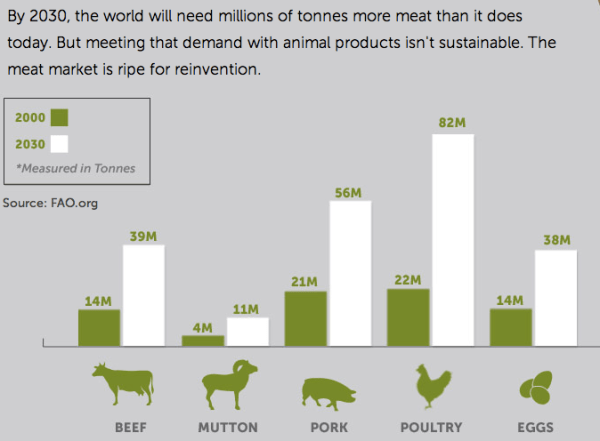
That’s encouraging, because sometimes cultural changes can hit a tipping point that creates a true shift. But according to Lester Brown we’d still need two or three Earths to meet the demand for grain and water if the rest of the world ate meat like Americans. So this chart is important to keep in mind, too:

Meat COnsumption 2030

More On Monsanto

The more your read about it, the more objectionable it becomes:

Monsanto and the US farm biotech industry wield legendary power. A revolving door allows corporate chiefs to switch to top posts in the Foodand Drug Administration and other agencies; US embassies around the world push GM technology onto dissenting countries; government subsidies back corporate research; federal regulators do largely as the industry wants; the companies pay millions of dollars a year to lobby politicians; conservative thinktanks combat any political opposition; thecourts enforce corporate patents on seeds; and the consumer is denied labels or information.

But even people used to the closeness of the US administration and food giants like Monsanto have been shocked by the latest demonstration of the GM industry’s political muscle. Little-noticed in Europe or outside the US, President Barack Obama last week signed off what has become widely known as “the Monsanto Protection Act”, technically the Farmer Assurance Provision rider in HR 933: Consolidated and Further Continuing Appropriations Act 2013

The key phrases are a mouthful of legal mumbo jumbo but are widely thought to have been added to the bill by the Missouri republican senator Roy Blunt who is Monsanto’s chief recipient of political funds.

But at least it’s not going down without a fight:

According to an array of food and consumer groups, organic farmers, civil liberty and trade unions and others, this hijacks the constitution, sets a legal precedent and puts Monsanto and other biotech companies above the federal courts. It means, they say, that not even the US government can now stop the sale, planting, harvest or distribution of any GM seed, even if it is linked to illness or environmental problems.

The backlash has been furious. Senator Barbara Mikulski, chair of the powerful Senate appropriations committee which was ultimately responsible for the bill, has apologised. A Food Democracy Now petition has attracted 250,000 names and sections of the liberal press and blogosphere are outraged. “This provision is simply an industry ploy to continue to sell genetically engineered seeds even when a court of law has found they were approved by US department of agriculture illegally,”says one petition. “It is unnecessary and an unprecedented attack on US judicial review. Congress should not be meddling with the judicial review process based solely on the special interest of a handful of companies.”

Some day (hopefully), this sort of over-reach and the near-complete subjugation of Congress to corporate interests and money will outrage enough Americans that real change will be possible.

Did China’s Meat Production Practices Create The Possibility Of A New Pandemic?

Laurie Garrett (free sign-up required) at Foreign Policy thinks the answer may be, “yes”:

Here’s how it would happen. Children playing along an urban river bank would spot hundreds of grotesque, bloated pig carcasses bobbing downstream. Hundreds of miles away, angry citizens would protest the rising stench from piles of dead ducks and swans, their rotting bodies collecting by the thousands along river banks. And three unrelated individuals would stagger into three different hospitals, gasping for air. Two would quickly die of severe pneumonia and the third would lay in critical condition in an intensive care unit for many days. Government officials would announce that a previously unknown virus had sickened three people, at least, and killed two of them. And while the world was left to wonder how the pigs, ducks, swans, and people might be connected, the World Health Organization would release deliberately terse statements, offering little insight.

It reads like a movie plot — I should know, as I was a consultant for Steven Soderbergh’s Contagion. But the facts delineated are all true, and have transpired over the last six weeks in China. The events could, indeed, be unrelated, and the new virus, a form of influenza denoted as H7N9, may have already run its course, infecting just three people and killing two.

Or this could be how pandemics begin.

We all know (or at least by now should know) about the cruelty and environmental impact of industrial meat production. And we know that there are personal health implications related to heart disease. What most people don’t know is that factory farms and modern livestock practices create ripe scenarios for new viruses and antibiotic resistant bacteria. The H7N9 virus may turn out not to be the pandemic health experts have feared might emanate from livestock. But even if it is not, it is a reminder that we have knowingly created conditions which probably will at some point produce a deadly pandemic. A definite “reap what you sow” situation, and an example of a modern threat that is much more worrisome than all the traditional threats (terrorism, for example) that we tend to spend time and money on.

This is yet another powerful reason that vegetarian and vegan practices would make for a lot safer, more inhabitable, planet in the future. (h/t Earth In Transition, for flagging Garrett’s piece).

Just one more environmental note on China, and an example of why China might end up wondering whether it was really so wise to try and emulate the western development and consumption model. Air Pollution Linked to 1.2 Million Premature Deaths in China:

Outdoor air pollution contributed to 1.2 million premature deaths in China in 2010, nearly 40 percent of the global total, according to a new summary of data from a scientific study on leading causes of death worldwide.

Figured another way, the researchers said, China’s toll from pollution was the loss of 25 million healthy years of life from the population.

That’s a big price to pay, no matter how you look at it.

Sweeping The Oceans Clean

So a teenager has designed a system to hoover up large amounts of plastic pollution from the ocean:

19-year-old Boyan Slat has unveiled plans to create an Ocean Cleanup Array that could remove 7,250,000 tons of plastic waste from the world’s oceans. The device consists of an anchored network of floating booms and processing platforms that could be dispatched to garbage patches around the world. Instead of moving through the ocean, the array would span the radius of a garbage patch, acting as a giant funnel. The angle of the booms would force plastic in the direction of the platforms, where it would be separated from plankton, filtered and stored for recycling.

This is exactly the sort of ambitious, creative, silver-bullet thinking that I believe is one of our only hopes to try and slow or reverse the growing and regrettable impact humans are having everywhere on the planet.

There is, of course, a huge difference between design and execution, and I know enough about the sea, and the law of unintended consequences, to know that successful operation of something like this is far from certain. Still, nicely done and we can only hope that the ranks of technology entrepreneurs aiming to protect the planet keep growing.

Here’s the non-profit Slat founded to try and make his idea a reality.And here is Slat explaining his concept at TedX:

Will Tourists Trash Antarctica?

Conservationists are worried that the growing numbers of visitors, and their desire to do more than sit around on ships, might mar one of the few remaining pristine environments on earth:

Tourism is rebounding here five years after the financial crisis stifled what had been a burgeoning industry. And it’s not just retirees watching penguins from the deck of a ship. Visitors are taking tours inland and even engaging in “adventure tourism” like skydiving and scuba diving under the ever-sunlit skies of a Southern Hemisphere summer.

In a remote, frozen, almost pristine land where the only human residents are involved in research, that tourism comes with risks, for both the continent and the tourists. Boats pollute water and air, and create the potential for more devastating environmental damage. When something goes wrong, help can be an exceptionally long way off.

The downturn triggered by the economic meltdown created an opportunity for the 50 countries that share responsibility through the Antarctic Treaty to set rules to manage tourism, but little has been done. An international committee on Antarctica has produced just two mandatory rules since it was formed, and neither of those is yet in force.

“I think there’s been a foot off the pedal in recent years,” said Alan Hemmings, an environmental consultant on polar regions. “If it takes five years, 10 years to bring even what you agree into force, it’s very difficult to micromanage these sorts of developments.”

Antarctic tourism has grown from fewer than 2,000 visitors a year in the 1980s to more than 46,000 in 2007-08. Then the numbers plummeted, bottoming out at fewer than 27,000 in 2011-12.

Humans have an unyielding desire for self-gratification: to go new places, see new things, impress their friends at cocktail parties. And they rarely think about–or care much about–the subtle ways in which their presence affects the very ecosystems they have come to admire. They love it to death.

Whenever I visit one of the world’s natural wonders I feel both awe and sadness–sadness at how crowds and commercialism have devalued and demeaned the site. The latest place I experienced this was Niagara Falls, which is a mesmerizing natural feature as long as you keep your eyes on the astounding flow of water and don’t let them stray to the shores, where casinos, chain hotels, fast food franchises, malls, and schlock have overgrown both banks.

Antarctica has been protected from this invasion by the Southern Ocean. But every barrier eventually and increasingly yields to the lure of commercial profit. That means more noise, more pollution, more garbage, more displacement and irritation for the wildlife, and a greater potential for inadvertent disaster like fuel spills. Whatever regulations and guidelines that do get created, if any do, will favor the idea of easy tourism. And no doubt we’ll hear the argument that to save and protect Antarctica first we have to love it. And to love it we have to see it.

I would love to go to Antarctica, but to me the over-riding value that humans should take with them into the wild is: do no harm, leave no trace. That will make it harder for thousands, or millions, of tourists to access remote ecosystems. But if we can’t go to a place without destroying or degrading it, we shouldn’t go at all. Seeing and immersing yourself in a spectacular natural environment is not a right. It is not there simply for your amusement. Going into the deep wild is a privilege and it comes with a responsibility to protect.

So my regulation for Antarctic tourism would be very simple: no engines. Sail there, and paddle once you arrive. Earn the right the visit. You won’t trash the place you are admiring, and I guarantee the experience will be far more rewarding.

The Relentless Rise Of CO2 Concentrations

Despite the global economic stagnation, in 2012 the amount of carbon dioxide in the atmosphere increased by 2.67 part per million, the second highest jump since levels were first measured in 1959:

 The new data, collected in Mauna Loa, Hawaii, suggests that levels of heat-trapping CO2 are now just under 395 parts per million (ppm) and could hit 400 ppm within two years, according to the National Oceanic and Atmospheric Administration (NOAA). The one-year increase was second only to 1998, when CO2 concentrations jumped by 2.84 parts per million; pre-industrial atmospheric concentrations of CO2 were 280 ppm.

Just one more data point which says 1) we are almost certainly in for a global temperature increase that exceeds the 3.6 degrees F (2 degrees C) threshold that scientists consider dangerous; and 2) we could see 4.5 degrees F increases within decades.

I’d say that calls for a paradigm shift in human thinking and behavior. Who’s in?

Media Failure And The Dying Oceans

CNN takes detailed note of the grim future of oceans, and the fish and mammals that live in them:

Remoteness, however, has not left the oceans and their inhabitants unaffected by humans, with overfishing, climate change and pollution destabilizing marine environments across the world.

Many marine scientists consider overfishing to be the greatest of these threats. The Census of Marine Life, a decade-long international survey of ocean life completed in 2010, estimated that 90% of the big fish had disappeared from the world’s oceans, victims primarily of overfishing.

Tens of thousands of bluefin tuna were caught every year in the North Sea in the 1930s and 1940s. Today, they have disappeared across the seas of Northern Europe. Halibut has suffered a similar fate, largely vanishing from the North Atlantic in the 19th century.

In some cases, the collapse has spread to entire fisheries. The remaining fishing trawlers in the Irish Sea, for example, bring back nothing more than prawns and scallops, says marine biologist Callum Roberts, from the UK’s York University.

“Is a smear of protein the sort of marine environment we want or need? No, we need one with a variety of species, that is going to be more resistant to the conditions we can expect from climate change,” Roberts said.

The situation is even worse in Southeast Asia. In Indonesia, people are now fishing for juvenile fish and protein that they can grind into fishmeal and use as feed for coastal prawn farms. “It’s heading towards an end game,” laments Roberts.

It’s as dismal a picture as you can imagine, and the collapse of fisheries and acidification of the ocean, apart from the moral failures involved, will have profound effects on humanity’s future. Usually, if self-interest is at stake, people care.

So here is my question: why are these global threats–to the climate, to the oceans, to other species–not front page news each and every day on every media platform modern man has devised? They are existential threats, threats that dwarf the issues and problems that regularly get coverage, threats that dwarf most challenges we have ever faced because they are truly global and go to the core of how we live.

I am sure that media companies would answer that the public doesn’t want to read or hear about the scale of the problem, and the role of humanity and its hyper-materialistic culture in creating the problem. Doesn’t want to hear about sacrifice and the need for change. Covering that stuff is a money-loser.

But if Hitler or Dr. Evil, or an alien invader was threatening to heat up the planet, acidify the oceans, and force mass extinctions, I assume mainstream media would think that was newsworthy, and the public would agree. The occasional due diligence report, like this one, just doesn’t cut it. We need to be going to Defcon 1, and instead we are being hypnotized by the modern opiate of the masses, celebrity worship and endless and feckless video distractions.

Here is one point of agreement I have with Sarah Palin. Mainstream media = Lamestream media. And its failures, like ours, will seem criminal and shockingly blind to future generations trying to cope with the compromised planet we have bequeathed them.