
Book Corner: The Lost Whale

If you aren’t familiar with the amazing and touching story of Luna, the whale that reached out to humanity, The Lost Whale, from Michael Parfit and Suzanne Chisolm, is a must-read.

And even if you are familiar with the story–which was featured in Parfitt and Chisolm’s documentary The Whale, you’ll learn lots more.

Here’s the book description:

The heartbreaking and true story of a lonely orca named Luna who befriended humans in Nootka Sound, off the coast of Vancouver Island by Michael Parfit and Suzanne Chisholm.

One summer in Nootka Sound on the west coast of Vancouver Island, British Columbia, a young killer whale called Luna got separated from his pod. Like humans, orcas are highly social and depend on their families, but Luna found himself desperately alone. So he tried to make contact with people. He begged for attention at boats and docks. He looked soulfully into people’s eyes. He wanted to have his tongue rubbed. When someone whistled at him, he squeaked and whistled back. People fell in love with him, but the government decided that being friendly with Luna was bad for him, and tried to keep him away from humans. Policemen arrested people for rubbing Luna’s nose. Fines were levied. Undaunted, Luna refused to give up his search for connection and people went out to meet him, like smugglers carrying friendship through the dark. But does friendship work between species? People who loved Luna couldn’t agree on how to help him. Conflict came to Nootka Sound. The government built a huge net. The First Nations’ members brought out their canoes. Nothing went as planned, and the ensuing events caught everyone by surprise and challenged the very nature of that special and mysterious bond we humans call friendship. The Lost Whale celebrates the life of a smart, friendly, determined, transcendent being from the sea who appeared among us like a promise out of the blue: that the greatest secrets in life are still to be discovered.

You can order The Lost Whale here.
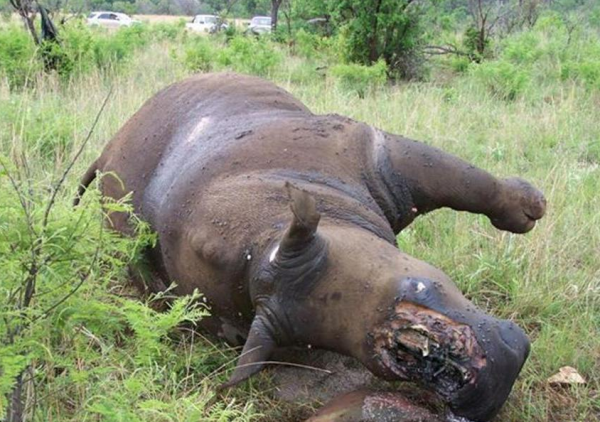
 

Seeing Is Important: Rhino Poaching

Screen Shot 2013-06-13 at 3.43.10 PM

I wonder if the (likely) Asian man who is using rhino horn powder to try and amp up his apparently unfulfilling life knows that this is on the other end of his desires.

What is truly devastating to see is that this rhino, found last April in Kruger National Park, is still alive [WARNING: very graphic and disturbing–but that’s the point]:

More info here.

Do Sharks “Spyhop”?

Sort of. Maybe.

Especially oceanic whitetips, according to Dr. Demian Chapman, via Blue Ocean Institute:

Is it akin to spy-hopping behavior of killer whales or great white sharks? Probably not, because these two apex predators use spy-hopping to see prey that spend part of their time or land or ice, such as seals. Oceanic whitetips feed on prey that live exclusively underwater, like fish and squid.

I remember reading a paper by a Russian scientist who speculated that oceanic whitetips pick up scents in the air and that they may spy-hop to pick up windborne scents of floating animal carcasses.  Who knows? We are free to speculate. One of the crew suggests the sharks are trying to startle us and make us fall in the water!

Man And Nature

Destroying nature, destroying ourselves.

This looks interesting:

Here’s more:

Elemental tells the story of three individuals united by their deep connection with nature and driven to confront some of the most pressing ecological challenges of our time.

The film follows Rajendra Singh, an Indian government official gone rogue, on a 40-day pilgrimage down India’s once pristine Ganges river, now polluted and dying. Facing community opposition and personal doubts, Singh works to shut down factories, halt construction of dams, and rouse the Indian public to treat their sacred “Mother Ganga” with respect. Across the globe in northern Canada, Eriel Deranger mounts her own “David and Goliath” struggle against the world’s largest industrial development, the Tar Sands, an oil deposit larger than the state of Florida. A young mother and native Denè, Deranger struggles with family challenges while campaigning tirelessly against the Tar Sands and its proposed 2,000-mile Keystone XL Pipeline, which are destroying Indigenous communities and threatening an entire continent.

And in Australia, inventor and entrepreneur Jay Harman searches for investors willing to risk millions on his conviction that nature’s own systems hold the key to our world’s ecological problems. Harman finds his inspiration in the natural world’s profound architecture and creates a revolutionary device that he believes can slow down global warming, but will it work?

Separated by continents yet sharing an unwavering commitment to protecting nature, the characters in this story are complex, flawed, postmodern heroes for whom stemming the tide of environmental destruction fades in and out of view – part mirage, part miracle.

The Real Orca Show

Sometimes the wild killer whales just go for it. And if we are all lucky, there is someone there with a fast camera to deliver an amazing photoset:

Wow.

And I can’t resist adding this incredible image:

Slaughtering Endangered Whales For….

…specialty dog food.

…sold in Japan.

This would be the perfect parody–mixing naked profit-seeking under the cynical guise of sustaining a retrograde whale-hunting culture, with insane cost-benefit tradeoffs, with the pet fetishism of a nation that itself is a leading killer of whales and dolphins. If it were a parody. Which apparently it is not:

ICELAND is to resume commercial whaling next month, killing up to 184 endangered fin whales over the coming summer partly to supply a burgeoning Japanese market in luxury dog snacks.

Could South Park or The Simpsons do any better? I doubt it.

Seabird Slaughter

Fisheries don’t just kill fish:

Evidence for the horrific impact of fishing gear on seabirds has been revealed by the closure of Canadian fisheries after fish stocks collapsed in the early 1990s.

Biologists have long worried that diving birds can become entangled in gillnets, which are anchored in fixed positions at sea. Designed to snare fish by the gills, these nets can also trap and drown birds.

This has been graphically demonstrated by finds of birds enmeshed in nets, but a quantitative assessment of the effects of such ‘by-catch’ on seabird populations has been hard to come by.

Now, that hard evidence has come from a careful study of seabird populations off the eastern coast of Canada, where cod and salmon fisheries were closed and gillnets removed in 1992. This work comes just weeks after another report estimated that hundreds of thousands of birds die each year in gillnets around the world.

Ecologists Paul Regular and William Montevecchi of the Memorial University of Newfoundland in St John’s and their colleagues examined data on various marine birds at five major Canadian seabird reserves in Newfoundland and Labrador between 1968 and 2012. They then compared bird population trends with data on gillnet use between 1987 and 2009.

The team found that populations of diving birds such as murres and gannets, which are vulnerable to entanglement in nets, increased after the ban. But in the same period, the numbers of gulls and other surface-feeding scavengers that benefit from unwanted fish thrown away by fisheries decreased, the researchers report in Biology Letters. Although the gull populations declined, these species are not at risk of extinction and it is likely their numbers are returning to more natural levels with the reduced influence of human activity.

Hard numbers
“Based on previous estimates of tens of thousands of murres killed each year in regional gillnet fishes, clearly significant numbers of breeding murres have survived that wouldn’t have otherwise,” say Regular and Montevecchi. The data ”support the widely held but rarely documented contention that by-catch mortality affects seabird populations”.

Just one more reason to not eat fish–even if you can convince yourself that the fish themselves are being fished “sustainably.”

Does Pristine Nature Exist?

“You think I am not used to change?”

Some ecologists are arguing that humans and alien species have been churning up ecosystems far more intensively, and for far longer, than we assume:

We like to think that most nature was pristine and largely untouched until recent times. But two major studies in recent weeks say we are deluded. In one, Erle Ellis, a geographer at the University of Maryland Baltimore County, and colleagues have calculated that at least a fifth of the land across most of the world had been transformed by humans as early as 5,000 years ago — a proportion that past studies of historical land use had assumed was only reached in the past 100 years or so.

The human footprint was huge from the day, perhaps 60,000 years ago, when we began burning grasslands and forests for hunting, according to the Ellis study. It extended further with swidden “slash-and-burn” agriculture, and became more intense when farmers began to domesticate animals and plow the land.

And if that is right we should change the way we think about stewardship:

Far from reaching some equilibrium state with niches filled, ecosystems have always been in a constant state of flux, says Stephen Jackson, of the Southwest Climate Science Center in Arizona, in Novel Ecosystems. “Change, including rapid and disruptive change, is a natural feature of the world.” Humans may have dramatically speeded that up, but novelty is the norm.

In that light, we need to look afresh at conservation priorities. Novel ecosystems cannot be dismissed as degraded versions of proper ecosystems, nor can alien species be demonized simply for not belonging. If novelty and change is the norm, Hobbs and colleagues ask, does it make sense for the growing business of ecosystem restoration to try and recreate static historic ecosystems? By doing that, you are not creating a functioning ecosystem; you are creating a museum exhibit that will require constant attention if it is to survive.

Ecosystems can be hardy, and no doubt have always been in a state of flux and evolution. The big issue now is that humans are turbo-charging the rate of change. And that will be a severe test of how fast ecosystems and the species within them can adapt. No doubt some will, but it could get ugly.

“[W]e now know that as much as a tenth of the trees in the Amazon rainforest grow on man-made “dark earths,” or terra preta, which archaeologists believe were created by pre-Columbian farmers who added organic wastes and charcoal to improve nutrient supply and boost yields. Much of the Amazon, Ellis concludes, is actually forest regrowth.”

Young Norwegians Don’t Want To Go Whaling

Raymond Nilsen and his father, Eilert, butcher a minke whale aboard the Nordfangst—Norwegian for Northern Catch. Over a typical summer whaling season they catch 20 to 30 minkes. In winter they fish for cod. (Photograph by Marcus Bleasdale)

For once I am grateful for all the distractions of modern life, because they are diverting the next generation of Norwegian whalers from the industry:

It isn’t a scarcity of whales that is bringing down the curtain, or even the complicated politics of whaling. It’s something far more prosaic and inexorable: Norwegian kids, even those who grow up in the seafaring stronghold of Lofoten, simply don’t want to become whalers anymore. Nor do they want to brave storm-tossed winter seas to net fortunes in cod, as their forebears have done for centuries. Instead, they aspire to land safer, salaried jobs in distant cities or with the offshore oil industry, and they have been leaving their island communities in droves.

There is irony in this turn of events. For most of its history, Lofoten exerted a gravitational pull on the young and ambitious. In his 1921 coming-of-age classic The Last of the Vikings, Norwegian novelist Johan Bojer described the legendary island chain as “a land in the Arctic Ocean that all the boys along the coast dreamed of visiting some day, a land where exploits were performed, fortunes were made, and where fishermen sailed in a race with Death.”

Smart kids. Haunting photo gallery here.

Killer Whale Menopause: It’s All About The Kids

This is pretty fascinating. A paper in Science on killer whale menopause reveals some interesting parallels with menopause in humans, and adds to our understanding of the incredibly tight mother-offspring bonds in killer whale society.

Here’s a summary from the Center For Whale Research:

Dr. Emma Foster has provided a brief summery of her paper that recently came out in Science:
“Adaptive Prolonged Postreproductive Life Span in Killer Whales”

1.      The key finding: We have discovered that female killer whales have the longest menopause of any non-human species so they can care for their adult sons. Our research shows that, for a male over 30, the death of his mother means an almost 14-fold-increase in the likelihood of his death within the following year.

2.      The relevance/link to humans: Biologically-speaking, the menopause is a bizarre concept! Very few species have a prolonged period of their lifespan when they no longer reproduce. Like humans, female killer whales buck this trend and stop reproducing in their 30s-40s, but can survive into their 90s. The benefit of a menopause to both human and killer whale mothers is in spreading their genes. The different ways this has evolved reflects the different structure of human and killer whale societies. While it is believed that the menopause evolved in humans partly to allow women to focus on providing support for their grandchildren, our research shows that female killer whales act as lifelong carers for their own offspring, particularly their adult sons.
3.      Why this is important: The menopause remains one of nature’s great mysteries. This research, which involved studying 36 years-worth of data, is the first ever study of its kind and is an exciting breakthrough in our understanding of the evolution of the menopause.
I wonder if there is a species with a more important mother-son bond? It certainly exceeds the same human connection.
The more we learn about killer whales, the more complex and sophisticated their relationships and culture appears.