Is Any Fish Truly Sustainably Fished?

A pile of shrimp bycatch.

There are probably a few, but good luck figuring out which. When my daughter and I went vegetarian we grappled with the question of whether we were just going meat-less, or meat-less AND fish-less. My daughter, bless her heart, had no question that we should leave fish alone. And I was fine with going along with her, partly for humane reasons, but also very much because all the evidence is that there are very few species of fish (whether wild-caught, or farmed) that are sustainably managed. And even fewer that don’t have some negative environmental impact (such as bycatch, disease transmission, antibiotic resistance, etc., etc.). So meat-less and fish-less we became.

We didn’t put a ton of research into that decision, but it feels vindicated by the news over the weekend that Whole Foods has decided to stop buying certain New England fish because it doesn’t believe that they are being fished sustainably (despite existing fisheries management, and “sustainable” certifications):

Starting Sunday, gray sole and skate, common catches in the region, will no longer appear in the grocery chain’s artfully arranged fish cases. Atlantic cod, a New England staple, will be sold only if it is not caught by trawlers, which drag nets across the ocean floor, a much-used method here.

“It’s totally maddening,” Mr. Sanfilippo said. “They’re just doing it to make all the green people happy.”

Whole Foods says that, in fact, it is doing its part to address the very real problem of overfishing and help badly depleted fish stocks recover. It is using ratings set by the Blue Ocean Institute, a conservation group, and the Monterey Bay Aquarium in California. They are based on factors including how abundant a species is, how quickly it reproduces and whether the catch method damages its habitat.

“Stewardship of the ocean is so important to our customers and to us,” said David Pilat, the global seafood buyer for Whole Foods. “We’re not necessarily here to tell fishermen how to fish, but on a species like Atlantic cod, we are out there actively saying, ‘For Whole Foods Market to buy your cod, the rating has to be favorable.’ ”

The company had originally planned to stop selling “red-rated” fish next year but moved up its deadline. The other fish it will no longer carry are Atlantic halibut, octopus, sturgeon, tautog, turbot, imported wild shrimp, some species of rockfish, and tuna and swordfish caught in certain areas or by certain methods. (Whole Foods has already stopped selling orange roughy, shark, bluefin tuna and most marlin.)

Then today, Juliet Eilperin followed up in the Washington Post with a story that got even deeper into the complexities and disagreements over all the organizations rating fisheries as sustainable or not:

Many retailers tout the environmental credentials of their seafood, but a growing number of scientists have begun to question whether these certification systems deliver on their promises. The labels give customers a false impression that purchasing certain products helps the ocean more than it really does, some researchers say.

Backers respond that they are helping transform many of the globe’s wild-caught fisheries, giving them a financial incentive to include environmental safeguards, while giving consumers a sense of what they can eat with a clear conscience.

To add to the confusion, there are a variety of certification labels and guides, prompting retailers to adopt a hybrid approach, relying on multiple seafood rating systems or establishing their own criteria and screening products that way….[snip]

…The most stringent and commonly used certification is that of the Marine Stewardship Council, which has certified 148 wild-caught fisheries, or between 6 and 7 percent of the global supply. It uses independent reviewers to determine whether a fishery earns an MSC-certified label and can be classified as sustainable — meaning that the fish is relatively abundant, the fishery is well managed, and catching it does not harm other species or ocean habitats.

It is a measure of the attention focused on the world’s fish stocks that the council’s work has come under scrutiny.

A study published online last week in the journal Marine Policy showed that, for fish stocks where there was sufficient information, 31 percent of MSC-certified stocks were overfished and subject to continuing overfishing.

There’s no question that if you are going to eat fish, you should buy only fish that is certified as sustainable by…someone (and hope that it really is). But, to me, the only unambiguous way to protect and preserve fish stocks is….not to eat them.

Here’s a good graphic the Washington Post included, which reinforces the point that it is hard to know whom to believe:

The Fisherman And The Dolphin

Because you can never see enough examples of the complex and moving relationships dolphins can choose (that’s a key word) to develop with humans, I want to point you toward a fascinating documentary series that depicts the complex bonds that can form between wild dolphins and humans.

Here’s a summary from the press release:

Blue Velvet In Sinai shows the remarkable relationship between a wild solitary female dolphin in the Red Sea named Olin, who in 1996 initiated a close relationship with a Bedouin fisherman called Abdullah, from The Mezzeina Tribe in the Sinai desert, Egypt.

This tribe is deaf due to inter-breeding, and communicate via sign language. In late December 1996 Olin, after mating with a dolphin from a passing school, gave birth to a male calf named Jimmy (by the Bedouin). Jimmy’s arrival heralded a massive tourism wave that changed the area and the lives of the Bedouin.

The programmes also highlight many aspects of Bedouin life and culture against the vast landscapes of the Sinai Desert. We will catch fish with Abdullah and members of his tribe, and compare differing life styles between the traditional and modern Bedouin..

An extract from a story by the ancient Roman writer Aleian, about a tragic love affair between a young boy and a female dolphin, will show that human and dolphin interaction is not something new. Dolphins were abundant in classical times, though now their species are declining.

Before discovering Olin, Abdallah had difficulty with speech. Now Abdallah is able to talk freely, and his hearing is said to have improved. A remarkable achievement, almost miraculous, though it can be partly explained scientifically.

Footage of pregnant woman swimming with dolphins, and interviews with women who have undergone water births, are examples of how close we are in nature to these playful creatures. Including the first birth with dolphins in Israel, which hit major headlines.

Dolphin healing is an area that makes me very, very nervous, because it is so ripe for commercial exploitation. When humans think dolphins can give them something they tend to take (and someone always has a way to make money from that dynamic). But the series at least helps show how remarkable dolphins are, which can only help humanity change the way it sees dolphins and the many ways in which human culture exploits them.

Here are some trailers from the Blue Velvet In Sinai website, and for a small fee you can watch the whole series online here, or buy a DVD.

The Story Of Whaling And The US Economy

A fascinating look at whaling, innovation, and the 19th century American economy. With lessons for America in the 21st century! How’s that for a daily double?

The standard explanation for the decline of whaling in the second half of the century is a pat two-parter consisting of falling demand (from alternative sources for energy) and falling supply (from over-hunting). But according to Leviathan, the standard explanation is wrong.

To be sure, energy preferences had been flowing to another source of oil: petroleum. In 1859, the US produced no more than 2,000 barrels of the stuff a year. Forty years later, we were producing 2,000 barrels every 17 minutes.

But demand doesn’t tell the whole story. In the middle of the 19th century, whale oil prices increased, which should have led to more production. But output never recovered after the 1850s even as whaling continued to grow around the world. Why did Americans give up?

The answer from Davis, Gallman, and Gleiter will also look familiar to a modern business audience: US workers got too darn expensive, and other countries stole our share of the whale business.

Thanks to the dry-land industrial revolution, “higher wages, higher opportunity costs of capital, and a plethora of entrepreneurial alternatives turned Americans toward the domestic economy,” the authors write. Meanwhile, slower growth overseas made whaling more attractive to other countries. “Lower wages, lower opportunity costs of capital, and a lack of entrepreneurial alternatives pushed [people like the] Norwegians into exploiting the whale stocks,” they continue.

Of course, whaling has little to do with economics anymore. It’s much more about cultural identity, nationalism, and a bankrupt view of man’s dominion over the planet. The true innovation here would be to treat whales as if they had a right to life, liberty, and the pursuit of happiness.

Seeing Is Important

No matter what your views on marine parks, it is important that you know as much about the lives of the animals there as possible. Otherwise, you can’t really hold whatever views you have honestly. A few days ago, a picture came across my desk, and Elizabeth Batt has written up the backstory over at Digital Journal.

I hesitated to publish the picture because it is dramatic and open to mis-interpretation. But the more I thought about it, the more I felt that not publishing it also is a dis-service, and also dishonest. And that you can never know or understand more by NOT seeing something.

So below is the picture that got Elizabeth going on her article. It shows a team at an Asian marine park trying to save a dolphin’s life by amputating an infected dorsal. One one level it is hard to object to what they are doing, as brutal as the procedure might be for an animal that can’t handle general anesthetic. But the picture also shows the sort of lives and experience marine mammals at marine parks live, in contrast to the lives they live in their natural environment.

If this dolphin came from the Taiji drives, as seems likely from Elizabeth’s reporting, you can say that it is “lucky” to be alive, and you would be right in the sense that getting sold to a marine park is possibly better than being slaughtered in a cove (though who really knows which of those two fates a dolphin would choose it if could choose between those two fates). But that doesn’t take away from the truth of what the picture shows about the alien (to a marine mammal) world of marine mammal captivity (plus, it is the sale of dolphins to marine parks that underlies much of the economic incentive for the Taiji drives, so there is a bigger picture).

Finally, yes, the ocean can be a tough place, and dolphins no doubt get injured and die at sea. But this situation is a result of human choices and human culture. So I am publishing the picture so it can be seen by human eyes.

Double Depravity: Dolphins Die So Sharks Can Be Finned

Sorry if you just had breakfast. Because this photo essay by Paul Hilton on the fishing practices he documented in Lombok, Indonesia is not easy on the stomach, or the human conscience. (Hilton recently won a World Press Photo award for a series on shark finning, and his work is well worth a look).

The basic story is that fishermen capture dolphins, use the meat to longline for sharks (to fin), and sell any surplus at local markets. It’s like a perfect storm of destruction. It’s the pictures, though, that really illustrate how sad this is.

Here’s Hilton, describing the scene:

In August of 2011, I headed to Indonesia to investigate. On the first morning I woke to the sounds of prayer at the local mosque, grabbed my camera and a notebook and headed down to Tanjung Luar, the largest fish market in Eastern Lombok. The smell was over powering. The crowd was a mix of tourists and locals.  I watched as the crew of two Indonesian longliners, tied up alongside each other, started dumping large fish over the sides into the shallow waters to be dragged into shore. I quickly made a list of species being offloaded. Scalloped hammerheads, thresher, mako, blue, silky, bull, tiger and oceanic white-tips sharks, manta and mobula rays, spinner dolphins and pilot whales. All coming off the same two boats, and not a tuna in sight.

The pictures, and the fact that this sort of fishing is going on–both killing highly intelligent mammals, and contributing to the destruction of shark species–can easily inspire outrage and condemnation (as it should). But it is important to remember the underlying cause of such a destructive practice is poverty. It may be easy to judge, or to assume that we wouldn’t make the same choices these fishermen are making, but many are subsistence fishermen simply trying to feed their families (though I have only scorn and antipathy for industrial shark finning operations that are all about corporate profit).

So anyone who really cares about ending human exploitation of dolphins and sharks (and other species) has to face this inconvenient truth: these practices (along with so many other destructive environmental practices) will not stop until the world gets serious about addressing global poverty. That’s not easy to do, but it is something that rarely gets acknowledged in policy and political debates.

Poverty and environmental destruction and cruelty are intimately linked. So if you want to oppose what you see here, it is incumbent on you to open your mind to what can be done about the underlying problem.

Driftnet Destruction

The problem with drift nets is that they, well, drift. For a long, long, time.

The non-profit The Blackfish is launching a new campaign to stop illegal drift net use in the Mediterranean.

Here’s what got them going:

http://www.theblackfish.org/news/driftnet-victims.html

A Market Solution For Saving Whales?

Greenpeace and Sea Shepherd confrontations with whaling fleets make for good television. But despite their efforts lots of whales still die every year (some 2000, in fact).

A minke whale is processed in Hvalskurður, Iceland. (Via WIRED. Photo: Dagur Brynjólfsson/Flickr

Environmental economists Christopher Costello, Steve Gaines, and Leah Berger think that market incentives might be a better way to reduce the numbers of whales killed every year. Writing in the January 11 issue of NATURE, they propose the equivalent of a cap and trade system for whales, which would allow conservationists to spend money on purchasing whale shares (and saving the lives of whales) in stead of spending money on chasing whaling fleets around the world’s oceans.

Here’s how WIRED describes the plan:

The proposed market would be patterned after a system known best known from fisheries management as catch shares: Sustainable harvest levels are quantified, a maximum quota established, and catch allotments put up for sale by the International Whaling Commission. Costello’s proposal would add the crucial wrinkle of allowing activists to buy shares, too. If they did, a corresponding number of whales would be removed from the quota. (Indigenous groups would receive a set number of shares to be owned in perpetuity, apart from the market — though those could conceivably be sold, too.)

According to Costello’s estimates, global whaling profits amount to $31 million, and likely less when government subsidies are removed. Mainstream anti-whaling groups — Greenpeace, Sea Shepherd Conservation Society, and the World Wildlife Fund — spend about $25 million to fight the hunts.

“This money could be used to purchase whales, arguably with the same or better effect,” write the researchers in Nature.

There is pushback over the idea that whales would continue to be treated as commodities to buy and sell, instead of exempted from human harvest because they are intelligent, social creatures.

But until humanity achieves a more enlightened and ethical understanding of the relationship between humankind and the other species on Earth–and can agree to leave whales alone–it makes sense to try any approach that actually reduces whale kills. Right now, money is what motivates mankind, so it’s an intriguing proposal.

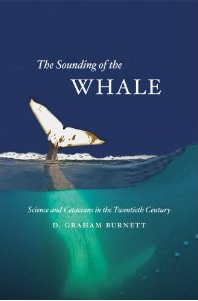
Must-Read Book Club: “The Sounding Of The Whale”

For anyone interested in whales and dolphins, this book looks fascinating: “The Sounding Of The Whale: Science And Cetaceans In The Twentieth Century.” It’s a masterwork by D. Graham Burnett, a professor of history of science at Princeton that explores the extensive–and sometimes brutal–history of humanity’s interaction with, and understanding of, cetaceans.

Here’s the publisher’s description:

From the Bible’s “Canst thou raise leviathan with a hook?” to Captain Ahab’s “From Hell’s heart I stab at thee!,” from the trials of Job to the legends of Sinbad, whales have breached in the human imagination as looming figures of terror, power, confusion, and mystery.

In the twentieth century, however, our understanding of and relationship to these superlatives of creation underwent some astonishing changes, and with The Sounding of the Whale, D. Graham Burnett tells the fascinating story of the transformation of cetaceans from grotesque monsters, useful only as wallowing kegs of fat and fertilizer, to playful friends of humanity, bellwethers of environmental devastation, and, finally, totems of the counterculture in the Age of Aquarius. When Burnett opens his story, ignorance reigns: even Nature was misclassifying whales at the turn of the century, and the only biological study of the species was happening in gruesome Arctic slaughterhouses. But in the aftermath of World War I, an international effort to bring rational regulations to the whaling industry led to an explosion of global research—and regulations that, while well-meaning, were quashed, or widely flouted, by whaling nations, the first shot in a battle that continues to this day. The book closes with a look at the remarkable shift in public attitudes toward whales that began in the 1960s, as environmental concerns and new discoveries about whale behavior combined to make whales an object of sentimental concern and public adulation.

A sweeping history, grounded in nearly a decade of research, The Sounding of the Whale tells a remarkable story of how science, politics, and simple human wonder intertwined to transform the way we see these behemoths from below.

This finback whale, found dead in the Baltic in 2006, was pulled from the sea by Greenpeace and dumped in front of the Japanese Embassy in Berlin as an anti-whaling protest. (Credit: Danny Gohlke/Agence France-Press — Getty Images)

And here is a passage from the New York Times review, which featured the above image, that in particular caught my attention:

From the likes of Hjort and Harmer and others, Burnett leads us to the superhumanly curious American A. Remington Kellogg, “the Prince of Whales.” Kellogg is perhaps the book’s most intellectually intriguing character, acting as a bridge between the gentleman scientists of the 19th century who had the luxury to leisurely catalog the world’s natural abundance and the conservation-minded biologists of the 20th who could see their research subjects vanishing before their very eyes. For Kellogg, the process of awakening to cetacean exceptionality was a grisly one. He was among the first to commission “vivisections” on porpoises even though, in his own words, “a live porpoise can be handled about as readily as a satchel of dynamite.” This did not deter the intrepid scientists who “fell to the unlovely task of restraining the furiously squealing animal in order first to expose the skull and then to saw into it to expose the brain.” When these operations were performed, Kellogg was witness to “a strangely large brain, one with elaborate patterns of convolution such as were generally thought to be more or less unique to human beings.”

Kellogg’s cruel-sounding investigations into cetacean morphology were paired with truly kind and selfless lobbying on whales’ behalf. In tracking Kellogg’s journey from naturalist to activist, Burnett makes good on his promise to show that “a history of whale science can shed considerable light on the changing understanding of nature in the 20th century.” Not only did Kellogg operate in a policy sphere, lobbying to create the Council for the Conservation of Whales, he also assiduously wooed the popular zeitgeist, most notably by working to produce the National Geographic article that would start to shift the general public’s perceptions of what had been largely maligned creatures. For any writer who has ever dealt with that hallowed magazine’s combination of nitpicking and bluster, the record of Kellogg’s editorial squabbles with National Geographic is worth the price of admission. “Left and right, he fought off editors’ desires to sensationalize cetacean ‘monstrosity,’ ” and at one point wrote to a colleague, “ ‘The publisher has the idea that all the pictures should be exciting, such as a whale running its head though a steamer and then winking its eye at the astonished crew.’ ” When the editors wanted to call the piece “Whales: Lions of the Sea,” Kellogg responded: “ ‘Whales are very distantly, if at all, related to the cat tribe. . . . Except when mortally wounded,’ they ‘are inoffensive and noted for their timidity.’ ”

Witness To Murder

With the dolphin slaughter in Taiji resuming after the holiday break, and ushering in a bloody 2012, I thought I would share this incredibly moving video lament.

It must be so hard to watch and bear witness to what happens in that Cove, and it is thanks only to the courage and persistence of Save Japan Dolphins and the other witnesses who spend day after day at the Cove that the rest of the world is not allowed to simply turn away and go back to playing XBox.

Here, for example, is SJD’s Heather Hill on what she saw today:

The boats slowly drove the dolphins towards the Cove, and divers lined the rocks, ready to intervene if and when the panic-prone dolphins entangled themselves in the nets or threw their bodies against the rocks in an attempt to flee.  Because the pod was so large, the fishermen were unable to push them all into the killing Cove (out of the range of our eyes and cameras) at once, and for a while there were dolphins cordoned off in three different sections of the Cove.  One lone dolphin swam between the outer nets while its family members were being slaughtered; watching, listening, and waiting.  After those dolphins already under the tarps were either killed or otherwise restrained, the fishermen opened the inside nets so they could drive the remaining individuals to their death.

One ironic note: Check out the ad on the right that Google’s algorithm selected for me as I watched dolphins being stabbed and killed. I think the algorithm needs some tweaking

Dolphin Discovery is all over the Caribbean and uses wild-caught dolphins to stock their pools. When anyone buys a ticket to a dolphin show they are helping create the demand that sustains the slaughter in Taiji. Please think about that next time your child or a friend suggests going to a dolphin show.

And then do the one thing that can help end this barbarism: say “No.”

A Song For The Oceans, Sung Underwater

This is just what you need at the end of a long day. From The TankBangers. Creative, amusing, poignant.