Sea Shepherd Goes To Sea

Whatever you think of Sea Shepherd’s Paul Watson, and Sea Shepherd’s confrontational anti-whaling strategy, you have to consider this: in an international whale management regime that seems custom-designed for gridlock and delay, Sea Shepherd is taking action.

Call it uncivil disobedience, and maybe that is an idea whose time has come. Increasingly, domestic politics and international diplomacy work at a pace that is insufficient to match the rapid pace of environmental change and destruction occurring around the globe. So we can rely entirely on the usual channels for resolving problems, and feel good about that, but watch whales die, seas rise, forests disappear, and extinction rates accelerate. Or we can continue with those channels but at the same time take more direct action to shock and galvanize the system to respond more quickly.

I’d argue that is what Sea Shepherd is doing with regard to whaling, and once again the Sea Shepherd fleet is headed to sea to confront the Japanese Antarctic whaling fleet:

Captain of the SSS Bob Barker, Captain Peter Hammarstedt stated, “The plan is for our fleet to meet the whaling fleet in the North Pacific off Japan. We are planning to take the battle pretty much up to Japan itself. We are keeping the location and identity of our new vessel, the SSS Sam Simon, a secret in the hope that the first time the whalers see the Sam, is when she comes into view on the slipway of the factory processing ship, the Nisshin Maru, effectively shutting down their illegal whaling operations.”

Currently docked in Marina del Rey, California on its very first trip to the mainland U.S., the fast scout vessel, the SSS Brigitte Bardot, will depart on November 11 and quickly meet up with the rest of the Sea Shepherd fleet.

Hammarstedt also went on to say “it is expected Sea Shepherd Founder and President Captain Paul Watson will appear in command of one of the vessels when the action begins.” Captain Watson has been in an undisclosed location since July 22 when he forfeited his bail and departed house arrest in Germany to avoid being extradited on bogus charges to Costa Rica and Japan.

Australian Director Jeff Hansen stated, “This is our strongest fleet to date, with four ships and more than 100 international crew representing 23 nations to defend the Southern Ocean Whale Sanctuary. Operation Zero Tolerance will be Sea Shepherd’s best-equipped and most effective campaign to date. This is a defining moment in Sea Shepherd’s history; we have no tolerance for whale poachers. Our objective this year is 100%. We are going to try and intercept them as quickly as possible, and try to make this the first year they get zero kills.”

I’m excited that dedicated animal rights defender Sam Simon will have a ship out there, and I’m sure it will get into some crazy trouble. But lest you are tempted to dismiss the Sea Shepherd campaign as trivial or a sideshow, please note the fact that Sea Shepherd has likely saved the lives of thousands of whales (they claim more than 3,600).

If you don’t think that really matters, then watch the death of just a single whale (dramatized as it is for Whale Wars). It will make you want to sign on as Sea Shepherd crew.

Aquariums Split Over Wild Beluga Import

This is a very interesting, and potentially important, development: two major players in the aquarium world are opposing the proposed Georgia Aquarium import of wild Russian belugas.

Over the past decades, marine parks and aquariums have mostly stayed united on issues related to the Marine Mammal Protection Act and the display of whales and dolphins. For the National Aquarium and Sea Life Centres to take a different view of the Georgia Aquarium’s plan to import wild belugas and distribute many of them on breeding loans to SeaWorld, Shedd Aquarium, and Mystic Aquarium is a big deal. And it’s an encouraging sign that some aquariums–given what we now know about the intelligence, awareness and sociability of small whales and dolphins–see the possibility of a different model for education and display than the model that has dominated the industry since its inception.

Here is the National Aquarium letter to NMFS, outlining its opposition. One thing that really catches my eye is the National Aquarium’s statement that it wants to review the Marine Mammal Protection Act along with other institutions and outline a new model for display that reflects all that we have learned about marine mammals since the MMPA was put in place in 1972. That is desperately needed, I think:

Here is the Sea Life Centres letter:

And here is a press release from Whale And Dolphin Conservation applauding the position of the National Aquarium and Sea Life Centres:

The stand that the National Aquarium and Sea Life Centres are taking will no doubt cause some heartburn in the industry. But any reform of the MMPA and how marine mammals are treated and displayed around the world is much likelier to make progress with some industry support. So kudos to these two organizations for taking a big and brave step forward.

Ocean Policy Is A No-Brainer

“Dude, would it be too much to ask you humans to have a national ocean policy?”

It seems so obvious to me that humans (and the subset known as Americans) need to see and treat the oceans, the lands, and the atmosphere as integrated ecosystems. What you do in one place, affects life (either human or non-) and resources in another place. So when you make choices about commerce, recreation, energy, whatever, it makes sense to think through the ripples those choices send through the system.

So I am always caught by surprise when such an obvious reality turns out to be controversial. Take ocean policy. To his credit, Barack Obama saw the interconnectedness of things, and the confusing disconnnectedness of federal agencies and polices, and decided to create a national ocean policy that actually considers the implications for the oceans off the United States of the decisions made by the federal government.

Yet considering the borader implications of any single decision for the oceans as a whole is apparently a controversial idea. According to the Washington Post:

Conservative Republicans warn that the administration is determined to expand its regulatory reach and curb the extraction of valuable energy resources, while many Democrats, and their environmentalist allies, argue that the policy will keep the ocean healthy and reduce conflicts over its use.

The wrangling threatens to overshadow a fundamental issue — the country’s patchwork approach to managing offshore waters. Twenty-seven federal agencies, representing interests as diverse as farmers and shippers, have some role in governing the oceans. Obama’s July 2010 executive order set up a National Ocean Council, based at the White House, that is designed to reconcile the competing interests of different agencies and ocean users.

The policy is already having an impact. The council, for example, is trying to broker a compromise among six federal agencies over the fate of defunct offshore oil rigs in the Gulf of Mexico. Recreational fishermen want the rigs, which attract fish, to stay, but some operators of commercial fishing trawlers consider them a hazard and want them removed.

The article goes on to detail debates over vessel speeds through national marine sanctuaries, the impact of wind farms on local fisheries, and river runoff. What is particularly striking to me is that all these debates are over competing human commercial interests. The impact on ocean health and ocean dwellers rarely seems to figure. So not only do you have controversy over the blindingly sensible idea of considering the broader impact of decisionmaking related to oceans. The idea doesn’t even really incorporate the basic health of the ecosystem (beyond what happens to commercial or sportfishing fish stocks) as a fundamental goal or interest.

Throw in the fact that the oceans really need international coordination and management, and this controversy over simply managing the oceans off our coasts in a sensible way makes you realize just how far we have to go to get where we need to be on global oceans policy. It’s not just about human interests (though it is in the largest sense, because we need a healthy planet and healthy oceans to thrive). Why is that controversial or so hard to see?

Shark Sanctuary

Sometimes the simplest ideas are the most powerful. If you want to stop shark fishing and finning, don’t muck around with caps, fisheries management, and licenses. Address the problam directly and ban commercial fishing.

That’s the approach the Marshall islands took when they created the world’s largest shark sanctuary. Almost two million square kilometers of protected waters and reefs, WITH (and this is key, obviously) enforcement.

But there’s always a difference between the vision and the implementation. So it’s worth checking in on how the sanctuary is working out one year in. So the Pew Environment Group, which has been intimately involved in this effort, takes a look.

I’d love to believe things are going so well. And I love the fact that some people are now calling for a Pacific Ocean sanctuary. But I wonder what is happening with poaching. And “non-commercial” shark fishing. And commercial fishing of other species and bycatch. There is so much money in shark finning that there is always the danger that it will find a way to overcome, evade, or sneak through loopholes, in any sanctuary.

But those are challenges of implementation, and can be addressed with greater vigilance and funding. The essential point remains: sanctuaries are an immensely simple and powerful idea. And can do more to preserve and steward fish populations than any other approach.

Plastic (Not) Fantastic

If you think humanity is getting ready to trash the Arctic Ocean, now that the Arctic ice is receding and the oil companies are getting ready to go to town with their drilling rigs, you don’t have it quite right. Because we are already trashing the Arctic Ocean, and a recent study revealed that its floor is littered with human debris:

Bremerhaven, 22nd October 2012. The seabed in the Arctic is increasingly strewn with litter and plastic waste. As reported in the advance online publication of the scientific journal Marine Pollution Bulletin by Dr. Melanie Bergmann, biologist and deep-sea expert at the Alfred Wegener Institute for Polar and Marine Research in the Helmholtz Association. The quantities of waste observed at the AWI deep-sea observatory HAUSGARTEN are even higher than those found in a deep-sea canyon near the Portuguese capital Lisbon.

For this study Dr. Melanie Bergmann examined some 2100 seafloor photographs taken near HAUSGARTEN, the deep-sea observatory of the Alfred Wegener Institute in the eastern Fram Strait. This is the sea route between Greenland and the Norwegian island Spitsbergen. “The study was prompted by a . When looking through our images I got the impression that plastic bags and other litter on the seafloor were seen more frequently in photos from 2011 than in those dating back to earlier years. For this reason I decided to go systematically through all photos from 2002, 2004, 2007, 2008 and 2011,” Melanie Bergmann explains.

The result was the realization that the amount of trash on the sea floor has about doubled over the past decade. Not good, because here is the consequence:

Melanie Bergmann is unable to determine the origin of litter from photographs alone. However she suspects that the shrinking and thinning of the Arctic sea ice may play an important role. “The Arctic sea ice cover normally acts as a natural barrier, preventing wind blowing waste from land out onto the sea, and blocking the path of most ships. Ship traffic has increased enormously since the ice cover has been continuously shrinking and getting thinner. We are now seeing three times the number of private yachts and up to 36 times more fishing vessels in the waters surrounding Spitsbergen compared to pre-2007 times,” Melanie Bergmann says. Furthermore, litter counts made during annual clean-ups of the beaches of Spitsbergen have shown that the litter washed up there originates primarily from fisheries.

The main victims of the increasing contamination of the seafloor are the deep-sea inhabitants. “Almost 70 percent of the plastic litter that we recorded had come into some kind of contact with deep-sea organisms. For example we found plastic bags entangled in sponges, sea anemones settling on pieces of plastic or rope, cardboard and a beer bottle colonised by ,” Melanie Bergmann says.

When sponges or other suspension feeders come into contact with plastic, this may cause injuries to the surface of their body. The consequence: the inhabitants of the sea bed are able to absorb fewer food particles, grow more slowly as a result, and probably reproduce less often. Breathing could also be impaired. Furthermore, plastic always contains chemical additives, which have various toxic effects. “Other studies have also revealed that plastic bags that sink to the seafloor can alter the gas exchange processes in this area. The sediment below then becomes a low oxygen zone, in which only few organisms survive,” Melanie Bergmann says.

Plastic, and what to do about it is an ungodly difficult problem. It permeates every part of our lives and it is so pervasive that it is almost impossible to Continue reading “Plastic (Not) Fantastic”

Mid-Day Infographic Interlude

Thought-provoking graphic showing what parts of earth will be submerged by rising sea levels, according to timing and global warming milestone (click image for full-size):

Sea level rise

The Future Of Fish

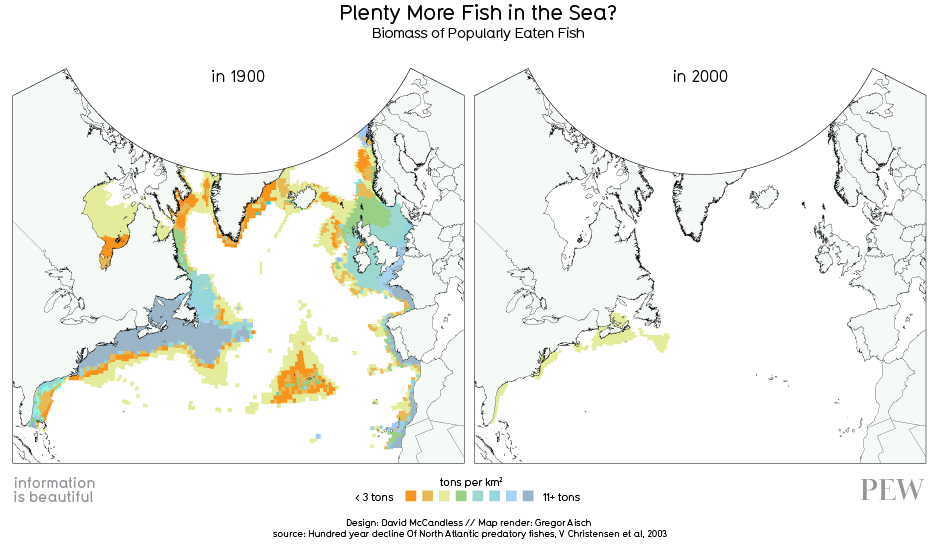
Any discussion of human fishing practices has to start with this chart (you know how I love infographics). Click image for full size:

The data presented here is damning on two levels. First, as a perfect visualization of the Tragedy Of The Commons, in which we don’t have the will or the wisdom to steward resources on a global scale, instead just seeking profit wherever it can be found, nevermind the fact that over time we are destroying the very stocks we seek profit from.

And second, because lots of the earth’s population relies on dwindling stocks of fish. This is a problem that Carl Safina and Brett Jenks focus on in a recent op-ed that argues for turning over fishing rights to local communities:

The journal Science recently published the first comprehensive analysis of more than 10,000 fisheries — roughly 80 percent of our global fish catch. The conclusion: fish populations worldwide are swiftly declining. This global analysis paints a stark new picture of a global ocean fished to exhaustion in an increasingly hungry world.

So, why are we hopeful? It’s because the analysis of global fisheries has a silver lining. We have not reached a point of no return. We have time. Solutions exist.

The good news is that many large commercial fisheries are already benefiting from the improved management of the last decade. The harder problem is with smaller-scale fisheries that local communities rely on for food and income. The fact is that small-scale fishers — who fish within 10 miles of their coast — account for nearly half of the world’s global catch and employ 33 million of the world’s 36 million fishermen, while also creating jobs for 107 million people in fish processing and selling [pdf]. Mostly poor, they live mainly in areas lacking fisheries management, monitoring and enforcement. No one is in a position to formally declare their fisheries “disasters.” They must just endure their situation. Or — take control of it.

Safina and Jenks propose a hyper-local approach to managing fisheries, called Territorial Use Rights, or TURF. Here’s how it would work:

In exchange for the privilege of exclusivity, local fishermen agree to establish and protect no-take zones. Results include increased fish populations, richer marine habitats, and coastlines less vulnerable to climate change — and more food for people.

Unleashing the self-interest of local fishermen to advance both conservation and economic development can create one of those rare win-win scenarios.

A growing body of research shows that fish populations inside a no-take zone can more than quadruple. Fish numbers outside the reserve can double. And, exclusive access enables investment and better management, increasing the catch’s value.

That feels right. No one cares more about managing stocks than the very people whose lives and livelihood depend on the stocks surviving. The challenge is that thousands of TURF zones would have to be created (and enforced) around the globe.

Traditional Fishing

That’s really just another way of saying that we have created a big problem so we need a dramatic solution. And I wish humanity had a better record of tackling big challenges by putting long term interests on a par with short term interests.

But the basic theme of localism is a very powerful one. And there is plenty of evidence that fishing’s emphasis on industrial practices and international fleets has been an accelerating disaster. So, sure, if we are going to do anything we should go local–and encourage traditional fishing practices that don’t strip mine the seas.

It would also help if the billions of people who don’t NEED to eat fish to survive would start laying off the tuna, Chilean Sea Bass, shrimp, shark fin soup, and every other fish our lust for high-end, boutique, food is destroying.

Raw Numbers: Ocean Acidification vs. The Kardashians

Okay, on one level this is a bit silly. But on a deeper level–i.e. what it says about the degree to which modern media has given up on informing in favor of (more profitable) gossip and entertainment, as well as the degree to which we are all becoming stupidly fixated on celebrity–it is troubling.

Because ocean acidification is going to affect your future, and the planet’s future, a lot more than the Kardashians will (click image for full size).

Oh, and I will send Kim K. a “Save The Whales” t-shirt if “ocean acidification” gets mentioned even once during tonight’s presidential debate.

Seeing Is Important: The Meaning Of (Melting) Ice

Back to one of my favorite themes, because last night I saw the documentary “Chasing Ice.”

It’s about the quest of photographer James Balog to capture–through time-lapse photographs taken by remotely positioned cameras–what is happening to the earth’s great glaciers.

You may know that they are melting and shrinking. But knowing something and seeing something are two different things. And seeing Balog’s time-lapse sequences–which convey both the majesty of what we are losing and the relentless, rapid rate at which the loss is occurring–drives home the reality in a way that provokes truly powerful emotions.

Balog is one of a number of photographers who are focused on the Arctic. It is there, perhaps more than anywhere else on earth, that you can see the dramatic impact of climate change, both on the natural world and on animal life. And the fact that it is a true wilderness, mostly unspoiled by a direct human presence, makes its degradation all the more poignant. That, plus the fact that human culture is having such an outsized impact on the atmosphere that it is destroying an entire ecosystem REMOTELY.

Another photographer whose work is documenting this phenomenon in a compelling way is Florian Schulz. Outside Online recently published a series of Schulz’s photos, called Into The Arctic. Here are a few (full set is here):

Schulz has also taken to film to try to convey the experience and meaning of the Arctic.

Welcome To The Arctic from Florian Schulz on Vimeo.

It’s impossible not to see all this and not feel anger and despair at the lack of wisdom and caring involved. But it also makes me want to channel those feelings into a desire to change everything. More on that soon…

Loving The Blue Whale Too Much

First we hunted them to near extinction, and now scientists estimate there are perhaps 25,000 blue whales left on the planet. They are magnificent creatures, and most humans hope their population will grow and thrive.

But human love for a species is often dangerous, because when humans love something they want to see it, be with it, and experience it. They put the human experience, and human desires, over the animals’ experience and the animals’ needs. Sometimes that means putting animals in zoos and marine parks. Sometimes it means invading wild habitats and disturbing natural life rhythms. And it seems that is what could be happening with blue whales, particularly in the waters off Sri Lanka (ironically because the end of a civil war is making tourism safer).

Throw in commercial shipping, which is not as deadly as actual whaling, but deadly nevertheless, and you have humans–despite their recent love for blue whales–once again putting pressure on a dwindling population.

Here’s the New York Times, putting it all together:

The problem is particularly troublesome here in Sri Lanka, where a largely unstudied population of blue whales, possibly numbering in the thousands, has come under increasing pressure from commercial shipping and from a boom in unregulated whale-watching boats.

Because these waters are poorly monitored, scientists do not know for sure whether ship strikes are on the rise. But the whale’s death in April was already the sixth of the year, according to news reports. In one grisly encounter in March, a blue whale was found draped over the bow of a container vessel in the harbor in the capital, Colombo, 90 miles north of this beach resort. Last year, some 20 whale carcasses (not all of them blue whales) were seen around the island, according to Arjan Rajasuriya, a research officer with the National Aquatic Resources Research and Development Agency in Colombo. It is not known how many of the deaths resulted from ship strikes.

“These strikes likely represent only a portion of the likely true mortality,” said John Calambokidis, a whale researcher in Olympia, Wash., who documents ship strikes off the West Coast of the United States. Because blue whales often sink soon after they are struck, most such deaths go unrecorded, and Dr. Calambokidis says the true number “could be 10 or 20 times” the number seen.

Fifteen miles off the southern coast of Sri Lanka is one of the world’s busiest shipping lanes, and whales are known to swim regularly inside them. But some scientists believe that the increase in whale watching could be forcing whales to seek food farther out, pushing them into the big ships’ path.

“I’m afraid the whales are being harassed by the whale-watching boats and that this could affect their movement,” said Asha de Vos, a whale researcher here.

The result, in the photo taken by Madzak Radjainia and published as part of the NY Times story, is dead whales floating near Sri Lanka, with ship strike injuries (they published a great video report as well).

Dead Blue Whale

It doesn’t have to be this way. Some day humans may gain the wisdom to realize we need to give much greater weight to the needs of other species, even if that means compromising on human desires and needs. An example would be accepting that even when we love a species we don’t have the right to disturb it in its natural habitat, and that doing so can do real harm.