There’s A New Milkman In Town

…”and he’s got some serious nuts.”

A pretty funny commercial for Silk Almond Milk (for me, almond milk was the key discovery that helped me ditch dairy. It’s tasty enough to drink plain, and good (enough) in coffee).

Silk Milk from CINEMA SCOTT on Vimeo.

“Those Crazy Plastic Cleaning Machines”

I expressed some skepticism that a teenager’s oceanic plastic hoover concept could easily make the jump to the real oceanic world.

Manuel Maqueda at KUMU, is a little more blunt:

If I had a dime for each brilliant idea to “clean up the “Garbage Patch” that has been forwarded to me over the last few years I would be a millionaire.

These gyre cleanup machines, devices and foundations that emerge periodically are not going to happen. However they are likely to get lots of media attention –and distract from the real solutions.

These more or less sophisticated delusions and fantasies of massive offshore cleanups testify to how misunderstood our plastic pollution problem is, and how disconnected we are from nature in general, and from our oceans in particular.

Apart from Maqueda’s justified skepticism about how far it is from the drawing board to the restless, relentless, inhospitable oceans, he argues that our main focus should be on keeping plastic from getting into the ocean in the first place:

Another key detail that seems to be consistently forgotten is that millions of tons of new plastic trash are entering the ocean as we speak. A fairly old and conservative study estimated that 6.4 million tons of plastic waste enter the ocean every year –adding up to over 100 million tons of plastic already polluting our oceans.

Trying to clean this spiraling mess with ships or machines would be like trying to bail out a bathtub with a tea spoon… while the faucet is running! [snip]…

…The inconvenient truth is that we are using plastic, a toxic and very durable material that lasts centuries,for packaging and single use applications, that is to create things are designed to become garbage after a short use. And we are doing this at a massive scale to the benefit of a few corporations, to the detriment of all.

We have created a spiraling consumer culture and then turned it into a throwaway culture. Unless you stop this first, “cleanups” are futile.

That’s all very true, and I wouldn’t hesitate to support a worldwide ban on plastic bags (which are pernicious, and constantly being found en masse in the stomachs of dead sea creatures). Or a worldwide ban on plastic bottles. Or gratuitous plastic packaging (and here comes my usual, increasingly plaintive pitch: just price in the environmental and health impacts, and presto, people change their behavior!).

But still. These are times to think big. To take on the impossible. To look for silver bullets. So at the same time we are working to keep plastic out of the oceans, I am all in favor of garage nerds tinkering and dreaming about ways to remove some of the plastic that is already IN the ocean. Maybe there is some teen out there thinking up some crazy bioengineering or genetic engineering solution that Maqueda cannot even yet imagine. You never know.

(Thanks to Jordan Waltz for flagging Maqueda’s pushback).

The Power Of Street Art: Human Meat Edition

Okay, this is kind of gross (and also awesome), but that is exactly the point. Cows, horses, pigs, people. We are all meat, and would look much the same packaged up in a supermarket. So eating one type of meat, but taking offense at the idea of eating another, is just strange.

It is the act of eating meat, not what type of meat you eat, that is the issue.

Screen Shot 2013-03-28 at 3.52.35 PM

It Gets Better: Elephant Edition

This is nice to see. Michael Mountain, at Earth In Transition, takes note of the journey two three elephants are making from the Toronto Zoo to the PAWS Sanctuary:

The three elephants at the Toronto Zoo have been cleared for take-off, and will soon be on their way to a new life at the PAWS sanctuary in California.

How are they getting there? They’re being flown door-to-door by the Royal Canadian Air Force. (Yes, that would be aboard one of their jumbo jets …..)

How much will it cost? More than $500,000, but less than the $850,000 that Bob Barker has already pledged to the effort. (Yes, the price is right ….)

Why are they flying, not driving? Four or five days on the road, shaking around in a truck would be too stressful on these senior citizens who already have foot troubles from standing around in a zoo for so many years.

Would love to see a lot more of this sort of retirement from zoo service,including for orcas and other species. In fact, it should be required past a certain age, or a certain number of years of service. That would be the right thing to do. And the cost of retirement should be paid for by whatever entity the animal has served all those years, as part of the life cycle cost of using the animal (sort of like a pension system). Yes, that would increase the costs of ownership. And, yes, that would reduce the number of businesses and facilities that decide to use an animal. Which would be a good thing.

Good Fences Make Good (Large Animal) Neighbors

At least that’s what scientists working on lion conservation have concluded:

After 35 years of field research in the Serengeti plains, Craig Packer, director of the Lion Research Center at the University of Minnesota, has lost all patience with the romance of African wilderness. Fences, he says, are the only way to stop the precipitous and continuing decline in the number of African lions.

“Reality has to intrude,” he said. “Do you want to know the two most hated species in Africa, by a mile? Elephants and lions.” They destroy crops and livestock, he said, and sometimes, in the case of lions, actually eat people.

Dr. Packer’s goal is to save lions. Fencing them in, away from people and livestock, is the best way to do that, he believes, both for conservation and economics. He made that argument in a paper this month in Ecology Letters, along with 57 co-authors, including most of the top lion scientists and conservationists.

I am a romantic when it comes to the wild, but I agree that sometimes you have to be practical. And if fences will save lives all around, then it is hard to argue against them–though the cost estimates are daunting. And even if you could build all that fencing, is there anything to prevent humans from continuing to shrink the fenced area as populations continue to grow?

It would be interesting to try to compare the net benefit of investing tens, if not hundreds, of millions of dollars in fencing versus investing in education and technical training, say, which in turn helps reduce the poverty and desperation that often gets lions (and elephants) killed, slows population growth, and reduces reliance on livestock farming.


Whales vs. Ships

Keeping them out of each other’s way is a complicated business:

A first-of-its-kind study matching whale habitat to Southern California shipping lanes shows that two species, humpback and fin whales, might suffer fewer ship strikes if a new lane were created.

But the solution is not quite so simple for blue whales. These giants of the sea appear to be in the most trouble from ship strikes, and would be unlikely to benefit from any change in the four shipping lanes the study considered.

The scientists who conducted the study also estimated that more blue whales are being struck off the Southern California coast than their population can sustain without raising the risk of depletion.

“At best, the blue whale population is remaining steady,” said Jessica Redfern, a marine ecologist at the National Marine Fisheries Service and the study’s lead author. “Of the three, we’re probably the most concerned about blue whales.”

All three species examined in the study are listed as endangered. The scientists used data on conditions in the marine environment, along with whale sighting records, to map out the most likely habitat for each species.

Four shipping routes were then superimposed over the habitat maps. The result: the clearest picture yet of the places on the Southern California coast where ships and whales are most likely to collide.

The findings reveal the intricate interweaving of ocean corridors used by humans and the massive sea mammals.

The route that presents the least risk to humpback whales, for example, poses the highest risk for fin whales. The reverse also is true.

Humpbacks tend to concentrate farther north, fins farther south.

“Something in the center there seems like it may be good for ameliorating the risks for both species,” Redfern said, though the study does not make specific recommendations about shifts in shipping lanes.

Blue whales, however, occur throughout the area along all four shipping routes, spread so evenly that concentrating shipping in any one of the four routes seemed unlikely to reduce their risk.

Here’s how it looks on paper:

Moving shipping lanes around, especially if it costs shipping companies money, is not an easy ask. Whales–dead or alive–don’t show up on a shipping company’s balance sheet. But shipping slowdowns and re-routing on the Atlantic coast have helped reduce some right whale deaths.

When whale populations are so fragile, and whales are so majestic and intelligent, each life saved is especially important. Shipping companies might resist, but they can pass the incremental cost on to customes. And if that induces people to buy less stuff shipped halfway around the world, then that’s not a bad thing, either.

Will Tourists Trash Antarctica?

Conservationists are worried that the growing numbers of visitors, and their desire to do more than sit around on ships, might mar one of the few remaining pristine environments on earth:

Tourism is rebounding here five years after the financial crisis stifled what had been a burgeoning industry. And it’s not just retirees watching penguins from the deck of a ship. Visitors are taking tours inland and even engaging in “adventure tourism” like skydiving and scuba diving under the ever-sunlit skies of a Southern Hemisphere summer.

In a remote, frozen, almost pristine land where the only human residents are involved in research, that tourism comes with risks, for both the continent and the tourists. Boats pollute water and air, and create the potential for more devastating environmental damage. When something goes wrong, help can be an exceptionally long way off.

The downturn triggered by the economic meltdown created an opportunity for the 50 countries that share responsibility through the Antarctic Treaty to set rules to manage tourism, but little has been done. An international committee on Antarctica has produced just two mandatory rules since it was formed, and neither of those is yet in force.

“I think there’s been a foot off the pedal in recent years,” said Alan Hemmings, an environmental consultant on polar regions. “If it takes five years, 10 years to bring even what you agree into force, it’s very difficult to micromanage these sorts of developments.”

Antarctic tourism has grown from fewer than 2,000 visitors a year in the 1980s to more than 46,000 in 2007-08. Then the numbers plummeted, bottoming out at fewer than 27,000 in 2011-12.

Humans have an unyielding desire for self-gratification: to go new places, see new things, impress their friends at cocktail parties. And they rarely think about–or care much about–the subtle ways in which their presence affects the very ecosystems they have come to admire. They love it to death.

Whenever I visit one of the world’s natural wonders I feel both awe and sadness–sadness at how crowds and commercialism have devalued and demeaned the site. The latest place I experienced this was Niagara Falls, which is a mesmerizing natural feature as long as you keep your eyes on the astounding flow of water and don’t let them stray to the shores, where casinos, chain hotels, fast food franchises, malls, and schlock have overgrown both banks.

Antarctica has been protected from this invasion by the Southern Ocean. But every barrier eventually and increasingly yields to the lure of commercial profit. That means more noise, more pollution, more garbage, more displacement and irritation for the wildlife, and a greater potential for inadvertent disaster like fuel spills. Whatever regulations and guidelines that do get created, if any do, will favor the idea of easy tourism. And no doubt we’ll hear the argument that to save and protect Antarctica first we have to love it. And to love it we have to see it.

I would love to go to Antarctica, but to me the over-riding value that humans should take with them into the wild is: do no harm, leave no trace. That will make it harder for thousands, or millions, of tourists to access remote ecosystems. But if we can’t go to a place without destroying or degrading it, we shouldn’t go at all. Seeing and immersing yourself in a spectacular natural environment is not a right. It is not there simply for your amusement. Going into the deep wild is a privilege and it comes with a responsibility to protect.

So my regulation for Antarctic tourism would be very simple: no engines. Sail there, and paddle once you arrive. Earn the right the visit. You won’t trash the place you are admiring, and I guarantee the experience will be far more rewarding.
Killing Coyotes

This is (oxy)moronic. Utah has a bounty program that pays hunters to kill coyotes, to keep coyotes from killing the mule deer, to enable more hunters to kill more mule deer. Seems like the only animal that wins out is the hunter.

The science is dubious:

Officially, the aim of the program is to protect the mule deer, a symbol of Utah. Larger than white-tailed deer, with distinctive oversize ears and impressive antlers, the mule deer is a favorite of hunters and hikers here. Coyotes prey on the fawns, so the Mule Deer Protection Act allots $500,000 for bounties. Gov. Gary R. Herbert, a Republican, signed the bill last March at a shop that manufactures hunting bows, as a way to emphasize the $2.3 billion that hunting and wildlife appreciation bring to the state economy.

But environmentalists argue that there is little scientific evidence that curbing the number of coyotes actually helps mule deer rebound. (A six-year study published in 2011 found that coyote removal did not effectively increase the mule deer population in neighboring southeastern Idaho.)

The results are grotesque (according to the accompanying video hunters lure the coyotes in with “lip squeaking,” which is sort of like an air kiss):

So this winter, when Mr. Glauser, 18, spotted a coyote on a patch of ice, he ably called it to him, and shot it. Then he made his way with the carcass to a Division of Wildlife Resources office here, where a government pickup truck served as a repository for parts. Ears, jaws, scalps and nose-to-tail pelts were deposited in an iced-over flatbed as hunters pulled up with garbage bags carrying the animals’ remains. In orderly fashion, their hauls were documented.

One veteran trapper came with a cargo of a dozen skins. Others, like Mr. Glauser, proudly carried one capture. They lined up to qualify for their bounty: $50 per coyote.

The expectations are half-assed:

“I want to have these predators on the landscape,” said John Shivik, the mammal program coordinator for the state’s Division of Wildlife Resources. “We’re not trying to kill them all off, but we’ve got to figure out ways to manage the damage they do, to keep them tolerated.

“Is it going to work? We don’t know,” he added. “But what we’re doing is, we’re giving it the best shot. Nobody’s tried anything this big before.”

You don’t know? Yep, that’s a solid program, and good reason to lock and load.

“Managing wildlife,” especially when it is motivated by human preferences, desires, and fears, always seems an objectionable, and often ill-fated,  proposition (even more so when the motivation is hunting tourism profits). Nature usually does quote well managing its own affairs. The only thing we should try and manage is our own impact on nature. Maybe there is a good bounty program that could be created for that. Kidding. Sort of.

Media Failure And The Dying Oceans

CNN takes detailed note of the grim future of oceans, and the fish and mammals that live in them:

Remoteness, however, has not left the oceans and their inhabitants unaffected by humans, with overfishing, climate change and pollution destabilizing marine environments across the world.

Many marine scientists consider overfishing to be the greatest of these threats. The Census of Marine Life, a decade-long international survey of ocean life completed in 2010, estimated that 90% of the big fish had disappeared from the world’s oceans, victims primarily of overfishing.

Tens of thousands of bluefin tuna were caught every year in the North Sea in the 1930s and 1940s. Today, they have disappeared across the seas of Northern Europe. Halibut has suffered a similar fate, largely vanishing from the North Atlantic in the 19th century.

In some cases, the collapse has spread to entire fisheries. The remaining fishing trawlers in the Irish Sea, for example, bring back nothing more than prawns and scallops, says marine biologist Callum Roberts, from the UK’s York University.

“Is a smear of protein the sort of marine environment we want or need? No, we need one with a variety of species, that is going to be more resistant to the conditions we can expect from climate change,” Roberts said.

The situation is even worse in Southeast Asia. In Indonesia, people are now fishing for juvenile fish and protein that they can grind into fishmeal and use as feed for coastal prawn farms. “It’s heading towards an end game,” laments Roberts.

It’s as dismal a picture as you can imagine, and the collapse of fisheries and acidification of the ocean, apart from the moral failures involved, will have profound effects on humanity’s future. Usually, if self-interest is at stake, people care.

So here is my question: why are these global threats–to the climate, to the oceans, to other species–not front page news each and every day on every media platform modern man has devised? They are existential threats, threats that dwarf the issues and problems that regularly get coverage, threats that dwarf most challenges we have ever faced because they are truly global and go to the core of how we live.

I am sure that media companies would answer that the public doesn’t want to read or hear about the scale of the problem, and the role of humanity and its hyper-materialistic culture in creating the problem. Doesn’t want to hear about sacrifice and the need for change. Covering that stuff is a money-loser.

But if Hitler or Dr. Evil, or an alien invader was threatening to heat up the planet, acidify the oceans, and force mass extinctions, I assume mainstream media would think that was newsworthy, and the public would agree. The occasional due diligence report, like this one, just doesn’t cut it. We need to be going to Defcon 1, and instead we are being hypnotized by the modern opiate of the masses, celebrity worship and endless and feckless video distractions.

Here is one point of agreement I have with Sarah Palin. Mainstream media = Lamestream media. And its failures, like ours, will seem criminal and shockingly blind to future generations trying to cope with the compromised planet we have bequeathed them.

William Hogarth On The Four Stages Of Animal Cruelty

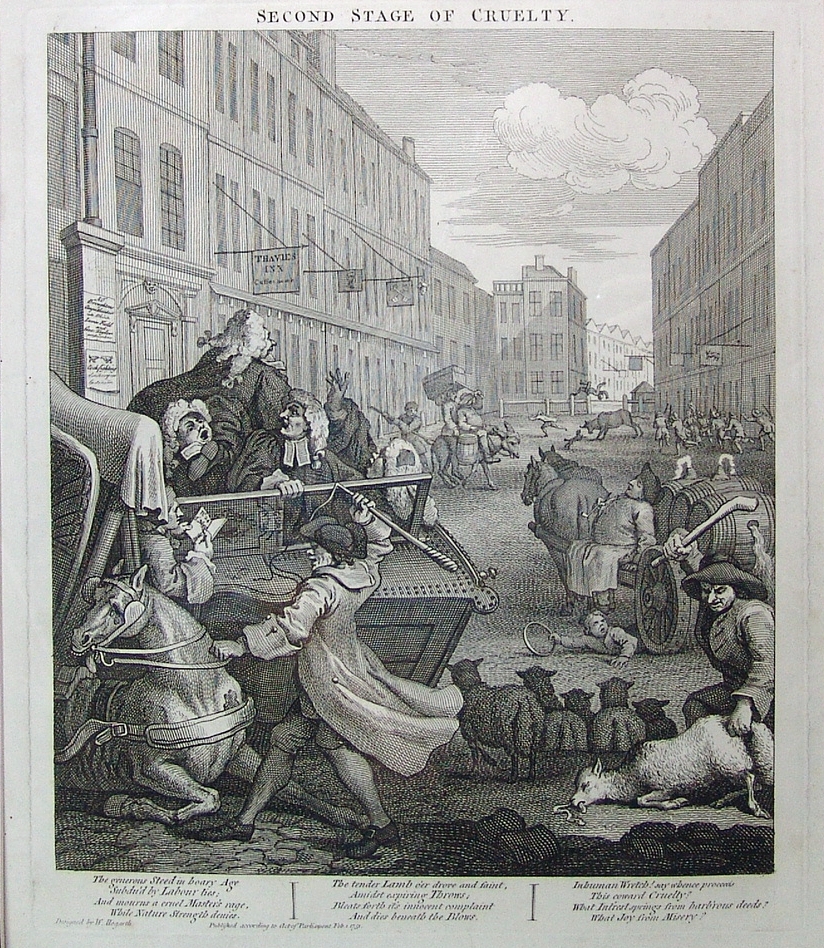
There’s a fantastic post over on Our Hen House, about the graphic work of Hogarth relating cruelty to animals to the human condition:

Specifically, Hogarth used visual imagery to underscore his belief that cruelty to animals would lead to other forms of social ills. In other words, Hogarth did not see the mistreatment of animals as a distinct issue but, rather, understood it to be part of a larger pattern of social problems. Hogarth’s series, entitled The Four Stages of Cruelty, was released in February 1751 and was comprised of four separate prints, each furthering the narrative of a fictional character named Tom Nero. Of this series, Hogarth noted that he created these images “in hopes of preventing in some degree that cruel treatment of poor Animals which makes the streets of London more disagreeable to the human mind…the very describing of which gives pain.”

You can imagine what Hogarth might think of a factory farm, the Taiji slaughter, or the ivory trade. But these days he’d probably tackle it on Vimeo.

His series of drawings on the four stages of animal cruelty are still worth looking at, though, because they make a powerful point that I think it is critical to understand: cruelty to animals (and cruelty to the environment, for that matter), is not an isolated problem. Instead, it is just one consequence of a chronic human failure, which is a lack of wisdom or enlightenment. So addressing these problems is not simply a matter of trying to end animal cruelty, but trying in the first place to cultivate a completely different understanding about the human role on earth, and human relationships with other species–one that moves away from profit and exploitation, and toward compassion and stewardship. Do that, and lots pf problems are open to solution.

Let’s take a look (click images for full resolution, and Wikipedia has more detail on the scenes):

From Our Hen HouseIn the first image (appropriately titled “The First Stage of Cruelty”), we are introduced to Tom Nero as a young boy. He is on a London street with several other children, most of whom are engaged in some form of cruelty: a pair of cats are suspended from a lamppost, a stray dog has an object tied to his tail, a bird is being blinded by a hot object inserted in her eye. Tom Nero, Hogarth’s protagonist, is in the center of the composition torturing a dog by sticking an arrow in the animal’s anus while another friend pulls harshly on a rope tied around the dog’s neck. While this scene of unchecked cruelty is bad enough, the artist hints at worse to come through the inclusion of a compositional device foreshadowing Tom Nero’s mounting violence: a young man sketches Tom Nero’s eventual demise on the brick wall that the children cluster around.

Our Hen House:

In “The Second Stage of Cruelty,” Tom is no longer a child, and in this print he is shown beating a horse who has collapsed on the street from exhaustion and Continue reading “William Hogarth On The Four Stages Of Animal Cruelty”