In an interview on Friday, Mr. Atchison gave some hints as to what those plans might be. Currently, SeaWorld Entertainment operates 11 theme parks in the United States, including SeaWorld and Busch Gardens, without a presence overseas.
“We could take our Shamu show in Orlando and probably show it in Malaysia or Abu Dhabi or Dubai,” Mr. Atchison said. “There’s a lot of interest in our brands from overseas.”
He cautioned that there is no “imminent announcement” along these lines.
Though building new theme parks requires capital, Mr. Atchison suggested that such projects could be undertaken in partnership with big investors, such as a sovereign wealth fund, which might add hotels or other structures to the development.
“If you look at these development opportunities, they’re often in connection with other real estate plays,” he explained. “A lot of the development opportunities we have are actually capital-light.”
New parks need whales. And that means breeding, and continuing to roll that Kshamenk AI program forward.
More than three years after its $2.3 billion sale by Anheuser-Busch InBev (BUD) to private-equity giant Blackstone (BX), SeaWorld (SEAS) is trading on the NYSE after raising a reported $702 million in one of the largest IPOs of the year. In its first minutes of trade, the stock is up 15% from its offer price of $27, which was at the top of a range starting at $24.
SeaWorld sold 10 million shares and Blackstone an additional 16 million, more than the 10 million originally slated. The underwriters, including Goldman Sachs and JP Morgan, have a 30-day option to sell an additional 3.9 million shares at the offer price. The deal values SeaWorld at just above $2.5 billion. This debut is part of a busy week for IPOs, which included New York-based grocery chain Fairway (FWM) on Wednesday.
Yahoo mentions the risks (another trainer tragedy, public opposition to orca captivity, and potential OSHA restrictions) that we have covered before, and adds:
When contacted regarding the IPO, a representative for People for the Ethical Treatment of Animals, or PETA, provided its official statement on SeaWorld, which includes its plan to purchase stock Friday in order to “educate other investors about the suffering endured by … animals who are confined to tiny barren tanks for human amusement … and push for their release.”
Other factors investors should keep in mind when deciding whether to dive into SeaWorld stock or stay onshore: The company’s high debt levels and multiples. SeaWorld, when it filed to go public, had $1.8 billion in long-term debt, some of which was incurred by a special dividend of $500 million paid last year to Blackstone (following a $100 million dividend in 2011). SeaWorld states in the filing that its debt could hinder its ability to raise additional capital. Also, its high price tag gives the company a hefty trailing PE of more than 27, exceeding Cedar Fair’s 22 and Six Flags’ 10.99 (per Yahoo! Finance data).
Having PETA attend shareholder meetings is definitely one consequence of going public that SeaWorld will not enjoy.
SeaWorld: Our Investors Should Know That It’s Bad For Business When Our Killer Whales Kill People
And then BI cites this important, but unusual, section of SeaWorld’s IPO filing:
Below is the aforementioned section of the prospectus (emphasis added):
Featuring animals at our theme parks involves risks.
Our theme parks feature numerous displays and interactions that include animals. All animal enterprises involve some degree of risk. All animal interaction by our employees and our guests in attractions in our theme parks, where offered, involves risk. While we maintain strict safety procedures for the protection of our employees and guests, injuries or death, while rare, have occurred in the past. For example, in February 2010, a trainer was killed while engaged in an interaction with a killer whale. Following this incident, we were subject to an inspection by the U.S. Department of Labor’s Occupational Safety and Health Administration (OSHA), which resulted in three citations concerning alleged violations of the Occupational Safety and Health Act and certain regulations thereunder. We have appealed certain of these citations and the appeal process is ongoing. In connection with this incident, we reviewed and revised our safety protocols and made certain safety-related facility enhancements. This incident has also been the subject of significant media attention, including television and newspaper coverage, a documentary and a book, as well as discussions in social media. This incident and similar events that may occur in the future may harm our reputation, reduce attendance and negatively impact our business, financial condition and results of operations.
In addition, seven killer whales are presently on loan to a third party. Although the occurrence of any accident or injury involving these killer whales would be outside of our control, any such occurrence could negatively affect our business and reputation.
That about covers it, no? So the investors can’t say they weren’t warned.
I’ve said before that I don’t have a problem with trainers taking risks, including waterwork, as long as SeaWorld is honest and transparent with trainers regarding the risks and the aggression history of any given killer whale.
But how much risk attaches to “drywork” is a big question as SeaWorld continues to try to reach a settlement with OSHA on what sort of close contact between killer whales and trainers should be allowed in shows.
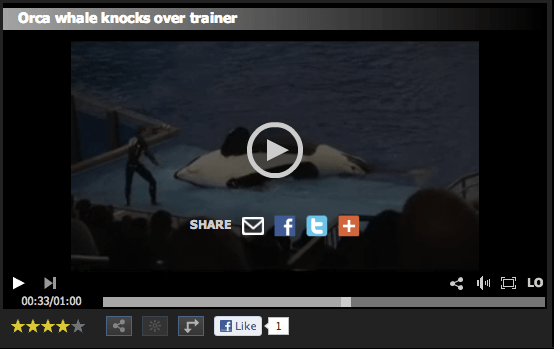
I’ll have a few things to say next week about what orcas are capable of even if a trainer is out of the pool. But in the meantime, here’s a (somewhat in jest) reminder that while waterwork definitely puts trainers at greater wisk, the stuff that happens out of the water doesn’t always go as intended.
Although unreported in wild orca populations, mosquito-transmitted diseases have killed at least two captive orcas
(Orcinus orca) in U.S. theme parks. St. Louis Encephalitis Virus (SLEV) was implicated in the 1990 death of the male orca Kanduke,
held at SeaWorld of Florida. In the second case, West Nile Virus (WNV) killed male orca Taku at SeaWorld of Texas in 2007.
Captive environments increase vulnerability to mosquitotransmitted diseases in a variety of ways. Unlike their wild counterparts who are rarely stationary, captive orcas typically spend hours each day (mostly at night) floating motionless (logging) during which time biting mosquitoes access their exposed dorsal surfaces. Mosquitoes are attracted to exhaled carbon dioxide, heat and dark surfaces, all of which are present during logging behavior. Further, captive orcas are often housed in geographic locations receiving high ultraviolet radiation, which acts as an immunosuppressant. Unfortunately, many of these facilities offer the animals little shade protection. Additionally, many captive orcas have broken, ground and bored teeth through which bacteria may enter the bloodstream, thus further compromising their ability to fight various pathogens. Given the often compromised health of captive orcas, and given that mosquito-transmitted viral outbreaks are likely to occur in the future, mosquito-transmitted diseases such as SLEV and WNV remain persistent health risks for captive orcas held in the U.S.
[JMATE. 2012;5(2):9-16].
At the time Kanduke died there was uncertainty over the cause. But here is the necropsy which indicated that something unusual had happened, and helped Ventre and Jett find the answer..
This is an important insight into how captivity affects the lives of killer whales, and what is particularly interesting is how a confluence of captivity-related issues–logging, temperatures, lack of shade, teeth-drilling, etc–combine to create a vector of vulnerability that wild orcas likely do not experience. Which is one more reason that mortality in captivity is greater than mortality in the wild. Very well-done, informative, fact-based, work.
Alternate titles: “Taku’s Follies,” or “The Challenges of Killer Whale Calves.”
The more you dig, or get taken, into the art of killer whale training, the more you understand how variable and distinctive the killer whale personalities are, how context (what is going on in the back pool, what happened the night before, who has a calf, etc) is everything, and how killer whale trainers must constantly make subjective judgements about how to deal with the almost infinite challenges or wrinkles which can pop up at any time.
That’s why experience is so crucial. It’s also why the “risk” attached to killer whale training does not just involve the major incidents (which can mean severe injury or death) that are apparent to everyone, but runs through all the small decisions, or minor incidents as well. Because a small decision, or minor incident, if not handled with the right judgement can easily become a major incident, with major consequences.
Here’s a quiet case in point, from the film archives of former SeaWorld Florida trainer Jeff Ventre. It was filmed in November 1994 by the stadium producers, who have have watched enough whale behaviors to know something is not right, and shows a young Taku (just over a year old) coming up under Ventre and bumping him.
Here’s Ventre’s explanation of what you are seeing, and how he handled the situation:
From a safety/behavioral standpoint I ignored Taku and elected to exit the scene by mounting Katina. I made a decision to get up on her and steer her away (you can see the touch steering stimulus and she makes a quick right turn). I felt that trying to exit the water right in front of Taku might become a game and he could pull me in.
Love the show director’s comment: “That’s gotta make you nervous, man.”
I often hear (or see) a lot of commentary from young aspiring orca trainers, whose passionate dream it is to work at SeaWorld. So it is very refreshing to be hearing from aspiring orca trainers who changed their minds.
Take, for example, Kelsey Prosser, who just posted this comment:
As a 3-yr old little girl, my parents took me to SeaWorld in SD, California. I fell in love with the orcas, and from then on, it was my lifelong dream to become a “marine biologist” and work with orcas. SeaWorld was my goal, and nothing was going to stop me from becoming an orca trainer. Until I went on a whale watch in the San Juan Islands and saw orcas in the wild for the first time: powerful, social, vocal, and free. They had the ocean to roam, and no concrete tank to stop them. I even had the great privilege of watching Residents hunt for salmon and Transients hunting harbor seals. I spoke with local orca biologists who work with these animals in the wild and read as much as I possibly could on orcas in captivity, and after 21 years as an aspiring orca trainer, I have changed my mind. These animals belong in the ocean. They are intelligent, social, incredible marine mammals and they deserve a life of freedom. In the wild, orcas can reach 90+ years! J-2, an orca known as “Granny,” is 102 years old! In captivity, a 30-yr old orca is considered lucky. To all of you want-to-be-trainers, I simply ask that you think about the animals you are so in love with. What’s best for them? To be locked in an acoustically-straining tank with no natural surroundings, no social structure, and no room to roam and hunt? Or to live free with their family pods for their entire lives, hunting and playing at will? If this is your passion, won’t you want what is best for them? Is it selfish to want to work with them in a tank, even though deep down you know it’s not the best living situation for an intelligent marine mammal? I, too, was once that young girl with a dream. Now, I finally see the reality of the situation and know that my dream is to ensure that these animals are protected and studied in our world’s oceans, so that they may live full, happy lives. Now a Master’s student in Biology, I am still aiming toward a career with orcas, but my dream has changed: instead of working as an orca trainer, I am striving to study orca in their natural environment as well as teach others about their beauty and their behavior in the wild and the importance of conservation.
Kelsey zeroes in on the number one contradiction of orca training: if it is about loving the animals how do trainers rationalize the aggression, rakes and injuries, and captivity-related stress that they see? This is the contradiction that every trainer I know who eventually turned against captivity struggled with. And to the oft-asked question of why they worked so long at SeaWorld if the were uncomfortable with what they saw and experienced, they almost always explain that they had a hard time stepping out of SeaWorld because they worried that no one would care for the whales as well as they did (though some just say it took a while for the reality to supplant the corporate and management BS).
Kelsey’s comment is especially on point, because it tracks the logic and questions that arise when an aspiring killer whale trainer focuses not on his or her own interests and dreams but on the interests of the whales. I have always felt that a dream to train killer whales is not about love for the whales. It is about love for the thrilling experience of working with whales. But that thrill is the trainer’s thrill. The whales did not choose to be at a marine park, or dream of working with humans (okay, I don’t know that for sure, but I think it’s a pretty reasonable assumption). So to me a dream of training killer whales is about the dreamer’s fantasy, and what the dreamer wants. It is not at all about what the whales might want or prefer, if they could have been given a choice to work at SeaWorld or live a normal killer whale life in the wild.
By the way, the photo above is from Kelsey, who has found a different and beautiful way to engage her love of working with whales.
Here’s another comment in a similar vein, from Jennifer Jackson:
I once wanted to be a trainer and was probably one of the happiest people when San Antonio got SW… I wanted to go everyday and eventually move there for work. Later I met a friend who trained dolphins in Hawaii and she showed me video of the dolphin she trained and told me the story about his death, its so sad to me so I began to do a little more research on captivity. I had heard tons of arguments from both and I just couldn’t make up my mind and eventually I kept researching but not the parks but the habitat of these sea animals and that was it I was convinced they did NOT belong in captivity!!
Now I just try and educate my friends on what I have learned and I am very proud to say I have convinced several people NOT to go to SW and it is one of the best feelings in the whole world
I just want to say Thank You to ALL who participate in helping educate others as to why these amazing creatures belong in the sea and only in the sea!! Love you all from the bottom of my heart ❤
I’d love to hear from more people who had a dream to work at SeaWorld and then changed their minds, including their reasons.
I’d also love to hear more from anyone who still aspires to be a trainer at SeaWorld, and would like to address Kelsey’s questions about whether love of killer whales can be consistent with wanting to work with them in captivity. I totally get why being a SeaWorld trainer would be thrilling and appealing from the human point of view. But I have a harder time understanding how aspiring trainers justify their dreams from the whales’ point of view. It’s an excellent conversation to have.
Here’s an interesting comment posted by “Future Orca Trainer” in the Comments section of this post about the Q&A that followed the Blackfish screening at the Sarasota Film festival last Friday:
An email from Jenna Costa Deedy, author of The Winter Dolphin Chronicles:
I think that Blackfish is just a movie that is doing more injustice to Dawn’s memory and the whole 2010 SeaWorld tragedy by making money off the whole situation. Yet, I find it funny that of all the five ex-trainers featured in that movie, only one of them did work with Tillikum and I don’t why the other four get to have a say on his case all because they are “activists” who once worked at SeaWorld for a period of time, but only John Hargrove worked longer than eight years at two SeaWorld Parks in San Diego and Texas, but NOT Orlando. It would not surprise me if SeaWorld and Dawn’s family intends to sue the filmmakers of the movie for defamation of character and emotional distress because a lot of people have come to the point where they are just getting tired of seeing Dawn’s death being exploited for money when they should honor her memory based on how she lived her life.
Though I strongly suspect that Jenna Costa Deedy (who has a blog and apparently is an aquarium intern) has not seen the film, I am highlighting the comment because I want to address some of the points, which seem to be making the rounds on internet forums. I hope people who support SeaWorld and killer whale captivity will have the courage and open-mindedness to see Blackfish. And that we can continue to debate the issues raised. So here’s a start:
1) Of the five ex-SeaWorld trainers featured in Blackfish, one was a Tilikum team leader (who got in trouble with management when he refused orders to start masturbating Tilikum every day to stockpile his semen). The others, however, all spent time around Tilikum. The only ex-trainer who was not around Tilikum much was John Hargrove, though he did spend some time at the Florida park (even though he never worked there). And Hargrove does not speak about Tilikum.
Update: Carol Ray, one of the former-SeaWorld trainers in Blackfish, e-mailed to clarify that she had left SeaWorld Orlando by the time Tilikum arrived. So the three trainers in Blackfish who had direct experience with Tilikum, and speak about him in the film, are John Jett, Jeffrey Ventre, and Samantha Berg.
2) None of the trainers were “activists” while they worked at SeaWorld. They were all thrilled to be SeaWorld trainers. It was the experience of working at SeaWorld that changed their views on issues related to keeping killer whales in captivity.
3) More broadly, while the story of Tilikum and Dawn Brancheau is the backbone of the movie, Blackfish delves into issues that ALL SeaWorld’s killer whales face. John Hargrove, for example, discusses the separation of young calves from mothers, and an incident in which Splash and Orkid pull a trainer into the pool and nearly drown her. The former trainers who were interviewed all speak about their personal direct experience, and are not asked to speculate about topics about which they have no first-hand experience or knowledge.
4) I don’t know whether any of Dawn’s family has seen the film, and what they think of it if they have. But Blackfish does everything it can to be respectful of Dawn, and her love of working with killer whales. Her death is not shown (though the Dine With Shamu Show that led up to her death is reviewed and dissected to show that Tilikum’s work with Dawn just before he killed her was not as flawless as SeaWorld has asserted). And, most import, Blackfish honors and defends Dawn by strongly rebutting SeaWorld’s initial effort to suggest that she made a mistake, when in fact she was following SeaWorld protocols with the same professionalism and discipline that made her such a great trainer. In fact, that is one of the major takeaways of Blackfish. Dawn is not defamed in any way in the film. She is portrayed as a passionate and talented killer whale trainer who was let down by the system in which she worked, and suffered the ultimate tragedy.
5) None of the trainers in Blackfish were paid anything to participate. They agreed to be interviewed because they want people to understand the reality of killer whale captivity as they experienced it. Anyone who knows anything about the economics of documentary film-making knows that almost all documentaries lose money. People nevertheless make them because they are passionate about a subject, and passionate about telling stories. That was what motivated the making of Blackfish. If it ends up making any money, it is the investors who will be rewarded for the faith they had in Gabriela Cowperthwaite, the director, and in the importance of explaining what happened with Tilikum and Dawn. And if that is the case, hopefully they will turn around and invest in another great documentary production!
Well, we knew that already. What’s new is that Judge Welsch–the Administrative Law Judge who upheld OSHA’s prescription that SeaWorld’s trainers maintain a safe distance from the killer whales unless there was a safety barrier between them–and local Florida media just noticed:
A federal judge believes SeaWorld had a duty to begin implementing new safety improvements required by workplace safety regulators last July, even while the theme park was fighting the Occupational Safety and Health Administration in court.
Meanwhile, Local 6 has learned SeaWorld trainers continue to have extremely close physical contact with the killer whales, despite new OSHA requirements that trainers must remain behind a barrier when interacting with the animals during performances…[snip]
…Yet since July, Sea World trainers have continued to have close physical contact with killer whales. During Tuesday’s 2:30 p.m. performance of “One Ocean” at Shamu Stadium, Local 6 cameras recorded SeaWorld trainers touching, petting and dancing alongside killer whales without any barriers separating them.
In one segment of the show, a trainer standing on a submerged ledge leans his entire body on the killer whale and rubs its back with both arms.
Whew, it’s a good thing Local 6 finally “learned” what everyone who has been to a SeaWorld show has known since Welsch’s order was issued. And you have to wonder about a regulatory system that SeaWorld has been so good at either manipulating or ignoring.
…here’s the post-screening Q&A with Director Gabriela Cowperthwaite and former SeaWorld trainers, at the Sarasota Film Festival last Friday. It’s from a handheld, but it gives you a good sense of how Blackfish impacts audiences, and how Gabriela went about making the film.


 Yahoo mentions the risks (another trainer tragedy, public opposition to orca captivity, and potential OSHA restrictions) that we have covered before, and adds:


 The Earthist Chronicles