Elizabeth Kolbert adds more perspective to the gap between policy and reality, with a look at the recent US-China emission agreement:
President Obama deserves a great deal of credit for the agreement, as does Secretary of State John Kerry, who conducted the behind-the-scenes negotiations. But, as many commentators have also noted, the deal doesn’t get the U.S. or China remotely near where they need to be if the world is to avoid disaster—which both countries, along with pretty much every other state in the world, have defined as warming of more than two degrees Celsius. Chris Hope, a policy researcher at Cambridge University, ran the terms of the agreement through what’s known as an “integrated assessment model.” He also included in his analysis a recent commitment by the European Union to cut its emissions by forty per cent before 2030. He found that even if all of the pledges made so far are fulfilled, there will be “less than a 1% chance of keeping the rise in global mean temperatures” below two degrees Celsius: “Most likely the rise will be about 3.8° C.”
On top of this rather nasty problem, there’s the issue of actually fulfilling the pledges. The Administration claims that reducing emissions by twenty-eight per cent over the next eleven years is “achievable under existing law.” This is a little like someone who’s trying to lose weight saying that his goal is “achievable” on a diet of doughnuts: it may be true in theory, but it’s extremely unlikely.
Well, Americans do love fad diets, though it is true that not many of them work, and some of them are dangerous. The real solution is to put a stiff tax on donuts, I mean carbon. The politics of doing that are of beyond comprehension at the moment. Still, understanding that pricing carbon is the single most important and indispensable policy step required to fight climate change would be a good first step.
In a review of Naomi Klein’s new book. “This Changes Everything,” Elizabeth Kolbert doubts Americans are ready for the reality of addressing climate change (h/t Daily Dish):
To draw on Klein paraphrasing Al Gore, here’s my inconvenient truth: when you tell people what it would actually take to radically reduce carbon emissions, they turn away. They don’t want to give up air travel or air conditioning or HDTV or trips to the mall or the family car or the myriad other things that go along with consuming 5,000 or 8,000 or 12,000 watts. All the major environmental groups know this, which is why they maintain, contrary to the requirements of a 2,000-watt society, that climate change can be tackled with minimal disruption to “the American way of life.” And Klein, you have to assume, knows it too. The irony of her book is that she ends up exactly where the “warmists” do, telling a fable she hopes will do some good.
And Kolbert doesn’t even include “not eating meat” to her list. I’m surprised Kolbert didn’t title her review “This Changes Nothing.”
Kolbert’s probably right, but this gets back to the problem that the media (and as a result political leaders) are completely failing to explain the scale and danger of the problem. When I want to imagine how we should be thinking about, and talking about, the threat of climate change I always go back to the thought experiment of imagining how the media, politicians, and the public would respond if ISIL had a master plan to warm the planet, melt the ice caps, flood our cities, and cause a mass extinction. Now that really would change everything.
End note: In her review Kolbert mentions an interesting study that examines how much energy each person on the planet should use, and how much they actually use. This also dramatizes how revolutionary real solutions to global warming would be:
What would it take to radically reduce global carbon emissions and to do so in a way that would alleviate inequality and poverty? Back in 1998, which is to say more than a decade before Klein became interested in climate change, a group of Swiss scientists decided to tackle precisely this question. The plan they came up with became known as the 2,000-Watt Society.
The idea behind the plan is that everyone on the planet is entitled to generate (more or less) the same emissions, meaning everyone should use (more or less) the same amount of energy. Most of us don’t think about our energy consumption—to the extent we think about it at all—in terms of watts or watt-hours. All you really need to know to understand the plan is that, if you’re American, you currently live in a 12,000-watt society; if you’re Dutch, you live in an 8,000-watt society; if you’re Swiss, you live in a 5,000-watt society; and if you’re Bangladeshi you live in a 300-watt society. Thus, for Americans, living on 2,000 watts would mean cutting consumption by more than four fifths; for Bangladeshis it would mean increasing it almost by a factor of seven.
To investigate what a 2,000-watt lifestyle might look like, the authors of the plan came up with a set of six fictional Swiss families. Even those who lived in super energy-efficient houses, had sold their cars, and flew very rarely turned out to be consuming more than 2,000 watts per person. Only “Alice,” a resident of a retirement home who had no TV or personal computer and occasionally took the train to visit her children, met the target.
The study doesn’t really take into account the fact that new energy technologies could and should allow us to consume more energy with fewer emissions. But it is still a wake-up slap to realize that for the average American the combination of reduced consumption and more efficient energy technologies needs to achieve an 83% reduction in per capita carbon emission. See what I mean about a revolution?
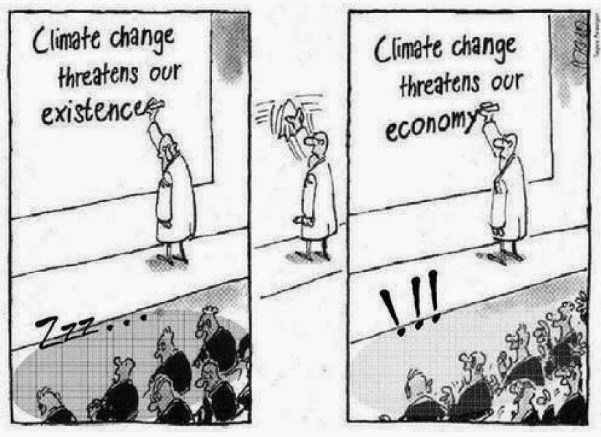
I am always struck by the gap that seems to exist between what the public and policymakers THINK we need to do to blunt climate change, and what we REALLY need to do. Part of the problem has been that the media has completely failed to treat climate change with the urgency and scale it deserves, a fail which future historians will arguably rate the biggest media fail ever. Another part may be that being honest about the threat of climate change would mean being honest about how completely humanity needs to change its lifestyle, it economics and its politics. And that scares people because change is hard, and change on the scale required implies certain sacrifices.
So I am always interested to see reminders that climate change does not demand incremental policy adjustments but revolutionary adjustments. Because it is only after we come to grips with this fact that we can understand, and hopefully move beyond, the complete inadequacy and complacency of current efforts to address the problem.
The latest screaming reminder that we need to think in revolutionary terms is a failed Google effort to develop renewable energy sources to replace carbon-based energy sources. And, after crunching the numbers, Google abandoned the initiative:
We decided to combine our energy innovation study’s best-case scenario results with Hansen’s climate model to see whether a 55 percent emission cut by 2050 would bring the world back below that 350-ppm threshold. Our calculations revealed otherwise. Even if every renewable energy technology advanced as quickly as imagined and they were all applied globally, atmospheric CO2 levels wouldn’t just remain above 350 ppm; they would continue to rise exponentially due to continued fossil fuel use. So our best-case scenario, which was based on our most optimistic forecasts for renewable energy, would still result in severe climate change, with all its dire consequences: shifting climatic zones, freshwater shortages, eroding coasts, and ocean acidification, among others. Our reckoning showed that reversing the trend would require both radical technological advances in cheap zero-carbon energy, as well as a method of extracting CO2 from the atmosphere and sequestering the carbon.
In other words, Google decided that even the most dramatic developments in current renewable energy technologies, leading to a 55% reduction of emissions by 2050, just wouldn’t do the job.
Because CO2 lingers in the atmosphere for more than a century, reducing emissions means only that less gas is being added to the existing problem. Research by James Hansen shows that reducing global CO2 levels requires both a drastic cut in emissions and some way of pulling CO2 from the atmosphere and storing it.
It was necessary, but not sufficient:
While this energy revolution is taking place, another field needs to progress as well. As Hansen has shown, if all power plants and industrial facilities switch over to zero-carbon energy sources right now, we’ll still be left with a ruinous amount of CO2 in the atmosphere. It would take centuries for atmospheric levels to return to normal, which means centuries of warming and instability. To bring levels down below the safety threshold, Hansen’s models show that we must not only cease emitting CO2 as soon as possible but also actively remove the gas from the air and store the carbon in a stable form. Hansen suggests reforestation as a carbon sink. We’re all for more trees, and we also exhort scientists and engineers to seek disruptive technologies in carbon storage.
Incremental improvements to existing technologies aren’t enough; we need something truly disruptive to reverse climate change. What, then, is the energy technology that can meet the challenging cost targets? How will we remove CO2 from the air? We don’t have the answers.
How do you achieve that energy revolution? Google’s engineers suggest following Google’s approach to investment and technology disruption:
Consider Google’s approach to innovation, which is summed up in the 70-20-10 rule espoused by executive chairman Eric Schmidt. The approach suggests that 70 percent of employee time be spent working on core business tasks, 20 percent on side projects related to core business, and the final 10 percent on strange new ideas that have the potential to be truly disruptive.
Wouldn’t it be great if governments and energy companies adopted a similar approach in their technology R&D investments? The result could be energy innovation at Google speed. Adopting the 70-20-10 rubric could lead to a portfolio of projects. The bulk of R&D resources could go to existing energy technologies that industry knows how to build and profitably deploy. These technologies probably won’t save us, but they can reduce the scale of the problem that needs fixing. The next 20 percent could be dedicated to cutting-edge technologies that are on the path to economic viability. Most crucially, the final 10 percent could be dedicated to ideas that may seem crazy but might have huge impact.
Today In the United States, the vast bulk of funding for energy R&D goes to established technologies. Essentially no money is allocated to related and potentially disruptive technologies, and about 10 percent is spent on projects that don’t seek to produce economically competitive energy.
I would add that we should also vastly increase the investment being applied to energy tech research (and in fact I would be prepared to make an argument that the United States would be more secure if we spent a very large chunk of our entire military budget on trying to solve the energy/climate problem instead of military forces and hardware).
As to how to start pulling carbon out of the atmosphere, I have an idea about that as well: get the world off meat and start reforesting the vast landscapes that have been de-forested for livestock.
Yes, all this sounds crazy and improbable. But as Google figured out, crazy and improbable is exactly what is needed if we are actually going to try and solve the problem.
The philosopher Thomas Nagel, who wrote the seminal essay “What Is It Like to Be a Bat?” used a term for the tendency to deny the existence of phenomena that cannot be proved empirically. “Scientism,” he wrote in 1986, “puts one type of human understanding in charge of the universe and what can be said about it. At its most myopic, it assumes that everything there is must be understandable by the employment of scientific theories like those we have developed to date — physics and evolutionary biology are the current paradigms — as if the present age were not just another in the series.”
It is presented in the article as an argument against the tendency among animal scientists and animal keepers to go to extremes to avoid anthropomorphism. But scientism–the idea that if science hasn’t proved it yet it must not be true; ignoring the possibility that science may YET prove it–is a phenomenon that I see across many spheres, from animal intelligence to the connections between diet and health (for example in the gluten debate).
We should be open to anecdotal evidence, and what our instincts and experience tell us, about the world around us (pet owners, for a long time, knew more about the emotional lives of animals than researchers did). We may not KNOW the truth, or have proof, of why something is the way it is. But sometimes we might have a pretty good idea, good enough to act on, even if the science isn’t definitive one way or the other yet.
From July to October the waters can rise at least 10 feet. The trunks of trees more than 30 feet away from the dry season riverbed show watermarks waist high. When the fields flood, the village’s farmers have no work.
“There is water all around,” said Hafiza Khatun, 25, a mother of two whose family income used to vanish for six months of the year when her farm laborer husband had nothing to do. “There was no happiness.”
But three years ago, Ms. Khatun was trained by Shidhulai Swanirvar Sangstha, a Bangladeshi nonprofit organization, to tend an unusual source of food and income: a floating farm with a duck coop, fish enclosures and vegetable garden moored by rope to the riverbank.
SeaWorld already doubled down on its killer whale captivity model by pledging to invest tens of millions of dollars in bigger tanks. And now it is doubling down on the idea that better PR can defuse growing doubts about using killer whales for entertainment:
SeaWorld is working aggressively on improving its image as it continues to fend off criticism over its whales in captivity.
The company is disputing animal-rights activists online, soliciting fan support and trying to call more attention to its work with animals — such as rescuing underweight orphan manatees.
SeaWorld is making these efforts amid declining attendance and lingering controversy intensified by last year’s anti-captivity “Blackfish” documentary. The company said in an earnings report last week that negative publicity contributed to an overall third-quarter attendance decline.
“I think we’ve just realized we have to do a better job of telling our story, sharing the good work we do,” company spokeswoman Aimee Jeansonne Becka said, reiterating the thoughts expressed by Chief Executive Officer Jim Atchison earlier this year.
“You’re going to see a PR offensive coming here,” Wells Fargo analyst Tim Conder told CNBC last week. “You’re going to see SeaWorld being more open about who they are, educating people [about] who they are, with other organizations.”
Best of luck. Sometimes the apparent problem is an actual problem, and not just a failure to “tell your story.” SeaWorld, in fact, has done a brilliant job over the past 50 years of telling exactly the story it wants to tell. That’s why many viewers found the story told in Blackfish–which was VERY different–so shocking.
Changing the story to emphasize conservation (especially if it is backed up by real investments in conservation, which would be a nice) might help at the margins. But promoting conservation still does not address the fundamental reality that increasing numbers of people find killer whale circus shows anachronistic and cruel. The only way to address that problem is to change the business model and start transitioning away from the product that fewer and fewer people want to buy.
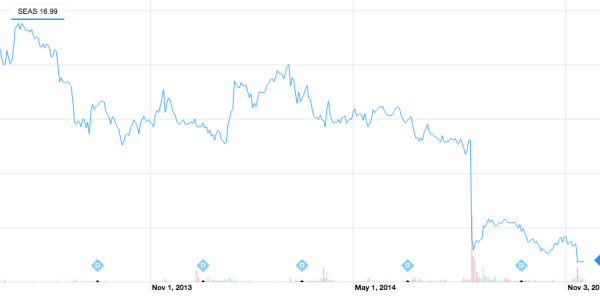
Despite the brutal beating SeaWorld is taking in the markets, and the steady decline in paying customers, it doesn’t look like SeaWorld is quite there yet.
To follow the stunning drone footage of killer whales off Norway, let’s turn to the National Geographic photo blog Proof, which in September published some incredible photos of Norwegian killer whales feeding on herring. Not only are the photos, by Paul Nicklen, beautiful. But they also show yet another highly intelligent, cooperative killer whale hunting behavior:
The orcas are working together, performing a highly coordinated exercise in the herding of fish–huge schools of herring, larger than any other I have ever seen, compacted together into a tight ball. The immense ball of fish: a mere 5 feet under the ocean’s surface, buckles and sways, trying to escape, but the orcas swim around the ball making it tighter and tighter. In this sophisticated team effort every orca plays a role and every member of the pod gets their turn to feed. Young calves flank their mother’s side and mimic every move as they hone their herring-herding skills. We can hear the constant high-pitch sound of their echolocation calls all around us.
So effective, in fact, that some humpbacks show up to take advantage of the feast that is created.
Read all about it. And here’s a sample of the photos:
Shares of SeaWorld Entertainment Inc. (SEAS) are falling by 6.72% to $17.35 in pre-market trading on Wednesday, as lower attendance at the company’s theme parks hurts earnings for the second quarter in a row.
SeaWorld’s net income for the 2014 third quarter declined to $87.2 million, or $1 per diluted share, compared to $120.7 million, or $1.34 per diluted share for the same period in 2013.
The marine mammal entertainment company reported adjusted net income for the 2014 third quarter of $88.6 million, or $1.01 per diluted share, which fell below the expectations of analysts polled by Bloomberg of $1.13 per share.
Revenue for the most recent quarter fell to $495.8 million versus $538.4 million for the 2013 third quarter. Analysts expected $496.4 million in revenue for the quarter.
SeaWorld reported attendance of 8.4 million guests versus 8.9 million from the same quarter last year.
Trying to explain the continued drop in attendance, SeaWorld continues to avoid the elephant, I mean blackfish, in the room: The company believes the decline in attendance was due to negative media attention resulting from a proposed bill in California that would ban the use of orcas in shows, and a “challenging competitive environment, particularly in Florida.”
Yes, the Blackfish bill is an issue, but the media attention on SeaWorld is focused much less on AB2140 than it is on the very essence of SeaWorld’s business: its reliance on keeping killer whales captive for entertainment.
A few more earnings reports like this one and SeaWorld suits will finally have to confront the fact that their business model is being rejected by the American public. That means SeaWorld needs a new business model that doesn’t rely on killer whale captivity (or at least moves killer whale captivity offshore to China, Russia and the Middle East).
It seems likely that SeaWorld is pursuing the latter strategy of developing its franchise in nations that don’t (yet) care as much about the ethics of killer whale captivity. But powerful ideas (like the idea that it’s not right to confine killer whales for profit) have a way of working their way around the globe. And if SeaWorld simply tries to move its failing business model to new countries, instead of reinventing its business model, it could find itself repeating the history it is experiencing here in the United States, and continuing to struggle.
What SeaWorld really needs is not new spin, but new leadership that is not so invested in the idea of killer whale captivity, and can move beyond that business model and SeaWorld’s history to think clearly and creatively about what will attract and entertain the crowds of the future.
First, the news. The US and China, following secret negotiations, have jointly pledged to accelerate carbon emission cuts:
A climate deal between China and the United States, the world’s No. 1 and No. 2 carbon polluters, is viewed as essential to concluding a new global accord. Unless Beijing and Washington can resolve their differences, climate experts say, few other countries will agree to mandatory cuts in emissions, and any meaningful worldwide pact will be likely to founder.
“The United States and China have often been seen as antagonists,” said a senior official, speaking in advance of Mr. Obama’s remarks. “We hope that this announcement can usher in a new day in which China and the U.S. can act much more as partners.”
As part of the agreement, Mr. Obama announced that the United States would emit 26 percent to 28 percent less carbon in 2025 than it did in 2005. That is double the pace of reduction it targeted for the period from 2005 to 2020.
China’s pledge to reach peak carbon emissions by 2030, if not sooner, is even more remarkable. To reach that goal, Mr. Xi pledged that so-called clean energy sources, like solar power and windmills, would account for 20 percent of China’s total energy production by 2030.
New, and more ambitious targets, are of course necessary and welcome (more detail here). But China, with its authoritarian political structure, has a far greater probability of actually meeting these targets than the polarized, climate-denying, sacrifice-averse, American political system. At least for the near term, President Obama will have to wrestle with a Republican majority in Congress that is both nihilistic and dishonest in its attempts to suck political gain from its insistence that climate change isn’t a problem.
Here’s just one recent example of what the White House (and the planet) is dealing with:
In September, John P. Holdren, the head of the White House Office of Science and Technology Policy, was testifying to a Congressional committee about climate change. Representative Steve Stockman, a Republican from Texas, recounted a visit he had made to NASA, where he asked what had ended the ice age:
“And the lead scientist at NASA said this — he said that what ended the ice age was global wobbling. That’s what I was told. This is a lead scientist down in Maryland; you’re welcome to go down there and ask him the same thing.
“So, and my second question, which I thought it was an intuitive question that should be followed up — is the wobbling of the earth included in any of your modelings? And the answer was no…
“How can you take an element which you give the credit for the collapse of global freezing and into global warming but leave it out of your models?”
That “lead scientist at NASA” was me. In July, Mr. Stockman spent a couple of hours at NASA’s Goddard Space Flight Center listening to presentations about earth science and climate change. The subject of ice ages came up. Mr. Stockman asked, “How can your models predict the climate when no one can tell me what causes the ice ages?”
I responded that, actually, the science community understood very well what takes the earth into and out of ice ages. A Serbian mathematician, Milutin Milankovitch, worked out the theory during the early years of the 20th century. He calculated by hand that variations in the earth’s tilt and the shape of its orbit around the sun start and end ice ages. I said that you could think of ice ages as resulting from wobbles in the earth’s tilt and orbit.
The time scales involved are on the order of tens of thousands to hundreds of thousands of years. I explained that this science has been well tested against the fossil record and is broadly accepted. I added that we don’t normally include these factors in 100-year climate projections because the effects are too tiny to be important on such a short time-scale.
And that, I thought, was that.
No, that is never that when it comes to honestly confronting the implications of reducing carbon emissions. And I have no doubt that Republicans will do just about everything they can to eviscerate both the President and his climate pledge. But at least the battle is slowly being joined. And climate needs to be central to the 2016 elections, and every election after that until real progress is made.







 The Earthist Chronicles