I never set out to make this short film. I hadn’t been to Sea World in probably 20 years but decided to give it a shot and take my niece. I tried to see the place through the eyes of young child but logic and my love for wildlife took over. I’ve spent most of my life committed to exploring wild places and observing wild animals. I understand why these places exist but also feel that it’s time we stepped back and reassessed our need to collect and to display conscious, intelligent animals.
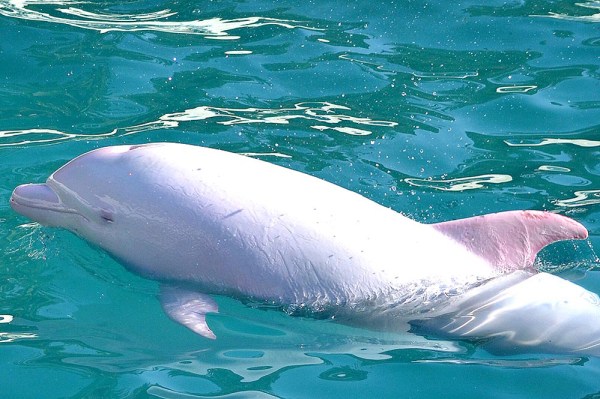
During my reporting last week on the fate and status of the albino calf (dubbed “Angel”) that was taken captive and shipped to the Taiji Whale Museum, I asked a local Japanese contact if she would relay a list of questions to the Whale Museum for me. Intrepid person that she is, she managed to reach Assistant Director Tetsuya Kirihata. Somewhat to my surprise he provided pretty detailed responses (which were translated by my extremely helpful contact).
For the record (and without comment), I am posting the Whale Museum’s responses here, as I haven’t seen any detailed updates on the calf, and its fate, from the Whale Museum itself.
Q: What is the status of the albino calf?
Kirihata: She’s kept in a spare pool next to the main dolphin show pool with another bottlenose dolphin. At first there were two other bottlenose dolphins in the same pool, but those were more active and would snatch the food she couldn’t catch. Therefore they were moved to another tank.
The reason why she cannot catch the food she is fed is not because she is sick, but probably due to the change of environment. When she manages to be fed, she continues to be fed. She eats the same amount as the other dolphins.
Q: How is she doing?
Kirihata: Compared to other bottlenose dolphins she doesn’t interact with other dolphins as much. It’ll be better if she becomes a little friendlier. During the day her eyes are closed or slightly open and at night they’re open.
She can see [note: observers have wondered about her sight, as most photos, like the one above, show her with her eyes closed] and has no hearing problems. She responds to the splashing sound of the fish hitting on the surface of the water.
Q: Does the Whale Museum plan to keep the calf or sell it to another facility?
Kirihata: We plan to keep her long term.
Q: Is there any possibility of giving her away or selling her?
Kirihata: Not for the moment, but it might happen if another aquarium or a research facility could provide a better or more beneficial environment for her.
Q: How are you able to care for such a young albino calf?
Kirihata: We do not necessarily give her extra care because she is albino. However, as she is still a young calf we do feed her more frequently than other adult dolphins.
We are still observing and examining if she shows any difference from other individual dolphins. The more we know about her the better conditions we can provide for her.
Q: Is there a possibility you will transfer her from the current pool to another pool within the Taiji Whale Museum?
Kirihata: She is only temporarily kept in the spare pool. Depending on the situations as well as her condition, we will consider transferring her to another pool within the Taiji Whale Museum.
Since albino dolphins are rarely seen in the nature and often do not survive long, we intend to do our best to take care of her and learn as much as possible from this unique albino dolphin.
Also, thanks to the determined efforts of Karla Sanjur, who was on the ground in Taiji for Ric O’Barry’s Dolphin Project, we have video footage of the young albino:
It is important to note that while the world’s attention has been preoccupied with the experience and fate of the albino calf, her life is no more important than the life of any other dolphin that gets driven into the Taiji capture and slaughter process. It’s just that she is easy to identify and is therefore easy for the world (and the media) to connect with. It shouldn’t be that way, and it would be nice if everyone cared as much about ALL the dolphins as they do about the albino calf. But if people are willing to pay more attention to what happens to dolphins off Taiji because Angel exists, then her experience is important and has additional meaning.
Obviously, Angel did not ask to become the poster-dolphin for the Taiji drive hunt, and would rather still be a wild dolphin, swimming with her mother and pod. But that is the role the human world has given her.
Lots of dolphin and orca news in the past week. And National Geographic online has been deep into the Taiji part of it.
Photo Credit: Satoshi Komiyama
Here’s my look at the changing financial incentives for the dolphin drives. Bottom line: over the past ten years the average annual number of dolphins slaughtered for meat has roughly been halved. And the average annual number of dolphins selected from the hunt for captivity has roughly doubled. The captive display industry, in all its forms and no matter what protestations it issues regarding drive hunts, is driving the demand for dolphins that drives the fishermen of Taiji to hunt them. Show the world that you can make a lot of money with dolphin shows and by letting park guests jump in a pool with them, and parks around the world (both existing and abuilding) will want dolphins. Fact.
NatGeo saw impressive traffic and social media sharing for its Taiji coverage, so followed up with the sort of media NatGeo does so well: a photo gallery. The interest that readers showed drove home the point that more and more people deeply care about how humans are treating the dolphins of this world, a point dramatized by the fact that Caroline Kennedy, newly installed as the U.S. Ambassador, had the undiplomatic temerity to voice, er tweet, opposition to the Taiji drive hunt. She explained why in this interview:
Q:Your tweet regarding the drive dolphin hunt in Taiji, Wakayama Prefecture, drew a lot of attention in Japan. Why did you make that comment?
A: Well, you know, people had been writing to me and tweeting and emailing and calling the United States–calling the embassy here. Hundreds and hundreds of people have been doing this for the last few weeks. And so I thought it was really important to make our policy known, and we have a longstanding policy of protecting these mammals, since 1972, in the United States. And the U.S. government has a policy on this: Drive hunt fisheries are unsustainable and inhumane. So I thought it was important to clarify that and put that out there.
Finally, I checked in on the albino dolphin calf that was taken from the Taiji drive hunt to the Taiji Whale Museum. Melissa Sehgal, the lead Cove Monitor for Sea Shepherd told me that the calf was the first dolphin selected for captivity, and that there appeared to be a good bargaining session by Taiji’s dolphin brokers under the tarps on the beach before the calf was finally trucked to the Whale Museum. (You can read an interview that I did with Melissa, about what it takes to be a Cove Monitor, here).
An albino bottlenose dolphin is extremely rare. In fact, no authority I spoke with had ever heard of one. That no doubt made the calf seem extremely valuable to the brokers and the captive industry. But the rarity of the calf also drew the attention of the world media. So the race to capture, select, and display the calf, could in the end backfire on the Taiji Whale Musuem. The calf may be a public draw. But it is also extremely young, likely stressed by the capture and its new environment, and without its mother. If it dies, it will not go unnoticed by the world and the media, and in the heat of the condemnation that will follow the Taiji Whale Museum could well end up regretting that they ever grabbed it.
No dolphin calf should ever be put in a position to be martyred. But if “Angel” as she has been dubbed becomes a victim of the hunts and the captive display industry, her memory will matter.
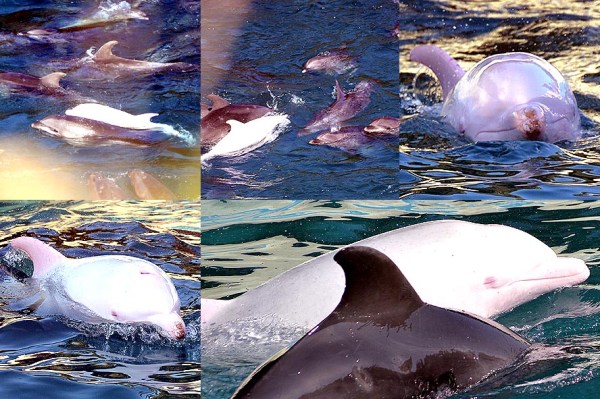
I hope to have more information to share about the status of the calf soon. The picture above was sent to me by Satoshi Komiyama. Here is another set of photos Satoshi took, and was kind enough to share:
Photo Credit: Satoshi Komiyama
It is hard not to feel for the albino calf, and the dramatic turn her life has taken. The life of Lolita, the killer whale who was captured at Penn Cove and has been performing at the Miami Seaquarium for more than 40 years, evokes all the same emotions.
We featured the capture operation that sent Lolita to Miami in Blackfish, and people often tell me it was one of the most moving sequences in the film.
A number of groups and individuals, most notably Howard Garrett and the Orca Network, have been fighting for Lolita’s freedom for almost two decades. Last week, after years of frustration in that quest, Lolita finally caught a potential break. I explain what happened over at Outside Online.
If Lolita does get listed with her family under the Endangered Species Act, then it will be very difficult for Miami Seaquarium to hold onto her. But, I learned, there is a note of caution that needs to be kept in mind. NOAA has already expressed some skepticism about returning Lolita to the wild. So, absent a very convincing and well-funded plan to take her to a sea pen in her home waters, there could be a scenario in which U.S. Fish And Wildlife (which would be responsible for enforcing the Endangered Species Act), would remove Lolita from Miami Seaquarium, but decide that it is less risky to place her in a better facility than it is to transport her across the country and drop her into the Haro Strait.
Photo Credit: Piotr Domaradzki, Miami, FL, 1998 via Wikimedia
Yep, SeaWorld could come into the Lolita scenario. Not saying it will happen, or that it is even likely to happen. But I am saying that if even if she is listed under the Endangered Species Act it will still be a fight to get her to a sea pen.
I am a Chipotle fan. Yes, they serve a lot of meat. But they are at least enlightened enough to make how meat is raised and produced an issue. That is a step in the right direction.
Now Chipotle is going on the offensive about the appalling cruelty involved in the production of meat used by all their fast-food competitors. But they are doing it in a funny, stylish way, with a four-part satirical comedy series that will air on Hulu. I don’t know if it will deliver real entertainment, or just come off as a clever infomercial.
But I love the fact that it is linking factory farming and the oil industry. That is in encouraging sign of the times, and an explicit attempt to change the zeitgeist on meat, which has long been seduced by too many ads depicting happy farm animals rolling around in the sun with cute kids.
Too bad they didn’t work in the tobacco industry, too.
“One Ocean,” SeaWorld Orlando‘s iconic killer-whale show, will be taking a break in early 2014.
The theme park will be doing routine maintenance on the main performing pool at Shamu Stadium, a SeaWorld official says. The work will begin in early January. “One Ocean” is currently on the park schedule posted on its website through Jan. 5.
The Dine With Shamu experience will also be suspended for the first part of next year.
During the closures, SeaWorld Orlando will offer “Shamu Up Close,” which will include above-water and underwater interactions and a look at training techniques. It will be held in the Dine With Shamu space and accommodate hundreds of guests at a time, a spokeswoman says.
“One Ocean” and Dine With Shamu will return sometime in the spring, SeaWorld says.
Shutting down the cash-gushing Shamu show for a period of months is not “routine maintenance.” I have no knowledge that a fast-rising floor is on its way (previous on SeaWorld’s fast-rising floor here). But if I was a betting man….
[Also worth noting: this will be a very interesting experiment in how important the Shamu show is to SeaWorld’s gate revenue].
We may talk about animal rights, but animals in fact have no legal rights. The NonHuman Rights Project is determined to change that, and win basic “personhood” rights for nonhuman animals, and has now filed its first lawsuit, on behalf of a chimpanzee named Tommy. Similar lawsuits will follow this week:
This morning at 10.00 E.T., the Nonhuman Rights Project filed suit in Fulton County Court in the state of New York on behalf of Tommy, a chimpanzee, who is being held captive in a cage in a shed at a used trailer lot in Gloversville.
This is the first of three suits we are filing this week. The second will be filed on Tuesday in Niagara Falls on behalf of Kiko, a chimpanzee who is deaf and living in a private home. And the third will be filed on Thursday on behalf of Hercules and Leo, who are owned by a research center and are being used in locomotion experiments at Stony Brook University on Long Island.
The lawsuits ask the judge to grant the chimpanzees the right to bodily liberty and to order that they be moved to a sanctuary that’s part of the North American Primate Sanctuary Alliance (NAPSA), where they can live out their days with others of their kind in an environment as close to the wild as is possible in North America.
Establishing some semblance of legal rights for animals is the new frontier for “animal rights,” and potentially the most powerful strategy possible to change the way in which humans relate to animals. Much more on the lawsuits being launched this week here.
Damien Mander chronicles his journey from a sniper in Iraq to a life dedicated to stopping animal suffering and seeking justice and rights for other species.
Sorry. Not that it’s a surprise, but Tili isn’t going anywhere.
When Icelandic media started reporting a few days ago that a permit request to return Tilikum to Icelandic waters had been filed with the Fisheries Ministry, it was a puzzler. There is just about zero chance that SeaWorld would ever release Tilikum (or any other killer whale). Yet, the Ministry Of Fisheries seemed to be confirming that at least someone had filed a permit request.
Icelandic media kept churning out stories, with at least one yielding an interesting anecdote about the young Tilikum in captivity. And I kept reading along, until I finally saw a name associated with the permit in this story (via tortured Google translation):
In the register of the Ministry stated that the application was received in August. Appointment of qualit inc., From Tracy ELPoured and copy center Sea World. Requested the Ministry to permit that Tilikum will be transferred to his home after decades stay as gripping performances. “It is not a position has been taken to the communication. But, here might be a new whale-tale coming up, “said an employee of the Ministry. “They want to get rid of him. But, this seems to be financially. “
So a new permit was filed in August. And seemed to come from a person called Tracy EL Poured, of Qualit Inc. The name Tracy Poured sounded very familiar and a quick search of my e-mail revealed she had been in contact with me in August (according to her e-mail signature she is CEO of Qualia Inc.), to express her support, and belief that the world is changing for the better. We also connected on LinkedIn (that’s her profile picture above), so she could share with me her own lengthy analysis of Tilikum and how his life had affected him.
I e-mailed Tracy yesterday to ask her about the Tilikum permit application, and she did not want to respond directly to the question of whether she had filed it (though she did make clear she did not in any way speak for SeaWorld). After some back and forth, here is what she said:
I appreciate your inquiry and desire for clear answers, Tim. I answer what is mine to answer. Some things are not mine to answer.
I pointed out the 1992 application* in response to your statement “SeaWorld would never release Tilikum”.
I’m involved in conversations with Iceland, SeaWorld, scientists and many more involved in the orca Tilikum situation.
The mention of the 1992 application refers to the inquiry SeaWorld made at the time it was trying to import Tilikum from Sealand to its Orlando park on an emergency basis. Part of that process was establishing that there was no good alternative to the import, so SeaWorld needed Iceland to say they didn’t want Tilikum back.
Separately, I learned that Tracy had been in touch with some of the former SeaWorld trainers about the possibility of participating in a rehab and release process for Tilikum.
So I think it is safe to conclude that Tracy filed the permit application, or at least played a role in it, in a well-meaning but quixotic hope that somehow she could help orchestrate Tilikum’s return to Icelandic waters. And the media took it from there.
SeaWorld’s “A Sea Of Surprises” is definitely surprising Macy’s. And not in a good way. But I guess you should never underestimate the power and energy of the orca-defending community. Or the power of television. And Blackfish is doing enough damage to the image of the Macy’s Thanksgiving parade, that we just might have to file a corporate incident report.
Buzzfeed gets in on the action with a sharp story about how Blackfish snuck up on Macy’s:
Blackfish, a damning documentary about SeaWorld’s treatment of animals after one of its whales killed a veteran trainer in 2010, premiered at Sundance in January, about three months before SeaWorld went public. Analysts who cover the company didn’t see it to be an issue. In September, J.P. Morgan analysts said it had “negligible, if any, impact on attendance,” given that it garnered just $1.8 million in the box office from its July 19 release. Goldman Sachs didn’t mention it in September and October notes about SeaWorld. The film didn’t show up in conference calls either, though visits have been falling.
But the documentary stopped being a non-issue when CNN aired it on Oct. 24, sweeping the ratings of every group under 55 during a Thursday night showing. Twitter said it was the most talked-about show on CNN in October, with 67,673 tweets seen by 7.3 million people. (It was the second-most tweeted about non-sports program that night after Scandal.)
Blackfish, SeaWorld, and the issue of whales in captivity have all been far more visible since then — and Macy’s is now catching a lot of the heat.
The company has drawn disparaging commentary for the float on its Facebook page and from celebrities including Alec Baldwin and Jason Biggs. People for the Ethical Treatment of Animals is leading an online campaign to get rid of the float and has protested at Macy’s New York flagship store.
I guess while we are on the topic, can we just pause for a second to note how utterly vacuous and meaningless Macy’s standard PR line about this controversy is? Here’s what Macy’s told Buzzfeed (and pretty much every other news organization that has sought comment):
“[The Macy’s Thanksgiving Parade] has never taken on, promoted or otherwise engaged in social commentary, political debate, or other forms of advocacy, no matter how worthy….Its mission has always been about entertaining millions of families and spectators. While it is understandable that such a widely embraced event can sometimes feature elements or performances that some people may find disagreeable, Macy’s intention is to provide a range of entertaining elements without judgement, endorsement or agenda.”
By that standard, SeaWorld could duck all the heat about Shamu by swapping in a float celebrating the use of slaves to grow the cotton industry. And Macy’s would be okay with that, and let it roll (without “judgment” or “endorsement,” mind you). As long as it was “entertaining.”
PS: Note to Macy’s PR specialists: Since Macy’s actually chooses who and what will be featured in the parade, there is an implicit endorsement no matter how many times you try to say there isn’t.
PPS: When said PR specialists also say that the Macy’s parade “has never taken on, promoted or otherwise engaged in social commentary, political debate, or other forms of advocacy, no matter how worthy” are they saying that the criticisms of SeaWorld raised by Blackfish are, well, worthy? Because that would be awkward.
Anyhow, read the whole Buzzfeed story, for lots more juicy goodness. It includes some of the pointed and clever tweets and comments that Macy’s has been dealing with. Like this one, from Jason Biggs:
The chatter about whether someone has filed for a permit to return Tilikum to Icelandic waters continues. I don’t for a minute believe that SeaWorld is in any way involved. And if any sort of permit request was in fact filed (I’m trying to confirm that) then I strongly suspect that someone is spoofing the Ministry Of Fisheries, or it has nothing to do with Tilikum.
More interesting to me is this report about all the rumors (sent to me by Elizabeth Batt). The details of Tilikum’s experience in captivity in Iceland during the many months before he was shipped to SeaLand of the Pacific have always been sparse. So this is worth noting, and adding to our understanding of this early chapter of Tilikum’s story:
Tilikum was captured by the Icelandic coast in 1983 and kept at the Aquarium in Hafnarfjörður to begin with.
There, Sigfús Halldórsson began the animal’s training. Sigfús is now a computer scientist and lives in England, but remembers Tilikum very well.
Tilikum was being prepped for transport to Canada when Sigfús started training him and was the smallest one of three killer whales kept at the aquarium.
Sigfús fed Tilikum on herring and had failed a few attempts to lure the animal into another pool. Eventually, it was decided upon to move Tilikum with an overhead crane.
“I foolishly jumped into the pool to remove the rail between the two pools and he must have been mad about being separated from the other two killer whales because he caught me from behind and pulled me underwater. He tore a big piece from the back of my wetsuit but I managed somehow to get out of the pool,” Sigfús told Vísir.is
He added that apart from that incident, Tilikum was normally sweet-tempered. “He was my friend, I often put my arm into his mouth to scratch his tongue; he liked that. He was normally very sweet except for that one time he got angry.”
Those were the cowboy days. My guess is that, in retrospect, Sigfus must think he is pretty lucky guy to have emerged from the “one time he got angry” fully intact.


 Sorry. Not that it’s a surprise, but Tili isn’t going anywhere.


 The Earthist Chronicles