It was perhaps the most interesting science I have ever seen, and the possibilities it opens up could change how humans view themselves and the other species on the planet.
Here is Herzing describing her work, in a newly released TED Talk:
The determined face of Jason Trigg, Wall Street revolutionary.
Just when you are convinced that Wall Street is eviscerating our future by sucking up the best talent in the country with the lure of mega-wealth, along comes a small movement of whiz-kids who are not going to Wall Street simply because they want to live like the 1 %:
Jason Trigg went into finance because he is after money — as much as he can earn.
The 25-year-old certainly had other career options. An MIT computer science graduate, he could be writing software for the next tech giant. Or he might have gone into academia in computing or applied math or even biology. He could literally be working to cure cancer.
Instead, he goes to work each morning for a high-frequency trading firm. It’s a hedge fund on steroids. He writes software that turns a lot of money into even more money. For his labors, he reaps an uptown salary — and over time his earning potential is unbounded. It’s all part of the plan.
Why this compulsion? It’s not for fast cars or fancy houses. Trigg makes money just to give it away. His logic is simple: The more he makes, the more good he can do.
He’s figured out just how to take measure of his contribution. His outlet of choice is the Against Malaria Foundation, considered one of the world’s most effective charities. It estimates that a $2,500 donation can save one life. A quantitative analyst at Trigg’s hedge fund can earn well more than $100,000 a year. By giving away half of a high finance salary, Trigg says, he can save many more lives than he could on an academic’s salary.
In another generation, giving something back might have more commonly led to a missionary stint digging wells in Kenya. This generation, perhaps more comfortable with data than labor, is leveraging its wealth for a better end. Instead of digging wells, it’s paying so that more wells are dug….[snip]
…While some of his peers have shunned Wall Street as the land of the morally bankrupt, Trigg’s moral code steered him there. And he’s not alone. To an emerging class of young professionals in America and Britain, making gobs of money is the surest way to save the world. When you ask Trigg where he got the idea, his answer is a common refrain among this crowd: “I feel like I’d read stuff by Peter Singer.”
It’s sort of like Bill Gates and his Giving Pledge, except these guys aren’t bothering to stockpile billions, or live rich, before giving most of it away. So you gotta love Peter Singer (and hope that the money rolling in doesn’t corrupt the idealism of the enterprise). Because if every young trader and hedgie played the Wall Street game like this, it would be an excellent mechanism for transferring wealth from the richest among us to the neediest among us. Though it wouldn’t be entirely sustainable because Wall Street would no longer be gushing 1 percenters (because they would be giving all their money away first). Not that Trigg (or many others) would mind.
Ben Bernanke might have been channeling Trigg and his cohort in his address to the Princeton commencement. Among other things, he said: “A career decision based only on money and not on love of the work or a desire to make a difference is a recipe for unhappiness.”
If that insight becomes conventional wisdom, and future generations start to live by that code rather than the code of wealth and celebrity that currently dominates our culture, maybe there is hope.
This would be the perfect parody–mixing naked profit-seeking under the cynical guise of sustaining a retrograde whale-hunting culture, with insane cost-benefit tradeoffs, with the pet fetishism of a nation that itself is a leading killer of whales and dolphins. If it were a parody. Which apparently it is not:
ICELAND is to resume commercial whaling next month, killing up to 184 endangered fin whales over the coming summer partly to supply a burgeoning Japanese market in luxury dog snacks.
Could South Park or The Simpsons do any better? I doubt it.
If you want to know how the whole raking-in-the-bucks-by-putting-killer-whales-on-public-display thing really got rolling, you need to know the sad and enraging story of Moby Doll.
Orcas, or killer whales, were traditionally feared, revered, and respected by the indigenous people of the coast. That sentiment morphed with the growth of commercial salmon fisheries into one of dislike and aggression, as the so-called “blackfish” were seen as dangerous competitors for fish. No one thought it was safe to come near them and it was not uncommon to shoot them. Little was known about their natural history, and they were still scientifically unstudied by the 1960s.
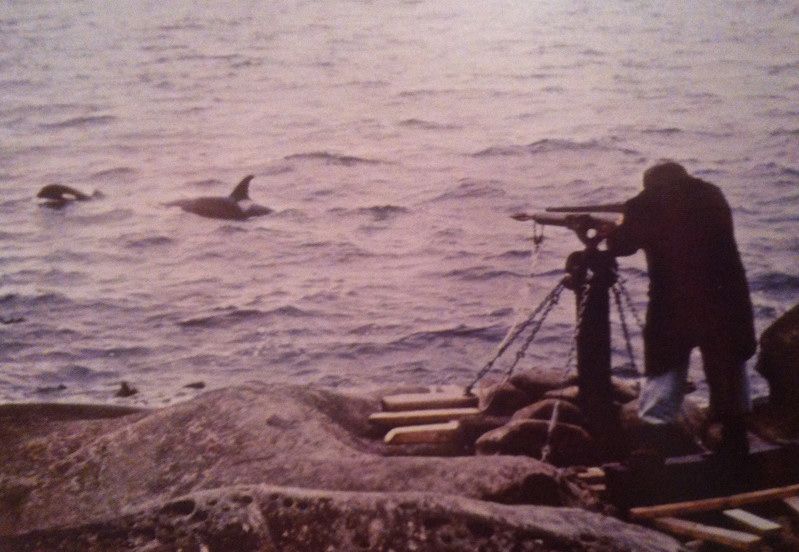
In 1964, the Vancouver Aquarium, which had been in operation for eight years, planned to harvest a killer whale for dissection, study, and use as a model for a realistic statue at the entrance to their facility. A team from the aquarium headed to Saturna, the southernmost of the Gulf Islands, and set up a harpoon on the rocks of East Point, now part of the National Park Reserve.
In due course, a pod of orcas arrived, and the five-metre-long Moby Doll was harpooned. Unexpectedly, it failed to die, as two other members of the pod swam to support it at the ocean’s surface. The aquarium team realized that they could bring the relatively calm animal back alive, and towed it 65 kilometres back to Vancouver.
They called it Moby Doll, mistaking the young male for a female, and exhibited him in a pen in the harbour, where he created a sensation. The public and media flocked to visit.
This was the first ever captive orca and as described by the Saturna symposium organizers, it “triggered a goldrush” on young orcas. Dozens were subsequently captured and put on display in aquariums around the world. The intelligent animals were often taught tricks, and would perform in shows.
Moby Doll survived just 88 days in captivity, but that was long enough to demonstrate the profit potential of live killer whale displays. More here, from the Whale Of A Business site over at PBS.
I don’t think it exists. But chef Dan Barber was determined to find some fish he could feel good about.
Since it appears to be Fish Friday here, I thought I’d let him tell the tale.
The backstory: “Chef Dan Barber squares off with a dilemma facing many chefs today: how to keep fish on the menu. With impeccable research and deadpan humor, he chronicles his pursuit of a sustainable fish he could love, and the foodie’s honeymoon he’s enjoyed since discovering an outrageously delicious fish raised using a revolutionary farming method in Spain.”
The Harvard University sociologist Lant Pritchett has proposed a sort oftaxonomy of social change that I find applicable to changing dominant transportation paradigms, which are really social paradigms. The four stages in the sequence might be labeled thusly: Silly, Controversial, Progressive, and Obvious. When applied to the the idea of bicycles serving as transportation in New York City, the stages of opinion have played out something like this:
Silly: It’s New York, you’d have to be crazy — or a messenger — to ride a bike. As more people began to do it, the tone shifted to:
Controversial: Bikes are dangerous, pedestrians are getting hurt, they will make traffic worse by removing space for cars. As these scenarios in turn failed to materialize, a new strand of critique began to surface:
Progressive: Biking proponents are nothing but an elitist, Copenhagenizing cabal trying to take over the city and turn us all into velocipede-loving socialists.
We would now seem to be entering the “Obvious” phase of the sequence, in which dissenters are spending less time arguing over the desirability or wisdom of the bike share program (which, it should be noted, enjoys the support ofmore than 70 percent of the citizenry) than they are over the precise location of bike infrastructure, and its day-to-day operation. The tone of this dissent has given it the characteristics of a classic NIMBY response — or perhaps, given New York City’s unique urban geography, a NOMB (Not On My Block) response.
I’d say we should all be well past the stage where the benefits of easy access to bicycles is “Obvious.” But maybe NYC will help get us there.







 The Earthist Chronicles