SeaWorld: Our Investors Should Know That It’s Bad For Business When Our Killer Whales Kill People
And then BI cites this important, but unusual, section of SeaWorld’s IPO filing:
Below is the aforementioned section of the prospectus (emphasis added):
Featuring animals at our theme parks involves risks.
Our theme parks feature numerous displays and interactions that include animals. All animal enterprises involve some degree of risk. All animal interaction by our employees and our guests in attractions in our theme parks, where offered, involves risk. While we maintain strict safety procedures for the protection of our employees and guests, injuries or death, while rare, have occurred in the past. For example, in February 2010, a trainer was killed while engaged in an interaction with a killer whale. Following this incident, we were subject to an inspection by the U.S. Department of Labor’s Occupational Safety and Health Administration (OSHA), which resulted in three citations concerning alleged violations of the Occupational Safety and Health Act and certain regulations thereunder. We have appealed certain of these citations and the appeal process is ongoing. In connection with this incident, we reviewed and revised our safety protocols and made certain safety-related facility enhancements. This incident has also been the subject of significant media attention, including television and newspaper coverage, a documentary and a book, as well as discussions in social media. This incident and similar events that may occur in the future may harm our reputation, reduce attendance and negatively impact our business, financial condition and results of operations.
In addition, seven killer whales are presently on loan to a third party. Although the occurrence of any accident or injury involving these killer whales would be outside of our control, any such occurrence could negatively affect our business and reputation.
That about covers it, no? So the investors can’t say they weren’t warned.
The video totally nails the problem that traditional economics does not value or account for “natural capital,” the single greatest (and most catastrophic) flaw in the way we humans conduct our lives, cultures and economies. So thanks for getting that key point out.
But the video also irks me slightly because:
1) No value is placed on preserving the oceans simply because they are the most spectacular, beautiful, awesome, and life-nurturing resource on the planet (what I would call “existential capital”). Sure, those are intangibles, but not all value attached to the ocean can be expressed in dollars and cents, or benefits to the human race. And the lives of all the myriad species that live in the ocean are invaluable, even if they don’t directly benefit humans (or contribute to our cosmetics!). Even if the oceans didn’t protect our beach homes, provide us with a tourist destination, or regulate the climate so we don’t all overheat, I’d be in favor of protecting and defending the oceans. The oceans are the heart and soul of the planet.
2) The remedies are sorta lame. Go to a green resort? Buy “sustainable” fish, whatever that is? That won’t save the oceans. Saving the oceans, and stopping ocean acidification will require much more dramatic shifts in our behavior and culture. How about urging people to stop eating meat (the single greatest step any human can take to protect the planet)? And stop eating fish, period? Or stop living in humungous houses that are heated and cooled to ridiculous temperatures? Or to reduce their driving, and travel by airplane (the carbon emissions of that trip to the beach are significant)? Or stop using so much plastic? Or any number of the other 3,546 things that modern humans do that impact the oceans?
Maybe people should watch this video (and movie) instead, because Revolution really is the right response to the crisis of the oceans:
If you are a billionaire Master Of The Universe of course you believe you can hold back the sea:
SOUTHAMPTON, N.Y. — Soon after Hurricane Sandy hit last fall, Joshua Harris, a billionaire hedge fund founder and an owner of the Philadelphia 76ers, began to fear that his $25 million home on the water here might fall victim to the next major storm. So he installed a costly defense against incoming waves: a shield of large metal plates on the beach, camouflaged by sand.
His neighbor, Mark Rachesky, another billionaire hedge fund founder, put up similar fortifications between his home and the surf. Chris Shumway, who closed his $8 billion hedge fund two years ago, trucked in boulders the size of Volkswagens.
Across a section of this wealthy town, some residents, accustomed to having their way in the business world, are now trying to hold back the ocean.
But the flurry of construction on beachfront residences since the hurricane is touching off bitter disputes over the environment, real estate and class.
Some local officials said they were worried that the owners were engaging in an arms race with nature, installing higher and higher barricades that could rapidly hasten erosion — essentially sacrificing public beaches to save private homes.
Here’s one more argument (save yourself!) to give up meat, even if you don’t care about the planet or animal cruelty:
More than half of samples of ground turkey, pork chops and ground beef collected from supermarkets for testing by the federal government contained a bacteria resistant to antibiotics, according to a new report highlighting the findings.
The data, collected in 2011 by the National Antimicrobial Resistance Monitoring System — a joint program of the Food and Drug Administration, the Agriculture Department and the Centers for Disease Control and Prevention — show a sizable increase in the amount of meat contaminated with antibiotic-resistant forms of bacteria, known as superbugs, like salmonella, E. coli and campylobacter.
I’ve said before that I don’t have a problem with trainers taking risks, including waterwork, as long as SeaWorld is honest and transparent with trainers regarding the risks and the aggression history of any given killer whale.
But how much risk attaches to “drywork” is a big question as SeaWorld continues to try to reach a settlement with OSHA on what sort of close contact between killer whales and trainers should be allowed in shows.
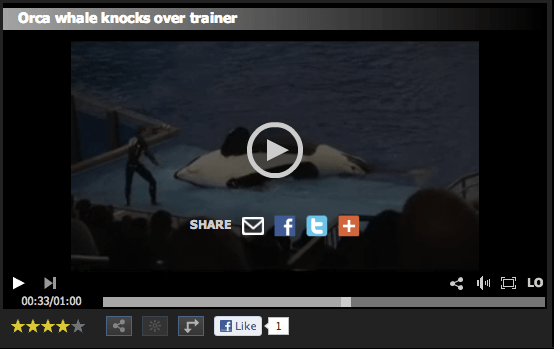
I’ll have a few things to say next week about what orcas are capable of even if a trainer is out of the pool. But in the meantime, here’s a (somewhat in jest) reminder that while waterwork definitely puts trainers at greater wisk, the stuff that happens out of the water doesn’t always go as intended.
To get more profit from the land, which his family had farmed for five generations, [Russ] Kremer erected a long, low warehouse-like building and cycled 2,400 hogs a year through his operation. It wasn’t pretty. The sows that produced his piglets spent their entire lives confined to gestation and farrowing crates — metal enclosures barely larger than the animals themselves, which barely allowed them to move. The piglets grew up cheek by jowl in metal pens. Stressed and sickly, the animals were fed a constant diet of commercial feed laced with low levels of antibiotics. Slatted concrete floors allowed their excrement to drop into a vast pit below the barn. Massive fans pushed out poisonous gasses from the pit. In the mid-1980s, a thunderstorm struck in the predawn hours of a Sunday morning, knocking out power. Within a few hours, more than 200 hogs suffocated from the gas. Instead of going to church that morning, Kremer dug a pit and buried them.
“Raising pigs like that was the worst mistake I ever made,” he says.
That’s partly because Kremer was almost killed by an antibiotic-resistant bacterial infection that he helped nurture with his factory farm methods. But Kremer also found that there was another way to be a pig farmer:
So Kremer did the unthinkable: he bought new pigs and began to raise them without antibiotics. “I went cold turkey. Everyone I talked to told me I was crazy,” he said. “All my pigs would die.”
They were wrong. The first drug-free year, Kremer saved $16,000 in veterinary bills, and his hogs flourished. Unfortunately, the hog market collapsed in the late 1990s. One after the other, small family hog farmers in the county went out of business, often unable to sell pigs at any price to slaughterhouses designed to handle thousands of animals a day.
To survive, Kremer had to reinvent his approach to farming a second time. He and 33 other hog producers formed the Ozark Mountain Pork Cooperative to market their meat directly to commercial customers at premium prices. Members agreed to abide by a set of strict regulations: no antibiotics would be fed to the pigs. The animals had to have access to pasture. Their diet would consist of unadultered corn, soy, and oats. Sows could not be confined to crates. At slaughter, Ozark pigs would be killed painlessly after being rendered insentient by carbon dioxide gas. “I called it retro hog raising,” Kremer says.
I’d prefer if no one would raise pigs for slaughter, but if they are going to do so I’d prefer that they farm pigs like Kremer does. Kremer’s coop has grown to about 60 farmers and he is wise enough to stop there.
His story inspired this video (made by Chipotle which was inspired to buy Kremer’s pork), and hopefully it will inspire some other hog farmers:
Talks are scheduled for later this month among diplomats and fisheries officials from Norway, Denmark, Canada, the United States and Russia. Most concern is focused on newly ice-free waters above the Bering Strait, above the exclusive economic zones of Russia and the United States, and now accessible to trawler fleets from hungry Pacific Ocean nations like China and Japan.
An accord would protect the open water until the fish stocks there can be more fully studied.
On the other hand, the intention is not to fully protect the Arctic fishery as the ice cap has been protecting it, but only to try to protect it from catastrophic overfishing:
The fishing accord would regulate commercial harvests in an area farther offshore — in the so-called doughnut hole of the Arctic Ocean. This is a Texas-size area of international water that includes the North Pole and is encircled by the exclusive economic zones of the coastal countries.
That the center of the Arctic Ocean was unregulated was hardly a concern when it was an icebound backwater. That is changing. Last summer, 40 percent of the central Arctic Ocean melted…
…Dmitry M. Glazov, a whale biologist at the Severtsov Institute of Ecology and Evolution and an authority on the marine ecosystem of the ice floes, said the waters teem with cod, herring, Greenland sharks, whales, walruses, seals and polar bears. It is unclear, though, whether the fish stocks are large enough to support a commercial fishery.
Even if the five countries agree on a fishery management plan, which is a big if, who believes it will be conservative enough, and enforced well enough, to truly conserve and sustain abundant fish stocks? I thought so.
The reality of global warming is that new ecosystems are opening up to human exploitation. The tragedy is that the possibility of preserving and NOT exploiting is somehow never part of the conversation (except on crazy blogs like this one). The Arctic is the biggest, richest ecosystem that is letting down its natural defenses. It would be inspiring if it became a test case in how nations can work together to avoid the plundering and destruction of yet another area of the planet. But fisheries management around the rest of the globe doesn’t offer much cause for optimism.
Although unreported in wild orca populations, mosquito-transmitted diseases have killed at least two captive orcas
(Orcinus orca) in U.S. theme parks. St. Louis Encephalitis Virus (SLEV) was implicated in the 1990 death of the male orca Kanduke,
held at SeaWorld of Florida. In the second case, West Nile Virus (WNV) killed male orca Taku at SeaWorld of Texas in 2007.
Captive environments increase vulnerability to mosquitotransmitted diseases in a variety of ways. Unlike their wild counterparts who are rarely stationary, captive orcas typically spend hours each day (mostly at night) floating motionless (logging) during which time biting mosquitoes access their exposed dorsal surfaces. Mosquitoes are attracted to exhaled carbon dioxide, heat and dark surfaces, all of which are present during logging behavior. Further, captive orcas are often housed in geographic locations receiving high ultraviolet radiation, which acts as an immunosuppressant. Unfortunately, many of these facilities offer the animals little shade protection. Additionally, many captive orcas have broken, ground and bored teeth through which bacteria may enter the bloodstream, thus further compromising their ability to fight various pathogens. Given the often compromised health of captive orcas, and given that mosquito-transmitted viral outbreaks are likely to occur in the future, mosquito-transmitted diseases such as SLEV and WNV remain persistent health risks for captive orcas held in the U.S.
[JMATE. 2012;5(2):9-16].
At the time Kanduke died there was uncertainty over the cause. But here is the necropsy which indicated that something unusual had happened, and helped Ventre and Jett find the answer..
This is an important insight into how captivity affects the lives of killer whales, and what is particularly interesting is how a confluence of captivity-related issues–logging, temperatures, lack of shade, teeth-drilling, etc–combine to create a vector of vulnerability that wild orcas likely do not experience. Which is one more reason that mortality in captivity is greater than mortality in the wild. Very well-done, informative, fact-based, work.
A Chinese vessel that ran aground on a protected Philippine coral reef was found to contain more than 20,000 pounds of meat from the scaly anteater, a protected species prized for its supposed medicinal qualities.


 It’s still pig farming, and that never works out well for the pigs in the end. But it’s nice to see there are


 The Earthist Chronicles