“The world is so much larger than I thought. I thought we went along paths—but it seems there are no paths. The going itself is the path.”
C.S. Lewis, Perelandra


“The world is so much larger than I thought. I thought we went along paths—but it seems there are no paths. The going itself is the path.”
C.S. Lewis, Perelandra

Bekoff, a leading ethologist, adds his voice to discussion of the newly published “A Veterinary and Behavioral Analysis of the Killing Methods Used in the Dolphin Drive Hunts in Taiji, Japan.” His main point–everyone needs to work together, and be patient, to change the painful reality of the drive hunts:
I realize that some people want much more action and they want it now. They are frustrated by the slow progress that is being made on the egregious and thoroughly unethical and inhumane murder of these amazing sentient beings. However, this press is a very good and much needed move for continuing to raise awareness of what is happening in Taiji. Many people really do not know about it. I surely understand the passion of those who want more and want it now. How could anyone sit back and let this brutal slaughter go on as if it isn’t really happening. It is, and countless gallons of the blood of these highly sentient beings are being spilled into the waters around Japan. Shame on those who kill the dolphins and shame on people who know about and who remain indifferent to this massacre. We all need to work together to stop the blood spills.
Those who share common goals must work for the animals and not against one another. There really is strength in numbers. For example, the frustratingly slow progress made over many years on gaining protection for chimpanzees is finally paying off (see also). A strong and unified community effort is needed to help the dolphins along and to stop this bloodthirsty, bloodcurdling bloodbath.
Hard to argue with that.
Here’s more from Bekoff on animal behavior and emotions:
Former SeaWorld trainers discuss what they did (and didn’t) know about the 1987 tragedy in which trainer John Sillick was crushed by a killer whale at Sea World San Diego.

Not that there was much doubt, but a scientific paper categorizes and defines the level of extreme cruelty. The DotEarth blog digs in:
In a new peer-reviewed study, scientists assess the killing method employed by the dolphin hunters of Taiji, Japan, by watching video recorded surreptitiously in 2011 by a German dolphin-protection group, AtlanticBlue. The still image at right is from the video, which can be seen here (but be forewarned; this is not suitable for children — or many adults, for that matter).
Here’s the researchers’ not-so-surprising prime conclusion:
This killing method does not conform to the recognized requirement for “immediate insensibility” [some background is here] and would not be tolerated or permitted in any regulated slaughterhouse process in the developed world.
Here’s the abstract from the paper:
Journal of Applied Animal Welfare Science, Volume 16, Issue 2, 2013 (DOI: 10.1080/10888705.2013.768925)
Andrew Butterworth, Philippa Brakes, Courtney S. Vail & Diana Reiss
Annually in Japanese waters, small cetaceans are killed in “drive hunts” with quotas set by the government of Japan. The Taiji Fishing Cooperative in Japan has published the details of a new killing method that involves cutting (transecting) the spinal cord and purports to reduce time to death. The method involves the repeated insertion of a metal rod followed by the plugging of the wound to prevent blood loss into the water. To date, a paucity of data exists regarding these methods utilized in the drive hunts. Our veterinary and behavioral analysis of video documentation of this method indicates that it does not immediately lead to death and that the time to death data provided in the description of the method, based on termination of breathing and movement, is not supported by the available video data. The method employed causes damage to the vertebral blood vessels and the vascular rete from insertion of the rod that will lead to significant hemorrhage, but this alone would not produce a rapid death in a large mammal of this type. The method induces paraplegia (paralysis of the body) and death through trauma and gradual blood loss. This killing method does not conform to the recognized requirement for “immediate insensibility” and would not be tolerated or permitted in any regulated slaughterhouse process in the developed world.
DotEarth also puts a few questions to co-author Diana Reiss, and includes a bunch of other useful links on the topics of Taiji, dolphins and intelligence.
Read the whole thing, but this exchange is particularly important, I think:
Q. One of the standard replies from Japan on this issue (whether with whales or dolphins) is that we, for example, cherish bison but eat bison burgers. Is there a distinction?
A. You cannot compare bison to dolphins in the cognitive domain. However, bison are not killed in this inhumane manner. Nor are lab rats. In cases in which animals are domesticated for food, most modern countries are striving for better animal welfare practices that minimize pain and suffering during the killing process with the goal to render an animal unconscious quickly before it is killed. This is not the case in the dolphin drive hunts. These are not domesticated animals; they are wild dolphins that are captured within their social groups, mother and young, and slaughtered using a technique that actually prolongs death, pain and suffering. The herding procedures themselves are inhumane and may include forced submersion as the dolphins are dragged by their tails to shore to be killed.This is not to say that dolphins should be killed. They should not.
This is probably the best answer Reiss could give to the contradiction of supporting animal rights and welfare for certain species, but eating meat produced by practices that are also cruel and inhumane. And I agree that the dolphin slaughter should be stopped quite apart from livestock slaughter.
But it is not really a satisfactory or convincing answer. There is a moral contradiction in eating meat while expressing outrage at the abuse and cruelty involved in the slaughter of other species. You can try to defend one species but not another by creating different categories of animals based on intelligence. But while cows and pigs might not be as intelligent as dolphins, they are sentient beings. They know fear. They know loss. To die is painful and they resist that fate as ardently as any species, no matter how intelligent. In the end, the only position which truly avoids this moral contradiction is to oppose animal slaughter and cruelty for all species.
Update: Lori Marino of Emory University and the Kimmela Center for Animal Advocacy, who has a long and complex history of disagreement on principle with Reiss, pushes back, hard, on another moral contradiction:
So what kind of killing WOULD be acceptable? It is absolutely offensive that anyone who works in the dolphin captivity industry would feel they have anything worthwhile to say about the Taiji dolphin drives. This is not about dolphin welfare any more than murdering humans is. This is about dolphin rights. But those in the captivity industry will continue to milk the welfare issue because it provides them a way to appear to be concerned about Taiji while still supporting the industry that drives the Taiji slaughters.
This video, which was used in the study (Warning: GRAPHIC) is horrific. But I could show you (and have) any number of videos of cows and pigs being slaughtered that you will find equally revolting and objectionable:

Americans still eat a lot of meat, but it is starting to look like they are eating less:
WASHINGTON — For the first time on record, U.S. per-capita meat consumption has declined for four consecutive years, according to the most recent figures from the U.S. Department of Agriculture.
The six percent drop between 2006 and 2010 is the largest sustained decline since recordkeeping began in 1970.
Reasons for the decline are at least partly economic: rising prices and a bad U.S. economy have made meat less affordable for American consumers.
But there are intriguing signs that a cultural shift may be underway, as well…[snip]
…While about seven percent of Americans identify themselves as vegetarians, it’s the “flexitarians” – people who eat occasional meatless meals – that market research firms have just begun to explore.
One such firm, Packaged Facts, found that eating along the “meatless spectrum” is popular among college students, who will carry those eating habits into their adult years.
“Young people today are just not so meat-and-potatoes oriented as earlier generations were,” said environmental researcher Lester Brown at the Washington-based Earth Policy Institute.

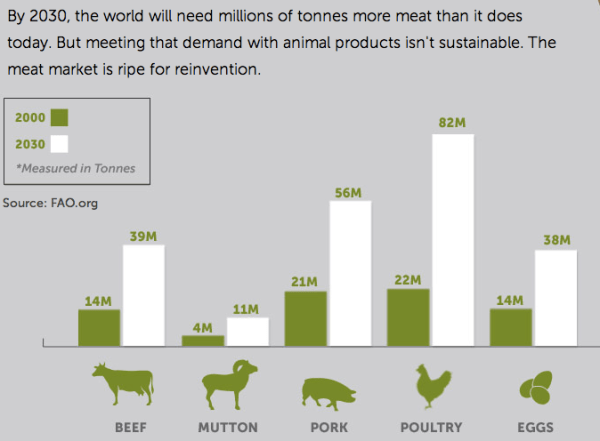
That’s encouraging, because sometimes cultural changes can hit a tipping point that creates a true shift. But according to Lester Brown we’d still need two or three Earths to meet the demand for grain and water if the rest of the world ate meat like Americans. So this chart is important to keep in mind, too:

Initially, worries about deaths from H7N9 in China were dismissed as paranoid. But now H979 is at starting to live up to the hype:
Six people are dead from the H7N9 strain of avian flu. The number of infected has grown to to 14. A new scare just hit Hong Kong. The United States has begun early research for a vaccine. And now China has slaughtered 20,000 chickens, ducks, geese, and pigeons — and shut down its live poultry markets — to try and cut off the health risk at the source. So: Is it time to panic yet?
Well, not exactly.
We’re not doctors, obviously, but the people at the World Health Organization said on Friday that they still haven’t found proof of “sustained human-to-human transmission” of [H7N9], reports Reuters. That’s the key difference between this latest scare going from a relatively isolated virus incident into full-fledged Contagion panic. In Hollywood terms, we’re about at the stage where the pig has left the farm but not yet arrived at the table with Gwyneth Paltrow. And while [H7N9] isn’t thought to be quite horror-movie bad, we might be at the point where Kate Winslet is about to get called in: The Centers for Disease Control in Atlanta is already working to develop a vaccine, CNN reports, although U.S. and Chinese scientists still haven’t exactly accounted for how humans developed the virus.
In order to stem the tide, China has culled tens of thousands of birds along with a poultry-market shutdown. And while 20,000 animals might seem a lot of stock, well, Mexico had bird flu fears of their own last year and killed 8 million chickens in August as a precaution. So, that’s another good takeaway — provided you are not a duck, goose, or chicken hanging out in Shanghai.
I’d rather see “proof” that there isn’t “sustained human-to-human transmission.” Because absence of proof does not mean absence of transmission, which presumably why the CDC is going all Kate Winslet and thinking about a vaccine.
Again, whether this plays out as feared or not, get used to this sort of scare. We’ll see it again and again because our livestock practices are nicely set up to create it. Is meat really worth it?
I see you. You see me. We are one.

The more your read about it, the more objectionable it becomes:
Monsanto and the US farm biotech industry wield legendary power. A revolving door allows corporate chiefs to switch to top posts in the Foodand Drug Administration and other agencies; US embassies around the world push GM technology onto dissenting countries; government subsidies back corporate research; federal regulators do largely as the industry wants; the companies pay millions of dollars a year to lobby politicians; conservative thinktanks combat any political opposition; thecourts enforce corporate patents on seeds; and the consumer is denied labels or information.
But even people used to the closeness of the US administration and food giants like Monsanto have been shocked by the latest demonstration of the GM industry’s political muscle. Little-noticed in Europe or outside the US, President Barack Obama last week signed off what has become widely known as “the Monsanto Protection Act”, technically the Farmer Assurance Provision rider in HR 933: Consolidated and Further Continuing Appropriations Act 2013
The key phrases are a mouthful of legal mumbo jumbo but are widely thought to have been added to the bill by the Missouri republican senator Roy Blunt who is Monsanto’s chief recipient of political funds.
But at least it’s not going down without a fight:
According to an array of food and consumer groups, organic farmers, civil liberty and trade unions and others, this hijacks the constitution, sets a legal precedent and puts Monsanto and other biotech companies above the federal courts. It means, they say, that not even the US government can now stop the sale, planting, harvest or distribution of any GM seed, even if it is linked to illness or environmental problems.
The backlash has been furious. Senator Barbara Mikulski, chair of the powerful Senate appropriations committee which was ultimately responsible for the bill, has apologised. A Food Democracy Now petition has attracted 250,000 names and sections of the liberal press and blogosphere are outraged. “This provision is simply an industry ploy to continue to sell genetically engineered seeds even when a court of law has found they were approved by US department of agriculture illegally,”says one petition. “It is unnecessary and an unprecedented attack on US judicial review. Congress should not be meddling with the judicial review process based solely on the special interest of a handful of companies.”
Some day (hopefully), this sort of over-reach and the near-complete subjugation of Congress to corporate interests and money will outrage enough Americans that real change will be possible.

Wherever there is a loophole or a vacuum, the poachers will go. And with Argentina and the Falkands failing to cooperate on fisheries management, there is a fishing fleet so large its lights can be seen from space working the area and clearing the ocean of squid:
BUENOS AIRES, Argentina (AP) — It was a rare victory in the squid wars: Argentina’s coast guard cutter Thompson fired warning shots at two Chinese trawlers, blocking their escape into international waters. Ten tons of squid were found in the holds of the Lu Rong Yu 6177 and 6178 after they were hauled into port on Christmas Day.
But this was just the first such capture in two years, a minor disturbance to the hundreds of unlicensed, unregulated fishing vessels that exploit the South Atlantic, pulling out an estimated 300,000 tons of ilex squid a year.
The species, which roams across the maritime boundary between Argentina and the Falkland Islands, is key to a food chain that sustains penguins, seals, birds and whales. Managed well, it could sustain a vigorous fishing industry and steady revenues for both governments.
But the two sides aren’t even talking.
Argentina pulled out of a fisheries management organization it had shared with Falklands in 2005. The lack of cooperation has left both sides ill-equipped to deal with the fleet scooping up squid just beyond their maritime boundaries, and sometimes within.
“It’s like the Wild West out there,” said Milko Schvartzman, who campaigns against overfishing for Greenpeace International. “There are more than 200 boats out there all the time,” and many routinely follow squid into Argentina’s economic exclusion zone, he added. “Unfortunately the Argentine government doesn’t have the naval capacity to continually control this area.”
This is just another example of how the inability of nations and fishing interests to work together to manage fishing resources drives fish populations toward disaster. I continue to think that the only way the oceans can truly be managed successfully is on a global basis (with fishing fleets regulated on a global basis no matter where they are fishing), and with all the oceans’s resources being managed as universal resources, and not just for coastal states or states with the naval power to assert sovereignty.
Yes, it is unlikely that coastal nations will surrender their claims. But the existing national model they are protecting is a complete failure.


I guess today must be corporate (un)democracy day. Since I’ve already hit up the livestock industry, and its seeming power to keep the details of its highly questionable use of antibiotics to itself, why not hop on over to the lobbying of the GMO industry, courtesy of Mark Bittman:
Genetic engineering in agriculture has disappointed many people who once had hopes for it. Excluding, of course, those who’ve made money from it, appropriately represented in the public’s mind by Monsanto. That corporation, or at least its friends, recently managed to have an outrageous rider slipped into the 587-page funding bill Congress sent to President Obama.[1]
The rider essentially prohibits the Department of Agriculture from stopping production of any genetically engineered crop once it’s in the ground, even if there is evidence that it is harmful.
That’s a pre-emptive Congressional override of the judicial system, since it is the courts that are most likely to ask the U.S.D.A. to halt planting or harvest of a particular crop. President Obama signed the bill last week (he kind of had to, to prevent a government shutdown) without mentioning the offensive rider [2] (he might have), despite the gathering of more than 250,000 signatures protesting the rider by the organization Food Democracy Now!
Bittman goes on to explain how crop seeds that are modified to tolerate weed killers like Roundup (so more Roundup can be used), in the long term lead to the development of weeds that are also resistant to Roundup. It’s sort of like the way in which the use of antibiotics in livestock leads to bacteria resistant to antibiotics, and another great example of how short term thinking tends to overwhelm consideration of the long term.
Presumably that will inspire Monsanto to develop additional GMOs, to try and stay ahead of the weeds, which will then catch up again, prompting Monsanto to…. Well, you can see how this goes.
 The Earthist Chronicles