Rise Of The Vegans

At least according to this cool Google Trends analysis of searches using the word “vegan” 2008 to the present. It was created by Compassion Over Killing, and, yes, it starts on the coasts (especially the PNW and the NE), but watch as it slowly spreads into the heartland.

There are holdout states, of course (I’m looking at you, Wyoming), but if Google searches are destiny then veganism is an idea and way of life whose time is arriving.

There’s A New Milkman In Town

…”and he’s got some serious nuts.”

A pretty funny commercial for Silk Almond Milk (for me, almond milk was the key discovery that helped me ditch dairy. It’s tasty enough to drink plain, and good (enough) in coffee).

Silk Milk from CINEMA SCOTT on Vimeo.

The Downside Of Tagging Great Whites

The research about their migrations is valuable. But knowing that they are along your coast or beach could create dilemmas.

Lesley likes the beach, too.

Pete Thomas reports on a tagged great white that has been hanging around close inshore along South Africa:

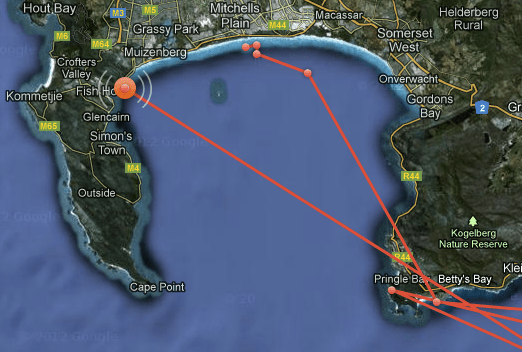
Shark spotters were put on alert Saturday in the Fish Hoek/Kalk Bay area in South Africa after a tagged great white shark was tracked swimming along the coast (see graphic).

The female shark, one of several great whites tagged by the nonprofit group OCEARCH, is named Lesley. She measured 13 feet, 8 inches and weighed 1,742 pounds when she was tagged off False Bay on April 15, 2012.

Knowing a great white is there is bound to make authorities nervous (they know they are generally there, but it is different when you have a position and track).

How long will it be before someone suggests preemptively capturing or killing Lesley? This is scientific research that aims to HELP sharks, but here’s what public safety officials are thinking about: the public outcry if a shark whose presence and whereabouts were known  injures or kills a swimmer. For that reason, OCEARCH is potentially putting the great whites it tags into danger.

I’m sure OCEARCH has thought about this dilemma. I wonder how they plan to handle it, and whether it has already come up.

Poaching To Extremes: Museum Ivory Edition

Jacques Cuisin, head of restoration at Paris’s Natural History Museum, said the damaged elephant skeleton would be repaired. Photograph: Joel Saget/AFP/Getty Images

The rhino and elephant horn poaching has got so out of hand, that even museum ivory is being targeted. Witness the recent attempt to escpae with the chainsawed tusk of an elephant once owned by Louis XIV, and on display at Paris’ Natural History Museum.

Really:

Visitors to Paris’s popular Museum of Natural History this weekend found a key exhibit under wraps after a man broke in and chainsawed a tusk from an elephant which once belonged to the Sun King, Louis XIV.

Police were called to the museum in the early hours of Saturday morning where they found a chainsaw still whirring after a man in his 20s escaped over a wall with a tusk over his shoulder. A police official said a neighbour of the museum on Paris’s Left Bank alerted authorities after hearing a strange sawing sound at around 3am. The museum alarm system was activated and startled the intruder into fleeing just minutes after beginning his chainsaw attack. He was treated in hospital for a fractured ankle from a fall while escaping and was being questioned by investigators.

Better keep an eye on your pianos. The only thing that has a hope of stopping this is a strictly enforced Chinese government ban on any and all ivory. But is any government, including the US, pressing this?

Nature Heals

And calms. And restores.

Of course, you already knew that. But here is an excellent discussion of all the science behind it:

Nature restores mental functioning in the same way that food and water restore bodies. The business of everyday life — dodging traffic, making decisions and judgment calls, interacting with strangers — is depleting, and what man-made environments take away from us, nature gives back. There’s something mystical and, you might say, unscientific about this claim, but its heart actually rests in what psychologists call attention restoration theory, or ART. According to ART, urban environments are draining because they force us to direct our attention to specific tasks (e.g., avoiding the onslaught of traffic) and grab our attention dynamically, compelling us to “look here!” before telling us to instead “look over there!” These demands are draining — and they’re also absent in natural environments. Forests, streams, rivers, lakes, and oceans demand very little from us, though they’re still engaging, ever changing, and attention-grabbing. The difference between natural and urban landscapes is how they command our attention. While man-made landscapes bombard us with stimulation, their natural counterparts give us the chance to think as much or as little as we’d like, and the opportunity to replenish exhausted mental resources.

These folks must be super-healed:

Battle For The Elephants

Via: http://ngm.nationalgeographic.com/2012/10/ivory/stirton-photography#/

Of all the intelligent, self-aware creatures under threat by man, the plight of the elephants is the most urgent and tragic. The reason is simple: they are being killed for the most indefensible of reasons (an Asian love of ivory trinkets), and the killing is so successful that 98% of the African population has been wiped out in a century, leaving a real possibility that African elephants will be extinct in as little as a decade.

That is an epic human failure–perhaps the most epic failure–to respect, steward, and conserve one of Earth’s most fascinating and iconic creatures.

Carl Safina is on it, and recommends the PBS special “Battle For The Elephants” as must-watch TV. It came out of Brian Christy’s epic National Geographic feature, Blood Ivory.

I hadn’t heard about it before, but dug around a bit.

Here’s the description from PBS:

The film tells the ultimate wildlife story — how the Earth’s most charismatic and majestic land animal today faces market forces driving the value of its tusks to levels once reserved for precious metals. Journalists Bryan Christy and Aidan Hartley take viewers undercover as they investigate the criminal network behind ivory’s supply and demand. In Dar es Salaam, Tanzania, one of the world’s main ports for smuggled ivory, Hartley attempts to buy large quantities of tusks from poachers. In China, Christy explores the thriving industry of luxury goods made from ivory and the ancient cultural tradition of ivory carving.

And here is the full episode:

Sharks And Humans

Sometimes an infographic conveys something important (get your scrolling finger ready):

Breaking: Ocean Trash Cleanup Solved?

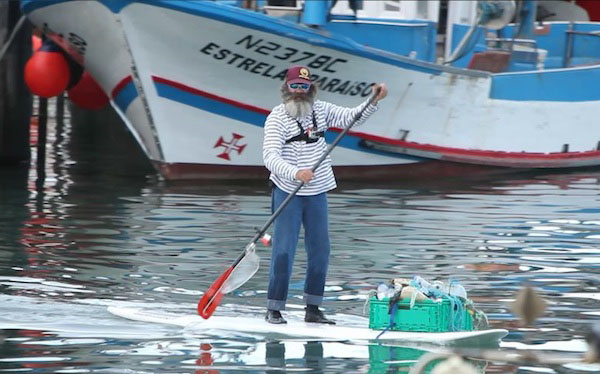
Who says humans can’t come up with a workable device for cleaning plastic and garbage from the ocean? I’d say this dude, who has affixed a net to his SUP paddle, has nailed it, no?

Explanation:

The EnviroNet is about 10 inches long and six inches wide and temporarily attaches to any paddle using a bungee cord. It’s easy to use and doesn’t interfere with paddling. All paddleboarders have to do is fasten the net to the paddle, put a basket on their board to put the trash in and they are all set to clean up the coast.

Since inventing the EnviroNet, Captain Macias has made it his mission to pick up more trash and recruit others to help him. He even made a pledge not to cut his beard until he collected 2,200 pounds of ocean trash! Nine-inches of facial hair later (about a year in real time), he made his goal.

Just need a few million SUP-ers to adopt this thing and we might see a dent in the problem. And a lot of long beards.

“Those Crazy Plastic Cleaning Machines”

I expressed some skepticism that a teenager’s oceanic plastic hoover concept could easily make the jump to the real oceanic world.

Manuel Maqueda at KUMU, is a little more blunt:

If I had a dime for each brilliant idea to “clean up the “Garbage Patch” that has been forwarded to me over the last few years I would be a millionaire.

These gyre cleanup machines, devices and foundations that emerge periodically are not going to happen. However they are likely to get lots of media attention –and distract from the real solutions.

These more or less sophisticated delusions and fantasies of massive offshore cleanups testify to how misunderstood our plastic pollution problem is, and how disconnected we are from nature in general, and from our oceans in particular.

Apart from Maqueda’s justified skepticism about how far it is from the drawing board to the restless, relentless, inhospitable oceans, he argues that our main focus should be on keeping plastic from getting into the ocean in the first place:

Another key detail that seems to be consistently forgotten is that millions of tons of new plastic trash are entering the ocean as we speak. A fairly old and conservative study estimated that 6.4 million tons of plastic waste enter the ocean every year –adding up to over 100 million tons of plastic already polluting our oceans.

Trying to clean this spiraling mess with ships or machines would be like trying to bail out a bathtub with a tea spoon… while the faucet is running! [snip]…

…The inconvenient truth is that we are using plastic, a toxic and very durable material that lasts centuries,for packaging and single use applications, that is to create things are designed to become garbage after a short use. And we are doing this at a massive scale to the benefit of a few corporations, to the detriment of all.

We have created a spiraling consumer culture and then turned it into a throwaway culture. Unless you stop this first, “cleanups” are futile.

That’s all very true, and I wouldn’t hesitate to support a worldwide ban on plastic bags (which are pernicious, and constantly being found en masse in the stomachs of dead sea creatures). Or a worldwide ban on plastic bottles. Or gratuitous plastic packaging (and here comes my usual, increasingly plaintive pitch: just price in the environmental and health impacts, and presto, people change their behavior!).

But still. These are times to think big. To take on the impossible. To look for silver bullets. So at the same time we are working to keep plastic out of the oceans, I am all in favor of garage nerds tinkering and dreaming about ways to remove some of the plastic that is already IN the ocean. Maybe there is some teen out there thinking up some crazy bioengineering or genetic engineering solution that Maqueda cannot even yet imagine. You never know.

(Thanks to Jordan Waltz for flagging Maqueda’s pushback).

The Power Of Street Art: Human Meat Edition

Okay, this is kind of gross (and also awesome), but that is exactly the point. Cows, horses, pigs, people. We are all meat, and would look much the same packaged up in a supermarket. So eating one type of meat, but taking offense at the idea of eating another, is just strange.

It is the act of eating meat, not what type of meat you eat, that is the issue.

Screen Shot 2013-03-28 at 3.52.35 PM