Killing Coyotes

This is (oxy)moronic. Utah has a bounty program that pays hunters to kill coyotes, to keep coyotes from killing the mule deer, to enable more hunters to kill more mule deer. Seems like the only animal that wins out is the hunter.

The science is dubious:

Officially, the aim of the program is to protect the mule deer, a symbol of Utah. Larger than white-tailed deer, with distinctive oversize ears and impressive antlers, the mule deer is a favorite of hunters and hikers here. Coyotes prey on the fawns, so the Mule Deer Protection Act allots $500,000 for bounties. Gov. Gary R. Herbert, a Republican, signed the bill last March at a shop that manufactures hunting bows, as a way to emphasize the $2.3 billion that hunting and wildlife appreciation bring to the state economy.

But environmentalists argue that there is little scientific evidence that curbing the number of coyotes actually helps mule deer rebound. (A six-year study published in 2011 found that coyote removal did not effectively increase the mule deer population in neighboring southeastern Idaho.)

The results are grotesque (according to the accompanying video hunters lure the coyotes in with “lip squeaking,” which is sort of like an air kiss):

So this winter, when Mr. Glauser, 18, spotted a coyote on a patch of ice, he ably called it to him, and shot it. Then he made his way with the carcass to a Division of Wildlife Resources office here, where a government pickup truck served as a repository for parts. Ears, jaws, scalps and nose-to-tail pelts were deposited in an iced-over flatbed as hunters pulled up with garbage bags carrying the animals’ remains. In orderly fashion, their hauls were documented.

One veteran trapper came with a cargo of a dozen skins. Others, like Mr. Glauser, proudly carried one capture. They lined up to qualify for their bounty: $50 per coyote.

The expectations are half-assed:

“I want to have these predators on the landscape,” said John Shivik, the mammal program coordinator for the state’s Division of Wildlife Resources. “We’re not trying to kill them all off, but we’ve got to figure out ways to manage the damage they do, to keep them tolerated.

“Is it going to work? We don’t know,” he added. “But what we’re doing is, we’re giving it the best shot. Nobody’s tried anything this big before.”

You don’t know? Yep, that’s a solid program, and good reason to lock and load.

“Managing wildlife,” especially when it is motivated by human preferences, desires, and fears, always seems an objectionable, and often ill-fated,  proposition (even more so when the motivation is hunting tourism profits). Nature usually does quote well managing its own affairs. The only thing we should try and manage is our own impact on nature. Maybe there is a good bounty program that could be created for that. Kidding. Sort of.

Former SeaWorld Trainer Bridgette Pirtle On Life At Shamu

It’s always illuminating to hear directly from trainers who worked with killer whales at SeaWorld. Recently, Bridgette Pirtle a former trainer at SeaWorld Texas, decided to come forward and talk about her experience, and views on orca captivity (she also provided some great waterwork footage for Blackfish).

Voice Of The Orcas, a site put together by other former SeaWorld trainers speaking out about orca captivity, caught up with Bridgette for an interview. Here’s a sample, but, as always, I urge you to read the whole thing (and not just because she says nice things about my work):

Halyn was the first killer whale I saw being born.  For the first few months of her life, I was there doing night-watches and around the clock bottle-feeds.  During the first week of her life, we had lowered a back pool to about 4 ft of water and lined the walls with tubes from the water park to act as bumpers.
I was snorkeling near one corner watching her swim when she just stopped and watched me too.  I don’t think I could hold my breathe that long ever again, butjust having those couple of minutes of  having this tiny whale make eye contact with you and stay there with you was unreal.  I was the first trainer to give her the bottle and some of my first behaviors I trained with killer whales were teaching Halyn.In the last few weeks of her life, I tried to be there with her as much as possible.  I was one of the trainers in the water holding her before she passed away.
I’m sure we’ll hear more from Bridgette and others, and that is an important trend. When I first started reporting The Killer In The Pool, there were only three former trainers who would speak to me (one pro-SeaWorld). Now the ranks of former trainers willing to speak openly about what SeaWorld is about for orcas, other animals, and trainers, is almost at double digits.

Vegan vs. Factory Farm Industry Smackdown


PIGLETS’ EYETEETH ARE CLIPPED TO PREVENT THEM HARMING THE SOW. PHOTO JAN VAN IJKEN

Emily Meredith, a meat industry flack, tries to put a positive spin on factory farming (note to Meredith and industry: if you want to get your spin out there, don’t hide it behind a registration requirement), via a field trip to a sow breeding facility. Robert Grillo of Free From Harm, is having none of it.

Here’s the setup to the takedown that follows:

As I was browsing the meat industry news site, MeatingPlace.com, I came across an article called “My Week on a “Fact”ory Farm: Part I” by Emily Meredith who is the communications director for the Animal Agriculture Alliance and who also writes a column called “Activist Watch” on the same site. Meredith defends the practices of the industrial pig farms she recently visited in her attempt to bring out the facts and debunk what she sees as distortions from the activist community. In the following article, I responded to various excerpts of Meredith’s original post.

Here’s a sample of the cutting that is done:

Meredith: “No matter the industry practices I observed that first day—from tail docking to castration to artificial insemination—that theme of respect carried through.”

What a disturbing oxymoron. How is it possible to “respect” someone that you are dismembering, amputating, impregnating and ultimately breeding for the sole purpose of slaughtering them against their will?

There’s lots more where that came from. This is the kind of ultimate fighting that is worth supporting.

Moment Of Zen: We Are All Connected

This is awesome. Alternate title: “Get Over Yourself, Humanity” (via Samantha Berg, who knows all this already).

Media Failure And The Dying Oceans

CNN takes detailed note of the grim future of oceans, and the fish and mammals that live in them:

Remoteness, however, has not left the oceans and their inhabitants unaffected by humans, with overfishing, climate change and pollution destabilizing marine environments across the world.

Many marine scientists consider overfishing to be the greatest of these threats. The Census of Marine Life, a decade-long international survey of ocean life completed in 2010, estimated that 90% of the big fish had disappeared from the world’s oceans, victims primarily of overfishing.

Tens of thousands of bluefin tuna were caught every year in the North Sea in the 1930s and 1940s. Today, they have disappeared across the seas of Northern Europe. Halibut has suffered a similar fate, largely vanishing from the North Atlantic in the 19th century.

In some cases, the collapse has spread to entire fisheries. The remaining fishing trawlers in the Irish Sea, for example, bring back nothing more than prawns and scallops, says marine biologist Callum Roberts, from the UK’s York University.

“Is a smear of protein the sort of marine environment we want or need? No, we need one with a variety of species, that is going to be more resistant to the conditions we can expect from climate change,” Roberts said.

The situation is even worse in Southeast Asia. In Indonesia, people are now fishing for juvenile fish and protein that they can grind into fishmeal and use as feed for coastal prawn farms. “It’s heading towards an end game,” laments Roberts.

It’s as dismal a picture as you can imagine, and the collapse of fisheries and acidification of the ocean, apart from the moral failures involved, will have profound effects on humanity’s future. Usually, if self-interest is at stake, people care.

So here is my question: why are these global threats–to the climate, to the oceans, to other species–not front page news each and every day on every media platform modern man has devised? They are existential threats, threats that dwarf the issues and problems that regularly get coverage, threats that dwarf most challenges we have ever faced because they are truly global and go to the core of how we live.

I am sure that media companies would answer that the public doesn’t want to read or hear about the scale of the problem, and the role of humanity and its hyper-materialistic culture in creating the problem. Doesn’t want to hear about sacrifice and the need for change. Covering that stuff is a money-loser.

But if Hitler or Dr. Evil, or an alien invader was threatening to heat up the planet, acidify the oceans, and force mass extinctions, I assume mainstream media would think that was newsworthy, and the public would agree. The occasional due diligence report, like this one, just doesn’t cut it. We need to be going to Defcon 1, and instead we are being hypnotized by the modern opiate of the masses, celebrity worship and endless and feckless video distractions.

Here is one point of agreement I have with Sarah Palin. Mainstream media = Lamestream media. And its failures, like ours, will seem criminal and shockingly blind to future generations trying to cope with the compromised planet we have bequeathed them.

Biggest Killers Of The 20th Century

Via Andrew Sullivan’s Daily Dish, here’s a fascinating Information Is Beautiful graphic accounting of how humans died over the course of the most recent century (click on image to go big):


A couple of things jump out at me. First is the prominence of disease (which took out just over 4 billion of us). Second is that infectious disease mortality (1.7 billion) vastly outweighs cancer mortality (.53 billion), which you wouldn’t know based on how we allocate research dollars. Third is that cardiovascular disease, which is really to say lifestyle (meat eaters and smokers, listen up!) killed more than 1.2 billion people.

I am also impressed that we–humanity–managed to take out about a billion or our own species (and you can only imagine the opportunity cost of all the resources we devoted to doing that). And, finally, that the natural world we love to fear (and make reality television series about), was almost benign in contrast, killing just .136 billion of us.

This is a very illuminating way of looking at what really kills us. I would love to see a similar graphic for non-human deaths over he course of the 20th century. Mortality due to humans would no doubt practically blot out the rest of the factors.

Getting Trashed: The Electronics Pile-Up

We love flat screens. We buy flat screens. We throw away the old stuff.

But what happens with all that old stuff, which has lots of toxic components? It piles up, and pollutes, making mountains of our hyper-consumer addictions.

Here’s the New York Times:

As recently as a few years ago, broken monitors and televisions like those piled in the warehouse were being recycled profitably. The big, glassy funnels inside these machines — known as cathode ray tubes, or CRTs — were melted down and turned into new ones.

But flat-screen technology has made those monitors and televisions obsolete, decimating the demand for the recycled tube glass used in them and creating what industry experts call a “glass tsunami” as stockpiles of the useless material accumulate across the country…

…In 2004, recyclers were paid more than $200 a ton to provide glass from these monitors for use in new cathode ray tubes. The same companies now have to pay more than $200 a ton to get anyone to take the glass off their hands.

So instead of recycling the waste, many recyclers have been storing millions of the monitors in warehouses, according to industry officials and experts. The practice is sometimes illegal since there are federal limits on how long a company can house the tubes, which are environmentally dangerous. Each one can include up to eight pounds of lead.

The scrap metal industry estimates that the amount of electronic waste has more than doubled in the past five years.

A little over a decade ago, there were at least 12 plants in the United States and 13 more worldwide that were taking these old televisions and monitors and using the cathode ray tube glass to produce new tubes. But now, there are only two plants in India doing this work.

This is just another reminder of how a failure to price the environmental impact of goods into the sales price (instead of the production cost alone) leads to manufacturing and consumption habits that trash the planet. Add in the carbon lifecycle cost, the environmental impact cost, and the recycling cost to a television, and manufacturers will make different, more durable, and less harmful TVs. And consumers will not be so quick to throw the old one away when they suddenly want to upgrade.

The failure to use this sort of pricing is, to me, the single biggest failure of capitalism and the free market approach. Externalities matter. A lot.

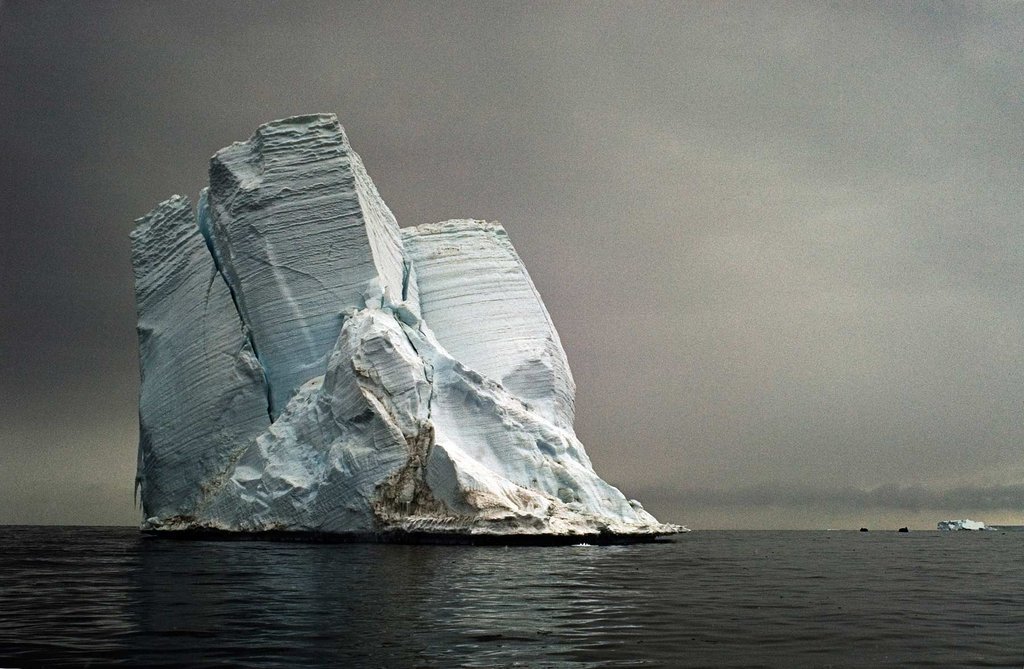
The Last Iceberg

A haunting image from photographer Camille Seaman. It’s from one of her powerful galleries depicting ice, the oceans, and polar life.

Screen Shot 2013-03-22 at 10.04.59 AM

As regular readers know, I believe Seeing Is Important. So I find this kind of photojournalism invaluable in terms of documenting change as well as eliciting emotion–which is a prelude to action.

Here, Seaman talks about her work:

Bill Gates Wants To Reinvent Meat

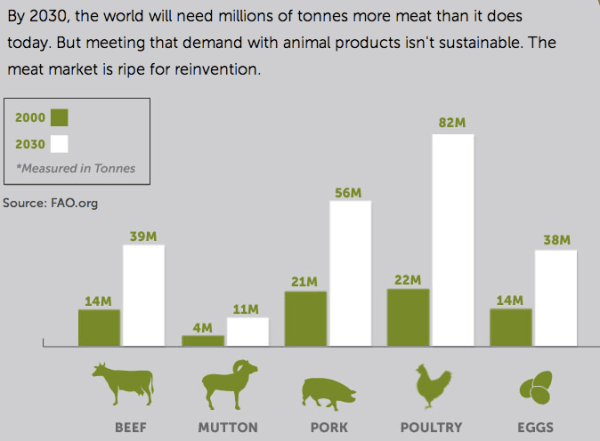
Bill Gates is a smart guy (obviously), and very good at looking at global problems and exploring creative global solutions. So it’s good news that he has focused his brainpower and advocacy on the fact that producing meat for everyone who wants to eat it simply isn’t sustainable (i.e. meat is killing the planet). The bad news he is promoting the wrong solution.

On his GatesNotes site, he now has an interesting section on “The Future Of Food.” It’s got lots of good data and thinking about why we can’t go on eating meat the way we do.

Screen Shot 2013-03-21 at 1.54.09 PM

Now, you’ll notice that one of the comparative items in the second and third slides is “Beyond Meat.” That is a meat substitute that Gates seems to be excited about.

His thinking is that we’ll never get the human race to move beyond meat and go vegetarian, so the solution to the impending meat bomb is to develop meat Continue reading “Bill Gates Wants To Reinvent Meat”

Film Fest: Wild Things

Nope, not more news about Blackfish.

But I wanted to take note of this documentary about the obscure Wildlife Service department of USDA, which every year kills 100,000 coyotes, bobcats, foxes, wolves, bears, and mountain lions. Two of the methods favored: baits traps containing spring-loaded poison cartridges, which shoot sodium cyanide into an animal’s mouth, and shooting animals from aircraft.

It’s not exactly what you would call living in harmony with the natural world.

OnEarth explains:

“It’s blatant killing,” former Wildlife Services employee Gary Strader says in the film, explaining the mindset of the agency where he used to work. “It’s just flying around — there’s a coyote, let’s kill it. There’s a coyote, let’s kill it. Let’s kill it, let’s kill it. You know, it’s just every coyote they see, they’re gonna kill it.”

And that’s just what the agency does on purpose. A Sacramento Beeinvestigation last year found that Wildlife Services has also accidentally killed more than 50,000 animals since 2000, including bald eagles, endangered wolverines, family dogs, and several species considered threatened or imperiled by wildlife biologists. And 10 plane crew members have died in crashes since 1989 during aerial gunning operations, including two in 2007, the Bee reports.

What’s the point of all this death and destruction? The Department of Agriculture says it’s spending about $30 million a year to protect commercial livestock from coyotes, wolves, and other predators. (It’s harder to argue with some of Wildlife Services’ other roles, like controlling rabies and removing geese from airport runways — although some people object to lethal measures there, as well.) The economic case for killing predators to protect livestock is pretty shaky, though. A 2001 Governmental Accountability Office report could find no independent studies of the costs and benefits associated with Wildlife Services, and it urged the agency to develop more nonlethal means of protecting livestock, including wildlife contraceptives and scare devices triggered by motion sensors.

The scientific argument for lethal control is even worse. As the Bee reports, a growing body of scientific research has found that by killing predators in such large numbers, Wildlife Services is “altering ecosystems in ways that diminish biodiversity, degrade habitat, and invite disease.”

More info here.