This must be a good omen: that’s ex-SeaWorld trainer John Hargrove on the slopes, 8 hours before the Blackfish premiere:

This must be a good omen: that’s ex-SeaWorld trainer John Hargrove on the slopes, 8 hours before the Blackfish premiere:
I’m in Park City, and looking forward to the start of Blackfish screenings at Sundance. I’ll be trying to post some updates on this page, but given the pace of things, and the ease of posting to Facebook while on the move, I’ll probably be posting more frequently to my Facebook page. Score one for Facebook over WordPress.
Here’s a nice preview I found this morning, which has Gabriela explaining what Blackfish is about and what it took to make the film:
Synopsis:
Notorious killer whale Tilikum is responsible for the deaths of three individuals, including a top killer whale trainer. Blackfish shows the sometimes devastating consequences of keeping such intelligent and sentient creatures in captivity.Blackfish quick pitch:
The story shows us what can happen when you put one of the world’s most intelligent, powerful, and beautiful predators in a tank of water, make them do tricks, and “add humans” to the recipe.Why it’s worth checking out at Sundance and beyond:
Oh I think you might be in for a ride. I guess I’m hoping you experience the same shock and discovery I experienced while making the film. But I had 2 years. You get 82 minutes!How it all came together:
I think the thing that takes everybody by surprise is that I took my kids to Sea World multiple times before making this film. When I started making the movie, I thought I was making a movie about the death of a trainer. It was only when I started filming that I discovered that nothing in this industry is what it seems. I was blown away by what I learned. So from that moment on, I think the biggest challenge for me was not putting things in the film. There was so much disturbing information, I found myself wanting to shoe horn any alarming fact into the film, even if it wasn’t part of the story. But in the end, I refrained because I didn’t want the film to feel manipulative. I knew if we had a chance to make this film stand out, it would be because we stuck to telling the story, not inundating an audience with damning facts designed to scare them or piss them off. So one of my strongest challenges was staying disciplined about telling the story. I think another of the biggest challenges was trying to interview people. It’s amazing how terrified people are of that marine park. Sometimes people would be willing to speak anonymously, but even they would eventually back out for fear of repercussions. Twice we had already flown to locations, unpacked our gear, only to learn that our interviewees had backed out. It was frustrating. This extends to other parks too. Our fixers at Loro Parque were terrified of being on camera for fear of what the owner of Loro Parque would do. They stood away from our cameras and whispered when they spoke. I want to say there was nothing to be afraid of, but we were followed and our pictures were taken on more than one occasion.On the Blackfish clip (click here):
The clip is actually our opening. I thought of the scene while I was interviewing a trainer. He was describing what it was like to do a “rocket hop.” This is a trick the experienced trainers do at Sea World, where the trainer is launched up into the air essentially off the nose of an orca. To me, the scene is a visual metaphor for the spectacle of the show above water versus the reality underneath. Above water you see a brilliant spectacle, a beautiful show with happy animals and trainers. Beneath the surface, you see what could arguably turn into a terrifying interaction at any moment. It still scares me every time I watch it!
 As many of you might know, for the past 18 months I’ve been helping documentary film-maker Gabriela Cowperthwaite make a documentary about Tilikum, Dawn Brancheau and SeaWorld. She first contacted me about the idea after reading Killer In The Pool, and the aim of the film is to try and help people understand why Tilikum’s life resulted in Dawn Brancheau’s tragic death.
Now the film is finished. It’s called Blackfish, and it will be shown to an audience for the first time on Saturday evening at the Sundance Film Festival (here’s the film’s page).
We’ve been flying below the radar, but here’s an early mention about the film, in a story about Hollywood and orcas. And Indiewire recommended it as one of 20 films to see. They also posted the only clip of Blackfish to be released so far. It’s the intro to the movie, so just a taste of what follows (click the image to play):

I just arrived in Park City for Sundance, and will soon be joined by the full production team as well as many of the trainers interviewed in the film. I’ll be posting about the premiere and the Sundance experience over the coming week, so stay tuned. In the meantime, here is Gabriela talking about Blackfish:
Off on a reporting trip until early next week, so limited (if any) posting.
Magazine: Outside
Location: Niagara Falls, Canada
Topic: A man and a walrus called Smooshi.
Should be interesting.
In the meantime, here’s a haunting and thought-provoking song that I have been giving heavy playtime. Anyone have any suggestions to match it?
Last month Greenpeace threw my minimal-impact (minimal shopping, minimal fashion, minimal thinking) clothing strategy into chaos by calling Levis out regarding hazardous chemicals.
This was a problem, because until then my entire wardrobe was based on Levis jeans, hand-me down clothing from various relatives, and free sailing apparel (which is one of the many perks of writing about the sailing world–though my wife does get embarrassed that most of my shirts that have boat names like “Tsunami” stitched on them).
I didn’t have to think about what to buy or wear. I was happy. But if I couldn’t wear my jeans in good conscience, what could I wear? Happily, the folks at Repair The World, which makes Earth-friendly clothing from recycled cotton scraps and recycled plastic bottles, stepped forward to help me resolve my clothing crisis. (You can read more about Repair The World here).
They took pity on me, and offered to send me one of their shirts, for a test run. So I selected a long sleeve t-shirt, not really knowing what to expect. I was fully prepared for a scratchy, ill-fitting, shirt that might melt if I got too near a lamp. Instead, I opened the mailer to find a shockingly soft, well-made, long-sleeve shirt. Exactly the sort of thing a lazy environmentally conscious person could rely on day after day.
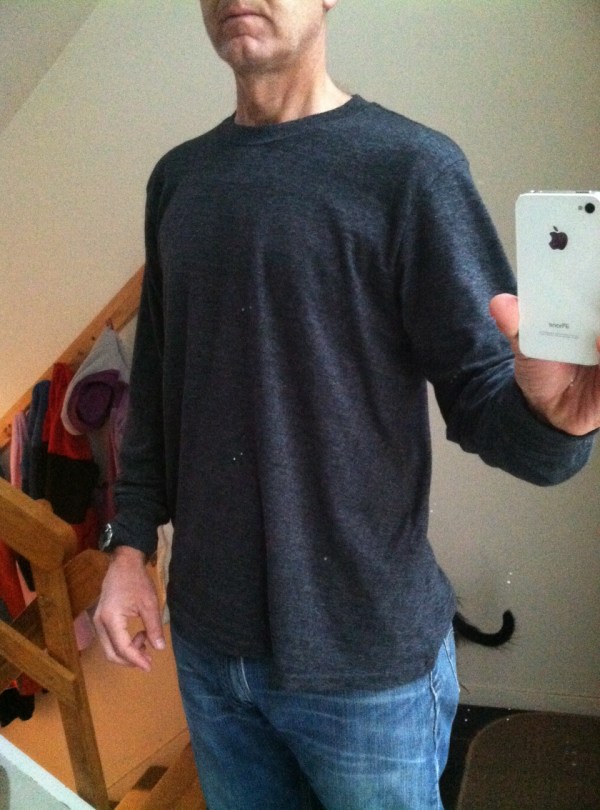
I’ve been wearing it for a week now, and it even (unintentionally) went through a full wash and high heat dryer cycle. Came out fine. (No, I haven’t grown a tail as a result of wearing the shirt; I guess the dog didn’t want to be left out of the photoshoot).
The material is quite thin, so it will be interesting to see how long the shirt lasts. As you can, see I am sticking with my Levis down below (no Anthony Weiner pictures for me; and Levis has agreed to address the problem of chemical release). But it seems that there just might be an ethical clothing solution for those in search of one. And you have to admire the ingenious effort to come up with a clothing fabric that tries to address the environmental shortcomings of cotton (even organic cotton), which takes huge inputs of water and energy to produce and process.
I don’t know if it is something that the mass market will go for (because the mass market is not really that concerned about the future). For anyone who thinks about what they eat, and what they wear, though, Repair The World just might have some clothing for you. If necessary, you can stitch boat names on it yourself.
According to NOAA, 2012 was the hottest year EVER for the lower 48 US states. More here and here.
This isn’t shocking news for most people, who understand that the climate is warming. We get these sorts of stories all the time now (just like we seem to get school shootings; be nice if political leaders would at least think about climate action, too). What most people don’t really understand, though, is the magnitude of change required in the pricing of carbon, and in their lives, to address this threat (which along with nuclear proliferation is clearly the greatest threat facing not just the United States, but humanity). I’m going to try to look into that question in more detail this year.
For now, though, some graphic illustrations of just how far off the charts we are going:


Here’s your Coast Guard in some hot video rescue action (What? Is there a video editing class at the Coast Guard Academy?)
This first video is a compilation to set up their annual video contest:
And this is the contest winner. Who’s ready to enlist?
Buzkashi is the Afghan national sport. It’s like polo, except the riders play with a headless, disemboweled goat. Buzkashi Boys is a short film about the ambitions of young Afghan boys that is getting Oscar buzz. It looks like a fascinating journey into the desperation and savagery that poverty and illiteracy can breed.
To fix the world, first you have to fix people.
Buzkashi Boys Trailer from Sam French on Vimeo.
 We are a culture which obsesses about the risks and benefits of just about everything (which in itself is probably a stress risk), particularly when it comes to human health and longevity. And we usually do it badly.
So, at the risk of feeding that obsession, here is some actual science (presented with the help of some very nice graphics):
“I hate when someone tells me that something is risky,” says David Spiegelhalter, a professor of risk assessment at the University of Cambridge. “Well, compared to what?”
To answer his own question, Spiegelhalter converted reams of statistical risk tables into a simple metric: a microlife—30 minutes. If you smoke two cigarettes, you lose 30 minutes of your life (top graphic). Exercise for 20 minutes, and you gain two units of microlife. Over time bad habits accelerate your aging, and good habits slow it down (bottom graphic). “That seems to resonate with people,” Spiegelhalter says. “No one likes to get older faster.”
This data caught my roving eye, to no ones surprise, because Spiegelhalter flags red meat and sitting, two topics which I have beaten to death featured (and, yes, I am still standing when I work). I will also be glad to show my wife the data regarding the beneficial effects of 1 serving of alcohol (and even if you have two servings, you make a net gain of 1/2 microlife–funny how I did that math so quickly).
Anyhow, how many microlives are you gaining or losing every day?

More on risk from Spiegelhalter in this TED Talk. It is very useful info to help me achieve my ambition of NOT having the last thought that goes through my mind be: “I am so stupid.”
Sadly, Spiegelhalter doesn’t have great news for cyclists (mostly because drivers are so dangerous, I suspect). But it is a very compelling way of looking at the world, and public policy and personal decisionmaking would be VERY different if we all thought about risk in such an analytical manner.:
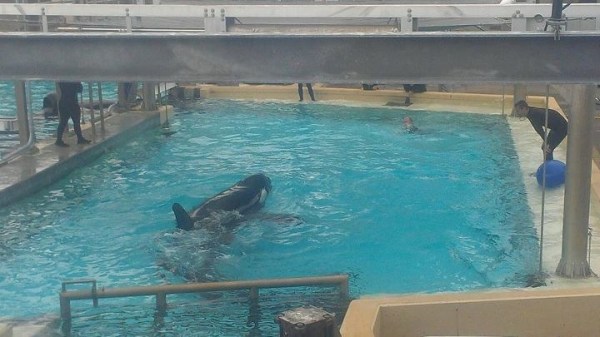
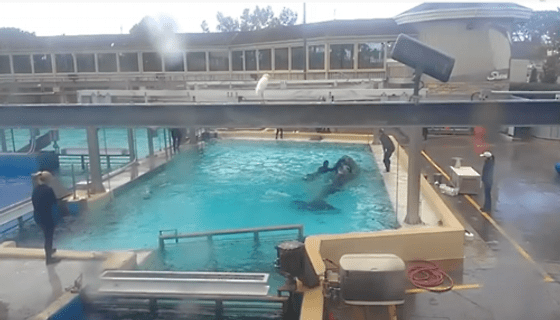
Last month, I wrote about SeaWorld’s whale interaction protocols since Dawn Brancheau died, and the fact that waterwork desensitization with certain whales had advanced to the point of swimming with whales in the med pool.
This picture of Orkid in the med pool with a trainer in San Diego is now making the rounds online:
Update: here’s one more.
 The Earthist Chronicles