The latest evidence: two fin whales enjoying the waters off the port of Marseilles.
The graceful pair of fin whales was filmed Tuesday in waters off the Calanques national park, a protected reserve of outstanding natural beauty next to the usually bustling but now locked-down Mediterranean port city of Marseille.
Didier Reault, who heads the park board, says it is “very, very rare” for fin whales to be spotted and filmed at such close quarters in the reserve’s waters. The whales usually stay further out in deeper Mediterranean waters but seem to have been drawn in by the lockdown-driven freeze on maritime traffic, water sports, pleasure fishing and pleasure craft, Reault said.
“The absence of human activity means the whales are far more serene, calm and confident about rediscovering their playground that they abandon when there is maritime traffic,” Reault told The Associated Press.
It must be such a strange time to be a marine mammal, and to suddenly enjoy oceans mostly free of human ship traffic and noise. It will be equally confusing when all the noise and intrusion suddenly starts up again.
If only we could be inspired by what we seeing with flourishing wildlife, and reductions in carbon and pollution all over the planet, to do everything just a bit (well, alot) differently.
“Dammit, this trainer’s runny nose is getting all over me.”
Maybe the world–forced into social-distancing lockdown and economic pain–is finally waking up to the many dangers of zoonotic viruses that can pass back and forth between humans and animals, and how close contact between humans and animals in factory farming, the bushmeat economy, and the wildlife trade and its “wet markets,” sharply elevates the risks.
And we have also seen how zoo animals, like a tiger at the Bronx zoo, can “catch” a virus from a human. Now the Voice Of San Diego notes that Sea World’s Shamu, and two other killer whales, were also likely infected by a flu virus passed from a trainer:
SeaWorld’s founding veterinarian was named Dr. David Kenney, a young man in the 1960s “who took credit for naming Shamu … and then figured out how to fly her to Sea World from Seattle,” according to his 2012 obituary in the Wall Street Journal.
In January 1969, Kenney noticed that Shamu and two other killer whales named Ramu and Kilroy seemed out of sorts. According to The San Diego Union, they had “bad cases of the sniffles, poor appetite, weakness and that all-over aching feeling.” Shamu, the paper reported, had been “moaning all day” and was “lethargic and irritable.”
The killer whales got a lighter schedule (although they apparently didn’t get to sit around and do nothing), and Kenney wondered whether they’d come down with the human flu. “We can’t be certain that they have human influenza,” he told the paper, “but the symptomology correlates, and blood tests indicate their infection is viral in nature.”
That killer whales in captivity can be victim to viruses they likely would not pick up in the wild, has already been established. And now Ingrid Visser and 20 scientists have published a detailed review of novel viruses in captive marine mammals and issued a call for killer whales and other marine mammals to be added to a permanent ban on the import of wildlife into China. They note that dozens of captive orcas have died from respiratory infections over the years, but that we don’t really know the extent of the problem because so many necropsies are kept confidential. It’s an eye-opening review, and you can read it here (and below):
Factory farms and wildlife markets are no doubt the most worrisome vectors for zoonotic viruses. But the fact that captive marine mammals and other zoo animals have also been infected by viruses that likely were passed from humans, and could themselves be the source of viruses that pass to humans, is just one more urgent reminder that humanity needs to dramatically change its relationship with animals–especially the degree to which they are commoditized and industrialized, and brought into the human economy.
Commercial fisheries are yet another example of the yin and yang of the pandemic era. The US commercial fishing industry, like so many industries, is being crushed, with demand plummeting:
The novel coronavirus pandemic has destroyed demand for seafood across a complicated U.S. supply chain, from luxury items such as lobster and crab, generally consumed at restaurants, to grocery staples sourced from the world’s fish farms.
Now, with restaurants closed, many of the nation’s fisheries — across geography, species, gear types and management — have reported sales slumps as high as 95 percent.
Boats from Honolulu to Buzzards Bay, Mass., are tied up dockside, with fisheries in the Atlantic, the Pacific, the Gulf of Mexico and Alaska affected, throwing thousands of fishermen out of work and devastating coastal communities.
This is brutal for fishing industry workers, and the relief bills coming out of Congress do not do enough to cushion the blows. But it is logical to assume that this forced hiatus for US commercial fishing is a big benefit to all the fish stocks commercial fishermen target.
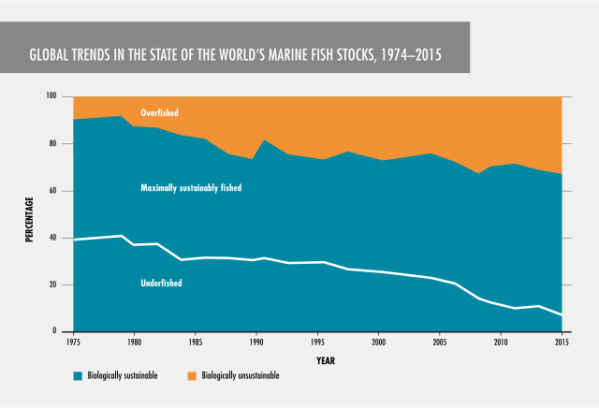
In the meantime, it is worth asking whether this pandemic might be a good time to restructure and shrink the global fishing industry. All the blather about “sustainable fisheries” aside, humanity is devastating fish stocks throughout the oceans. Only a tiny percentage is not overfished or maxed out (and, remember, that is a self-interested human judgement). If the fishing industry comes back from COVID, much smaller, and puts a lot less pressure on global fish stocks, that would be a good thing.
That is not to advocate throwing fishermen around the planet into poverty and destitution. But it is to say this would be a good time for governments everywhere to help idled fishermen with the financial support and education they need to find new ways to make a living. Like regenerative agriculture, for example.
Climate change had already brought humanity to an inflection point that demands global change. COVID is reinforcing, and bringing urgency, to that inflection. The massive disruptions of this pandemic are costly and painful. They are also an opportunity to revolutionize how we live and how we care for the planet.
This is why I have resolutely avoided the series and the ensuing “Tiger King” craze. I didn’t care if it was Blackfish. But I did care if it put the plight of the animals at the heart of the story. And it doesn’t:
Many of the interview subjects featured in “Tiger King” say the story was presented to them as one that would expose the problem of private big cat ownership in this country, following in the tradition of many conservation-themed documentaries. Some in the film even say Eric Goode and Rebecca Chaiklin, the show’s co-directors and co-producers, claimed to be making the big cat version of “Blackfish,” the award-winning 2013 documentary that spurred widespread backlash against SeaWorld.
“Tiger King,” however, “is not the ‘Blackfish’ of the big cat world,” said Manny Oteyza, the producer of “Blackfish.”
Instead, big cats and the issues affecting them are completely lost in the show’s “soap opera-esque drama,” Dr. Nasser said.
Film-makers make lots of artistic and subjective choices. But when truth and compassion get abandoned in the effort to amp up the entertainment, then that is a deal-breaker.
I don’t see any real outcry about roadside zoos keeping exotic animals. I do see lots of attention being paid to Joe Exotic, and whether Trump should pardon him. What more do you need to know about the impact of the series?
The novel coronavirus is giving us a novel glimpse of one of the many benefits to the planet that would occur if humanity could slow its roll.
But one unintended upside to this crisis has been improved air quality, particularly in the hardest-hit areas where the most draconian measures have gone into force. This has been evident in Asia, including China’s Hubei province, where this virus began spreading among humans. It’s also a trend observed in Italy, another devastated region with several thousand deaths.
Now, given that all but a handful of states have implemented stay-at-home orders, the air-quality shifts are also being seen in the United States. This offers a rare — and unintended — large-scale experiment for scientists to see how human emissions contribute to hazardous air quality and analyze the effectiveness of particular policy ideas…[snip]
…Before stay-at-home orders were issued March 16, Zhu said, the EPA’s Air Quality Index, which incorporates multiple air pollutants, including NO2 and PM2.5 (fine particulate matter), was about 60, or in the “moderate” category. Since then, it has improved by about 20 percent and recorded the longest stretch of “good” air quality in March seen since at least 1995.
When a sharp reduction in human presence and activity leads to visible improvements to the welfare and wellbeing of the planet and its other species, it is time to take a hard look at what we could be doing to live more lightly.
“I know, I know. I’m fascinating.” (Collared wolf from the Druid pack, Yellowstone National Park, NPS)
Unless you are an elk, or rancher, I guess. But they are a great example of the importance of top predators to entire ecosystems.
Reintroducing the wolf to Yellowstone is arguably the world’s greatest wildlife experiment. The wolves’ progress has been documented meticulously by a team of hiking, driving and flying biologists and passionate volunteers — so much so that no wolf study comes close to yielding its abundance of information. The research generated has been distilled into a new book, “Yellowstone Wolves: Science and Discovery,” assembled by three of the biologists who studied the wolves’ return.
“It’s the best place on the planet to view wolves,” said Dr. Smith. Elsewhere, wolf biologists must fly and canoe and hike into remote areas and sneak through forests to spy on wolves. In Yellowstone, says Dr. Smith, “I can drive out to watch wolves with a cup of coffee in my hand.”
At the time the first 14 wolves were released in 1995 (followed by another 27 wolves over the next two years), some 20,000 elk populated the park’s northern range, known as the Serengeti of North America for its profusion of wildlife. With few predators, elk had for decades gobbled up anything green that poked above ground. Today, the elk population totals 6,000 to 8,000. Wolves, at the same time, have made a full-scale return to the Northern Rockies. They now number about 1,500 in Montana, Idaho (where another group was released) and Wyoming, with 350 to 400 in and around Yellowstone. Outside Yellowstone, they can be hunted.
Some believe allowing wolves to be hunted makes their presence more acceptable. “A little blood satisfies a lot of anger,” said Edward Bangs, the retired U.S. Fish and Wildlife Service biologist who was in charge of reintroducing the wolves in 1995.
Of course, in my world there would be no combustion engines in Yellowstone, so anyone who wanted to see wolves (and wildlife) would have to walk. And for sure instead of anger (and hunting) there should be gratitude for the insight and changes the wolves have brought to Yellowstone, and a commitment to restoring predator-prey balance in wild landscapes because that is what wilderness needs to thrive.
That requires elevating the interests of wilderness alongside human interest, and in some cases above it, which would transform our relationship with nature and be a huge step toward revitalizing the natural world.
But, back to wolves. And a podcast that will enthrall you even more with their lives and culture.
New aerial data from Professor Hughes and other scientists released on Monday shows example after example of overheating and damage along the reef, a 1,500-mile natural wonder. The survey amounts to an updated X-ray for a dying patient, with the markers of illness being the telltale white of coral that has lost its color, visible from the air and in the water.
The world’s oceans, which absorb 93 percent of the heat trapped by the greenhouse gases that humans send into the atmosphere by burning fossil fuels, are warming up 40 percent faster on average than scientists estimated six years ago.
Nature is under constant pressure from humanity. But when large-scale systems are failing before our eyes, you have to wonder what the trophic consequences will be.
I’m not sure if the rampant degradation of the natural world–particularly its icons, like the Great Barrier Reef or the Amazon rainforest–will ever trigger a real shift in human culture and practice. I suppose, eventually. Now would be good, though.
It’s not good to be SeaWorld (or its CEO) these days.
SeaWorld Entertainment’s chief executive has resigned only five months into his job, becoming the third leader of the theme park company to depart in just over two years, according to a company filing released Monday.
Sergio Rivera cited his disagreement with the board of directors’ involvement in decision-making at the company, according to a filing with the U.S. Securities and Exchange Commission.
His predecessor, Gustavo “Gus” Antorcha, cited a similar reason for his leaving last September [snip]…
…The spread of the novel coronavirus has paralyzed the theme park industry. Like most other theme park companies operating in the U.S., SeaWorld’s 12 theme parks have been closed since mid-March.
The company said more than a week ago that it was furloughing 90% of its workers.
It would be interesting to know just what, exactly, is causing so much turmoil between SeaWorld CEOs and the SeaWorld Board. Whatever it is, the underlying problem is that SeaWorld’s business model, and its reliance on captive animals and large crowds, is simply not a good fit for today’s world.




 The Earthist Chronicles