Thought-provoking graphic showing what parts of earth will be submerged by rising sea levels, according to timing and global warming milestone (click image for full-size):


Any discussion of human fishing practices has to start with this chart (you know how I love infographics). Click image for full size:
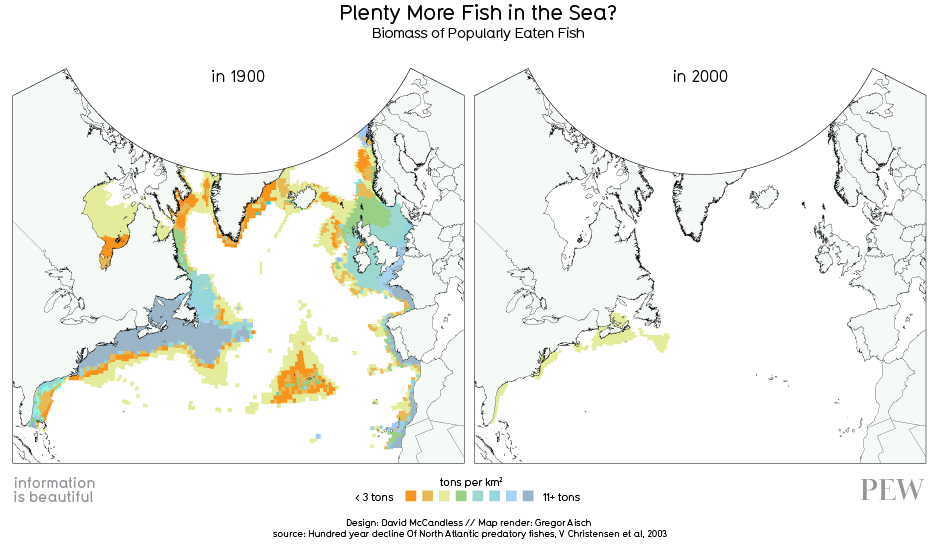
The data presented here is damning on two levels. First, as a perfect visualization of the Tragedy Of The Commons, in which we don’t have the will or the wisdom to steward resources on a global scale, instead just seeking profit wherever it can be found, nevermind the fact that over time we are destroying the very stocks we seek profit from.
And second, because lots of the earth’s population relies on dwindling stocks of fish. This is a problem that Carl Safina and Brett Jenks focus on in a recent op-ed that argues for turning over fishing rights to local communities:
The journal Science recently published the first comprehensive analysis of more than 10,000 fisheries — roughly 80 percent of our global fish catch. The conclusion: fish populations worldwide are swiftly declining. This global analysis paints a stark new picture of a global ocean fished to exhaustion in an increasingly hungry world.
So, why are we hopeful? It’s because the analysis of global fisheries has a silver lining. We have not reached a point of no return. We have time. Solutions exist.
The good news is that many large commercial fisheries are already benefiting from the improved management of the last decade. The harder problem is with smaller-scale fisheries that local communities rely on for food and income. The fact is that small-scale fishers — who fish within 10 miles of their coast — account for nearly half of the world’s global catch and employ 33 million of the world’s 36 million fishermen, while also creating jobs for 107 million people in fish processing and selling [pdf]. Mostly poor, they live mainly in areas lacking fisheries management, monitoring and enforcement. No one is in a position to formally declare their fisheries “disasters.” They must just endure their situation. Or — take control of it.
Safina and Jenks propose a hyper-local approach to managing fisheries, called Territorial Use Rights, or TURF. Here’s how it would work:
In exchange for the privilege of exclusivity, local fishermen agree to establish and protect no-take zones. Results include increased fish populations, richer marine habitats, and coastlines less vulnerable to climate change — and more food for people.
Unleashing the self-interest of local fishermen to advance both conservation and economic development can create one of those rare win-win scenarios.
A growing body of research shows that fish populations inside a no-take zone can more than quadruple. Fish numbers outside the reserve can double. And, exclusive access enables investment and better management, increasing the catch’s value.
That feels right. No one cares more about managing stocks than the very people whose lives and livelihood depend on the stocks surviving. The challenge is that thousands of TURF zones would have to be created (and enforced) around the globe.

That’s really just another way of saying that we have created a big problem so we need a dramatic solution. And I wish humanity had a better record of tackling big challenges by putting long term interests on a par with short term interests.
But the basic theme of localism is a very powerful one. And there is plenty of evidence that fishing’s emphasis on industrial practices and international fleets has been an accelerating disaster. So, sure, if we are going to do anything we should go local–and encourage traditional fishing practices that don’t strip mine the seas.
It would also help if the billions of people who don’t NEED to eat fish to survive would start laying off the tuna, Chilean Sea Bass, shrimp, shark fin soup, and every other fish our lust for high-end, boutique, food is destroying.

Links to to ponder (or sleep on)…
Counterintuitive: Are electric cars worse for the environment than gas cars?

Two-Fer: I unburden myself of interesting links by handing you off to Mark Bittman unburdening himself of interesting links.

Alternate Reality: Planet Money assembles a spectrum of economists to craft a bipartisan tax reform plan that makes economic sense. They do. It’s really good. And almost none of it will ever get passed. But here is how it would be pitched:
 Or it could be that Happiness = Vegetables. Either way, researchers have established a correlation (and, yes, I’ve been waiting for this a long time):
People who eat more vegetables and fruits are significantly happier than those who eschew such foods.
Dartmouth University’s Daniel Blanchflower looked at the eating habits of 80,000 British citizens. He, alongside two British researchers, saw that mental well being — satisfaction with one’s life on a scale of one to 10 — rose alongside each serving of produce consumed daily…
[snip]…There is one big, outstanding question that he acknowledges: What’s the causal relationship? It could be that eating vegetables make people happy — or that happier people tend to chow down on more salads.
“It might be that we just have all these vegetarians that are richer or happier,” Blanchflower says. “There are definitely issues of causality. At the same time, I think what we’ve done here is establish correlation. I don’t think we expected to see the relationship we did. The reason you’re calling me is because this was unexpected.”
Nevermind they haven’t figured out which way the causation runs. The correlation alone is just one more reason to at least think like a vegetarian.
Now all they need to show is that vegetarians have more sex and we’ll be getting somewhere.
Okay, on one level this is a bit silly. But on a deeper level–i.e. what it says about the degree to which modern media has given up on informing in favor of (more profitable) gossip and entertainment, as well as the degree to which we are all becoming stupidly fixated on celebrity–it is troubling.
Because ocean acidification is going to affect your future, and the planet’s future, a lot more than the Kardashians will (click image for full size).
Oh, and I will send Kim K. a “Save The Whales” t-shirt if “ocean acidification” gets mentioned even once during tonight’s presidential debate.

 The idea that we might be able to establish a two-way conversation with dolphins is so intriguing that I wrote a story about it. I came away convinced that it will happen. The only question is how long it will take to get there.
If you are interested in knowing more, then you should check out this interview with evolutionary neurobiologist Lori Marino.
She knows more about the dolphin brain, and dolphin cognition, than most. Here’s a taste:
What’s currently most difficult in understanding the language of the Bottlenose dolphin?
We don’t have the Rosetta stone or a basic understanding of the nature of their communication system. We don’t know whether they’re using dimensional information, or categorical information. We don’t know how they parse their communication system.
We don’t know if they’re putting different components together in ways that we don’t.Do you think their whistle carries the most information content?
It’s likely. The dolphin’s whistles have been sampled, statistically-parsed and then analyzed to determine whether certain whistle types can be predicted from the same or another whistle type. Results show that dolphin whistle repertoires contain higher-order internal structure or organizational complexity. This suggests their whistle “language” contains elements loosely analogous to grammar or syntax in human language.
Read the rest. And if you want to stay on top of how efforts to communiocate with dolphins are progressing, then you need to check in with the Wild Dolphin Project.
Back to one of my favorite themes, because last night I saw the documentary “Chasing Ice.”
It’s about the quest of photographer James Balog to capture–through time-lapse photographs taken by remotely positioned cameras–what is happening to the earth’s great glaciers.
You may know that they are melting and shrinking. But knowing something and seeing something are two different things. And seeing Balog’s time-lapse sequences–which convey both the majesty of what we are losing and the relentless, rapid rate at which the loss is occurring–drives home the reality in a way that provokes truly powerful emotions.
Balog is one of a number of photographers who are focused on the Arctic. It is there, perhaps more than anywhere else on earth, that you can see the dramatic impact of climate change, both on the natural world and on animal life. And the fact that it is a true wilderness, mostly unspoiled by a direct human presence, makes its degradation all the more poignant. That, plus the fact that human culture is having such an outsized impact on the atmosphere that it is destroying an entire ecosystem REMOTELY.
Another photographer whose work is documenting this phenomenon in a compelling way is Florian Schulz. Outside Online recently published a series of Schulz’s photos, called Into The Arctic. Here are a few (full set is here):


Schulz has also taken to film to try to convey the experience and meaning of the Arctic.
Welcome To The Arctic from Florian Schulz on Vimeo.
It’s impossible not to see all this and not feel anger and despair at the lack of wisdom and caring involved. But it also makes me want to channel those feelings into a desire to change everything. More on that soon…
The Free Morgan Foundation, in advance of a new, Nov. 1, court hearing, has released a passionate PSA calling for Morgan’s release back into the wild.
Morgan’s story is a case study in how the cover of “rehabilitation” is sometimes used as a way to bring wild marine mammals into captivity, which is always looking to diversify the gene pool. I doubt Loro Parque or any other marine park would have been so eager to bring Morgan into their collection if the Judge that authorized that decision had said that she was not to be used for breeding.
I’m developing an iron law of marine park reporting, which is: the more detail you know the worse marine parks sound. Rarely do additional facts make you feel better about marine parks.
This law just received serious reinforcement by a devastating report in Canada’s The Star newspaper about the life of Kiska, the lone remaining killer whale at Marineland in Ontario.
Marineland has been in the news recently, over animal abuse allegations by former staffers. This new report does nothing to change the dismal picture of Marineland they painted.
Here’s what The Star reports on Kiska:
Kiska, the killer whale, swims alone in her pool at Marineland, often followed by a trail of her own blood.
Her tail has been bleeding off and on since July but has been getting progressively worse, according to Christine Santos, who has been one of Kiska’s primary trainers. She described the bleeding as “gushing” last week….
[snip]…
The Star obtained recent video of Kiska showing a blood trail from cuts in her tail. Once one of Marineland’s best show animals, Santos said she now spends her days swimming listlessly and scratching parts of her body against the sides and sharp fibreglass grates that run the circumference of her Friendship Cove pool.
Treating her is difficult because Kiska, about 37, has refused to go into the medical pool for the past month. Her behaviour has been “breaking down for some time,” said Santos. She won’t even present her tail for blood samples.
Santos believes there aren’t enough trainers to give Kiska and 39 beluga whales enough attention at Friendship and Arctic Coves.
Santos was fired Wednesday. She said she was asked to sign a document that included a statement she’d never seen animal abuse at Marineland. She didn’t sign because “it didn’t feel right.”
Marineland called Santos’ allegations inaccurate and false. Here’s a photo of Kiska, trailing blood, published by The Star (click image for full size).

The Star story also has some pretty gruesome details about a beluga transfer that went wrong:
Other whales have been bloodied at the Niagara Falls tourist park. On Apr. 11, 2012, after female beluga Charmin was left on a trailer when a crane jammed during a move to another pool, photos show the area soaked with blood…
[snip]…
Last April, staffers moved two belugas, Tofino, a male, and Charmin from Friendship Cove to the performing stadium pool. At the end of Charmin’s move, the crane set to lift her in a sling over to the pool jammed, and she was stuck on the flatbed, her tail thrashing against the metal slats and edges of the trailer, according to former senior trainer Phil Demers.
“It was one of the worst days of my life,” says Demers, who helped in the move. “It went on for at least an hour. . . . There was blood on Charmin, on the ground, on the side of the pool, on the pads — it was sprayed all over. The worst, though, was that she lay there all that time with the pressure of her heavy weight (about 1,350 kilograms) on her internal organs — so bad.”
Here’s a photo of Charmin’s bloody transfer (full set is here). Is it something that NOAA and the rest of us should keep in mind when considering what sort of stresses could be involved in Georgia Aquarium’s proposed transfer of 18 belugas from northern Russia to Atlanta, and then on to SeaWorld, Shedd Aquarium, and Mystic Aquarium?

All the staffer accounts that have been leaking out of Marineland this summer certainly paint Marineland as a poorly managed park where animals suffer daily (video here).
It’s possible that Marineland is, in fact, the worst park in North America. But who knows for sure? How much do we really know about all the other marine parks? It is not until insiders step forward and put the facts out in the light, or the parks open up to real scrutiny, that we can really know the reality.
(h/t to JF for alerting me to this story)
 Well, sort of.
A new study warns that humans are on the verge of extinguishing 25 species of primates:
Twenty-five species of humans’ closest living relatives – apes, monkeys and lemurs – need urgent protection from extinction, a report by international conservation groups said on Monday.
Many of the primates, from the Ecuadorean brown-headed spider monkey to the eastern black-crested gibbon in China and Vietnam, are under threat from human destruction of forests, from hunting and from illegal wildlife trade.
The study said five of the 25 most endangered primates were from Africa, six from the Indian Ocean island of Madagascar, nine from Asia, and five from South America, including the Ka’apor capuchin monkey in Brazil.
“Mankind’s closest living relatives … are on the brink of extinction and in need of urgent conservation measures,” said the report by groups including the International Union for Conservation of Nature (IUCN).
What’s striking is the global distribution, and the range of human activities that is threatening these primates. It illustrates how universally damaging human culture has become, and how radical the changes in behavior required to reverse human pressure on fragile species.
 The Earthist Chronicles