I have no doubt that the next great evolution in humanity’s relationship with animals is a steady expansion of animal rights that will start to elevate the most social and intelligent animals to an approximation of “personhood.”. I don’t know how fast it will happen, but I do believe that it will happen and that, say 100 years from now, people looking back on the way in which animals are treated today–in food production, in entertainment, and in medical research–will view us as certainly unenlightened and perhaps even barbaric.
There is similar energy in the effort to elevate the rights of primates and chimpanzees (also intelligent and social), and with regard to chimpanzees this is especially poignant as, unlike cetaceans, they are used for medical research.
It is a very complex issue because chimps arguably do have unique research value when it comes to finding cures for some human diseases (I don’t hold out much hope that humanity will stop entirely subordinating animal welfare to human welfare anytime soon–though I support the ethical argument to do just that). But the guidelines would at least be a significant improvement and set a much higher bar for chimp research. They are:
That the knowledge gained must be necessary to advance the public’s health;
There must be no other research model by which the knowledge could be obtained, and the research cannot be ethically performed on human subjects; and
The animals used in the proposed research must be maintained either in ethologically appropriate physical and social environments (i.e., as would occur in their natural environment) or in natural habitats.
These sorts of debates, and human consensus, move painfully slowly. But over years the accumulation of these incremental steps will add up to real change (I hope). I just wish that the process could be fast-forwarded from its current glacial pace.
UPDATE: Have to add this, since this 14-year old girl is a powerful example of how the future could look very different. You can imagine how an impassioned young person like this might help pick up the pace of change.
"Mmm, there's nothing better than tetracycline in the morning."
One of the most short-sighted and objectionable practices of factory farms (sadly, there are so many to choose from) is the massive use of antibiotics on healthy animals in an effort to stave off illness that might prevent getting them to the slaughter. And when I say massive, I mean massive. US factory farms pour some 30 million pounds of antibiotics into their animals every year (in contrast, humans consume just a few million pounds).
That’s a lot of antibiotics, and it is a practice that helps boost the profit margins of both Big Agriculture and Big Pharma. There’s a problem, though. A big one. Using such outsize quantities of antibiotics helps breed antibiotic resistant bacteria. And those hardy little bacteria kill lots of people every year.
The FDA has been aware of the resistance problem for many years. In 1977, it decided to act on scientific evidence and order farmers to stop using penicillin and tetracycline in farm animals. The law required the agency to act immediately. But under pressure from Big Ag and Big Pharma (80 percent of all antibiotics sold in the United States are fed to healthy animals), the agency dragged its feet and did nothing, even though public health and environmental organizations, including the American Medical Association(PDF), urged it to act.
With scientific appeals falling on deaf ears for decades, the Natural Resource Defense Council, joined by other plaintiffs, filed a lawsuit last spring seeking to make the FDA follow its own rules. In a calculated attempt to undermine the legal basis for the NRDC suit, the FDA’s recent reversal simply nullified the original 1977 order, in effect wiping out 35 years of history and scientific research.
So there you have it: your (totally corrupted) government at work.
Your smart policy response? Stop eating factory-farmed meat. Even better, stop eating all meat.
Greenpeace and Sea Shepherd confrontations with whaling fleets make for good television. But despite their efforts lots of whales still die every year (some 2000, in fact).
A minke whale is processed in Hvalskurður, Iceland. (Via WIRED. Photo: Dagur Brynjólfsson/Flickr
Environmental economists Christopher Costello, Steve Gaines, and Leah Berger think that market incentives might be a better way to reduce the numbers of whales killed every year. Writing in the January 11 issue of NATURE, they propose the equivalent of a cap and trade system for whales, which would allow conservationists to spend money on purchasing whale shares (and saving the lives of whales) in stead of spending money on chasing whaling fleets around the world’s oceans.
The proposed market would be patterned after a system known best known from fisheries management as catch shares: Sustainable harvest levels are quantified, a maximum quota established, and catch allotments put up for sale by the International Whaling Commission. Costello’s proposal would add the crucial wrinkle of allowing activists to buy shares, too. If they did, a corresponding number of whales would be removed from the quota. (Indigenous groups would receive a set number of shares to be owned in perpetuity, apart from the market — though those could conceivably be sold, too.)
According to Costello’s estimates, global whaling profits amount to $31 million, and likely less when government subsidies are removed. Mainstream anti-whaling groups — Greenpeace, Sea Shepherd Conservation Society, and the World Wildlife Fund — spend about $25 million to fight the hunts.
“This money could be used to purchase whales, arguably with the same or better effect,” write the researchers in Nature.
There is pushback over the idea that whales would continue to be treated as commodities to buy and sell, instead of exempted from human harvest because they are intelligent, social creatures.
But until humanity achieves a more enlightened and ethical understanding of the relationship between humankind and the other species on Earth–and can agree to leave whales alone–it makes sense to try any approach that actually reduces whale kills. Right now, money is what motivates mankind, so it’s an intriguing proposal.
You may not know it, but the single most powerful act you as a human being can take to fight global warming, fight the abuse of animals, and fight the outbreak of global superbugs like avian flu is to become a vegetarian (if you want to know why, read this book). How’s that for a three-fer?
So against that context, we have a good news/bad news situation to report.
The good news: Americans are eating less meat.
The bad news: Americans are still meat gluttons (we consume one-sixth of the total meat consumed annually by the planet, but represent only one-twentieth of the population).
(Source: Daily Livestock Report)
The NYT’s Mark Bittman digs into the data, and the possible reasons Americans are slightly reducing their meat consumption. At least part of the reduction seems to be that Americans are increasingly concerned about the moral and environmental implications of eating meat.
That’s a big deal, I think, because it suggests that awareness and knowledge (and not just cost) can change people’s attitudes about meat, and the frequency with which they eat it. And I hope to do a lot more writing about this because the consumption of meat has such a huge impact on so many critical issues.
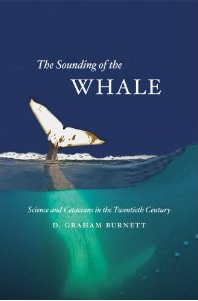
For anyone interested in whales and dolphins, this book looks fascinating: “The Sounding Of The Whale: Science And Cetaceans In The Twentieth Century.” It’s a masterwork by D. Graham Burnett, a professor of history of science at Princeton that explores the extensive–and sometimes brutal–history of humanity’s interaction with, and understanding of, cetaceans.
Here’s the publisher’s description:
From the Bible’s “Canst thou raise leviathan with a hook?” to Captain Ahab’s “From Hell’s heart I stab at thee!,” from the trials of Job to the legends of Sinbad, whales have breached in the human imagination as looming figures of terror, power, confusion, and mystery.
In the twentieth century, however, our understanding of and relationship to these superlatives of creation underwent some astonishing changes, and with The Sounding of the Whale, D. Graham Burnett tells the fascinating story of the transformation of cetaceans from grotesque monsters, useful only as wallowing kegs of fat and fertilizer, to playful friends of humanity, bellwethers of environmental devastation, and, finally, totems of the counterculture in the Age of Aquarius. When Burnett opens his story, ignorance reigns: even Nature was misclassifying whales at the turn of the century, and the only biological study of the species was happening in gruesome Arctic slaughterhouses. But in the aftermath of World War I, an international effort to bring rational regulations to the whaling industry led to an explosion of global research—and regulations that, while well-meaning, were quashed, or widely flouted, by whaling nations, the first shot in a battle that continues to this day. The book closes with a look at the remarkable shift in public attitudes toward whales that began in the 1960s, as environmental concerns and new discoveries about whale behavior combined to make whales an object of sentimental concern and public adulation.
A sweeping history, grounded in nearly a decade of research, The Sounding of the Whale tells a remarkable story of how science, politics, and simple human wonder intertwined to transform the way we see these behemoths from below.
This finback whale, found dead in the Baltic in 2006, was pulled from the sea by Greenpeace and dumped in front of the Japanese Embassy in Berlin as an anti-whaling protest. (Credit: Danny Gohlke/Agence France-Press — Getty Images)
And here is a passage from the New York Times review, which featured the above image, that in particular caught my attention:
From the likes of Hjort and Harmer and others, Burnett leads us to the superhumanly curious American A. Remington Kellogg, “the Prince of Whales.” Kellogg is perhaps the book’s most intellectually intriguing character, acting as a bridge between the gentleman scientists of the 19th century who had the luxury to leisurely catalog the world’s natural abundance and the conservation-minded biologists of the 20th who could see their research subjects vanishing before their very eyes. For Kellogg, the process of awakening to cetacean exceptionality was a grisly one. He was among the first to commission “vivisections” on porpoises even though, in his own words, “a live porpoise can be handled about as readily as a satchel of dynamite.” This did not deter the intrepid scientists who “fell to the unlovely task of restraining the furiously squealing animal in order first to expose the skull and then to saw into it to expose the brain.” When these operations were performed, Kellogg was witness to “a strangely large brain, one with elaborate patterns of convolution such as were generally thought to be more or less unique to human beings.”
Kellogg’s cruel-sounding investigations into cetacean morphology were paired with truly kind and selfless lobbying on whales’ behalf. In tracking Kellogg’s journey from naturalist to activist, Burnett makes good on his promise to show that “a history of whale science can shed considerable light on the changing understanding of nature in the 20th century.” Not only did Kellogg operate in a policy sphere, lobbying to create the Council for the Conservation of Whales, he also assiduously wooed the popular zeitgeist, most notably by working to produce the National Geographic article that would start to shift the general public’s perceptions of what had been largely maligned creatures. For any writer who has ever dealt with that hallowed magazine’s combination of nitpicking and bluster, the record of Kellogg’s editorial squabbles with National Geographic is worth the price of admission. “Left and right, he fought off editors’ desires to sensationalize cetacean ‘monstrosity,’ ” and at one point wrote to a colleague, “ ‘The publisher has the idea that all the pictures should be exciting, such as a whale running its head though a steamer and then winking its eye at the astonished crew.’ ” When the editors wanted to call the piece “Whales: Lions of the Sea,” Kellogg responded: “ ‘Whales are very distantly, if at all, related to the cat tribe. . . . Except when mortally wounded,’ they ‘are inoffensive and noted for their timidity.’ ”
It must be so hard to watch and bear witness to what happens in that Cove, and it is thanks only to the courage and persistence of Save Japan Dolphins and the other witnesses who spend day after day at the Cove that the rest of the world is not allowed to simply turn away and go back to playing XBox.
Here, for example, is SJD’s Heather Hill on what she saw today:
The boats slowly drove the dolphins towards the Cove, and divers lined the rocks, ready to intervene if and when the panic-prone dolphins entangled themselves in the nets or threw their bodies against the rocks in an attempt to flee. Because the pod was so large, the fishermen were unable to push them all into the killing Cove (out of the range of our eyes and cameras) at once, and for a while there were dolphins cordoned off in three different sections of the Cove. One lone dolphin swam between the outer nets while its family members were being slaughtered; watching, listening, and waiting. After those dolphins already under the tarps were either killed or otherwise restrained, the fishermen opened the inside nets so they could drive the remaining individuals to their death.
One ironic note: Check out the ad on the right that Google’s algorithm selected for me as I watched dolphins being stabbed and killed. I think the algorithm needs some tweaking
Dolphin Discovery is all over the Caribbean and uses wild-caught dolphins to stock their pools. When anyone buys a ticket to a dolphin show they are helping create the demand that sustains the slaughter in Taiji. Please think about that next time your child or a friend suggests going to a dolphin show.
And then do the one thing that can help end this barbarism: say “No.”



 Want to know who is dumping tons of greenhouse gases into the atmosphere? And where they are?
 You may not know it, but the single most powerful act you as a human being can take to fight global warming, fight the abuse of animals, and fight the outbreak of global superbugs like avian flu is to become a vegetarian (if you want to know why, read


 The Earthist Chronicles