Choosing The Right Stuff

American Apparel
Image via Wikipedia

More on the choices that flummox us: I was glad to see that apparel makers are going to start rating their products, because it’s pretty impossible for your average consumer (if they care) to have any idea what impact clothing choices have. So the Sustainable Apparel Coalition seems like the kind of innovation that is at least pointed in the right direction.

That made me wish it was easy to dig into the sustainability and environmental impact of lots more products, and–poof–I immediately stumbled across this outfit: The Good Guide (maybe it’s time to play the lottery). The Good Guide is basically a bunch of science geeks who are doing us all the favor of analyzing thousands of products, and the companies that make them (for the final rating they also take into account any conglomerates that might own the producer, as well, which is smart).

I was glad to discover that Levis gets a pretty green score (so I don’t have to figure out what else to wear).

Now it’s very unlikely that this sort of thing will drive the spending habits (for now) of anyone but eco-obsessed yuppies, but it is important that the idea of evaluating the things we buy according to how they impact the world is taking root. Even better would be if stores (I’m talking to you Walmart) committed to displaying this sort of score along with the products on their shelves. And I am sure that there will soon be an app that can scan a bar good and ping you a rating, which would make it even easier.

But nothing will really change unless sustainability and environmental and health impact are reflected in the price of a good (and not just the cost of labor and production, where all manner of abuses are hidden within an ultra-low price). You can’t fault people for wanting to save money. So the real revolution that awaits, the real revolution that is a prerequisite for the sort of change that will make a difference, is the adoption of an economic philosophy and approach that includes the external costs of making a good (impact on the environment, health of the workers, etc) in the purchase price of the good.

That is a world of $200 hamburgers, which is one way to make clear the massive shift in culture and economics that is at the logical end of this movement to start caring about how what we buy affects the earth and the future. Unfortunately, I don’t see that shift happening anytime soon. Listen to Raj Patel on this, and imagine how crazy he would sound to most Americans (and Glenn Beck’s head would explode). But Raj Patel is right.

Enhanced by Zemanta

Save The World? Get A Bike

San Francisco Critical Mass, April 29, 2005.
Image via Wikipedia

Figuring out how to save the world can be a complicated process. Paper versus plastic. Glass milk bottle versus carton. Car versus bike.


Oh wait, that last one is not at all complicated. It’s pretty obvious that transporting our human selves more frequently, when possible, by bicycle, is good for the planet and good for us (though apparently it is tragically annoying to some drivers; and I should mention that some guy in a car, for some inexplicable (really) reason, gave me the finger yesterday while I was riding).

Here in traffic-locked DC, it’s nice to see that this conclusion is starting to change the way people get around, and that bikesharing is taking off.

These kids in Nairobi agree, and they made a pretty good rap ode to how bikes can save the world (backstory is here):


Enhanced by Zemanta

Are Wild Orca Captures About To Begin Again?


The orca, the largest dolphin and pack predato...
Image via Wikipedia

Capturing killer whales from the wild has always been enormously controversial: first in the Pacific Northwest, where the first captures took place, and then in Iceland, where the marine park industry went after the Pacific Northwest capture industry was shut down (Iceland eventually shut it down, too). Marine parks, acutely aware of the bad publicity that came from taking killer whales from their wild pods, developed the techniques to breed killer whales in captivity, and since the mid-1980s the majority of killer whales in marine parks have been captive bred.

But it would be wrong to assume that killer whale captures in the wild are a matter for history. Killer whales are enormously valuable to marine parks around the world, and breeding them in captivity is not a simple matter. Recently, according to the Orca Home website, Russia extended a permit for the live capture of killer whales in Russian waters, and Japan might, too:

February 6, 2011:
Capture plans in Russia and Japan

Russia has extended the permit for allowing up to 10 killer whales to be captured from the wild, reports the Russian Orca Project.
And there rumours that Taiji has applied for permits to capture 5 orcas, one to replace Nami who was sold from Taiji to Nagoya and died on 14 January this year, one for Taiji and the others are probably destined for new projects in China.

It’s been a long time since the world has seen wild captures, and new captures would be highly controversial. Hardy Jones of BlueVoice.org, has long tracked the situation in Japan, and produced this video about a 1997 capture:

A lot less is known about Russian orcas, but a friend steered me toward this video that documents the the lives of killer whales that live off the Kamchatka Peninsula:

Part 1

Part 2 (which includes video of a 2003 capture operation that goes sadly wrong, starting at about 1:30)

I’ll be keeping an eye on what’s happening in Japan and Russia. No matter what you think of marine parks, I find it hard to believe even marine park enthusiasts can or would support this inarguably cruel and brutal process of procuring killer whales for family entertainment.

Enhanced by Zemanta

February Is When The Southern Ocean Takes Center Stage

(Originally published on SailingWorld.com)

It’s possible to get sick of winter weather (and here in the Mid-Atlantic, more is on the way). But I don’t think it’s ever possible for any sailor to ever get sick of the Southern Ocean or the Jules Verne (unless, of course, you’re actually in the Southern Ocean, where, by the time you reach Cape Horn, I expect you’re thoroughly tired of the Southern Ocean).

But, I digress. Where was I? Oh yes, I mention this because February is prime time in the Southern Ocean. And 2011 is a serious banner year. We’ve already got the Barcelona World Racers hitting their stride as they accelerate south of Cape Town (see the tracking chart here). It involves a lot of this:

Jules Verne bidder Banque Populaire is diving south and is now into the Roaring Forties as well. No Southern Ocean vid, yet, but this will give you a sense of what’s possible:

UPDATE: BanquePop has retired, after hitting a UFO (Unidentified Floating Object) at 37 knots just after entering the Roaring Forties, and smashing up its daggerboard and daggerboard case. Like Groupama 3, the boat whose record they are trying to beat, they will have to make repairs and try again. Such are the predictable vagaries of Jules Verne record sailing, as noted below.

But wait! That’s not all. Thomas Coville and Sodebo have just departed the English Channel and will be joining the party at the bottom of the world (barring breakdown or any more near-tragedies like this—34 seconds in you will stop breathing):

And last, and I’m sorry to say least (sorry Brad!), the Velux 5 Oceans racers are about to leave Wellington on the way to Cape Horn. Yep, all four of them. Though they did make a nice music video out of the Cape Town to Wellington Indian Ocean leg:

In short, it will be plenty crowded down south, with two races plus solo and crewed Jules Verne attempts. The beauty of sailing through this extraordinary ocean is that anything can happen. So the only prediction I will make is that something dramatic WILL occur. I just don’t know what, but I do know it will involve wind, waves (hopefully not ice), and some inspiring facet of the human spirit.

As I look outside at the latest wintry blast, it’s humbling to know that over the next few weeks some three-dozen iron-willed sailors will be doing everything they can to write themselves a new chapter in the storied history of the world’s greatest sailing ground. Everything in my world will pale alongside that.

Enhanced by Zemanta

I’m Down With Dropbox

Image representing Dropbox as depicted in Crun...
Image via CrunchBase

I keep reading about Dropbox (latest here), a program that allows you to store media and files in a special folder on one computer, which in turn allows you to synch it across all your computers as well as onto mobile devices. So no more e-mailing yourself files or loading up a USB stick so you can transfer stuff between computers and devices.

Here’s what Dropbox does (full tour is here):

Dropbox is software that syncs your files online and across your computers

Put your files into your Dropbox folder on one computer, and they’ll automatically appear on any of your other computers that also have Dropbox installed (Windows, Mac, and Linux too!). You can even download Dropbox apps for your smartphone or mobile device (iPhone, iPad, Android, and Blackberry). Everything in your Dropbox is available from the Dropbox website, too.

That sounds pretty useful, and I am always using a USB stick to carry files around and create backups. So I downloaded Dropbox (and even talked my wife–who uses multiple computers–into it).

I love that every modern writing problem has a modern writing solution. And when I see enough writers talking (raving) about a program, that’s when I pull the trigger. Same thing happened with Scrivener, which I now use for all writing projects.

Enhanced by Zemanta

Do Orcas At Marine Parks Injure One Another? More Photos…

Loro Parque's Killer Whales

Last September I looked at the question of killer whales injuring other killer whales at marine parks (aggression within wild pods is very rare). Recently, I came across these pictures of some killer whales from the Loro Parque marine park in the Canary Islands. In 2006 SeaWorld loaned four killer whales to Loro Parque: Keto (a 10-year old male) and Tekoa (a five-year old male) were shipped from SeaWorld Texas; and Kohana (a 3-year old female) and Skyla (a 2-year old female) were shipped from SeaWorld Florida.

Part of the theory for why marine park orcas injure one another is that the groupings they find themselves in at marine parks are artificial. The groupings have more to do with the park’s needs than they do with family, or orca type ((i.e. killer whales with Icelandic roots might be placed with killer whales that have Pacific roots). And the groupings change as killer whales are moved around from one park to another for breeding, or any number of other reasons (including the need to sometimes separate warring killer whales).

In contrast, killer whale groupings in the wild are much more homogeneous, family-based, and stable. They speak the same language. The social order is set along matriarchal lines and killer whales settle into their place over decades. So it is not surprising that there is evidence (see the previous post for some of it) that killer whales in marine parks are much more prone to beating on each other as the social dynamic in marine parks is much more fluid, and the killer whales are less tightly bonded by language and genetics.

This, of course, is not an aspect of marine park life that marine parks or their supporters are eager to acknowledge or address. So it is always useful to see pictures that help convey what is happening in the pools.

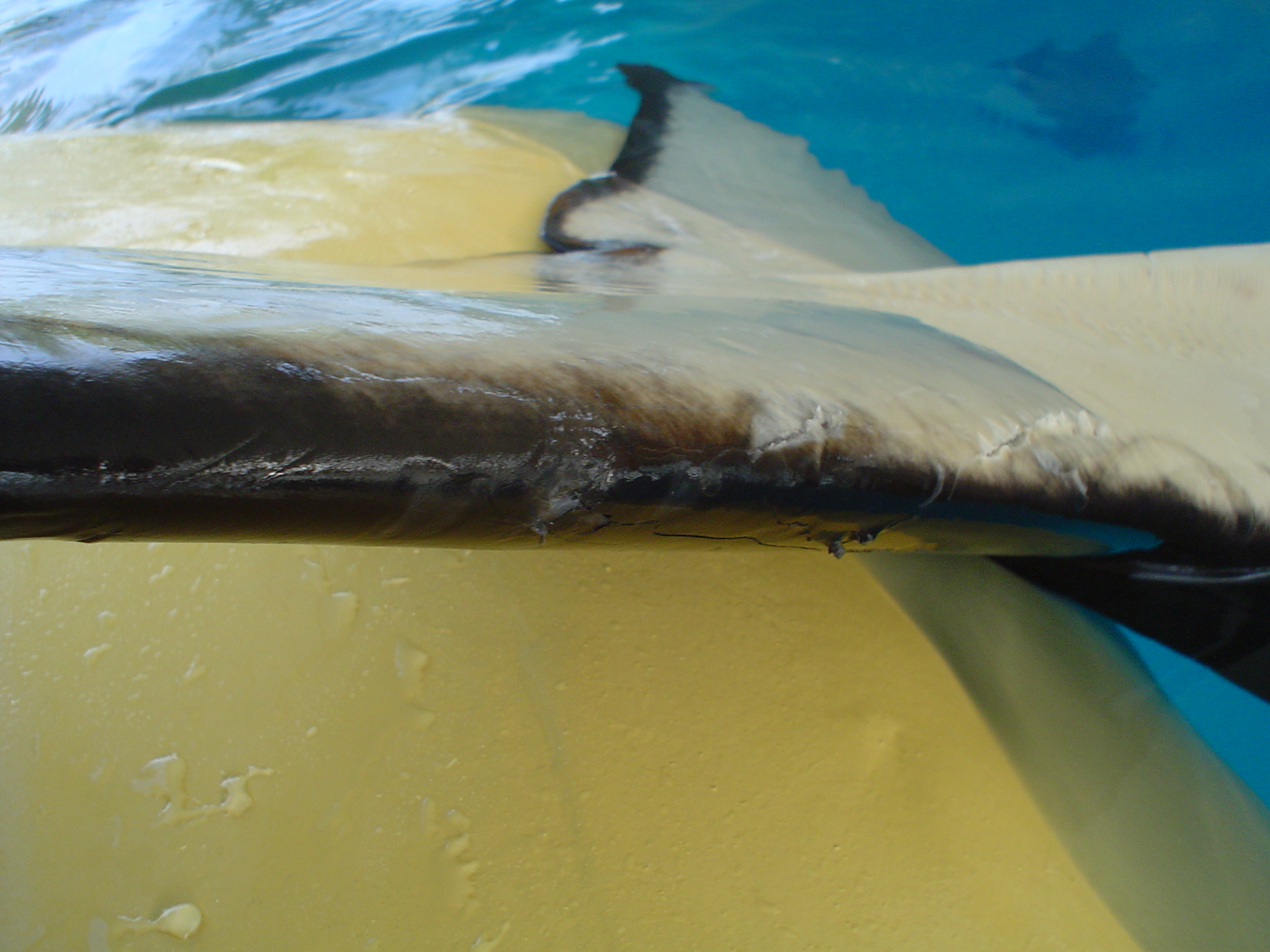
When the four SeaWorld killer whales arrived at Loro Parque in 2006, and were put together in the pools, a new social grouping was created. That demanded a new social order, which in turn meant some beatdowns as the killer whales tried to sort themselves out. These pictures show just part of the result:

These two show Kohana’s dorsal fin and tail fluke, after she was bitten by Keto:

And these two pictures show young Skyla’s raggedy dorsal fin after Kohana went after her:

If you have any photos that document this phenomenon of orca on orca aggression in marine park pools, please send them to me and I will post them as well. It is just one of the many factors that affects the life and psychology of killer whales in captivity (for a detailed report on all the factors that contribute to killer whale stress at marine parks, go here).

Enhanced by Zemanta

The Fun Of Frostbite Sailing

(Original post published over at Sailing World)

It's impossible not to like this...

When most people envision a perfect sailing scenario, they think of warm breezes and T-shirt weather. I like that, too, of course (you gotta go to Cabarete, if this is your ideal). And, sure, most of the sailing world right now is coming down off their warm Key West high, feeling all smug and superior. But increasingly, I am finding that the most fun I have sailing and racing my Laser is when the skies are gray, the air temps are cold, and there’s the possibility of snow.

Yep, there’s an excellent Laser frostbiting fleet here in Washington, D.C., courtesy of the Potomac River Sailing Association. They race just south of Reagan National Airport, on the river or in a shifty, flat-water cove that’s ideal for cold-weather sailing. I started racing with them a few years ago as a way to get outside on winter Sundays and make Laser-sailing a year-round thing. There are usually 15-20 Lasers racing, the competition is good and friendly, and the fleet is really well-organized. It’s everything you want, except, in theory, the cold weather. But now I find myself seduced by the sublime pleasure of winter sailing, too.

Of course, racing in cold weather in a small boat that goes upside down easily requires a slightly different approach. The fleet has a rule of thumb that if the wind speed exceeds the air temps, you think twice about sailing. Come to think of it, that rule would be REALLY wise to follow for anyone who sails in warm climes. And cold weather does sometimes prevent racing, as it did this past weekend, when ice sheets floated across the race course. The one guy who did go out still managed to have fun, and came up with some useful frostbiting rules of thumb: 1) Don’t sail into an ice field on an ebb tide—its ugly; 2) Set the sail at the dock to something you can live with—frozen control lines don’t move; 3) If you notice the RC boat has been hauled out, you might oughta head back to the dock.

Obstruction? Not according to the PRSA frostbite fleet.

The icy winter has also forced our frostbite fleet to resolve some difficult philosophical questions via the PRSA group e-mail list, such as: what kind of ice floes should be considered obstructions under the rules of sailing? I think the answer was black ice that would stop you short, as opposed to slushy, white ice you could potentially sail through, albeit slowly.

But the truth is, while there might be a few weekends per winter that require a hefty dram of masochism paired with a hefty dram of post-race whiskey, frostbiting in Washington, D.C., rarely involves actual frost. Hats off to those fleets further north, on Long Island Sound, Narragansett Bay, and beyond. So, while your friends might be impressed with how tough and dedicated you are to the sport of sailing—and one of the pleasures of frostbiting is to NOT disabuse them of this view—the reality is you’re often enjoying spectacular, 50-degree days.

In any case, whatever the temperature, a dry suit combined with modern fleecy layers can keep you as warm as you like. I often find myself sweating and taking off my hat to cool down by letting the steam rise from my head. The only real cold-weather dilemma I grapple with, truth be told, is whether to sail with gloves or not, since I can never find gloves that give me the same line feel and grip as my bare hands. Last week, I sailed commando in 37 degrees, and it was fine, with my overheated core pumping lots of warm blood into my naked digits. Nor sure it would be as simple in Newport, R.I.

Continue reading “The Fun Of Frostbite Sailing”

Two Former Orca Trainers Document The Deadly Stresses Of Captivity

Since the death of SeaWorld trainer Dawn Brancheau almost one year ago, the world has been learning a lot about more about the reality of life in marine parks for killer whales.

Now two former trainers have just released a powerful report that captures the full range of stresses suffered by orcas in captivity, stresses that likely contributed to the death of Dawn Brancheau (as well as a trainer named Alexis Martinez as a marine park in the Canary Island two months earlier).

2011-01-20-AlexisDawn.png
(Note: Images are from the report)

The former trainers, Jeff Ventre and John Jett (now a doctor and a professor, respectively), worked as trainers at SeaWorld Orlando (including with Tilikum) for a combined total of 12 years, and both knew Dawn Brancheau. The stresses they catalog include: aggression between whales, medical issues, captive breeding practices, and the total disconnect between marine park life and the natural world and social structures killer whales are used to in the wild.

2011-01-20-Kandu5Caption.png

In particular, Jett and Ventre break new ground by explaining how life at marine parks leads killer whales to damage their teeth:

Social strife and boredom accompanying orca captivity also contribute to broken teeth. Steel gates are the primary method of separating orcas prior to training sessions, shows, or when aggressive tensions exist between animals (e.g. Kayla and Kalina). It is common for separated whales to bite down on the horizontal metal bars, or to “jaw-pop” through the gates as they display aggression at each other. In addition, under-stimulated and bored animals also “chew” metal bars and mouth concrete pool corners, like the main stage at SWF. As a consequence, tooth fragments can sometimes be found on the pool bottoms following these displays. This breakage leaves the pulp of some teeth exposed.

This behavior, and the resulting broken teeth and exposed pulp, prompts SeaWorld to drill out broken or worn-down teeth to prevent abscess and infection. The resulting bore holes require trainers to irrigate the teeth multiple times each day (the authors note that SeaWorld trainers tell visitors this is evidence of the superior dental care the whales receive), and might be a vector for some of the mysterious infections which often seem to be the cause of death in marine park killer whales.

2011-01-20-KalinaTeeth.png

Continue reading “Two Former Orca Trainers Document The Deadly Stresses Of Captivity”

The Long Way Back: The Resurrection Of Ronnie Simpson

Sometimes sailing is more than a sport. It can also be a way of life that heals and saves. Last year, I came across the story of Ronnie Simpson, a Marine grievously wounded in Iraq in 2004, who was racing in the Singlehanded Transpac. I got in touch and it turned out he had quite an epic tale to tell. So I wrote it up in Outside.

Ronnie Simpson in Point Richmond, California, in November (Photo by Alex Tehrani)

Here’s the intro:

Ronnie Simpson ambles up from the docks of the Stockton Sailing Club. At 25, he is whip thin and browned by the Northern California sun. His hair is close-cropped, and he’s wearing his preferred uniform: boardshorts and a faded sailing T-shirt. He’s in Stockton to take possession of a 28-foot Albin Cumulus sailboat that he just bought for $2,800, with money borrowed from a friend. The boat is called Chippewa, and the cockpit is strewn with tools, gear, and empty beer cans. A dark scrim of weeds encrusts the bottom, but beneath the grime you can see the shape of a blue-water pedigree. Ronnie is taking Chippewa down the San Joaquin River to San Francisco Bay, to the Marina Village Yacht Harbor, in Alameda, where the boat will become his new home. As soon as he feels it’s ready to sail to Hawaii and beyond, Ronnie Simpson will do what he does best: take off and see what happens.

Ronnie looks like any boat bum who works odd jobs on the waterfront. He’s always up for a party or a deal on Craigslist, and he’s not averse to drinking beer within an hour or two of a late breakfast. He has a laid-back, renegade charm and tells stories as easily as he draws breath. He makes friends wherever he goes, and sometimes it’s hard to keep track of all the girlfriends (“she was soooooo hot”) who’ve wandered into his life. It wasn’t very long ago that he had just $15 to his name.

But Ronnie is not an aimless vagabond. To understand this, you need to take note of the long, moon-shaped scar under his left arm, which arcs around his rib cage from pectoral to scapula. You need to observe the seven-inch vertical scar that bisects his stomach, deviating only slightly around his belly button. You should also take in the coin-size cicatrices that pepper his torso, pale blotches against the dark of his skin, and try to imagine the searing heat that branded him. Ronnie served as a marine in Iraq, and on the night of June 30, 2004, at age 19, he almost died.

How he got from there to here is a wrenching story, of how war takes human beings, breaks them into little pieces, and gives them two choices: surrender or fight. Unlike many veterans, Ronnie eventually found a way back from his life-threatening injuries, enduring a long hospitalization, the death of his father, and a few years of soul-numbing suburban striving before the accidental discovery of sailing and adventure helped him to reinvent himself. It was an odyssey that almost killed him more than once, but in the end, it also saved him. “I have never been so broke in my life,” he says. “And I’ve never been happier.”

You can read the rest here.

Enhanced by Zemanta

Apps For Mac. Finally.

I always wondered why my wife got to have all the fun on her iPad and iPhone, and why Apple didn’t create an App Store for the Mac (I am still waiting for the Verizon iPhone while trying to sneak time with said wife’s iPad, so my MacBook is about all I have when it comes to App Amusement).

Well, now they have, and you can start downloading lots of distracting, time-wasting, yet ingenious and amusing apps to your Mac. You need to upgrade to Mac OS X v10.6.6, and the Mac App Store, in Austin Powers, anti-climactic fashion, grandly declares “More than one thousand apps.”

But it’s a start. Thanks, Apple. Now, can you please tell me when the Verizon iPhone will be out? My Blackberry is totally dying.