Sundance Posting

I’m in Park City, and looking forward to the start of Blackfish screenings at Sundance. I’ll be trying to post some updates on this page, but given the pace of things, and the ease of posting to Facebook while on the move, I’ll probably be posting more frequently to my Facebook page. Score one for Facebook over WordPress.

Here’s a nice preview I found this morning, which has Gabriela explaining what Blackfish is about and what it took to make the film:

Synopsis:
Notorious killer whale Tilikum is responsible for the deaths of three individuals, including a top killer whale trainer. Blackfish shows the sometimes devastating consequences of keeping such intelligent and sentient creatures in captivity.

Blackfish quick pitch:
The story shows us what can happen when you put one of the world’s most intelligent, powerful, and beautiful predators in a tank of water, make them do tricks, and “add humans” to the recipe.

Why it’s worth checking out at Sundance and beyond:
Oh I think you might be in for a ride. I guess I’m hoping you experience the same shock and discovery I experienced while making the film. But I had 2 years. You get 82 minutes!

How it all came together:
I think the thing that takes everybody by surprise is that I took my kids to Sea World multiple times before making this film. When I started making the movie, I thought I was making a movie about the death of a trainer. It was only when I started filming that I discovered that nothing in this industry is what it seems. I was blown away by what I learned. So from that moment on, I think the biggest challenge for me was not putting things in the film. There was so much disturbing information, I found myself wanting to shoe horn any alarming fact into the film, even if it wasn’t part of the story. But in the end, I refrained because I didn’t want the film to feel manipulative. I knew if we had a chance to make this film stand out, it would be because we stuck to telling the story, not inundating an audience with damning facts designed to scare them or piss them off. So one of my strongest challenges was staying disciplined about telling the story. 

I think another of the biggest challenges was trying to interview people. It’s amazing how terrified people are of that marine park. Sometimes people would be willing to speak anonymously, but even they would eventually back out for fear of repercussions. Twice we had already flown to locations, unpacked our gear, only to learn that our interviewees had backed out. It was frustrating. This extends to other parks too. Our fixers at Loro Parque were terrified of being on camera for fear of what the owner of Loro Parque would do. They stood away from our cameras and whispered when they spoke. I want to say there was nothing to be afraid of, but we were followed and our pictures were taken on more than one occasion.

On the Blackfish clip (click here):
The clip is actually our opening. I thought of the scene while I was interviewing a trainer. He was describing what it was like to do a “rocket hop.” This is a trick the experienced trainers do at Sea World, where the trainer is launched up into the air essentially off the nose of an orca. To me, the scene is a visual metaphor for the spectacle of the show above water versus the reality underneath. Above water you see a brilliant spectacle, a beautiful show with happy animals and trainers. Beneath the surface, you see what could arguably turn into a terrifying interaction at any moment. It still scares me every time I watch it!

Blackfish Is About To Premiere At Sundance

As many of you might know, for the past 18 months I’ve been helping documentary film-maker Gabriela Cowperthwaite make a documentary about Tilikum, Dawn Brancheau and SeaWorld. She first contacted me about the idea after reading Killer In The Pool, and the aim of the film is to try and help people understand why Tilikum’s life resulted in Dawn Brancheau’s tragic death.

Now the film is finished. It’s called Blackfish, and it will be shown to an audience for the first time on Saturday evening at the Sundance Film Festival (here’s the film’s page).

We’ve been flying below the radar, but here’s an early mention about the film, in a story about Hollywood and orcas. And Indiewire recommended it as one of 20 films to see. They also posted the only clip of Blackfish to be released so far. It’s the intro to the movie, so just a taste of what follows (click the image to play):

Screen Shot 2013-01-16 at 3.59.49 PM

I just arrived in Park City for Sundance, and will soon be joined by the full production team as well as many of the trainers interviewed in the film. I’ll be posting about the premiere and the Sundance experience over the coming week, so stay tuned. In the meantime, here is Gabriela talking about Blackfish:

SeaWorld Waterwork Update

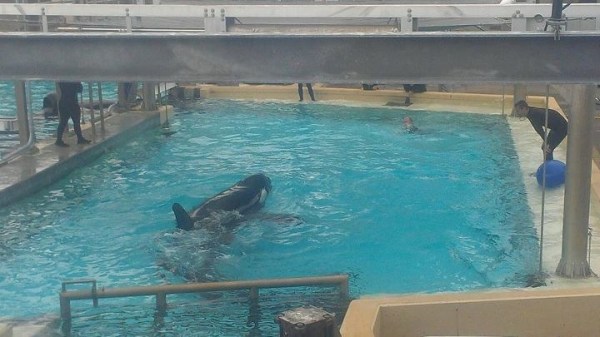
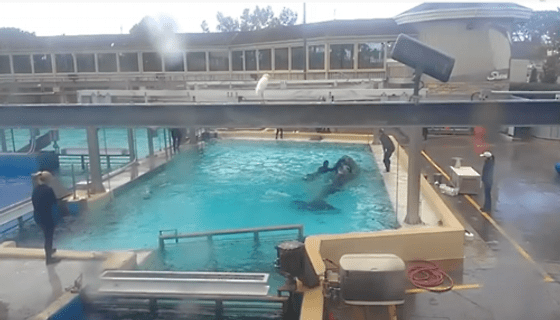
Last month, I wrote about SeaWorld’s whale interaction protocols since Dawn Brancheau died, and the fact that waterwork desensitization with certain whales had advanced to the point of swimming with whales in the med pool.

This picture of Orkid in the med pool with a trainer in San Diego is now making the rounds online:

SanDiegoWaterwork


Update: here’s one more.

SanDiegoWaterwork1

Frontline: A Whale Of A Business

First aired in 1997, PBS Frontline’s A Whale Of A Business was the pioneering investigation of the business and practices of marine mammal parks. The reporting and materials Frontline gathered and put online were invaluable when I first started to report Killer In The Pool.

Now the documentary has been uploaded to YouTube and you can watch the entire report PBS aired.

The Orcas Strike Back?

Just downloaded this intriguing Kindle book, which I found referenced on David Kirby’s Take Part blog post about captive orcas and 2013.

Here’s the description:

Enigmatic billionaire Mitchell Chandler churns out obscene profits at his aquatic theme parks driven by the spectacular killer whale exhibits.

Then the orca at Chandler’s Seattle Park dies. Now the animal rights activists have all the ammo they need to shut him down.

But Chandler has a plan: Blackmail commercial fisherman Zora Flynn into capturing a replacement whale—and use Zora’s mother as bait.

Forced into the orca hunt, Zora encounters a never-before-seen species of killer whale—creatures of mind-bending size, speed, and intelligence.

As awe-struck scientists race to understand the whales’ sudden appearance, Zora and Chandler come face-to-face with each other and the chilling truth: the mighty orcas have simply returned… to exact justice.

Sounds like a revenge fantasy worth reading. I’ll report back after I’ve done just that.

The Morgan Decision

Apparently the judge bought the argument that Morgan is being used for research and education. Guess he or she has never been to a Loro Parque Orca Ocean show. I have, and what amazed me was that there was not a single fact about wild orcas in the show. Not one.

According to this story (and Google Translate):

Relocation orca Morgan not unlawfully

AMSTERDAM – The relocation of orca Morgan of the Dolphinarium in Harderwijk to Loro Parque, a park in Tenerife, was not unlawful.

Photo: Reuters

That the court in Amsterdam Thursday determined. The case was brought by the Orca Coalition, an alliance of animal activists, who wanted the animal in nature would be released.

Morgan was severely weakened in 2010 found in the Wadden Sea. The animal was brought to the Dolphinarium to recover. In 2011 it was announced that Morgan to Loro Parque in Tenerife should move, where all five other killer whales lived.

Then State Secretary Henk Bleacher gave a permit for the removal of Morgan to Tenerife. This was according to the Orca Coalition never happen.

The permit should only be issued if the goal was their research or teaching was that the protection or conservation of the species was intended. This is according to the court case. The park on Tenerife conducts research and performs an educational function, the judge said.

The Court sees no reason to believe that the welfare of Morgan danger in Tenerife. The Orca Coalition may, if they disagree, a case in Spain started.

PLUS: Comment from The Blackfish.

Marineland In Eleven Minutes

Very nice mini-doc on Marineland, and the grassroots movement on behalf of its animals that was launched when Phil Demers and other trainers started speaking out about Kiska, and the conditions for the other animals there.

Marineland is taking to the courts to try to go on the offensive. I’m betting on the whistleblowers, and it will be interesting to see how far SeaWorld, and its files on killer whale care at Marineland (which needed a court to help it get its orca Ikaika out of Marineland), gets dragged into this fight.

Marineland? Keep Moving, Nothing To See Here

No, that’s not my opinion. That’s what the Canadian Association Of  Zoos And Aquariums concluded after inspecting Marineland following revelations from former trainers about poor water quality, suffering animals, and a bleeding killer whale:

A national agency that oversees the care of animals in captivity says Marineland’s lone killer whale is in good health.

The Canadian Association of Zoos and Aquariums (CAZA) conducted an unannounced inspection at the Niagara Falls theme park on Nov. 27 to assess several areas in the park, including the health of Kiska.

The female killer whale has been alone in a tank since November 2011 after Marineland was forced to return its male orca Ikaika to SeaWorld.

Former Marineland trainer Christine Santos told Toronto media in October that Kiska was bleeding sporadically from her tail and had been for some time.

In a CAZA accreditation report completed on Nov. 29 and obtained by The Review, the agency’s business manager Greg Tarry said he reviewed copies of Kiska’s medical records for November and was also given copies of the daily observation sheets completed by staff.

“This animal appears to be in good health and is eating a full ration,” Tarry wrote, adding he did not see any signs of bleeding or injury. “It is my opinion that there is no cause for concern on the part of the (CAZA) commission regarding the health of the animal at this time.”

According to the report, Marineland staff and management were “open and candid in their comments and provided any and all information and assistance requested” during the inspection.

“There were no concerns identified during the inspection that the commission need react to at this time,” Tarry wrote.

The inspection also included an assessment of the water quality.

“All of the water was clear and clean, there were no problems with color or odour of the water in any of the areas,” the report states.

“In addition, none of the animals in the water appeared to be experiencing any discomfort as a result of being in the pools. “

Hmm. That’s a pretty different story than that told by former trainers.  But who are you going to believe: the people who devoted their lives to caring for the animals or the industry group dedicated to promoting business and profits?

File it under another totally predictable outcome. I guess we’ll have to wait and see whether Ontario’s government decides to take any action, or not. You now what my prediction would be. Hope I’m wrong..

When (Not) Seeing Is Important

As regular readers will know, I like to say “Seeing Is Important” because seeing helps people understand (and believe) the reality of what goes on in the world, whether at a marine park or a factory farm.

So I was struck by the following tidbit in Elizabeth Batt’s report on legal threats made against Dr. Ingrid Visser over her reports about orca Morgan’s experience at Loro Parque.

This is the gate at the entrance to Loro Parque’s Orca Ocean as it was last June (and was when I was there last year):

And this is the same gate in July 2011 (and presumably today):

Notice a difference? Visser has used her camera to tell Morgan’s story at Loro Parque in devastating detail. So Loro Parque took measures to make it hard or impossible for visitors to see what is going on with the orca outside of shows.

It’s an obvious response. But when an industry or corporation is blocking access, and becoming less transparent, it is a sign that all is not well inside, and that the industry is afraid of what the public might think if they truly understood what goes on behind closed doors (and hastily erected fences). For that sort of business “Not Seeing Is Important.”

Batt publishes one other “A Picture Is Worth A Thousand Words” picture taken by Visser. It shows SeaWorld’s Chief Zoological officer, Brad Andrews, taking in the orca show alongside Kiessling.

SeaWorld, despite protestations to the contrary, has long had a very close working relationship with Loro Parque, and helped launch its orca program. If Morgan is used for breeding it will bbe very interesting–and telling–to see where the calves go.

Anyhow, I doubt that fences or legal threats can slow Visser down. And her work is making a difference, judging from the number of people who have signed this petition calling for Morgan’s release. The Dutch court will issue a ruling on Morgan’s fate on Dec. 13. Whether it calls for the revisitation of the Dutch ministry decision to send Morgan to Loro Parque or not, Visser will have accomplished something very important simply by making so many people aware of Morgan’s story.


Safety Bar?

Check out this picture which someone just sent me (not sure where it comes from; apologies in advance to any potentially outraged photographer).

I’m posting it as a follow-up to my post on SeaWorld whale interaction protocols, because it really captures the fact that the safety bars which are required for head tactile in shows really wouldn’t offer much protection to a trainer if a whale decided to go after the trainer.

It also illustrates that “close contact”–even with a barrier–can mean, well, REALLY close.

Screen Shot 2012-12-07 at 4.50.59 PM