Morgan’s Story

The Free Morgan Foundation, in advance of a new, Nov. 1, court hearing, has released a passionate PSA calling for Morgan’s release back into the wild.

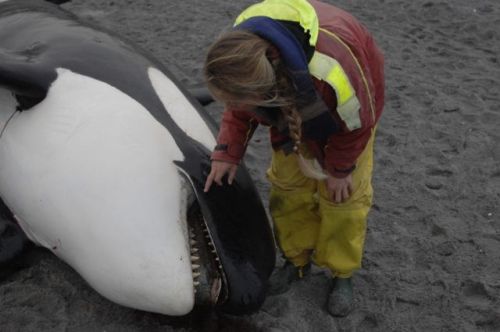
Morgan’s story is a case study in how the cover of “rehabilitation” is sometimes used as a way to bring wild marine mammals into captivity, which is always looking to diversify the gene pool. I doubt Loro Parque or any other marine park would have been so eager to bring Morgan into their collection if the Judge that authorized that decision had said that she was not to be used for breeding.

The Life Of Kiska

I’m developing an iron law of marine park reporting, which is: the more detail you know the worse marine parks sound. Rarely do additional facts make you feel better about marine parks.

This law just received serious reinforcement by a devastating report in Canada’s The Star newspaper about the life of Kiska, the lone remaining killer whale at Marineland in Ontario.

Marineland has been in the news recently, over animal abuse allegations by former staffers. This new report does nothing to change the dismal picture of Marineland they painted.

Here’s what The Star reports on Kiska:

Kiska, the killer whale, swims alone in her pool at Marineland, often followed by a trail of her own blood.

Her tail has been bleeding off and on since July but has been getting progressively worse, according to Christine Santos, who has been one of Kiska’s primary trainers. She described the bleeding as “gushing” last week….

[snip]…

The Star obtained recent video of Kiska showing a blood trail from cuts in her tail. Once one of Marineland’s best show animals, Santos said she now spends her days swimming listlessly and scratching parts of her body against the sides and sharp fibreglass grates that run the circumference of her Friendship Cove pool.

Treating her is difficult because Kiska, about 37, has refused to go into the medical pool for the past month. Her behaviour has been “breaking down for some time,” said Santos. She won’t even present her tail for blood samples.

Santos believes there aren’t enough trainers to give Kiska and 39 beluga whales enough attention at Friendship and Arctic Coves.

Santos was fired Wednesday. She said she was asked to sign a document that included a statement she’d never seen animal abuse at Marineland. She didn’t sign because “it didn’t feel right.”

Marineland called Santos’ allegations inaccurate and false. Here’s a photo of Kiska, trailing blood, published by The Star (click image for full size).

The Star story also has some pretty gruesome details about a beluga transfer that went wrong:

Other whales have been bloodied at the Niagara Falls tourist park. On Apr. 11, 2012, after female beluga Charmin was left on a trailer when a crane jammed during a move to another pool, photos show the area soaked with blood…

[snip]…

Last April, staffers moved two belugas, Tofino, a male, and Charmin from Friendship Cove to the performing stadium pool. At the end of Charmin’s move, the crane set to lift her in a sling over to the pool jammed, and she was stuck on the flatbed, her tail thrashing against the metal slats and edges of the trailer, according to former senior trainer Phil Demers.

“It was one of the worst days of my life,” says Demers, who helped in the move. “It went on for at least an hour. . . . There was blood on Charmin, on the ground, on the side of the pool, on the pads — it was sprayed all over. The worst, though, was that she lay there all that time with the pressure of her heavy weight (about 1,350 kilograms) on her internal organs — so bad.”

Here’s a photo of Charmin’s bloody transfer (full set is here). Is it something that  NOAA and the rest of us should keep in mind when considering what sort of stresses could be involved in Georgia Aquarium’s proposed transfer of 18 belugas from northern Russia to Atlanta, and then on to SeaWorld, Shedd Aquarium, and Mystic Aquarium?

Beluga Charmin

All the staffer accounts that have been leaking out of Marineland this summer certainly paint Marineland as a poorly managed park where animals suffer daily (video here).

It’s possible that Marineland is, in fact, the worst park in North America. But who knows for sure? How much do we really know about all the other marine parks? It is not until insiders step forward and put the facts out in the light, or the parks open up to real scrutiny, that we can really know the reality.

(h/t to JF for alerting me to this story)
Deep Dive Into Belugas

Felicity Barringer, who wrote yesterday’s New York Times article about the controversy over whether the Georgia Aquarium should be allowed to import wild belugas from Russia, takes to the NYT’s Green blog to go much deeper into the ethical, moral and scientific arguments over the question of beluga captivity.

Partly because, apparently, this song was in her head the entire time she was reporting the story:

Anyhow, her post is a great example of how online space can add insight to a story in the printed newspaper and it’s worth reading the whole thing. But here are the questions she is trying to get at:

Therein lies the conundrum built into the decision facing the National Oceanic and Atmospheric Association in coming months. Is the goal of inspiring visitors — and doing research that may help conserve these animals in the wild — worth the price of taking extremely social animals with deep bonds of kinship out of the ocean, teaching them crowd-pleasing tricks and putting them on display in an aquarium?

Should animals that migrate hundreds of miles between their ice-clogged Arctic habitats and the estuaries at the mouths of rivers like Russia’s Amur or Canada’s St. Lawrence, that dive hundreds of yards deep to forage on the ocean floor, be confined to a tank with no more than a handful of other belugas for company?

Should belugas whose range of calls represents one of the most extensive vocabularies in the animal kingdom have to listen to their whistles bouncing off walls?

Unfortunately, these are not the issues NOAA is considering when it weighs the beluga import permit application. Which is why the Marine Mammal Protection Act is outdated and needs to be revisited.

Ocean Park, Hong Kong: A Different Approach To Belugas

BelugaThe New York Times weighs in with a well-reported story about the controversy over the Georgia Aquarium’s plan to import 18 wild belugas from Russia.

The story contains an absolutely classic example of the bogus beluga rationale I wrote about the other day, again courtesy of Georgia Aquarium’s William Hurley:

But beyond those legal considerations, said William Hurley, a senior vice president of the Georgia Aquarium, marine institutions need a strong captive population for research that could help safeguard the beluga as its Arctic habitat is transformed by a changing climate.

“If you don’t have enough of these animals in our care and don’t have enough to extend that for more decades,” Mr. Hurley said, the aquarium will be unable to unlock “the secrets these animals hold.”

What the story doesn’t mention is that not all the marine parks that originally set out to research this Russian beluga population, as a step toward importing wild belugas from Russia, are in agreement about displaying belugas.

Ocean Park in Hong Kong was part of the marine park consortium that helped fund the research, and was planning to import some of the belugas for its new Polar Adventure exhibit. But along the way, Ocean Park decided that it would not include belugas in the exhibit, and would not be importing any of the 18 belugas captured in Russia for the consortium.

Beluga SantaOver the summer, I called Allan Zeman, the chairman of Ocean Park’s Board Of Directors to ask why. He was refreshingly forthright and candid about Ocean Park’s decision. And his thinking is an example of how at least one marine park looked at the ethics of displaying belugas and–despite the fact that belugas are popular with the public and generate lots of revenue–decided to go another direction.

Here is what Zeman told me, lightly edited for clarity:

What happened with the belugas is that we originally six years ago talked about doing belugas and other animals. Ocean Park is really about animals. It’s similar to SeaWorld.

Nobody 6 or 7 years ago came out against the idea. Everyone was excited about plan, which even had polar bears. But after we started designing the park–the CEO and myself–we started traveling around to familiarize ourselves with the animals in different parks. Nobody said anything. Most people didn’t know what a beluga was, except for the animal rights people. Continue reading “Ocean Park, Hong Kong: A Different Approach To Belugas”

A Bogus Beluga Rationale

Nicely detailed piece on Wired.com about Georgia Aquarium’s application (on its own behalf, but also fronting for SeaWorld, Shedd, Mystic) to import 18 wild-caught beluga whales from Russia.

Here’s the set-up:

Controversy is brewing over the Georgia Aquarium’s plan to import 18 beluga whales captured off the coast of Russia. If the U.S. government approves the plan, it will mark the first time in nearly two decades that wild-caught cetaceans have been imported into an aquarium in the United States.

According to the aquarium, the whales are needed for research and education. According to animal welfare advocates, that doesn’t justify the trauma inflicted on intelligent, emotional creatures that suffer in captivity.

“If we let them in, it means we’re going to have this issue all the time. It will open up the floodgates,” said Lori Marino, a neurobiologist at Emory University and prominent cetacean rights activist.

Georgia Aquarium trots out the shopworn argument that the belugas will be ambassadors for their species, which is the core rationale marine parks use to justify keeping marine mammals in captivity.

But it’s an analogy that has some problems, I think. Most important, ambassadors are not normally forced into service. My father was an ambassador and he was sent abroad because the United States wanted a representative in the countries he served. In contrast, ambassador to the human world is not a choice any belugas are making. It is a choice humans (profit-seeking humans, I might add) are making FOR the belugas.

Russian Belugas

The Russian Belugas in Ambassador School

Now, you could say belugas need ambassadors because humans are trashing the oceans, and putting the future of wild beluga populations at risk. I think that Continue reading “A Bogus Beluga Rationale”

Was Nakai Bitten? Analysis From Ingrid Visser

Ingrid Visser of the Orca Reasearch Trust, has spent twenty years studying and observing orcas in the wild.

Ingrid Visser

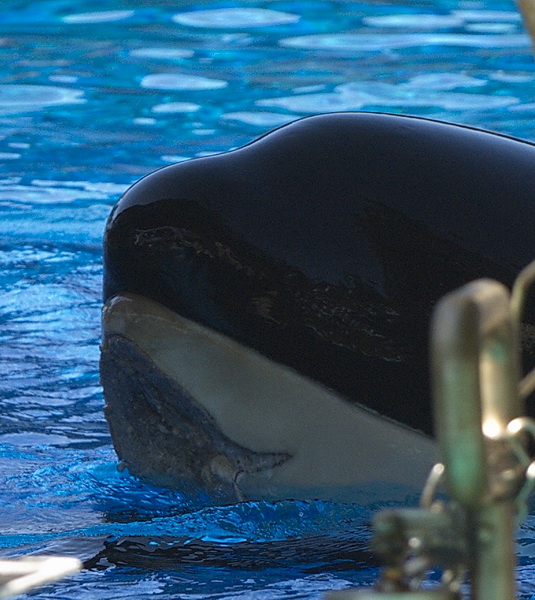
And she was responsible for taking this highly detailed picture of Nakai’s wound:

Nakai Wound

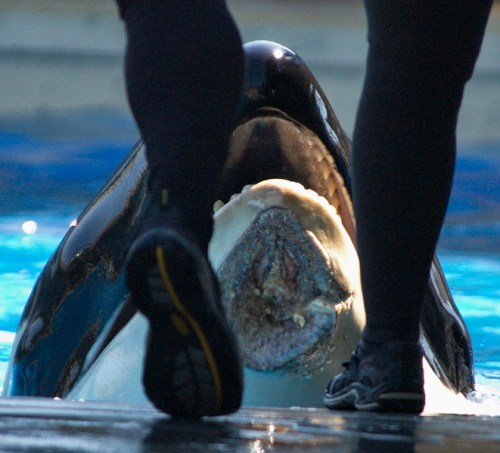
Perhaps the most important detail in this picture is the puncture marks which appear on the lower right margin of the wound, opening up the possibility that Nakai’s wound was caused by a bite from another orca, and not a collision with some part of the pool, as SeaWorld has suggested.

Now Visser has sent me a more detailed analysis of Nakai’s wound. Here it is:

The recent wound on the captive orca Nakai remains an enigma as to how it occurred.  When I first viewed (unreleased) photographs taken a week after the graphic injury, I was of the opinion that it was unlikely to have been inflicted by other orca, based on the fact that no orca teeth marks were clearly visible in the photos and the very ‘clean’ edges to the wound.

Regardless of the source of the wound, I didn’t buy the story from SeaWorld that Nakai had ‘come into contact with the pool’ (AP, Sept 28th 2012, press release), as to me such wording implied a light brush past, or perhaps at worst a bump into the side of the tank.  Clearly such a striking wound wasn’t from a light brush or even a ‘bump’. Continue reading “Was Nakai Bitten? Analysis From Ingrid Visser”

Was Nakai Bitten? Another Take

It may be that we never really know how Nakai injured his jaw (though we do know–and SeaWorld has confirmed with their euphemistic language about him having a “normal social interaction” with two other whales immediately prior to the injury–that a fight was involved). For what it is worth, I am told that even SeaWorld San Diego can’t determine exactly how the injury occurred, even though they have reviewed all the video they have of the show.

So we are left trying to pull a CSI-style forensic analysis on the injury photos, like this photo taken by Ingrid Visser of the Orca Research Trust:

(c) Ingrid Visser

As I noted yesterday, Visser said of this photo: “Of note is that in [this photo], at the bottom right of the wound, near the trainers shoe in the photo, there are four puncture marks – and the spacing matches that for orca teeth – as you can see from Nakai’s teeth in this same photo.”

I don’t think this is definitive, but because I posted it a number of readers complained that I was drawing a conclusion without sufficient evidence. I agree that there is no conclusive proof one way or another how the injury occurred, and remain agnostic on the question pending any additional information or evidence (if it ever emerges).

But to balance the scales I thought I would post this counter-analysis of the photo (as well as some other photo evidence I shared but have not posted) from someone who knows a lot about orcas and who is reliably insightful about orca matters:

“There is no way this is a bite. An orca’s jaws just aren’t precise enough to make such a clean cut in such a specific area without leaving trails (rake marks Continue reading “Was Nakai Bitten? Another Take”

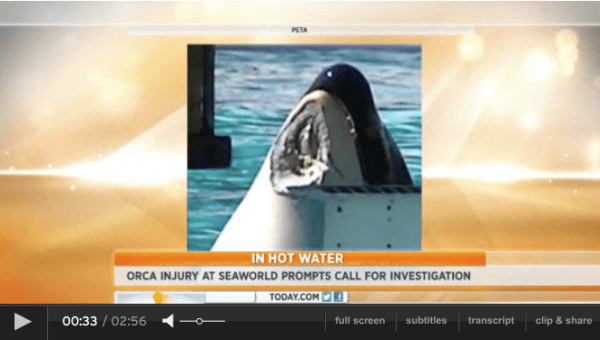
Nakai Makes The Today Show Too

Watch it here.

Just to be clear: SeaWorld’s statement that Nakai was engaged in “normal social behavior” with two other whales immediately prior to the injury is SeaWorld’s way of saying Nakai was in a fight.

Nakai Featured On Good Morning America

I doubt that it was ever one of his life ambitions, and certainly not for the reason he is being featured. But at least tens of millions of Americans just got a glimpse of what can happen at a marine park. Since one of the biggest limitations of WordPress is that you can’t embed many types of video, I can’t embed the vid here (advantage Tumblr!).

But you can watch the ABC segment here.

Nakai Photos and Backstory

Over the weekend I learned a little bit more about the incident that led to Nakai’s injury, and Ingrid Visser of the Orca Research Trust visited SeaWorld in San Diego and took some more pictures of Nakai’s injury. Here is the most detailed photo she took (more photos after the jump):

(c) Ingrid Visser

Regarding the question of whether the injury might come from a bite from another orca, Visser writes: “Of note is that in [this photo], at the bottom right of the wound, near the trainers shoe in the photo, there are four puncture marks – and the spacing matches that for orca teeth – as you can see from Nakai’s teeth in this same photo.”

And here is some additional detail on what happened that night when Nakai was injured. As a number of people have noted, the injury occurred after Sea World San Diego closed to the general public for the evening. Sometimes SeaWorld puts on special shows for corporate groups, and the evening show on the 29th (oope, typo) 20th was such a show.

During the show Nakai, Keet and Ike were all at stage when all three killer whales suddenly took off without warning and and started fighting with one another. SeaWorld’s review of the tapes could not identify an instigator or an aggressor. As I wrote last week, Nakai split into the back pool. Ike and Keet, however, returned to the stage and control, so the trainers continued the show. When trainers finally called Nakai over later that evening for the final feeding and saw that he was injured they were shocked be the severity of the wound. In fact, it is about as bad a wound as most trainers have ever seen. In response, SeaWorld San Diego will henceforth adopt the practice of immediately checking any killer whales involved in similar, high-intensity, melees to try and make sure that injuries are identified right away.

(c) Ingrid Visser

Apart from the death of Kandu V at SeaWorld San Diego in 1989, the only injury many trainers can remember that was even close in severity to Nakai’s was a 1990s injury to Splash, who lost part of his jaw when he was thrown by Takara against a gate while they were messing around. The gate had a chain and Continue reading “Nakai Photos and Backstory”