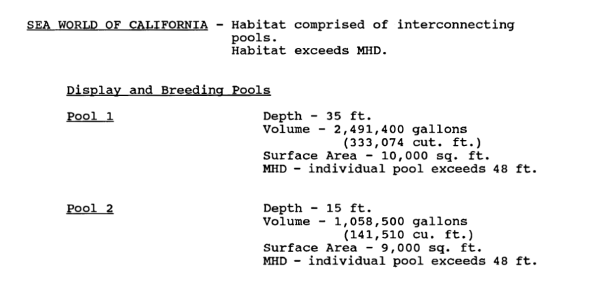
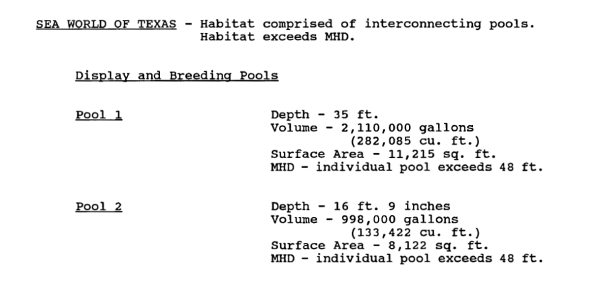
Okay, this is only for people who are deep, deep in the weeds. Every once in a while I get an email asking me for the sizes of SeaWorld’s pools. And I have never really had rock-solid information on the dimensions. So, apart from the insights into SeaWorld’s thinking about Tilikum, Haida, and Nootka contained in Russ Rector’s FOIA’d documents, I was glad to see that SeaWorld’s 1991 application to import and display Tilikum, Haida, and Nootka from Sealand included…..very detailed pool dimensions. So I have posted them below (I have left SeaWorld Ohio out since that is now closed).
One thing that jumped out at me from this section of SeaWorld;’s application is just how few killer whales SeaWorld had in 1991 (12, including Ohio), compared to the 29 they keep today (23 at SeaWorld parks, and 6 at Loro Parque).
So, for the record, here are the sizes of SeaWorld’s pools in 1991:
After years of persistent FOIA appeals, dolphin advocate Russ Rector has managed the very worthwhile feat of getting NOAA to release more than 1000 pages of documents related to SeaWorld’s purchase of Tilikum, Haida, and Nootka from Sealand Of The Pacific. I am going through them and posting some of the details and insights that the documents contain.
My first post, about the back and forth SeaWorld and NOAA had over how SeaWorld planned to deal with the fact that the three killer whales it was purchasing from Sealand had killed a trainer, is up at The Dodo.
SeaWorld’s take on whether Tilikum, Haida and Nootka’s behavior was normal, and whether SeaWorld was set to handle the three whales in the aftermath of Keltie Byrne’s death, doesn’t look so great in light of what followed with Tilikum’s life at SeaWorld. NOAA, which gets credit for pressing SeaWorld on the question of how it might deal with killer whales that had killed, was clearly not that impressed by SeaWorld’s complacency. Nevertheless, they ended up granting the permit.
You can download the full set of permit-related documents here, and I’ve also embedded them below:
Despite insisting that Blackfish is having no impact on its business, SeaWorld continues to invest heavily in a PR counter-attack on Blackfish and the former trainers who appear in the film.
It’s latest minute-by-minute critique of Blackfish was perhaps the most detailed, and most tediously off-base, critique it has issued yet.
Below you will find the Blackfish production team’s rebuttal. What’s notable is that SeaWorld continues to massage and manipulate the facts even as it tries to accuse Blackfish of mis-representing the facts. What’s also notable is that SeaWorld continues to try and distract and divert from the core issues raised in Blackfish about the wisdom and morality of killer whale captivity, without ever directly addressing those issues.
I guess we can keep going round after round on this, but the facts simply are not on SeaWorld’s side. And it seems clear that the public is beginning to understand a very different, more credible, and increasingly troubling version of killer whale captivity than the narrative SeaWorld has been promoting for the past 50 years.
Mucus weep from Morgan’s eye. (Ingrid Visser/Free Morgan Foundation)
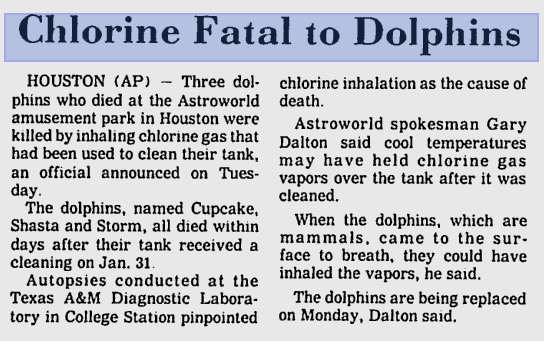
Over the weekend, The Dodo posted a short article I put together on how the effort to maintain sparkly, clear water in SeaWorld’s pools can affect the physical well-being of the animals (and the humans who used to swim with them).
It’s not the biggest issue with captivity, but is a perfect example of how every little thing can impact the lives of the orcas and other marine mammals:
It is indeed true that great effort is made to maintain the water at just the right temperature and salinity for the animals. What is not mentioned is all the chlorine that is used to keep the water clear and sparkling (you can’t see Shamu clearly in a murky pool), and free of algae and bacteria. (Don’t even get a killer whale trainer started on what it looks like after a killer whale defecates in the pool, or produces any other bodily emissions.)
A number of former SeaWorld trainers I have spoken with about water quality have noted that captive killer whales routinely have mucus streaming from their eyes — an apparent protective mechanism that is considered “normal” at SeaWorld.
After the article was posted this story (from 1985) came to me via Ceta-Base:
A decision on whether Morgan, the lost young female orca, should remain at Loro Parque is due anytime, and could be released this Wednesday.
The arguments over Morgan have always been based on two completely different, and contradictory, narratives of her life at Loro Parque. Today, over on The Dodo, I took a look at what both sides claim regarding Morgan’s well-being, and how a pregnancy is the big wild card, and would seal her fate if it happens.
Here’s a key part of the story:
Loro Parque, in a statement e-mailed in response to a request for comment, calls Visser’s argument “erroneous and misleading,” as well as “emotionally charged. The statement goes on to try and rebut each of Visser’s claims one by one, and dismisses Visser’s work as an “animal activist opinion piece.” For Morgan, the statement flatly states, “negative welfare conditions do not exist.”
“I’m not an activist. I am a scientist who happens to care about the welfare of animals,” Visser responds. “There is a big difference.” Moreover, Visser’s research and conclusions about Morgan’s life at Loro Parque have won an interesting advocate in Jeff Foster, who spent decades catching killer whales, dolphins, and other animals for SeaWorld and other marine parks. Foster knows a lot about killer whales and how they handle captivity, and is not opposed to captivity for killer whales if they are well-integrated into a stable environment. After observing Loro Parque’s videos of Morgan he was initially skeptical that her experience at Loro Parque was as negative as Visser believes. But based on two trips to observe Morgan (the most recent was last Fall), Foster says he fully agrees that the group of SeaWorld killer whales at Loro Parque is dysfunctional, that Morgan has not been well-integrated, and that Morgan is suffering. “It’s pretty obvious. She’s crying out in distress almost all the time,” Foster says. “You usually don’t hear those vocals from animals unless they are really in distress. The only time I’ve heard them is when we were catching whales and separating them from their families.”
It is often said that it is hard to hide an orca. But (perhaps not surprisingly) the Russians seem to be doing a pretty good job. There’s lots of circumstantial evidence that that the big new Moscow Dolphinarium and Aquarium at the All-Russian Exhibition Center, currently being built, plans to put two orcas on display. In an interview, God Nisanov Year Nisanova, a billionaire and one of the financial backers, says that 17 dolphins have been purchased in Japan, that they will be displayed in multiple pools (a number of which will be used in therapy programs), and that the project has also caught beluga and killer whales for display (even if photos of the captured whales made him sad). And this air transport report indicates that two orcas (a 5-meter, 2700 kg female, believed to be the orca dubbed Narnia; and a 1700 kg male) were flown to Moscow in late November or early December (a 10-hour journey in crates).
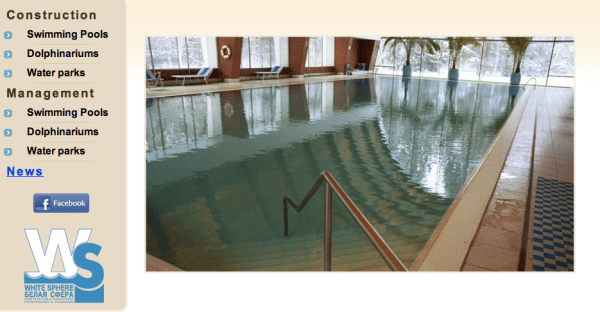
Yet no one seems to know for sure where the two orcas are right now, creating a minor mystery. The location that appears to be the most likely temporary home for them (and presumably any other whales or dolphins the Moscow Dolphinarium flies in) is the two large tanks pictured above. The tanks have since been covered by an inflatable bubble. And according to this Russian blog, the facility, which measures about 37 x 68 meters, was put together last October, and was said to be a temporary shelter, and acclimatization stop, for animals being brought in for the dolphinarium. Here are some pictures the Russian blogger posted (and there are more here, plus a video):
As far as I can tell, no one has managed to get inside and confirm there are two orcas swimming around in these tanks. But if there are it is a crude and no doubt extremely discombobulating introduction to their life as show animals in captivity. Not that there is any nice way to make that transition.
It has been amazing to see all the Blackfish-inspired efforts to campaign for changes in the way we see and think about SeaWorld and the captive display of orcas. There have been a multitude of grassroots petitions urging musical acts to avoid playing at SeaWorld. There have also been grassroots efforts to inspire SeaWorld’s corporate partners to revisit their relationship with a business that displays orcas. For example, this Change.org petition to Southwest Airlines.
The response from singers and bands has been impressive. But getting corporate partners to move on from longstanding relationships is a bigger challenge, and multiple approaches are possible. That’s why I wanted to flag Kimberly Ventre’s quiet and respectful effort to engage Southwest about its relationship with SeaWorld. Instead of rallying thousands of potential fliers to petition Southwest, it is based on a strategy of trying to engage Southwest’s leadership in a thoughtful conversation about SeaWorld and captivity (and included offers to screen Blackfish and have some of the former SeaWorld trainers who featured in Blackfish meet with Southwest executives; Ventre is former SeaWorld trainer Jeff Ventre’s sister, and a devoted Southwest flier).
Southwest has been open and responsive, but also hasn’t accepted Ventre’s offer for further engagement and discussion. They did send her a Southwest thumb drive, but I suspect that won’t be enough to deter her from her goal of having Southwest revisit its SeaWorld partnership.
It will be interesting to see whether this alternative approach to the Blackfish Effect will succeed. And whether it can be a good model for change. So, for the record, I am posting a summary from Ventre regarding her Southwest campaign, as well as the letters that have gone back and forth.
Here’s Ventre:
When is the last time you wrote an airline and they responded right away? This is why I love Southwest. They are different. They are thoughtful. They listen.
Recently, I sent a letter to Southwest CEO Gary Kelly (and four other executives) expressing my concern over their on-going partnership with SeaWorld. I explained a group of scientists, filmmakers, and authors were willing to come present the facts surrounding orcas and captivity. Shortly thereafter, I received an encouraging response.
Southwest’s leadership team said their eyes and ears are not closed and vowed to “remain transparent and open in their desire to learn and educate (them)selves.” Remarkably, they confirmed they had seen Blackfish and said they would read Death at SeaWorld as well as the other articles I provided.
Their transparency, willingness to engage in dialogue and commitment to do their due diligence are all hallmarks of great global brands. Their partner SeaWorld could learn a lot from them.
Southwest asked for patience as they move through their learning process. As they begin to understand the real story of Shamu, they will reach the same conclusion millions around the globe already have. What was once popular is now seen as an inhumane. I believe Southwest will evolve and choose to be on the right side of history.
So there are no killer whales in Sochi for the Olympics, just athletes and spectators.
But the run-up to the opening of the Winter Games featured an unexpected, and persistent, media story-line: wild-caught Russian killer whales would be joining the athletes at the Black Sea resort. Based mostly on rumors, mysterious and contradictory tweets, and unconfirmed reports, the basic narrative was that a Russian company called White Sphere had, over the past two years, captured 8 orcas from the Sea Of Okhotsk and two of them were headed to Sochi to wow the Olympic crowds and generate Olympic-size profits for the Sochi Dolphinarium.
The story mobilized animal rights activists, and reporters bombarded White Sphere and the Sochi Dolphinarium with questions about their killer whale doings. After trying to ignore media queries, the story got enough traction that White Sphere, a builder of aquariums (including aquariums for marine mammal display) issued an adamant denial on its Facebook page (it’s also here), saying “White Sphere officially declares that we have nothing to do with catching the killer whales or any other marine animals.” (Aquatoriya, the company which operates the Sochi Dolphinarium also took to Facebook to issue a heated and similarly self-righteous denial; also posted here). The impassioned and indignant White Sphere statement (you have to read the whole thing in Google Translate to get the full Boris Badenov flavor), acknowledged that White Sphere builds aquariums to display marine mammals, but added (I’ve had parts of the statement translated, for better accuracy; sorry Google Translate):
“If the amateur conservationists and sensation-hungry press thought twice and performed more rigorous investigation, they would have found neither documents supporting connections between “White Sphere” and captures of animals, nor holding facilities belonging to it. It’s unlikely that the company’s name would be mentioned by organizations allocating quotas for captures of marine animals. With no less surprise they would have found that inspections would discover no orcas in the Sochi dolphinarium (including those “captured by “White Sphere”).”
The statement, in similar high dudgeon, goes on to decry the slander and the damage done to White Sphere and its employees and partners. It bemoans the fact that the world media got White Sphere and its business so wrong. It encourages journalists to do proper reporting and investigation of the facts.
So I did. And here is what I found, with help on the ground in Moscow.
The idea that White Sphere has been connected to the capture of wild killer whales in Russia starts with the work of Erich Hoyt–co-founder of the Far East Russia Orca Project (FEROP) and a senior research fellow with Whale and Dolphin Conservation, who tracks the Russian orca hunt very closely. Hoyt is careful, reliable, and has good sources and connections in Russia. And in an interview last November, he detailed the web of companies involved in the capture of the 8 killer whales taken from Russian waters (including a female called “Narnia”) over the past two years:
“For these 7 orcas this year [2013] and the one last year [2012], it’s one company doing the orca captures and they have also done beluga captures for some years. They have been identified publicly as “White Sphere”. This is a group of companies, in fact, with White Sphere building dolphinariums in Russia, White Whale capturing animals in the wild, and Aquatoriya operating dolphinariums. The [Sochi Dolphinarium] is a subsidiary of Aquatoriya, identified as the captor and owner of Narnia.”
So you have three Russian companies: White Sphere, White Whale, and Aquatoriya (Aquatoriya’s homepage lists the Sochi Dolphinarium among its facilities, and is named by the Sochi Dolphinarium as one of its partners, which, to complete the circle, also lists White Sphere on its homepage under a section titled “Our Friends). One company builds aquariums, one captures animals for aquariums, and one owns and manages aquariums. That’s a pretty complementary group, and Russian killer whale advocates have taken to calling all of them “White Sphere,” which perhaps helps explain how the world’s attention got focused on White Sphere, the aquarium construction company. But is it true that they have nothing to do with one another, that White Sphere (the construction company) is not connected to the capture and display side of the business? Um, not really.
It’s no secret that it has been going on. But here are two quick vids, shot by an enthusiastic guest, showing Orkid working with a trainer in the med pool (which has a floor that can be raised).
Orkid, or course, made a particularly dramatic appearance in Blackfish:
Here’s one section of SeaWorld’s investigation into the incident which illustrates how hard it is for SeaWorld to maintain situational control all the time:
Of course, Orkid is no slouch when it comes to doing what she feels like doing, and ignoring protocol, either. Here’s the rap sheet from her SeaWorld profile:
The renewed waterwork desense training is a good reminder that, despite claiming record revenues in 2013, SeaWorld is still determined to bring waterwork back into the show. I’ve always thought it was a long shot, because I always figured it would be hard to get anyone, most of all OSHA, to agree that being in the water with fast-rising floors (or any other safety mechanisms SeaWorld could throw into the mix) would be as safe as simply staying out of the water.
Which is perhaps why SeaWorld’s best hope is winning the federal appeal it argued last November, which in essence argued–to put it into layman’s terms–that OSHA had no right to butt into SeaWorld’s business, and that in any case waterwork was so central to SeaWorld’s brand and business that asking for a ban was akin to asking the NFL to ban tackling. That decision should come down in coming months.
If it doesn’t go SeaWorld’s way I’m not sure what SeaWorld’s options are. Steamroll OSHA into accepting fast-rising floors with some power lobbying and Congressional pressure? Resume waterwork at the California and texas parks, which weren’t cited by OSHA? None of the alternatives seem very good.
I never set out to make this short film. I hadn’t been to Sea World in probably 20 years but decided to give it a shot and take my niece. I tried to see the place through the eyes of young child but logic and my love for wildlife took over. I’ve spent most of my life committed to exploring wild places and observing wild animals. I understand why these places exist but also feel that it’s time we stepped back and reassessed our need to collect and to display conscious, intelligent animals.









 The Earthist Chronicles