Video Smackdown: Marineland vs. Taiji

Video is a powerful medium for trying to shape opinion and emotion, a point that is made by two videos which I came across this morning.

One, from Marineland Canada, aims to convince the public that allegations of animal cruelty at Marineland are false.

The other, from a group of citizens dedicated to trying to end the Taiji dolphin hunts, aims to mobilize public opinion against captivity and Taiji.

It’s interesting to see them both together. What strikes me is that the anti-captivity side has more powerful material to make their case.

Here’s Marineland’s argument in favor of captivity and the way Marineland does business:

And here’s the argument against captivity, and the way in which the Taiji dolphin hunt is connected:

Waterwork, Calves, And Cadillac Killer Whales

A few weeks ago I dug into the details of a minor incident in which Taku gave former SeaWorld Florida trainer Jeff Ventre an unscheduled bump.

There were two aspects I have been meaning to follow up on, which further illustrate the complexities and subtleties of killer whale entertainment.

As I noted in the previous post, Taku’s little stunt was written off as “baby behavior.” Calves are naturally immature, inexperienced, and can be unpredictable. According to Carol Ray, another former SeaWorld Florida trainer from that era, Katerina and Taima were also well known for that sort of acting up as calves. Former SeaWorld Florida trainer Samantha Berg adds: “Taima had her way with Teri Corbett’s ponytail on more than one occasion, until management decided that women working Taima in the water had to wear their hair in a bun. But I don’t know how long that rule lasted.”

So when calves went off script it was tolerated–up to a point.

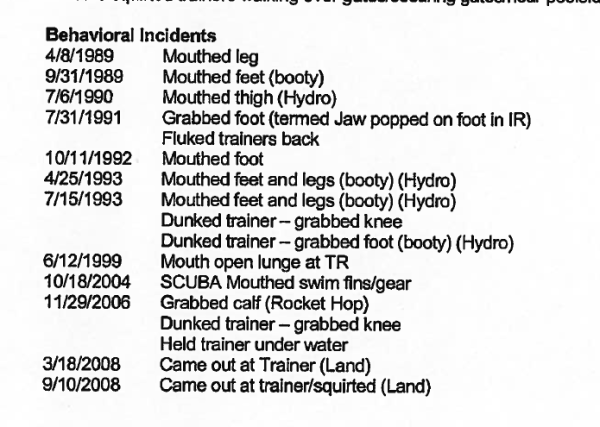
But the fact that calves are unpredictable and sometimes do not do what they are supposed to do created an interesting dilemma for SeaWorld regarding waterwork. On the one hand, a number of SeaWorld killer whale mothers have been sensitive to whether their caves were with them in the pool. The most notorious is Kasatka at SeaWorld California, whose profile notes that aggression was sometimes linked to “when she was separated from her calf and her calf was in distress.” Kasatka’s profile includes a pretty long rap sheet of incidents, a number of which were attributed to a calf being in another pool and/or vocalizing.

Screen Shot 2013-04-26 at 12.16.08 PM

Of course, the most dramatic incident was when she repeatedly dragged Ken Peters to the bottom of the pool in 2006, a scene which features in Blackfish.

So, for whales like Kasatka who liked to have their calves around, it could be an important safety measure to have a calf in the show pool if the Continue reading “Waterwork, Calves, And Cadillac Killer Whales”

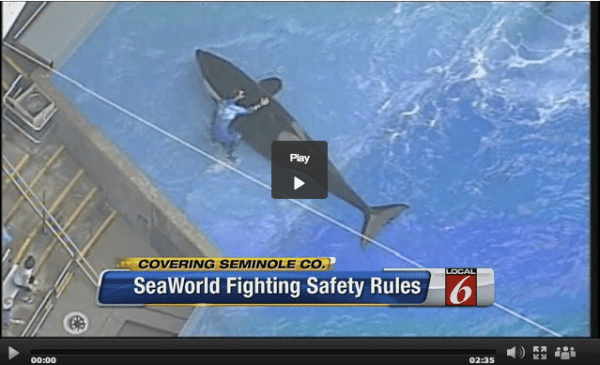
OSHA vs. SeaWorld: Hearing Update

Screen Shot 2013-04-25 at 3.12.36 PM

Local 6 was in the courtroom, and Local 6 has a report on how the day went:

In court Thursday, SeaWorld lawyers said the company consulted with marine mammal experts from the Georgia Aquarium and Atlantis Resorts in the Bahamas to establish its own minimum distances trainers can interact with killer whales. Neither facility houses killer whales.

According to SeaWorld Animal Training Curator Kelly Flaherty Clark, trainers are now required to stay three feet away from killer whales if they are kneeling on a flat surface. Trainers must be 18 inches from the edge of the pool if they standing near the whales, she said.

Clark testified that trainers may still touch a killer whale or rub its back while standing next to the animal on a submerged ledge in the pool, as long as the trainer is positioned along the side of the animal’s body between its blowhole and tail. The trainer must stay away from the whale’s mouth and tail and have an escape route if the whale were to move, said Clark.

Under cross examination by OSHA lawyers, Clark acknowleged a killer whale can potentially spin 360 degrees on the submerged ledge as a trainer stands next to it. OSHA lawyers point out that it is up to the employees themselves to determine whether the whale might attempt to hurt them.

“Everything we did was about making sure my employees were safe,” testified Clark, who said no SeaWorld trainers have been injured since Dawn Brancheau was drowned by a killer whale in 2010. “We haven’t even had a scraped knee.”

Judge Welsch must know more about SeaWorld and killer whales than he ever dreamed possible. Following the hearing he will rule on whether SeaWorld had a good excuse for missing last July’s deadline to be in compliance with his ruling that trainers must maintain a minimum separation or work from behind a barrier.

I don’t think he will care as much about whether SeaWorld has suffered any scraped knees, as he will about the question of whether SeaWorld had any legal justification to ignore his ruling and avoid compliance. Some judges might take that hard.

SeaWorld Vs OSHA (Round 412)

They are in court again right now, debating trainer-killer whale protocols, and an Orlando reporter is live-tweeting the proceedings.

Screen Shot 2013-04-25 at 12.07.00 PM

Trainer Corner: John Hargrove On “Drywork” Risk

As SeaWorld and OSHA continue their backroom and courtroom dealings over what sort of interactions SeaWorld trainers should be allowed to have with SeaWorld’s killer whales, the question of the risks inherent in drywork is central.

“Drywork” is when trainers interact with the killer whales on slideouts, stages, and shallow ledges. That is in contrast to waterwork, which is interactions in which trainers are in the pools with the killer whales. SeaWorld stopped performing waterwork after Dawn Brancheau was killed by Tilikum (even though Brancheau was in fact doing drywork according to SeaWorld’s definition). Given the OSHA citations and court rulings so far, it doesn’t seem likely that SeaWorld will feature waterwork again anytime soon.

However, SeaWorld, it appears, would like to work out a deal that would modify OSHA’s stipulation that trainers maintain a minimum distance or work from behind a barrier, and allow SeaWorld trainers during shows to have close contact with killer whales when the trainer (and often the killer whale, too) is out of the water on the stage or a slideout.

I think that we can stipulate that a trainer in the water with a killer whale is much more vulnerable than a trainer out of the water. But even if that is so, OSHA’s main concern has to be what sort of risks to trainers exist during drywork. OSHA’s expert witness when it faced off against SeaWorld in court in 2011, Dr. David Duffus (who also features in Blackfish) has long been of the view that a killer whale’s speed, power and intelligence means that the risks to trainers are inversely correlated to the distance that exists between a trainer and a killer whale. No distance = higher risk. Greater distance = lower risk.
Screen Shot 2013-04-17 at 5.12.27 PM

As OSHA ponders how much risk there is in trainers getting close to killer whales, I thought I would ask an expert, John Hargrove, a former SeaWorld senior trainer with long experience at both the SeaWorld California and SeaWorld Texas parks.

Hargrove told me that the risk for trainers who are out of the water “is low.” But he also made clear that risks remain, and “that we have documented past incidents which prove trainers can be struck.”

He cited as an example an incident at SeaWorld California in which Orkid broke off a requested behavior underwater and instead came up on the stage and struck a trainer, sending her tumbling, and putting her in the hospital. “Orkid intentionally slid out and struck her,” Hargrove says, noting that any time a whale is sliding across the stage–which is a popular behavior–it has the opportunity to strike trainers. “The only safe place to be during a stage slide is far stage right or left, in a place where there is no set blocking the trainer from jumping back. Anywhere else the whale can crush you if they want to.”

Another time, during a sonogram, Orkid came up out of the water and struck that same trainer as she stood poolside, knocking her over a wall. Continue reading “Trainer Corner: John Hargrove On “Drywork” Risk”
SeaWorld IPO: Overseas Expansion?

“I’m so glad you love Shamu. Do you think they’ll love him in Dubai?”

SeaWorld president Jim Atchison visits the NYSE floor and suggests Shamu may be headed to Dubai, or other disant parts. Which could help explain why there seems to be so much orca breeding going on:

In an interview on Friday, Mr. Atchison gave some hints as to what those plans might be. Currently, SeaWorld Entertainment operates 11 theme parks in the United States, including SeaWorld and Busch Gardens, without a presence overseas.

“We could take our Shamu show in Orlando and probably show it in Malaysia or Abu Dhabi or Dubai,” Mr. Atchison said. “There’s a lot of interest in our brands from overseas.”

He cautioned that there is no “imminent announcement” along these lines.

Though building new theme parks requires capital, Mr. Atchison suggested that such projects could be undertaken in partnership with big investors, such as a sovereign wealth fund, which might add hotels or other structures to the development.

“If you look at these development opportunities, they’re often in connection with other real estate plays,” he explained. “A lot of the development opportunities we have are actually capital-light.”

New parks need whales. And that means breeding, and continuing to roll that Kshamenk AI program forward.

SeaWorld IPO Update

Screen Shot 2013-04-19 at 1.15.55 PM

From Yahoo Finance:

More than three years after its $2.3 billion sale by Anheuser-Busch InBev (BUD) to private-equity giant Blackstone (BX), SeaWorld (SEAS) is trading on the NYSE after raising a reported $702 million in one of the largest IPOs of the year. In its first minutes of trade, the stock is up 15% from its offer price of $27, which was at the top of a range starting at $24.

SeaWorld sold 10 million shares and Blackstone an additional 16 million, more than the 10 million originally slated. The underwriters, including Goldman Sachs and JP Morgan, have a 30-day option to sell an additional 3.9 million shares at the offer price. The deal values SeaWorld at just above $2.5 billion. This debut is part of a busy week for IPOs, which included New York-based grocery chain Fairway (FWM) on Wednesday.

Yahoo mentions the risks (another trainer tragedy, public opposition to orca captivity, and potential OSHA restrictions) that we have covered before, and adds:

When contacted regarding the IPO, a representative for People for the Ethical Treatment of Animals, or PETA, provided its official statement on SeaWorld, which includes its plan to purchase stock Friday in order to “educate other investors about the suffering endured by … animals who are confined to tiny barren tanks for human amusement … and push for their release.”

Other factors investors should keep in mind when deciding whether to dive into SeaWorld stock or stay onshore: The company’s high debt levels and multiples. SeaWorld, when it filed to go public, had $1.8 billion in long-term debt, some of which was incurred by a special dividend of $500 million paid last year to Blackstone (following a $100 million dividend in 2011). SeaWorld states in the filing that its debt could hinder its ability to raise additional capital. Also, its high price tag gives the company a hefty trailing PE of more than 27, exceeding Cedar Fair’s 22 and Six Flags’ 10.99 (per Yahoo! Finance data).

Having PETA attend shareholder meetings is definitely one consequence of going public that SeaWorld will not enjoy.

Headline Of The Day: SeaWorld IPO Edition

Business Insider comes up with this classic:

SeaWorld: Our Investors Should Know That It’s Bad For Business When Our Killer Whales Kill People

And then BI cites this important, but unusual, section of SeaWorld’s IPO filing:

Below is the aforementioned section of the prospectus (emphasis added):

Featuring animals at our theme parks involves risks.

Our theme parks feature numerous displays and interactions that include animals. All animal enterprises involve some degree of risk. All animal interaction by our employees and our guests in attractions in our theme parks, where offered, involves risk. While we maintain strict safety procedures for the protection of our employees and guests, injuries or death, while rare, have occurred in the past. For example, in February 2010, a trainer was killed while engaged in an interaction with a killer whale. Following this incident, we were subject to an inspection by the U.S. Department of Labor’s Occupational Safety and Health Administration (OSHA), which resulted in three citations concerning alleged violations of the Occupational Safety and Health Act and certain regulations thereunder. We have appealed certain of these citations and the appeal process is ongoing. In connection with this incident, we reviewed and revised our safety protocols and made certain safety-related facility enhancements. This incident has also been the subject of significant media attention, including television and newspaper coverage, a documentary and a book, as well as discussions in social media. This incident and similar events that may occur in the future may harm our reputation, reduce attendance and negatively impact our business, financial condition and results of operations.

In addition, seven killer whales are presently on loan to a third party. Although the occurrence of any accident or injury involving these killer whales would be outside of our control, any such occurrence could negatively affect our business and reputation.

That about covers it, no? So the investors can’t say they weren’t warned.

Is Orca “Drywork” Risky

I’ve said before that I don’t have a problem with trainers taking risks, including waterwork, as long as SeaWorld is honest and transparent with trainers regarding the risks and the aggression history of any given killer whale.

But how much risk attaches to “drywork” is a big question as SeaWorld continues to try to reach a settlement with OSHA on what sort of close contact between killer whales and trainers should be allowed in shows.

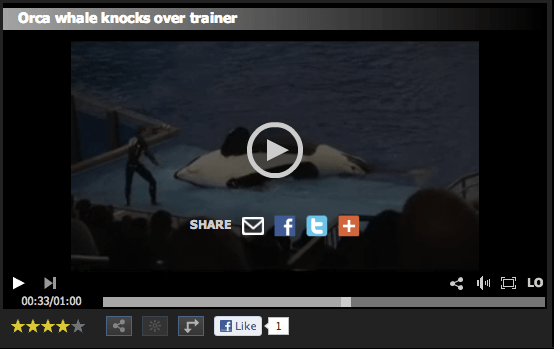
I’ll have a few things to say next week about what orcas are capable of even if a trainer is out of the pool. But in the meantime, here’s a (somewhat in jest) reminder that while waterwork definitely puts trainers at greater wisk, the stuff that happens out of the water doesn’t always go as intended.

Screen Shot 2013-04-17 at 5.12.27 PM

Captive Orcas And Mosquitos

Mosquito landing pad?

Former SeaWorld trainers Jeffrey Ventre (now a doctor) and John Jett (now a university professor) have published a peer-reviewed scientific paper in the Journal Of Marine Mammals And Their Ecology, on the vulnerability of captive orcas to mosquito-borne viruses (PDF). Here’s the abstract:

Although unreported in wild orca populations, mosquito-transmitted diseases have killed at least two captive orcas
(Orcinus orca) in U.S. theme parks. St. Louis Encephalitis Virus (SLEV) was implicated in the 1990 death of the male orca Kanduke,
held at SeaWorld of Florida. In the second case, West Nile Virus (WNV) killed male orca Taku at SeaWorld of Texas in 2007.
Captive environments increase vulnerability to mosquitotransmitted diseases in a variety of ways. Unlike their wild counterparts who are rarely stationary, captive orcas typically spend hours each day (mostly at night) floating motionless (logging) during which time biting mosquitoes access their exposed dorsal surfaces. Mosquitoes are attracted to exhaled carbon dioxide, heat and dark surfaces, all of which are present during logging behavior. Further, captive orcas are often housed in geographic locations receiving high ultraviolet radiation, which acts as an immunosuppressant. Unfortunately, many of these facilities offer the animals little shade protection. Additionally, many captive orcas have broken, ground and bored teeth through which bacteria may enter the bloodstream, thus further compromising their ability to fight various pathogens. Given the often compromised health of captive orcas, and given that mosquito-transmitted viral outbreaks are likely to occur in the future, mosquito-transmitted diseases such as SLEV and WNV remain persistent health risks for captive orcas held in the U.S.
[JMATE. 2012;5(2):9-16].

At the time Kanduke died there was uncertainty over the cause. But here is the necropsy which indicated that something unusual had happened, and helped Ventre and Jett find the answer..

This is an important insight into how captivity affects the lives of killer whales, and what is particularly interesting is how a confluence of captivity-related issues–logging, temperatures, lack of shade, teeth-drilling, etc–combine to create a vector of vulnerability that wild orcas likely do not experience. Which is one more reason that mortality in captivity is greater than mortality in the wild. Very well-done, informative, fact-based, work.