Why Do We Continue To Abuse And Exploit Animals?

It’s a profoundly important question. I tend do go with the simple explanation that we can, we have retrograde beliefs about the moral consideration we should give animals, and doing so often yields profit or profits human in some way (allowing them, for example, to go around saying “MMMM. Bacon.”).

But Dr. Lori Marino and Michael Mountain go deeper. In an attempt to better understand our very troubled relationship with the other species on the planet, they argue that awareness of our own mortality plays a role. The result is a paper for Anthrozoos called “Denial of Death and the Relationship Between Humans and Other Animals.

Here is the abstract:

The focus of this paper is to explore how cultural anthropologist Ernest Becker’s claim that human behavior is largely motivated by fear of death may explain important aspects of our relationship with nonhuman animals. Terror Management Theory (TMT) suggests that when we humans are reminded of our personal mortality, we tend to deny our biological identity or creatureliness and distance ourselves from the other animals, since they remind us of our own mortal nature. In support of this, an abundance of peer-reviewed experimental literature shows that reminders of our own mortality create a strong psychological need to proclaim that “I am not an animal.” We contend that the denial of death is an important factor in driving how and why our relationships with other animals are fundamentally exploitive and harmful. Even though today there are more animal advocacy and protection organizations than ever, the situation for nonhuman animals continues to deteriorate (e.g. more factory farming, mass extinction of wildlife species, and ocean life under severe stress). We also suggest that developing a new and more appropriate relationship with the natural world would be a key factor in resolving the question that Becker was never able to answer: How can we deal with the existential anxiety that is engendered by the awareness of our own mortality?

Got it? Michael Mountain, in a blog post, explains further, in an effort to better understand whether this dynamic can help explain the disastrous and destructive trajectory of the human race:

Why are we doing this? Why have we created a way of living that’s destroying the only home we have and bringing on a mass extinction that will most likely consume us, too? And all in the name of “progress.” Why can’t we stop?

Those are the questions Dr. Lori Marino and I set out to answer in a paper that will be published in March in the journal Anthrozoos, but is already fast-tracked online here. (You need a subscription to Anthrozoos to access the full text.)

The paper, entitled Denial of Death and the Relationship between Humans and Other Animals”, explores the psychology of how and why we humans feel compelled to treat our fellow animals as commodities and resources – and the whole natural world as our property.

The reason lies at the core of the human condition. It’s probably best summed up by the French author Albert Camus, who wrote:

“Humans are the only creatures who don’t want to be what they are.”

And what we absolutely don’t want to be is an animal.

Our central problem, as humans, is that as much as we reach for the stars and create profoundly beautiful works of art, we cannot escape the knowledge that, just like all the other animals, we are destined to die, go into the ground, and become food for worms.

In his Pulitzer Prize-winning book The Denial of Death, social anthropologist Ernest Becker wrote that the awareness we humans have of our personal mortality creates a level of anxiety that drives much of our behavior. Certainly other animals experience bursts of terror in the face of death, but for us humans it’s a lifelong awareness, and one that brings about a chronic level of anxiety.

And so, to alleviate the anxiety we feel over our animal nature, we try to separate ourselves from our fellow animals and to exert control over the natural world. We tell ourselves that we’re superior to them and that they exist for our benefit. We treat them as commodities and resources, use them as biomedical “models” or “systems” in research, and force them to perform for our entertainment.

I personally am comfortable with my animal nature (though that doesn’t mean I don’t try to better understand it and resist its more aggressive tendencies). And I experience joy at the connectedness I feel with regard to other creatures.

That connection is where true empathy comes from, and is the foundation of the idea that while we may be more powerful than other species our power should not be mistaken for moral superiority or the right of dominion. In fact, our power to dominate (and destroy) should be the moral basis for greater consideration and care for other species. We should be stewards, not exploiters. But since that is clearly not a view that our global culture accepts or promotes, I am glad that Lori Marino and Michael Mountain are making a bold intellectual bid to explain why.

The Wonder Of Whales (And Nature)

A beautiful homage to the infinite complexity of Nature, and a reminder that it is hubris to act as if we understand the most subtle workings of the planet.

From the summary:

“When we try to pick out anything by itself, we find it hitched to everything else in the Universe.” – John Muir

When whales were at their historic populations, before their numbers were reduced, it seems that whales might have been responsible for removing tens of millions of tonnes of carbon from the atmosphere every year. Whales change the climate. The return of the great whales, if they are allowed to recover, could be seen as a benign form of geo-engineering. It could undo some of the damage we have done, both to the living systems of the sea, and to the atmosphere.

Everything we do has implications for the planet and its regulatory systems. Tread lightly, lightly…

(h/t Cetacean News Network)

Major Misperception On Climate

Perceived contribution (gray bars) versus actual contribution (red dots) of different industries to global carbon emissions.


This has puzzled me for years:

The general public has a major lack of understanding of how eating meat and dairy contributes to climate change, according to a survey of Europe, the Americas, Asia, and Africa by the market research organization Ipsos MORI. Although meat and dairy production accounts for roughly 15 percent of total global carbon emissions — equal to exhaust emissions from the international transportation sector — less than 30 percent of survey respondents identified meat and dairy production as a major contributor to climate change. More than twice as many — 64 percent — said transportation was a major contributor.

Interestingly, many people are aware that deforestation contributes to global warming, but don’t apparently don’t connect deforestation to clearing land to run livestock.

I guess the meat and dairy industry has a better PR team than the oil and gas companies.

Points Worth Noting…

From Anthony Barnosky, who is featured in the new Smithsonian Channel documentary Mass Extinction: Life at the Brink (which aired last night):

“We have killed about 50 percent of the world’s vertebrate wildlife in just the past 40 years,” he says. “We’ve killed half the numbers of individuals. We’ve fished 90 percent of the fish out of the seas. So these are big things we’re doing to the world.”

Yes, very big. Sounds like Barnosky’s book, Dodging Extinction: Power, Food, Money and the Future of Life on Earthis worth a read. (via)

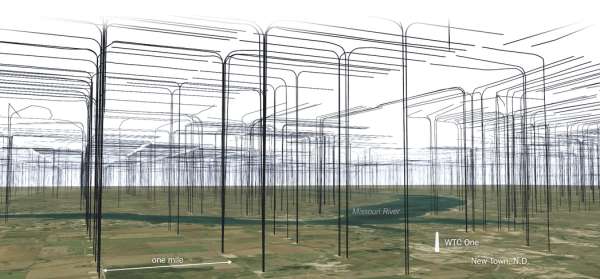
Peek Oil: North Dakota Oil Wells Visualized

Screen Shot 2014-11-26 at 1.19.16 PM

Courtesy of the clever folks at the New York Times:

More than 11,000 oil wells have been drilled in North Dakota since 2006, covering the state’s agricultural landscape. In all, almost 40,000 miles of well bores have been drilled underground to connect the fracking operations to surface wells. Laid end to end, they would circle the Earth about one and a half times.

On Sunday, The New York Times published a monthslong investigation by Deborah Sontag and Robert Gebeloff into North Dakota’s conflicted relationship with its booming oil industry. In the process of reporting that article, we obtained the locations of every oil drilling line of every well in the state.

The precise depths and directions of these remain out of sight for a very obvious reason: The drilling lines are underground. Here, we change that.

The illustrations shown here are accurate in every respect except one: We changed the vertical direction of each oil well bore to go above ground instead of below it. Otherwise, every bore line is shown precisely how it’s described by North Dakota’s Department of Mineral Resources.

Gives new (visual) meaning to oil addiction. And very effectively conveys the reality that the business of being human is the business of constantly probing, altering, and wounding the planet.

Cory Booker Takes Out A Trial Membership In The The Vegan Club

Photo: The Daily Beast


A long-time vegetarian, Booker says he’s trying veganism through the end of they year. He tried and failed once before. Hopefully, this time it will stick. Because he knows that vegetarianism doesn’t quite resolve the moral issues involved in animal production:

There’s tension in vegetarianism, though, since many of the reasons we have to give up meat—the animal death and suffering, the negative environmental impact, the health consequences—are still problems when we look at milk or eggs. The milk industry tacitly supports veal production, since lactation requires frequent pregnancies and something has to be done with the calves. The egg industry, too, takes a staggering number of lives—every male chick is killed shortly after it hatches, and egg-laying hens are killed at around a quarter or fifth of their natural lifespan. Even more, animal agriculture produces a startling proportion of our greenhouse gas emissions (by some accounts nearly 20 percent) and consumes ashocking amount of water. The environmental consequences of animal agriculture don’t change whether a cow is grown for dairy or meat nor whether a chicken is raised for poultry or eggs.

Booker also expressed concern about his own health. “African-American males have some of the worst health data out of any sort of gender-race combination in our country,” he said. “Do I want to be an exemplar of good health and health outcomes, or do I want to participate in things that are making me unhealthy?”

Hard to argue with that. And if he sneaks some Ben & Jerry’s every once in a while, no one should think the worse of him.

Veganism: it’s a wave that’s building…

Climate And Revolution (“Put down that donut!” Edition)

Elizabeth Kolbert adds more perspective to the gap between policy and reality, with a look at the recent US-China emission agreement:

President Obama deserves a great deal of credit for the agreement, as does Secretary of State John Kerry, who conducted the behind-the-scenes negotiations. But, as many commentators have also noted, the deal doesn’t get the U.S. or China remotely near where they need to be if the world is to avoid disaster—which both countries, along with pretty much every other state in the world, have defined as warming of more than two degrees Celsius. Chris Hope, a policy researcher at Cambridge University, ran the terms of the agreement through what’s known as an “integrated assessment model.” He also included in his analysis a recent commitment by the European Union to cut its emissions by forty per cent before 2030. He found that even if all of the pledges made so far are fulfilled, there will be “less than a 1% chance of keeping the rise in global mean temperatures” below two degrees Celsius: “Most likely the rise will be about 3.8° C.”

On top of this rather nasty problem, there’s the issue of actually fulfilling the pledges. The Administration claims that reducing emissions by twenty-eight per cent over the next eleven years is “achievable under existing law.” This is a little like someone who’s trying to lose weight saying that his goal is “achievable” on a diet of doughnuts: it may be true in theory, but it’s extremely unlikely.

Well, Americans do love fad diets, though it is true that not many of them work, and some of them are dangerous. The real solution is to put a stiff tax on donuts, I mean carbon. The politics of doing that are of beyond comprehension at the moment. Still, understanding that pricing carbon is the single most important and indispensable policy step required to fight climate change would be a good first step.

Climate And Revolution (Cont.)

In a review of Naomi Klein’s new book. “This Changes Everything,” Elizabeth Kolbert doubts Americans are ready for the reality of addressing climate change (h/t Daily Dish):

To draw on Klein paraphrasing Al Gore, here’s my inconvenient truth: when you tell people what it would actually take to radically reduce carbon emissions, they turn away. They don’t want to give up air travel or air conditioning or HDTV or trips to the mall or the family car or the myriad other things that go along with consuming 5,000 or 8,000 or 12,000 watts. All the major environmental groups know this, which is why they maintain, contrary to the requirements of a 2,000-watt society, that climate change can be tackled with minimal disruption to “the American way of life.” And Klein, you have to assume, knows it too. The irony of her book is that she ends up exactly where the “warmists” do, telling a fable she hopes will do some good.

And Kolbert doesn’t even include “not eating meat” to her list. I’m surprised Kolbert didn’t title her review “This Changes Nothing.”

Kolbert’s probably right, but this gets back to the problem that the media (and as a result political leaders) are completely failing to explain the scale and danger of the problem. When I want to imagine how we should be thinking about, and talking about, the threat of climate change I always go back to the thought experiment of imagining how the media, politicians, and the public would respond if ISIL had a master plan to warm the planet, melt the ice caps, flood our cities, and cause a mass extinction. Now that really would change everything.

End note: In her review Kolbert mentions an interesting study that examines how much energy each person on the planet should use, and how much they actually use. This also dramatizes how revolutionary real solutions to global warming would be:

What would it take to radically reduce global carbon emissions and to do so in a way that would alleviate inequality and poverty? Back in 1998, which is to say more than a decade before Klein became interested in climate change, a group of Swiss scientists decided to tackle precisely this question. The plan they came up with became known as the 2,000-Watt Society.

The idea behind the plan is that everyone on the planet is entitled to generate (more or less) the same emissions, meaning everyone should use (more or less) the same amount of energy. Most of us don’t think about our energy consumption—to the extent we think about it at all—in terms of watts or watt-hours. All you really need to know to understand the plan is that, if you’re American, you currently live in a 12,000-watt society; if you’re Dutch, you live in an 8,000-watt society; if you’re Swiss, you live in a 5,000-watt society; and if you’re Bangladeshi you live in a 300-watt society. Thus, for Americans, living on 2,000 watts would mean cutting consumption by more than four fifths; for Bangladeshis it would mean increasing it almost by a factor of seven.

To investigate what a 2,000-watt lifestyle might look like, the authors of the plan came up with a set of six fictional Swiss families. Even those who lived in super energy-efficient houses, had sold their cars, and flew very rarely turned out to be consuming more than 2,000 watts per person. Only “Alice,” a resident of a retirement home who had no TV or personal computer and occasionally took the train to visit her children, met the target.

The study doesn’t really take into account the fact that new energy technologies could and should allow us to consume more energy with fewer emissions. But it is still a wake-up slap to realize that for the average American the combination of reduced consumption and more efficient energy technologies needs to achieve an 83% reduction in per capita carbon emission. See what I mean about a revolution?


Climate And Revolution

I am always struck by the gap that seems to exist between what the public and policymakers THINK we need to do to blunt climate change, and what we REALLY need to do. Part of the problem has been that the media has completely failed to treat climate change with the urgency and scale it deserves, a fail which future historians will arguably rate the biggest media fail ever. Another part may be that being honest about the threat of climate change would mean being honest about how completely humanity needs to change its lifestyle, it economics and its politics. And that scares people because change is hard, and change on the scale required implies certain sacrifices.

So I am always interested to see reminders that climate change does not demand incremental policy adjustments but revolutionary adjustments. Because it is only after we come to grips with this fact that we can understand, and hopefully move beyond, the complete inadequacy and complacency of current efforts to address the problem.

The latest screaming reminder that we need to think in revolutionary terms is a failed Google effort to develop renewable energy sources to replace carbon-based energy sources. And, after crunching the numbers, Google abandoned the initiative:

We decided to combine our energy innovation study’s best-case scenario results with Hansen’s climate model to see whether a 55 percent emission cut by 2050 would bring the world back below that 350-ppm threshold. Our calculations revealed otherwise. Even if every renewable energy technology advanced as quickly as imagined and they were all applied globally, atmospheric CO2 levels wouldn’t just remain above 350 ppm; they would continue to rise exponentially due to continued fossil fuel use. So our best-case scenario, which was based on our most optimistic forecasts for renewable energy, would still result in severe climate change, with all its dire consequences: shifting climatic zones, freshwater shortages, eroding coasts, and ocean acidification, among others. Our reckoning showed that reversing the trend would require both radical technological advances in cheap zero-carbon energy, as well as a method of extracting CO2 from the atmosphere and sequestering the carbon.

In other words, Google decided that even the most dramatic developments in current renewable energy technologies, leading to a 55% reduction of emissions by 2050, just wouldn’t do the job.

Because CO2 lingers in the atmosphere for more than a century, reducing emissions means only that less gas is being added to the existing problem. Research by James Hansen shows that reducing global CO2 levels requires both a drastic cut in emissions and some way of pulling CO2 from the atmosphere and storing it.


It was necessary, but not sufficient:

While this energy revolution is taking place, another field needs to progress as well. As Hansen has shown, if all power plants and industrial facilities switch over to zero-carbon energy sources right now, we’ll still be left with a ruinous amount of CO2 in the atmosphere. It would take centuries for atmospheric levels to return to normal, which means centuries of warming and instability. To bring levels down below the safety threshold, Hansen’s models show that we must not only cease emitting CO2 as soon as possible but also actively remove the gas from the air and store the carbon in a stable form. Hansen suggests reforestation as a carbon sink. We’re all for more trees, and we also exhort scientists and engineers to seek disruptive technologies in carbon storage.

Incremental improvements to existing technologies aren’t enough; we need something truly disruptive to reverse climate change. What, then, is the energy technology that can meet the challenging cost targets? How will we remove CO2 from the air? We don’t have the answers.

How do you achieve that energy revolution? Google’s engineers suggest following Google’s approach to investment and technology disruption:

Consider Google’s approach to innovation, which is summed up in the 70-20-10 rule espoused by executive chairman Eric Schmidt. The approach suggests that 70 percent of employee time be spent working on core business tasks, 20 percent on side projects related to core business, and the final 10 percent on strange new ideas that have the potential to be truly disruptive.

Wouldn’t it be great if governments and energy companies adopted a similar approach in their technology R&D investments? The result could be energy innovation at Google speed. Adopting the 70-20-10 rubric could lead to a portfolio of projects. The bulk of R&D resources could go to existing energy technologies that industry knows how to build and profitably deploy. These technologies probably won’t save us, but they can reduce the scale of the problem that needs fixing. The next 20 percent could be dedicated to cutting-edge technologies that are on the path to economic viability. Most crucially, the final 10 percent could be dedicated to ideas that may seem crazy but might have huge impact.

Today In the United States, the vast bulk of funding for energy R&D goes to established technologies. Essentially no money is allocated to related and potentially disruptive technologies, and about 10 percent is spent on projects that don’t seek to produce economically competitive energy.


I would add that we should also vastly increase the investment being applied to energy tech research (and in fact I would be prepared to make an argument that the United States would be more secure if we spent a very large chunk of our entire military budget on trying to solve the energy/climate problem instead of military forces and hardware).

As to how to start pulling carbon out of the atmosphere, I have an idea about that as well: get the world off meat and start reforesting the vast landscapes that have been de-forested for livestock.

Yes, all this sounds crazy and improbable. But as Google figured out, crazy and improbable is exactly what is needed if we are actually going to try and solve the problem.

This Is What Climate Change Adaptation Looks Like

“Sure, it sorta works. But it used to be a lot easier to walk around.”


When the river rises to cover your farm, farm on the river:

From July to October the waters can rise at least 10 feet. The trunks of trees more than 30 feet away from the dry season riverbed show watermarks waist high. When the fields flood, the village’s farmers have no work.

“There is water all around,” said Hafiza Khatun, 25, a mother of two whose family income used to vanish for six months of the year when her farm laborer husband had nothing to do. “There was no happiness.”

But three years ago, Ms. Khatun was trained by Shidhulai Swanirvar Sangstha, a Bangladeshi nonprofit organization, to tend an unusual source of food and income: a floating farm with a duck coop, fish enclosures and vegetable garden moored by rope to the riverbank.