
Killing Lions To Save Lions

That’s the objectionable paradox that exists in Tanzania, where human pressures are reducing lion numbers but American big game hunters are helping fund protection and conservation.

This is an issue because US Fish & Wildlife is considering classifying African lions as endangered, which means that said big game hunters would no longer be able to bring their dead lion trophies home, and display them in their 15,000 square foot McMansions to impress their guests. Which means that they would no longer pay large fees to hunt lions, and support Tanzanian conservation efforts.

That has prompted the Director Of Wildlife for the Tanzanian Ministry of Natural Resources and Tourism to take to the pages of the New York Times to ask Fish & Wildlife not to list the lion as endangered, and remove the incentive American blowhards have to some spend lots of their American dollars on the thrill of blowing a lion away with a high-powered rifle.

Here’s the argument:

Of all the species found here, lions are particularly important because they draw visitors from throughout the world — visitors who support our tourism industry and economy. Many of these visitors only take pictures. But others pay thousands of dollars to pursue lions with rifles and take home trophies from what is often a once-in-a-lifetime hunt. Those hunters spend 10 to 25 times more than regular tourists and travel to (and spend money in) remote areas rarely visited by photographic tourists.

In Tanzania, lions are hunted under a 21-day safari package. Hunters pay $9,800 in government fees for the opportunity. An average of about 200 lions are shot a year, generating about $1,960,000 in revenue. Money is also spent on camp fees, wages, local goods and transportation. And hunters almost always come to hunt more than one species, though the lion is often the most coveted trophy sought. All told, trophy hunting generated roughly $75 million for Tanzania’s economy from 2008 to 2011.

The money helps support 26 game reserves and a growing number of wildlife management areas owned and operated by local communities as well as the building of roads, schools, hospitals and other infrastructure — all of which are important as Tanzania continues to develop as a peaceful and thriving democracy.

Putting aside the notion that putting an end to lion hunting will somehow endanger Tanzanian growth and democracy, there is a certain practical logic to this argument. Kill a few lions to save the rest. But just because it is practical does not mean that it is moral or acceptable.

It would be nice if Tanzania would take the trouble to search for alternative solutions, instead of relying on the easy money of people who think that shooting lion will impress their poker buddies. And I suspect that some of that $75 million from trophy hunting finds its way into a few pockets here and there.

Lion populations are shrinking

But this paradox of killing lions to save them is also a reminder that anyone who cares about lions, or any other species, and prefers a more humane formula for conservation, must be willing to support aid to poorer countries that cannot afford conservation on their own. Too often, the developed world reacts with outrage to animal abuse, slaughter, or mismanagement in the developing world, and reacts with equal outrage to the idea that more assistance should flow from the wealthy countries to the poorer countries to help them meet conservation challenges.

Yes, assistance must be safeguarded against corruption and misuse. But lions in Tanzania, along with so many other iconic and important regional species, are viewed as a global resource, and a matter of global concern, by the rest of the world. So the rest of the world needs to be willing to put some skin in the game and contribute what’s needed to manage and conserve those species on a global basis. Otherwise, the Texans with trophy rooms will take care of it for the rest of us.

Do Elephants Grieve?

It sure looks like it, and it’s very moving to watch.

Hard to believe we are so wantonly exterminating such a magnificent, feeling, creature.

Dept. Of Unintended Consequences: Messing With Stingrays

Most people view encounters in the wild as a benign way for humans to see interesting species outside of zoos and aquariums. I think that is generally true when encounters in the wild occur by chance. Spend time in the wild, and you will see interesting things. You don’t know what, you just know the wild will show you what it wants to show you.

But whenever wild encounters get turned into a profit-making business, there is the chance that humans–even with the best of intentions–will have a negative impact on the species they are out there to admire. It’s a constant tension in the whale watching business, and as Juliet Eilperin reports, it’s a definite problem in the stingray business:

Being fed by tourists has transformed the behavior of a group of Southern stingrays in the Caribbean over the past three decades, according to a study in the journal PLOS One.

Female rays fed packaged squid by vacationers at Grand Cayman Island’s Stingray City sandbar have switched from being nocturnal to being active during the day, and they now confine their activities to the feeding site.

“Ecotourism-provided food is drastically changing the behavior of these stingrays, including shifting their activity rhythms from night to day and causing overcrowding,” said one of the paper’s authors, Mahmood Shivji, who is director of the Guy Harvey Research Institute at Nova Southeastern University in Dania Beach, Fla.

What happens to the stingrays if the tour operators close up shop suddenly? Can they adapt back to their old ways? What other impacts, in terms of predation, vulnerability, socialization, and breeding, does daytime feeding have? We don’t know.

This illustrates an important point: we don’t have a “right” to indulge our curiosity to see wild species. Turning wild animals into entertainment and diversion for our pleasure (and for someone’s profit), is not that different than what happens at a marine park or at a circus. It just happens to take place in a natural setting.

Instead we have a duty to make sure that whatever we do in the wild, we try to leave no impact and no trace. Thats how you try to live in balance with nature, and it is certainly possible for whale watching and other wildlife encounter operations to find that balance. But wild animals are not there for your entertainment. Our primary role is to respect, conserve, and nurture the natural world. Whatever pleasure or wonder you get from being in nature or seeing nature should occur without extreme artifice or distortion, and within the constraints of those values.

If that means you can’t see (or feed, or swim with) some animal you want to get close to, well, too bad.

Moment Of Zen: Photographer and Whale

Just a reminder that there are many jobs which aren’t secure or very lucrative in monetary terms, but nevertheless are immensely rewarding (and meaningful):

Bryant Austin’s website is here.

William Hogarth On The Four Stages Of Animal Cruelty

There’s a fantastic post over on Our Hen House, about the graphic work of Hogarth relating cruelty to animals to the human condition:

Specifically, Hogarth used visual imagery to underscore his belief that cruelty to animals would lead to other forms of social ills. In other words, Hogarth did not see the mistreatment of animals as a distinct issue but, rather, understood it to be part of a larger pattern of social problems. Hogarth’s series, entitled The Four Stages of Cruelty, was released in February 1751 and was comprised of four separate prints, each furthering the narrative of a fictional character named Tom Nero. Of this series, Hogarth noted that he created these images “in hopes of preventing in some degree that cruel treatment of poor Animals which makes the streets of London more disagreeable to the human mind…the very describing of which gives pain.”

You can imagine what Hogarth might think of a factory farm, the Taiji slaughter, or the ivory trade. But these days he’d probably tackle it on Vimeo.

His series of drawings on the four stages of animal cruelty are still worth looking at, though, because they make a powerful point that I think it is critical to understand: cruelty to animals (and cruelty to the environment, for that matter), is not an isolated problem. Instead, it is just one consequence of a chronic human failure, which is a lack of wisdom or enlightenment. So addressing these problems is not simply a matter of trying to end animal cruelty, but trying in the first place to cultivate a completely different understanding about the human role on earth, and human relationships with other species–one that moves away from profit and exploitation, and toward compassion and stewardship. Do that, and lots pf problems are open to solution.

Let’s take a look (click images for full resolution, and Wikipedia has more detail on the scenes):

From Our Hen HouseIn the first image (appropriately titled “The First Stage of Cruelty”), we are introduced to Tom Nero as a young boy. He is on a London street with several other children, most of whom are engaged in some form of cruelty: a pair of cats are suspended from a lamppost, a stray dog has an object tied to his tail, a bird is being blinded by a hot object inserted in her eye. Tom Nero, Hogarth’s protagonist, is in the center of the composition torturing a dog by sticking an arrow in the animal’s anus while another friend pulls harshly on a rope tied around the dog’s neck. While this scene of unchecked cruelty is bad enough, the artist hints at worse to come through the inclusion of a compositional device foreshadowing Tom Nero’s mounting violence: a young man sketches Tom Nero’s eventual demise on the brick wall that the children cluster around.

Our Hen House:

In “The Second Stage of Cruelty,” Tom is no longer a child, and in this print he is shown beating a horse who has collapsed on the street from exhaustion and Continue reading “William Hogarth On The Four Stages Of Animal Cruelty”

Elephant Slaughter: A Call To Radicalism

Screen Shot 2013-03-18 at 10.33.53 AM

This brutal photo comes from a heartbreaking gallery on elephant poaching in the New York Times.

It accompanies a New York Times oped-ed plea for a global response to elephant slaughter, from the authors of a recent study detailing the devastating impact of poaching on African forest elephants:

THERE is nothing a mother elephant will not do for her infant, but even she cannot protect it from bullets. About a year ago, poachers attacked a family of forest elephants in central Africa. The biologist who witnessed the attack told us that wildlife guards were completely outgunned. In the end, an elephant mother, riddled with bullets and trumpeting with pain and fear, was left to use her enormous body to shield her baby. Her sacrifice was for naught; the baby was also killed. Such is the reality facing African forest elephants today.

This mother and child were just two of the tens of thousands of forest elephants that have been butchered over the past decade. A staggering 62 percent vanished from central Africa between 2002 and 2011, according to a study we have just published with 60 other scientists in the journal PLoS One. It was the largest such study ever conducted in the central African forests, where elephants are being poached out of existence for their ivory.

In China and other countries in the Far East, there has been an astronomical rise in the demand for ivory trinkets that, no matter how exquisitely made, have no essential utility whatsoever. An elephant’s tusks have become bling for consumers who have no idea or simply don’t care that it was obtained by inflicting terror, horrendous pain and death on thinking, feeling, self-aware beings.

They make a powerful argument that the ongoing elephant slaughter is immoral and completely unacceptable. But they finish with an almost polite plea for sanity:

Poaching is big business, involving organized-crime cartels every bit as ruthless as those trafficking narcotics, arms and people. Existing international laws against money laundering should be used to follow the money trail and to prosecute these criminals.

A universal attribute of humanity is compassion. We protect those in harm’s way. We need to show this compassion to forest elephants, giving them space to roam and protection from danger. Most crucially, people must stop buying ivory. If we do not act, we will have to shamefully admit to our children that we stood by as elephants were driven out of existence.

This struck me as a little anti-climactic. The clock is ticking, the cruelty is extreme, the implications catastrophic. Does anyone think a nice plea like this will save the elephants? Why not call out political leaders and international regimes like CITES? Why not raise the possibility of more radical responses, like boycotts or economic sanctions against countries and economies that are tacitly supporting the slaughter?

I understand there are rules about scientists and advocacy, and that care must be taken not to alienate institutions or potential funding sources. But the time for such niceties is long past, because we are long past the point on so many crises where standard, moderate, calls for action will do the job.  And I am frequently struck by the fact that the urgency and radicalism of the problems we face is rarely matched with similar urgency and radicalism when it comes to proposed solutions.

Extremism is often disdained or dismissed. Given the scale and implications of climate change and species loss perhaps we had better start seeing extremism as a virtue. Or a necessity.

TV Conservation: Rhino Wars?

Well, you can’t argue with success. And with Whale Wars captivating the public and drawing attention to slaughter in the Antarctica, it only makes sense to take the show (concept) on the road and profile the battle against other human depredations.

Thus, we have Animal Planet’s new “Battleground: Rhino Wars” which airs Thursday evenings. Instead of Sea Shepherd, we get four former US soldiers dropping in on the rhino poachers, and raising macho havoc.

According to the NY Times:

The show may be annoying, but it is also blunt and fearless about documenting the effects of poaching. The animals — the word “majestic” is often used to describe them, and for good reason — are being killed for their horns, which are a valuable commodity in Asia, both for their supposed medicinal value and for ornamental use.

The show contains horrible images of rhinoceroses whose horns have been hacked off, leaving their faces a bloody mess. It’s one thing to read about poaching and acknowledge intellectually the cruel senselessness of it. It’s quite another to be confronted with what it actually looks like. If you weren’t outraged before by what is happening to these animals, you will be a few minutes into this show.

Enhanced interrogations, anyone?

Here’s a clip:

Bearing Witness

Seeing the truth, and communicating the truth, are antidotes to ignorance and apathy. So the idea of bearing witness is a powerful strategy for change, and for mobilizing action. That makes sense for any crime, especially epic crimes like genocide. It also makes sense when it comes to trying to turn the tide against the ongoing global extinction of cultures and species due to the way in which humans live. And that is the idea behind this very interesting, art-based project, Extinction Witness:
As artists, we translate the truth of feeling this world in all its frustrations of contrast and contradiction. Our creations speak the unspeakable. They move the dialogue beyond politics to the seeds of belief.

Art invokes feeling. Art is love in action.

Much more here:

http://vimeo.com/61216977

Cry The Beloved Wolf

The twisted politics and false dilemmas of trying to save the American wolf. These conflicts between human culture and economics on the one hand, and species survival on the other hand, are increasingly legion. So far, the sensibilities and priorities we bring to these issues don’t bode well for the animals.

I have to say, I have particular disdain for claims regarding the romance and pleasure of hunting as a priority or rationale for killing animals.

What about the romance and heritage of one of North America’s iconic species?

But what the heck, maybe we can undo it all later.

CITES Schizophrenia: Sharks And Rays Vs. Polar Bears

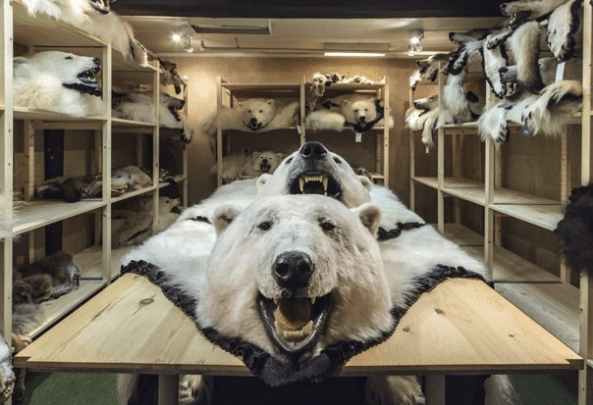
CITES giveth (to some sharks and manta rays), and CITES taketh away (or doesn’t giveth, for polar bears).

Screen Shot 2013-03-12 at 9.33.22 AM


(via Washington Post)

This news came out last week, but it illustrates perfectly the imperfections of the CITES regime and its inscrutable byzantine politics:

An international meeting of government wildlife officials rejected a U.S. proposal to ban the global trade of polar bear parts Thursday, following an impassioned appeal by Canadian Inuits to preserve polar bear hunting in their communities.

There are between 20,000 to 25,000 polar bears living in the wild in Canada, the United States, Russia, Denmark and Norway, according to the most recent analysis, which was conducted in the early 1990s. Scientists project that as Arctic summer sea ice shrinks, many polar bear populations could decline by 66 percent by mid-century.

I still haven’t seen an account which explains what actually went on behind the scenes to kill this proposal. But all sorts of vote-trading and vote-buying is the norm at CITES. And often enough protecting endangered species is not, in fact, the priority.

Because it’s not like the evidence of climate change, and the rate at which it is occurring, is diminishing. In fact, a recent study only makes it look more dramatic in the context of the past 11,000 years of earth history.