A View Of Earth

It’s always said that seeing earth from space gives humans a unique perspective that encourages a sense of earth as an integrated and fragile ecosystem. In other words, it helps us see the WHOLE earth.

This narrated video from the international space station achieves exactly that:

Humans tend to see everything from a human-first perspective. We tend to analyze events according to how it impacts humanity. We tend to act in our own interest.

But what if we started to see things from an Earth-first perspective? If we made personal, political, economic, and cultural decisions based on how they impact the Earth and ALL its species, not just the one we happen to belong to? If we acknowledged that we are just one part of a complex ecosystem, and that our cleverness does not necessarily give us the right to compromise the rights and futures of other parts of that ecosystem? If we had the wisdom to recognize that exploiting earth and its inhabitants instead of nurturing them is a way of undermining our own future.

What would happen? Well, everything would change.

Watch the video, see how humanity is visible almost everywhere, and think about that.

End Times For Meat?

Asks Time’s Josh Ozersky

Catte Feed Lot CAFOSure hope so. Ozersky explains that the future for meat is looking grim:

But while the bacon panic wasn’t real, there is a crisis in our meat supply and it’s no joke. We produce a lot of meat, but we feed a lot of Americans, and more all the time, thanks to the simple laws of multiplication, along with the simple addition of immigration. There is a drought, so there is less grain and corn for the animals to eat. Most of the producers are marginally profitable at best, and Americans refuse to pay more for meat than they do for Froot Loops, despite the fact that no one has to raise and feed and kill and process Froot Loops. I’m not kidding about this: go to the supermarket and see how much a package of pork chops cost, or half a chicken, and then compare that price to a box of Froot Loops.

All the things that consumers have, rightly, come to fear and distrust about the meat industry are a result of this problem. Hormones, to make the animals grow faster? Check. Antibiotics, to allow animals be cramped and crammed and stressed without dying of infections? Check. Farrowing crates and beak clipping, so as to squeeze more meat more efficiently out of factories? Check. Even the vile pink slime that everyone hates so much is simply a product, literally, of the beef industry’s need to get maximal yield out of each animal. We all love happy animals on small farms, but there’s no way to feed Americans living in or near poverty, as well as having tons of meat to export to China and elsewhere. The result is that producers are bumping off animals as fast as they can and getting out of the business before feed costs get worse and they are forced out. That’s where the bacon shortage comes in. Less pigs, less pork, less pork bellies for yummy, smoky bacon.

To Ozersky, this means a future of expensive, unhealthy meat and abused animals. I would argue we already have two of the three (yes, meat is cheap). He seems to lament the prospect. However, he doesn’t really have much to say on what to do about it.

So I’ll help him out: when a product is getting more expensive, more unhealthy, more ethically execrable, and more environmentally costly (which Ozersky doesn’t really go into), then perhaps the public should stop consuming that product.

I know. Radical idea. But Is it really that hard for Americans and the rest of humanity to imagine a future that isn’t fueled by cheap, factory-farmed meat?

The Wisdom Of Bertrand Russell

Bertrand Russell was a very wise man. In this 1959 recording he talks about what truths he would like future generations to understand.

His two key points, if grasped and honored by humanity, would change everything:

1) What are the facts and what is the truth that the facts bear out?

2) Love is wise. Hatred is foolish. In this world, which is getting more and more inter-connected, we have to learn to tolerate each other.

As I say, a very wise man. With an accent and speaking style that makes him utterly convincing.

(via @Sam10K)

(Don’t) Supersize Me

We’re America, so bigger is better. Except when it’s not, like when it drives up our carbon footprint and consumption without really making us any happier.

YES magazine has some telling charts on the growth of home sizes in the United States.

The biggest appeal to me of downsizing is that it requires getting rid of all the stuff your family accumulates because you have space to accumulate.

Anyhow, here is the extreme counterpoint to the McMansion revolution in America: a tiny house:

In 2004, Williams sold her bungalow, shedding a mortgage payment of over $1,000 per month, and bought plans for an 84-square-foot house on wheels. It cost her $10,000 to build, a quarter of which went for photovoltaic panels that generate her electricity. Now her house is paid for, and her monthly bills total about $8—for heating.

Even with the economic freedom she gained, it wasn’t easy to leave her house. “I loved my house and I liked my community in Portland.” And she knew that day-to-day life in the tiny house would be very different. “I’m going to have to carry water, I’m going to have to deal with my compost toilet, find a place to shower.”

“It was scary,” she admits. “But I also felt like, God! This is so cool!”

Leaving her stuff behind was not that hard for Williams. It was liberating. She got rid of photos, old love letters, her college letter jacket—“all that crap that you have because it reminds you of who you used to be.” Her friends and family have quit giving her things for Christmas, she says, “unless I get some kind of, you know, short fork!” She allows herself to own no more than 300 items, and she keeps careful count. “Not because I have obsessive-compulsive disorder,” she laughs, but because she once bet a friend that she had less stuff than he did. She’s kept count ever since.

I know my wife and kids could not go that low, but it’s an example of how simplicity can work. And how current assumptions about what we think we need are both out of tune with reality, and way, way, off.

The Meaning Of A Dead Orca

It’s hard to see the nobility, or the preservation of worthwhile values, in this.

This orca was killed with a harpoon, fired from a speedboat off St. Vincent and The Grenadines. The photo was posted by the West Indian Wildlife Conservation Society (WIWCS), and further disseminated by the American Cetacean Society. According to the WIWCS: “It happens almost on a weekly basis on the west coast of Saint Vincent, however, usually the victims are Pilot Whales. This is the second or third time an Orca has been killed off of St. Vincent.”

It’s of course terrible to see such an intelligent and socially sophisticated animal slaughtered (and the Facebook comments are running wild with opprobrium). But the hard reality is that traditional whale hunts, or the claim of “tradition” to protect whale hunting, will not go away until the economic needs of the hunters are addressed (subsidized Japanese whalers excepted; that’s a whole other twisted national identity issue).

Just one more example of the hard fact that we need to see the world–and its peoples and economies–as deeply interconnected, and act on the enormous disparities in wealth, before we can truly address the cruel practices that poverty breeds.

And, just as an aside, the slaughterhouse and industrial farming practices that produce the meat eaten by many who are outraged by whale hunting, are equally cruel and barbaric. So there is an issue of moral consistency that needs to be addressed, as well.

The Machines Have Won

A searing, hilarious, and sadly accurate cartoon railing against the modern attachment to screens at the expense of real interaction with one another and nature.

This is my favorite panel, but make sure you go read the whole thing.

Mark Bittman Is Coming Out (Slowly)

It’s been interesting to track NYT’s food writer Mark Bittman’s growing preoccupation and alarm over the human, environmental, and animal costs of meat production and consumption. He’s not yet an all-out vegetarian crusader. But he seems to be getting there one column at a time.

Here, he calls on meat eaters to be heroes by….eating less meat. Okay, that’s not terribly inspiring, but he is quoting Bruce Willis in Armageddon, so at least he has the Apocalypytic context right:

Here’s the thing: It’s seldom that such enormous problems have such simple solutions, but this is one that does. We can tackle climate change without inventing new cars or spending billions on mass transit or trillions on new forms of energy, though all of that is not only desirable but essential.

In the meantime, we can begin eating less meat tomorrow. That’s something any of us can do, with no technological advances. If personal choice enacted on a large scale could literally save the world, maybe we have to talk about it that way. We could be heroes, like Bruce Willis in “Armageddon,” only maybe the sacrifice is on a more modest and easier scale. (You already changed your light bulbs; how about eating a salad?)

Well, “heroic” and “modest” don’t usually go together. So I’ll stick to my personal hope that one by one people simply decide to stop eating meat altogether, instead of eating the planet into fiery, supervirus-infected oblivion, one heaping platter of sirloin at a time (while aiding and abetting an animal Holocaust for good measure).

I’d urge you to read Bittman’s piece, anyhow, because even if his rallying cry is a bit timid, his summary of all the impacts of meat eating and production is concise and bracing. It came out of a request the NYT made, asking readers to defend the ethics of eating meat (Bittman was a judge who helped pick the winner and finalists). He writes:

A fascinating discussion. But you need not have a philosophy about meat-eating to understand that we — Americans, that is — need to do less of it. In fact, only if meat were produced at no or little expense to the environment, public health or animal welfare (as, arguably, some of it is), would our decisions about whether to raise and kill animals for food come down to ethics.

That seems odd to me, since it is exactly all of those things (cost to the environment, public health, and animal welfare), which are at the heart of any evaluation of the ethics of meat eating and production (especially factory farming).

Anyhow, it feels like it won’t be long before Bittman is writing about vegan cooking, and wondering why anyone eats any meat at all.
Portlandia Takes Care Of Chickens

This is just a quick vignette illustrating the compassion and sympathy some people are capable of with regard to animals that provide humans with sustenance. It’s a story about a farmer in Portland, Oregon (of course!) who has gotten into the business of helping people retire their egg-laying chickens to a farm, instead of retiring them to the dinner table:
While many Portlanders still pluck aging birds for the broiler, others seek a blissful, pastoral end for them. Because most chickens lay the majority of eggs early in life, and can live about 10 years, the quest for a place where chickens can live out their sunset years has brought a boom to at least two farm animal sanctuaries and led Pete Porath, a self-described chicken slinger, to expand the portion of his business that finds new homes for unwanted birds.

“I would say I’m a halfway house for chickens on the move,” he said.

Mr. Porath, who brokers chicks to feed stores and other buyers from his five-acre farm in Estacada, first began finding new homes for birds as a free service to smooth bad feelings about misdelivered roosters. Now he “rehomes” 1,000 to 2,000 birds a year, most belonging to a unique subset he dubs “the Portland birds.”

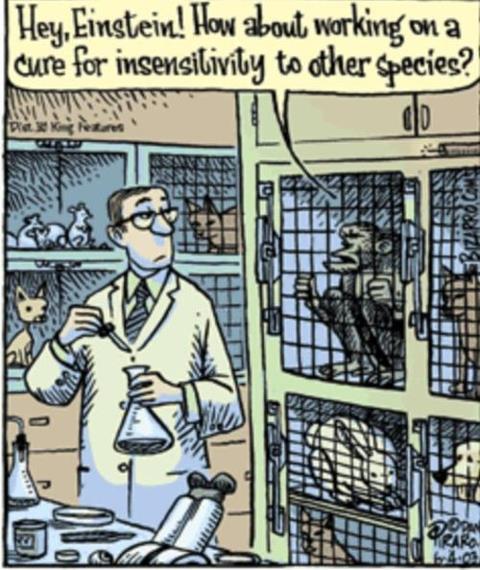
Most people will laugh at this story, as an eccentricity. And I can see it being written into Fred Armisen’s often funny TV show, Portlandia. But imagine what the world would be like if this sort of thinking, and respect for animals, was mainstream instead of scoffed at as too inconvenient (or costly) for humans. And imagine what the world would be like if our moral calculus demanded such concern for the welfare of animals we exploit. Would be fun to find out (and you gotta love the fact that Portland allows each homeowner to keep 3 chickens).

But I guess “Colin” is one chicken that didn’t make it:

If Only…

From SB:

#MuckReads = #MustReads

Can’t believe I just discovered this: ProPublica has been curating the best of watchdog journalism, via the Twitter hashtag #MuckReads.

This is the kind of journalism I love to read. It’s not good for your blood pressure, or for your view of humanity. But it’s the kind of journalism that’s essential in mobilizing people to tear down the status quo, reinvent, and rebuild.

The best #MuckReads of this week include stories about the poisonous legacy of factories, the degree to which the derivatives industry is putting a fierce smackdown on regulators, and (yes!) snow plow corruption in Montreal.

Time to get deep into the muck and start spreading it around.