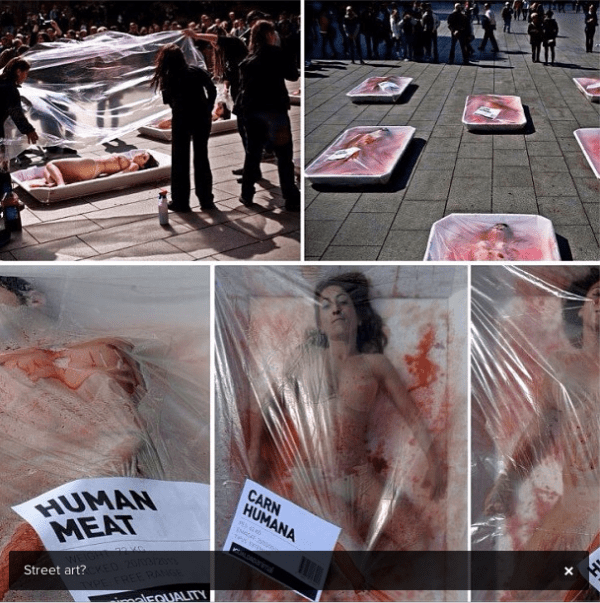
Okay, this is kind of gross (and also awesome), but that is exactly the point. Cows, horses, pigs, people. We are all meat, and would look much the same packaged up in a supermarket. So eating one type of meat, but taking offense at the idea of eating another, is just strange.
It is the act of eating meat, not what type of meat you eat, that is the issue.
From my long experience in environmental assessment, I can identify three key gaps in Mr. Savory’s assessment. First, what he proposes is unachievable. Second, he omits to incorporate a basic element in environmental assessment, and that’s analysis of alternatives. Third, he omits to say how long his recommendation would take to implement. Yet one expert group after another has projected that reversing climate change must begin in the next five years, or it will be too late.
Read the whole thing for the blow by blow deconstruction of Savory’s arguments, and approach. One additional key point Goodland makes is that Savory is important because his arguments are being used to help PERPETUATE the factory farm industry:
At least Mr. Savory promotes his approach to farmers, policymakers and academics — and not to consumers who must choose from foods available in the marketplace today. Indeed, few if any consumers seeking meat from their local grocers that’s produced using Mr. Savory’s approach will find any such product to be available today.
However, while Mr. Savory himself cautions that most livestock today are produced unsustainably, meat promoters can be seen spinning Mr. Savory’s claims as if they apply equally to factory-farmed meat. Yet it’s no new trick to promote factory farmed meat as grass-fed. A grassland producer has himself noted that most marketing of “grass-fed” beef is a hoax. Beef marketed this way commands a 200-300% price premium — so the incentive for producers to cheat is overwhelming, as evidenced in one videotape after another.
Here’s Goodland’s argument, presented in a much lighter way:
As I was browsing the meat industry news site, MeatingPlace.com, I came across an article called “My Week on a “Fact”ory Farm: Part I” by Emily Meredith who is the communications director for the Animal Agriculture Alliance and who also writes a column called “Activist Watch” on the same site. Meredith defends the practices of the industrial pig farms she recently visited in her attempt to bring out the facts and debunk what she sees as distortions from the activist community. In the following article, I responded to various excerpts of Meredith’s original post.
Here’s a sample of the cutting that is done:
Meredith: “No matter the industry practices I observed that first day—from tail docking to castration to artificial insemination—that theme of respect carried through.”
What a disturbing oxymoron. How is it possible to “respect” someone that you are dismembering, amputating, impregnating and ultimately breeding for the sole purpose of slaughtering them against their will?
There’s lots more where that came from. This is the kind of ultimate fighting that is worth supporting.
Bill Gates is a smart guy (obviously), and very good at looking at global problems and exploring creative global solutions. So it’s good news that he has focused his brainpower and advocacy on the fact that producing meat for everyone who wants to eat it simply isn’t sustainable (i.e. meat is killing the planet). The bad news he is promoting the wrong solution.
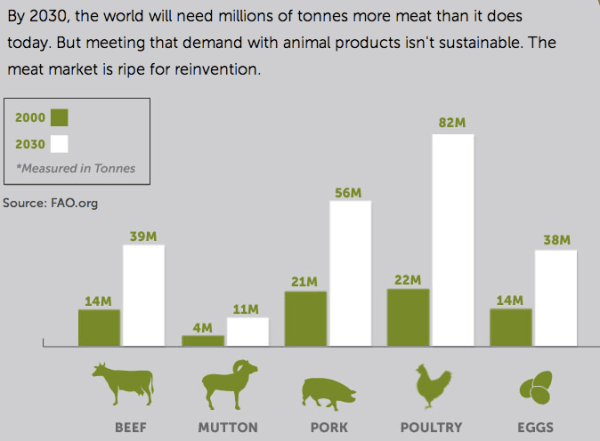
On his GatesNotes site, he now has an interesting section on “The Future Of Food.” It’s got lots of good data and thinking about why we can’t go on eating meat the way we do.
Now, you’ll notice that one of the comparative items in the second and third slides is “Beyond Meat.” That is a meat substitute that Gates seems to be excited about.
Forget the floating pigs (I know you are eager to forget the floating pigs). Perhaps the most compelling planet-saving rationale for giving up meat is the massive carbon footprint generated by the global meat industry. When people think about reducing their personal carbon footprint (if they think about it), they usually turn their thermostats down, buy fuel-efficient cars, and shut off lights when they are not using them. All good things to do.
But a choice that people don’t usually think about–and that has an outsized impact on their personal carbon footprint–is meat-eating. Numbers are inherently slippery, but one recent study concluded that the contribution to greenhouse gas (GHG) emissions to global warming contributed by a vegan are about 40% less than the GHG contributions of a meat-lover:
America’s most prominent vegan?
So in some ways, choosing to eat meat is like choosing to have a few Hummers in your garage, cranking your heat and AC up, and leaving all your lights on. Most environmentally conscious people would be appalled by a neighbor that lived like that. But somehow meat doesn’t enter into the carbon equation when people are thinking about their personal impact on the planet. And it should because it is such a major factor.
So think about getting rid of those Hummers on your plate. And if you are worried that your friends and family will scorn you for going vegetarian or vegan, I’ve got good news for you. America, despite it’s meat-celebrating culture, is warming up to the meatless:
About half of American voters view vegetarians favorably, and less than a quarter view them unfavorably. Vegans are viewed less positively, but still have significantly more than a third of American voters seeing them favorably. Generally, women, Democrats, and younger respondents have a more positive opinion of vegetarians and vegans. These are among the results of a poll of 500 registered American voters conducted by Public Policy Polling (PPP), a North Carolina-based firm, from February 21st to 24th. The survey asked what respondents like to eat, what they think of fast-food, which chain restaurants they like most, and a number of other food-related issues, as well as key demographic information.
So you can be healthy, planet-friendly, AND popular (though apparently you’ll need to go easy on the vegan righteousness). And there will be fewer dead pigs floating in the rivers.
I know, I know. You can’t take any more grotesque meat news. Well, it is what it is, so deal with it next time you are tucking into a pulled pork sandwich.
The latest installment in this cringe-inducing series comes from China, where the public, though it doesn’t mind a few dead pigs floating in Shanghai’s rivers, is not very happy about 6,000 dead pigs floating by. Here’s the Washington Post:
When hundreds of porcine bodies started surfacing this weekend in rivers upstream from the city, it prompted only mild shock, showing perhaps how routine safety scares about food and water have become in China.
But worries turned to panic late Tuesday, when authorities revealed that the number of pigs pulled out of waterways had climbed in the course of three days to an astonishing 5,916.
Shanghai officials pleaded for calm and insisted drinking water for Shanghai’s 23 million residents is still safe. They said there is no disease epidemic at cause. Instead they pointed their fingers at farmers in a nearby city of Jiaxing, who they say are dumping pigs who die in the course of their farming into the Huangpu River instead of properly burying or incinerating them. Local authorities near the pig farms in turn blamed their recent spike in dead pigs on colder temperatures, which they say caused the pigs to freeze or catch colds.
But all such explanations have been met online with equal measures of skepticism, anger and gallows humor, with some residents joking that perhaps the pigs killed themselves after refusing to breathe China’s increasingly polluted air or in protest of being force fed hormones and antibiotics.
Just another indication that of all the meat production industries, pig farming is the worst.
In case the above words don’t adequately convey what is happening, here’s a video report.
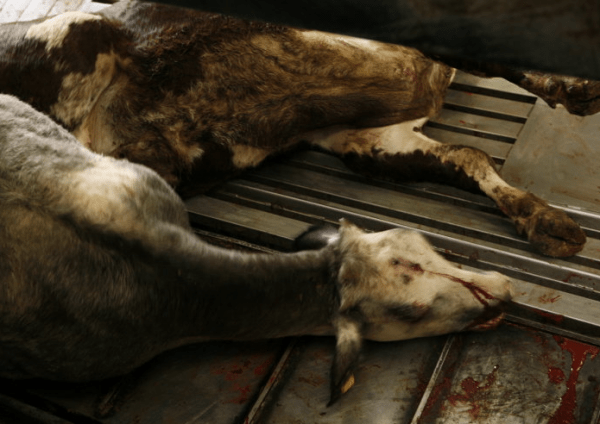
Italian photographer Francesco Scipioni spent a day photographing the workings of a slaughterhouse. The experience compelled him to make a change in his life: he became a vegetarian.
NYT writer Mark Bittman writes about food, and has long been troubled by the impact of our food choices on health, the environment, and the animals use in the food production system. He’s got the setup to the problem right, as here:
Nothing affects public health in the United States more than food. Gun violence kills tens of thousands of Americans a year. Heart disease, cancer, stroke and diabetes kill more than a million people a year — nearly half of all deaths — and diet is a root cause of many of those diseases.
And the root of that dangerous diet is our system of hyper-industrial agriculture, the kind that uses 10 times as much energy as it produces.
We must figure out a way to un-invent this food system. It’s been a major contributor to climate change, spawned the obesity crisis, poisoned countless volumes of land and water, wasted energy, tortured billions of animals… I could go on. The point is that “sustainability” is not only possible but essential: only by saving the earth can we save ourselves, and vice versa.
But given his diagnosis of the problem, I keep thinking he will eventually come right out and urge the world to go vegetarian (and he has written an excellent vegetarian cookbook). Yet for some reason he prefers to nibble his way toward that highly logical recommendation, without ever fully voicing it, which is a shame because there are few changes any human can make that match going meatless for beneficial impact on health, the environment, and animal welfare.
For example, after the setup above, Bittman goes on to write:
I believe that the two issues that will have the greatest reverberations in agriculture, health and the environment are reducing the consumption of sugar-laden beverages and improving the living conditions of livestock.
I have no problem with less sugar, which indeed would improve human health and reduce human impact on the environment. But just substitute “and dramatically reducing or eliminating the consumption of meat” for “and improving the living conditions of livestock” and his sentence (and argument) would make so much more sense.
I am all for attacking the mindblowing animal cruelty embedded in our food production system. But c’mon, Mark. Why not just flat out urge your audience to give up meat? I know it sounds radical, but everything you write about food simply screams for that conclusion.
Mercy For Animals is one of the best outfits fighting animal cruelty in factory farms, and opening consumers’ eyes. And apparently they make a great year-end video too.
At the end of this you can almost believe there will be a time when most people are vegetarian, and factory farms are a distant and ugly memory.





 The Earthist Chronicles