
Climate Change And Grasslands

Some very hard (and welcome) pushback from Robert Goodland on Allan Savory’s popular TED talk about livestock and the restoration of grasslands.

From Goodland’s “Meat, Lies, and Videotape (A Deeply Flawed TED Talk)“:

From my long experience in environmental assessment, I can identify three key gaps in Mr. Savory’s assessment. First, what he proposes is unachievable. Second, he omits to incorporate a basic element in environmental assessment, and that’s analysis of alternatives. Third, he omits to say how long his recommendation would take to implement. Yet one expert group after another has projected that reversing climate change must begin in the next five years, or it will be too late.

Read the whole thing for the blow by blow deconstruction of Savory’s arguments, and approach. One additional key point Goodland makes is that Savory is important because his arguments are being used to help PERPETUATE the factory farm industry:

At least Mr. Savory promotes his approach to farmers, policymakers and academics — and not to consumers who must choose from foods available in the marketplace today. Indeed, few if any consumers seeking meat from their local grocers that’s produced using Mr. Savory’s approach will find any such product to be available today.

However, while Mr. Savory himself cautions that most livestock today are produced unsustainably, meat promoters can be seen spinning Mr. Savory’s claims as if they apply equally to factory-farmed meat. Yet it’s no new trick to promote factory farmed meat as grass-fed. A grassland producer has himself noted that most marketing of “grass-fed” beef is a hoax. Beef marketed this way commands a 200-300% price premium — so the incentive for producers to cheat is overwhelming, as evidenced in one videotape after another.

Here’s Goodland’s argument, presented in a much lighter way:
Bill Gates Wants To Reinvent Meat

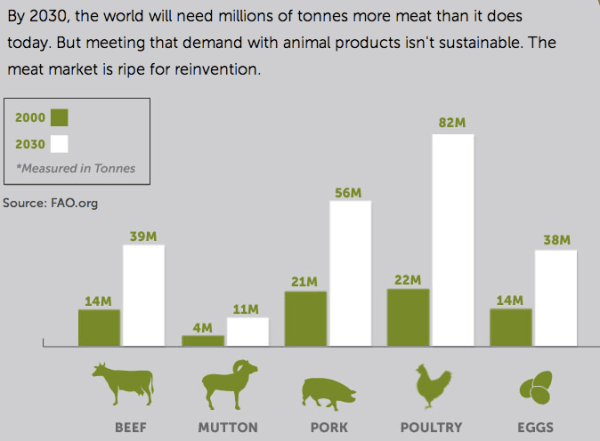
Bill Gates is a smart guy (obviously), and very good at looking at global problems and exploring creative global solutions. So it’s good news that he has focused his brainpower and advocacy on the fact that producing meat for everyone who wants to eat it simply isn’t sustainable (i.e. meat is killing the planet). The bad news he is promoting the wrong solution.

On his GatesNotes site, he now has an interesting section on “The Future Of Food.” It’s got lots of good data and thinking about why we can’t go on eating meat the way we do.

Screen Shot 2013-03-21 at 1.54.09 PM

Now, you’ll notice that one of the comparative items in the second and third slides is “Beyond Meat.” That is a meat substitute that Gates seems to be excited about.

His thinking is that we’ll never get the human race to move beyond meat and go vegetarian, so the solution to the impending meat bomb is to develop meat Continue reading “Bill Gates Wants To Reinvent Meat”

Climate Change IS An Existential Threat

Oddly, though, despite repeated warnings from the scientific and conservation community, it never seems to get elevated above all the other problems publics and governments face. And in the United States, I would argue, it is a lower priority than many.

And that’s despite the steady accumulation of data and research, like this, which indicates that every centigrade degree of global temperature increase could result in seven times as many Katrinas.

For anyone who wants to make the case for urgency and sacrifice, David Roberts has a really nice piece (explaining for the 545th time) that there are 2 big reasons that climate change really is a different beast from the many global challenges it gets lumped in with:

The public-policy implications are straightforward: Because CO2 is slow to drain, and the damages are cumulative, we need to reduce the amount of CO2 we’re spewing out of the faucet now, as much as possible, as quickly as possible. Yes, we’ll need new technologies and techniques to drive emissions down near to zero, and we should R&D the hell out of them. But we absolutely cannot afford to wait. There is no benign neglect possible here. Neglect is malign….

….The damage we’re doing now is something the next 40 to 50 generations will have to cope with, even if we stop emitting CO2 tomorrow. And the CO2 we’ve already released has locked in another 50 or 100 years of damage (because of the slow draining). There is no “reversing” climate change. There is only reducing the amount we change the climate.

Both these facts about climate change set it apart from other environmental problems. They also, for what it’s worth, set it apart from social problems like poverty, crime, or poor healthcare. All of those problems are serious; they all have an impact on public health. But they can all be measurably affected by public policy within our lifetimes. They are bad but they are not cumulative. They are not becoming less solvable over time.

Climate change, on the other hand, is forever.

Or at least a few eons. (Click image for full size)

To me, there are three existential threats we face: 1) nuclear war; 2) a highly contagious, drug-resistant, virus or bacteria; and 3) climate change. Those are the key problems humanity should be working on together, with climate change arguably being the most difficult to address, and requiring the most sacrifice.

But we are asleep. History will not, and should not, be kind. Our willful avoidance will be inexplicable. It is already inexplicable.

Revolution Comes To DC

We really need the real thing here in the nation’s capital. But for now I will settle for a viewing of Rob Stewart’s new documentary, Revolution, which will screen at the DC Environmental Film Festival (sponsored by GM??!!) this weekend.
Stewart’s Sharkwater was a revelation for audiences. I hope Revolution will be too.

And here is the synopsis:

Revolution is a film about changing the world. The true-life adventure of Rob Stewart, this follow-up to his acclaimed Sharkwater documentary continues his remarkable journey; one that will take him through 15 countries over four years, and where he’ll discover that it’s not only sharks that are in grave danger – it’s humanity itself.

In an effort to uncover the truth and find the secret to saving the ecosystems we depend on for survival, Stewart embarks on a life-threatening adventure. From the coral reefs in Papua New Guinea and deforestation in Madagascar to the largest and most destructive environmental project in history in Alberta, Canada, he reveals that all of our actions are interconnected and that environmental degradation, species loss, ocean acidification, pollution and food/water scarcity are reducing the Earth’s ability to house humans. How did this happen, and what will it take to change the course that humanity has set itself on?

Travelling the globe to meet with the dedicated individuals and organizations working on a solution, Stewart finds encouragement and hope, pointing to the revolutions of the past and how we’ve evolved and changed our course in times of necessity. If people were informed about what was really going on, they would fight for their future – and the future of other generations. From the evolution of our species to the revolution to save it, Stewart and his team take viewers on a groundbreaking mission into the greatest war ever waged.

Startling, beautiful, and provocative, Revolution inspires audiences from across the globe to start a revolution and change the world forever.

That would be nice. If you are in DC and want to join me, just message me via my Facebook page.

CITES Schizophrenia: Sharks And Rays Vs. Polar Bears

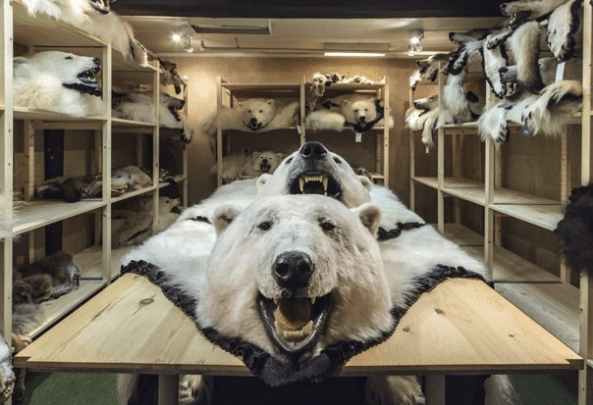
CITES giveth (to some sharks and manta rays), and CITES taketh away (or doesn’t giveth, for polar bears).

Screen Shot 2013-03-12 at 9.33.22 AM


(via Washington Post)

This news came out last week, but it illustrates perfectly the imperfections of the CITES regime and its inscrutable byzantine politics:

An international meeting of government wildlife officials rejected a U.S. proposal to ban the global trade of polar bear parts Thursday, following an impassioned appeal by Canadian Inuits to preserve polar bear hunting in their communities.

There are between 20,000 to 25,000 polar bears living in the wild in Canada, the United States, Russia, Denmark and Norway, according to the most recent analysis, which was conducted in the early 1990s. Scientists project that as Arctic summer sea ice shrinks, many polar bear populations could decline by 66 percent by mid-century.

I still haven’t seen an account which explains what actually went on behind the scenes to kill this proposal. But all sorts of vote-trading and vote-buying is the norm at CITES. And often enough protecting endangered species is not, in fact, the priority.

Because it’s not like the evidence of climate change, and the rate at which it is occurring, is diminishing. In fact, a recent study only makes it look more dramatic in the context of the past 11,000 years of earth history.

Carbon Math

You may think that all that driving you do, or air conditioning your house, is your biggest contribution you make to global warming. But how about all those air miles?

For many people reading this, air travel is their most serious environmental sin. One round-trip flight from New York to Europe or to San Francisco creates about 2 or 3 tons of carbon dioxide per person. The average American generates about 19 tons of carbon dioxide a year; the average European, 10.

So if you take five long flights a year, they may well account for three-quarters of the emissions you create. “For many people in New York City, who don’t drive much and live in apartments, this is probably going to be by far the largest part of their carbon footprint,” says Anja Kollmuss, a Zurich-based environmental consultant.

It is for me. And for people like Al Gore or Richard Branson who crisscross the world, often by private jet, proclaiming their devotion to the environment.

Though air travel emissions now account for only about 5 percent of warming, that fraction is projected to rise significantly, since the volume of air travel is increasing much faster than gains in flight fuel efficiency. (Also, emissions from most other sectors are falling.)

Tax carbon at $20 a ton, which is roughly the tax that many economists believe would be required to have an impact on human behavior adequate to slow warming, and suddenly you will understand how big a climate change driver air travel is. And you will also think more carefully about how often, and how far, you fly.

Another alternative is to sell carbon offsets along with air travel tickets.

Just The Facts: Hot, Hot, Hot

According to NOAA, 2012 was the hottest year EVER for the lower 48 US states. More here and here.

This isn’t shocking news for most people, who understand that the climate is warming. We get these sorts of stories all the time now (just like we seem to get school shootings; be nice if political leaders would at least think about climate action, too). What most people don’t really understand, though, is the magnitude of change required in the pricing of carbon, and in their lives, to address this threat (which along with nuclear proliferation is clearly the greatest threat facing not just the United States, but humanity). I’m going to try to look into that question in more detail this year.

For now, though, some graphic illustrations of just how far off the charts we are going:

Average annual temperatures for contiguous U.S. Data from NOAA.
The Climate Extremes Index in the contiguous U.S. over time. 2012 ranked second highest on record (NOAA NCDC)
Difference from average annual temperature in 2012 compared to the 1981-2010 average. (NOAA)


The Tangled (And Impressive) Finances Of Susan Rice

I’ve long thought that John McCain and Lindsey Graham’s shrill jihad against Susan Rice over Benghazi was hyperpartisan blather. But OnEarth reports something that really does give me pause: A huge chunk of Susan Rice’s personal wealth, which is estimated at $23.5-$43.5 million dollars, is tied up in Canadian oil and energy companies. That means that she would directly benefit from a State Department decision to approve the Keystone XL pipeline.

From OnEarth:

Susan Rice, the candidate believed to be favored by President Obama to become the next Secretary of State, holds significant investments in more than a dozen Canadian oil companies and banks that would stand to benefit from expansion of the North American tar sands industry and construction of the proposed $7 billion Keystone XL pipeline. If confirmed by the Senate, one of Rice’s first duties likely would be consideration, and potentially approval, of the controversial mega-project.

Rice’s financial holdings could raise questions about her status as a neutral decision maker. The current U.S. ambassador to the United Nations, Rice owns stock valued between $300,000 and $600,000 in TransCanada, the company seeking a federal permit to transport tar sands crude 1,700 miles to refineries on the Texas Gulf Coast, crossing fragile Midwest ecosystems and the largest freshwater aquifer in North America.

Beyond that, according to financial disclosure reports, about a third of Rice’s personal net worth is tied up in oil producers, pipeline operators, and related energy industries north of the 49th parallel — including companies with poor environmental and safety records on both U.S. and Canadian soil. Rice and her husband own at least $1.25 million worth of stock in four of Canada’s eight leading oil producers, as ranked by Forbes magazine. That includes Enbridge, which spilled more than a million gallons of toxic bitumen into Michigan’s Kalamazoo River in 2010 — the largest inland oil spill in U.S. history.

Rice also has smaller stakes in several other big Canadian energy firms, as well as the country’s transportation companies and coal-fired utilities. Another 20 percent or so of her personal wealth is derived from investments in five Canadian banks. These are some of the institutions that provide loans and financial backing to TransCanada and its competitors for tar sands extraction and major infrastructure projects, such as Keystone XL and Enbridge’s proposed Northern Gateway pipeline, which would stretch 700 miles from Alberta to the Canadian coast.

Obviously, if she she became Secretary Of State, her financial holdings could be sold off and put into a blind trust. So it’s inconceivable to me that she could be making a decision on Keystone while holding stocks that would make big gains from a green light.

But I guess what surprises me is the extent of her wealth, as well as the fact that it is so tied up in carbon-spewing investments. I don’t know the source of her wealth (maybe it comes from her husband or family), but it’s a reminder of the increasing connection between public service and wealth in this country. Serving in Congress or an administration is a path to riches these days. That has consequences, because it is inevitable that the public interest gets undermined–even if subconsciously–in the daily business of the country as public servants make decision after decision that affect the industries and interests that are or will become the source of their wealth. So the critical divide in America, in my view, is no longer left or right but IN (elite; wealthy; with access to power) and OUT (on the margins; with diminished representation).

While Susan Rice may be a democrat, and may hold liberal views on the environment, her portfolio defines her as a card-carrying member of the one percent. And I prefer my Cabinet secretaries to be of moderate means, with minds and motivations unclouded by the deserve to preserve or add to their wealth.

Sea Level Rise Visualization

A thought-provoking interactive graphic that let’s you see now what will be flooded later (in major US cities).

Guess what? It’s not very reassuring…

Annals Of Climate Opportunism: Natural Gas Shipments Via The Arctic

Another example of the climate change-carbon economy loop, in which burning carbon leads to warming which in turn leads to new fossil fuel economy opportunities.

In this example, the reduction in Arctic sea ice is opening the northwest and northeast passages to fuel shipping. The first liquid natural gas tanker recently left Norway, and is headed toward Japan, escorted by a Russian nuclear-powered icebreaker:

“It’s an extraordinarily interesting adventure,” Tony Lauritzen, commercial director at Dynagas, told BBC News.

“The people on board have been seeing polar bears on the route. We’ve had the plans for a long time and everything has gone well.”

Mr Lauritzen says that a key factor in the decision to use the northern route was the recent scientific record on melting in the Arctic.

“We have studied lots of observation data – there is an observable trend that the ice conditions are becoming more and more favourable for transiting this route. You are able to reach a highly profitable market by saving 40% of the distance, that’s 40% less fuel used as well.”

Forty percent less fuel burned is good, I guess. But the whole thing, along with Arctic oil drilling, reminds me of a cartoon I posted on my Facebook page earlier today.