Former SeaWorld trainers discuss what they did (and didn’t) know about the 1987 tragedy in which trainer John Sillick was crushed by a killer whale at Sea World San Diego.
Tag: SeaWorld
Former SeaWorld Trainer Bridgette Pirtle On Life At Shamu
It’s always illuminating to hear directly from trainers who worked with killer whales at SeaWorld. Recently, Bridgette Pirtle a former trainer at SeaWorld Texas, decided to come forward and talk about her experience, and views on orca captivity (she also provided some great waterwork footage for Blackfish).

Voice Of The Orcas, a site put together by other former SeaWorld trainers speaking out about orca captivity, caught up with Bridgette for an interview. Here’s a sample, but, as always, I urge you to read the whole thing (and not just because she says nice things about my work):
Halyn was the first killer whale I saw being born. For the first few months of her life, I was there doing night-watches and around the clock bottle-feeds. During the first week of her life, we had lowered a back pool to about 4 ft of water and lined the walls with tubes from the water park to act as bumpers.I was snorkeling near one corner watching her swim when she just stopped and watched me too. I don’t think I could hold my breathe that long ever again, butjust having those couple of minutes of having this tiny whale make eye contact with you and stay there with you was unreal. I was the first trainer to give her the bottle and some of my first behaviors I trained with killer whales were teaching Halyn.In the last few weeks of her life, I tried to be there with her as much as possible. I was one of the trainers in the water holding her before she passed away.
I’m sure we’ll hear more from Bridgette and others, and that is an important trend. When I first started reporting The Killer In The Pool, there were only three former trainers who would speak to me (one pro-SeaWorld). Now the ranks of former trainers willing to speak openly about what SeaWorld is about for orcas, other animals, and trainers, is almost at double digits.
The Death Of Sumar: Raw Footage
 I hesitate to post this, which was shot over SeaWorld San Diego when Sumar died in September 2010, because I don’t want it to seem gratuitous. But I am going ahead, because death for orcas at marine parks, usually premature death, is part of the orca experience in captivity that marine parks would prefer the public knew little about (much less see).
But marine parks can’t control everything that gets presented to the public, or the air space over their pools. So when there are opportunities to tell a fuller story than gets told from a marine park stage, or in a cheery brochure or TV commercial, the fuller story should be told.
Blackfish Will Make Its International Premiere At Sundance London
This is great news, and will be the perfect way to take Blackfish overseas for the first time:
The programme announced today includes 18 feature films and nine short films across four sections, including a new UK Spotlight. Twenty-three films will make their international, European or UK premieres at Sundance London. Ten are by female filmmakers and six are by first-time feature filmmakers. The films collectively received 12 awards when they premiered at the Sundance Film Festival in Park City, Utah, U.S.A.. Among the artists expected to attend Sundance London are Lake Bell, Mike Birbiglia, Jimmy Carr, the Eagles, Barbara Kopple and Peaches, as well as Sundance Institute President & Founder Robert Redford.
For any Londoners, tickets will be available from 9:00 am GMT, March 15, at www.sundance-london.com.

Orca Breeding Update: Takara Pregnant
Folks in orca forums have been suspecting this for a while, but as Blackfish continues to roll out, I thought I would confirm that Takara is indeed pregnant.
Following the failure of her last pregnancy, she was AI’d again last summer, presumably again with sperm from Kshamenk. Takara is the dominant orca at SeaWorld Texas, and she tends to be on more of a hair trigger through the early hormonal surges of pregnancy. So for a while the Texas orca group had to be managed carefully to minimize the likelihood that Takara would rough up other whales. Interestingly, part of the strategy was to keep the whole group of orcas together in one pool whenever possible, on the theory that Takara’s mobility would be limited and that for Takara a confined space limits her inclination toward aggression during the early stages of pregnancy. Separating her was believed to make her more anxious to affirm her dominance when she got a chance.
Apparently, Kasatka, Takara’s mother, also has similar issues with hormones and aggression during early pregnancy. But while conscious of Kastaka’s propensity for increased aggression during the early stages of pregnancy, the California park did what it could to manage the aggression without reducing Kasatka’s space.
Not sure what is happening with Kayla, who last year was also on the AI list…
Blackfish Premiere
 After almost two years of shoots and editing, Blackfish was finally shown on a big screen, in front of an auditorium full of normal people who don’t obsess about orcas. There were some gasps and murmurs during the viewing, when some particularly stunning footage of trainer injury, or orca captures, came on the screen. And most of the audience stayed after to listen to the former SeaWorld trainers featured in the movie answer questions.
Now, we wait to see if a distributor picks up the movie, which is the next step to getting it in front of a general audience. Whether and how that happens will depend in part on how Blackfish is received by the critics. And here is the first review, from Indiewire:
Nobody from SeaWorld agreed to an interview for “Blackfish,” Gabriela Cowperthwaite’s searing take on the theme park’s mistreatment of killer whales and the dozens of deaths that have resulted from it. Instead, the majority of its subjects are ex-SeaWorld trainers frustrated by the negligence they witnessed up close and willing to speak out. Nevertheless, based on the evidence on display in “Blackfish,” Cowperthwaite’s case against SeaWorld would change little with an opposing point of view. The movie makes a strong case against the captivity of killer whales under sub-circus conditions, but the stance is made even more horrifying because so little has changed in the history of the organization. “Blackfish” is less balanced investigation than full-on takedown of a broken system.
My only quibble is that the former trainers in Blackfish are not “disgruntled.” They are “disillusioned.” But it’s a review that we are pretty happy with.
Here’s one more moment from last night’s premiere that was pretty cool. Sundance Institute’s Director Of Programming, Trevor Groth, did us the honor of introducing Blackfish and Gabriela. And he talked about how it impacted him. You can’t really see him, but you can hear him:
What Are These Signs Saying?
This must be a good omen: that’s ex-SeaWorld trainer John Hargrove on the slopes, 8 hours before the Blackfish premiere:

Sundance Posting
I’m in Park City, and looking forward to the start of Blackfish screenings at Sundance. I’ll be trying to post some updates on this page, but given the pace of things, and the ease of posting to Facebook while on the move, I’ll probably be posting more frequently to my Facebook page. Score one for Facebook over WordPress.
Here’s a nice preview I found this morning, which has Gabriela explaining what Blackfish is about and what it took to make the film:
Synopsis:
Notorious killer whale Tilikum is responsible for the deaths of three individuals, including a top killer whale trainer. Blackfish shows the sometimes devastating consequences of keeping such intelligent and sentient creatures in captivity.Blackfish quick pitch:
The story shows us what can happen when you put one of the world’s most intelligent, powerful, and beautiful predators in a tank of water, make them do tricks, and “add humans” to the recipe.Why it’s worth checking out at Sundance and beyond:
Oh I think you might be in for a ride. I guess I’m hoping you experience the same shock and discovery I experienced while making the film. But I had 2 years. You get 82 minutes!How it all came together:
I think the thing that takes everybody by surprise is that I took my kids to Sea World multiple times before making this film. When I started making the movie, I thought I was making a movie about the death of a trainer. It was only when I started filming that I discovered that nothing in this industry is what it seems. I was blown away by what I learned. So from that moment on, I think the biggest challenge for me was not putting things in the film. There was so much disturbing information, I found myself wanting to shoe horn any alarming fact into the film, even if it wasn’t part of the story. But in the end, I refrained because I didn’t want the film to feel manipulative. I knew if we had a chance to make this film stand out, it would be because we stuck to telling the story, not inundating an audience with damning facts designed to scare them or piss them off. So one of my strongest challenges was staying disciplined about telling the story. I think another of the biggest challenges was trying to interview people. It’s amazing how terrified people are of that marine park. Sometimes people would be willing to speak anonymously, but even they would eventually back out for fear of repercussions. Twice we had already flown to locations, unpacked our gear, only to learn that our interviewees had backed out. It was frustrating. This extends to other parks too. Our fixers at Loro Parque were terrified of being on camera for fear of what the owner of Loro Parque would do. They stood away from our cameras and whispered when they spoke. I want to say there was nothing to be afraid of, but we were followed and our pictures were taken on more than one occasion.On the Blackfish clip (click here):
The clip is actually our opening. I thought of the scene while I was interviewing a trainer. He was describing what it was like to do a “rocket hop.” This is a trick the experienced trainers do at Sea World, where the trainer is launched up into the air essentially off the nose of an orca. To me, the scene is a visual metaphor for the spectacle of the show above water versus the reality underneath. Above water you see a brilliant spectacle, a beautiful show with happy animals and trainers. Beneath the surface, you see what could arguably turn into a terrifying interaction at any moment. It still scares me every time I watch it!
Blackfish Is About To Premiere At Sundance
 As many of you might know, for the past 18 months I’ve been helping documentary film-maker Gabriela Cowperthwaite make a documentary about Tilikum, Dawn Brancheau and SeaWorld. She first contacted me about the idea after reading Killer In The Pool, and the aim of the film is to try and help people understand why Tilikum’s life resulted in Dawn Brancheau’s tragic death.
Now the film is finished. It’s called Blackfish, and it will be shown to an audience for the first time on Saturday evening at the Sundance Film Festival (here’s the film’s page).
We’ve been flying below the radar, but here’s an early mention about the film, in a story about Hollywood and orcas. And Indiewire recommended it as one of 20 films to see. They also posted the only clip of Blackfish to be released so far. It’s the intro to the movie, so just a taste of what follows (click the image to play):

I just arrived in Park City for Sundance, and will soon be joined by the full production team as well as many of the trainers interviewed in the film. I’ll be posting about the premiere and the Sundance experience over the coming week, so stay tuned. In the meantime, here is Gabriela talking about Blackfish:
SeaWorld Waterwork Update
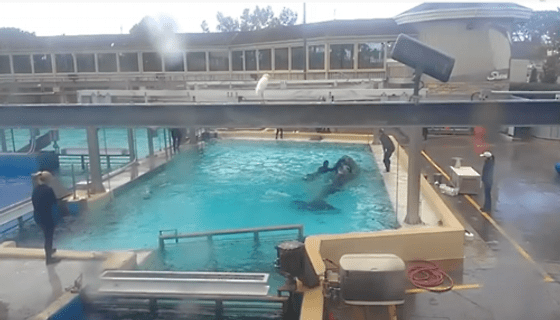
Last month, I wrote about SeaWorld’s whale interaction protocols since Dawn Brancheau died, and the fact that waterwork desensitization with certain whales had advanced to the point of swimming with whales in the med pool.
This picture of Orkid in the med pool with a trainer in San Diego is now making the rounds online:
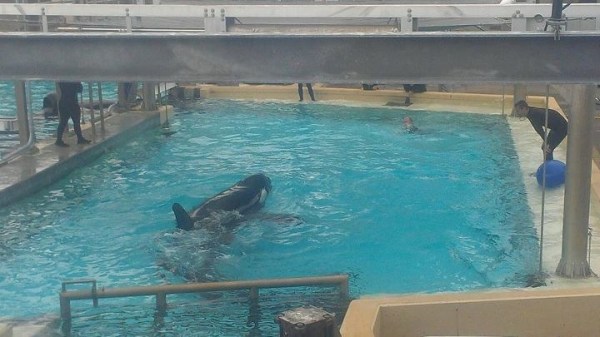
Update: here’s one more.
 The Earthist Chronicles