
I believe in the power of film, and “The Circular Glance” is an award-winning short film that makes the powerful and important connection between how we live, and the implications for animals. It turns a perfect day into a perfect nightmare and will make you think.
Tag: vegetarian
Seeing Is Important: Slaughterhouse Transparency Trending

The New York Times catches up with the Ag-Gag problem:
But a dozen or so state legislatures have had a different reaction: They proposed or enacted bills that would make it illegal to covertly videotape livestock farms, or apply for a job at one without disclosing ties to animal rights groups. They have also drafted measures to require such videos to be given to the authorities almost immediately, which activists say would thwart any meaningful undercover investigation of large factory farms.
Critics call them “Ag-Gag” bills.
Some of the legislation appears inspired by the American Legislative Exchange Council, a business advocacy group with hundreds of state representatives from farm states as members. The group creates model bills, drafted by lobbyists and lawmakers, that in the past have included such things as “stand your ground” gun laws and tighter voter identification rules.
One of the group’s model bills, “The Animal and Ecological Terrorism Act,” prohibits filming or taking pictures on livestock farms to “defame the facility or its owner.” Violators would be placed on a “terrorist registry.”
Officials from the group did not respond to a request for comment.
Mercy For Animals argues that this sort of exposure is an example of how the factory farm industry’s pursuit of ag-gag laws is an over-reach that is backfiring by drawing MORE attention to the conditions of slaughterhouses (one can hope, I guess):
In response to a spate of undercover investigations that have uncovered horrific animal abuse and shocking food safety problems in meat, dairy, and egg production, the factory farming industry has been furiously lobbying to pass “ag-gag” laws designed to keep its cruel and unsanitary practices hidden from public view. But that effort seems to be backfiring, as scores of media outlets nationwide are throwing back the curtain on Big Ag and shining a bright light on the industry’s sickening practices…[snip]
…Here is just a sample of the ag-gag news coverage in only the last few weeks:
Associated Press: Bills Seek End To Farm Animal Abuse Videos
Mother Jones: Flies, Maggots, Rats, and Lots of Poop: What Big Ag Doesn’t Want You To See
Nightline: ‘Ag Gag’ Bills Target Hidden Cameras
Raw Story: Business Lobby Moves to Criminalize Filming Animal Abuse on Factory Farms
Bakersfield Californian: Cattle Industry Must Rethink ‘Ag-Gag’ Bill
Food Safety News: “Ag-Gag” Bills Getting Hearings Today in Nebraska, Arkansas and Tennessee
Salon: States Seek “Ag-Gag” Laws to Silence Farm Whistleblowers
Vice: Beat Your Meat: Factory Farmers Want to Choke Their Chickens in Private
Huffington Post: Why Everyone Should Be Angry About Factory Farming
Lowell Sun: Agri-farm Bills Would Weaken Oversight
The Daily Aztec: Only We Can Stop Inhumane Factory Farming
Herald Times: Bill would shield farms, factories from cameras
Public Source: Bill would limit whistleblower activities on PA farms
Ironically, as the factory farming industry more desperately tries to hide its cruel practices, the more they are exposed.
You can see why a farm owner might prefer that this sort of imagery be criminalized (instead of the behavior it shows).
But if this op-ed contributor to the Times got his way, I think we could definitely conclude that the ag-gag initiative backfired. He calls for a Continue reading “Seeing Is Important: Slaughterhouse Transparency Trending”
Meat Culture: Americans Eating Less Meat, The World Eating More

Americans still eat a lot of meat, but it is starting to look like they are eating less:
WASHINGTON — For the first time on record, U.S. per-capita meat consumption has declined for four consecutive years, according to the most recent figures from the U.S. Department of Agriculture.
The six percent drop between 2006 and 2010 is the largest sustained decline since recordkeeping began in 1970.
Reasons for the decline are at least partly economic: rising prices and a bad U.S. economy have made meat less affordable for American consumers.
But there are intriguing signs that a cultural shift may be underway, as well…[snip]
…While about seven percent of Americans identify themselves as vegetarians, it’s the “flexitarians” – people who eat occasional meatless meals – that market research firms have just begun to explore.
One such firm, Packaged Facts, found that eating along the “meatless spectrum” is popular among college students, who will carry those eating habits into their adult years.
“Young people today are just not so meat-and-potatoes oriented as earlier generations were,” said environmental researcher Lester Brown at the Washington-based Earth Policy Institute.

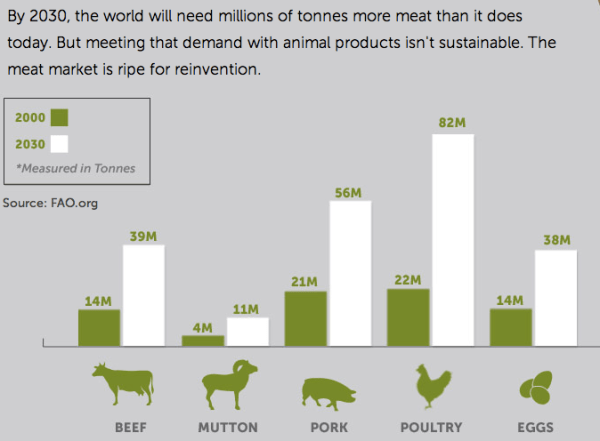
That’s encouraging, because sometimes cultural changes can hit a tipping point that creates a true shift. But according to Lester Brown we’d still need two or three Earths to meet the demand for grain and water if the rest of the world ate meat like Americans. So this chart is important to keep in mind, too:
The McVegans Are Coming

According to Mark Bittman, there are vegetables afoot in the fast food industry:
Twelve years after the publication of “Fast Food Nation” and nearly as long since Morgan Spurlock almost ate himself to death, our relationship with fast food has changed. We’ve gone from the whistle-blowing stage to the higher-expectations stage, and some of those expectations are being met. Various states have passed measures to limit the confinement of farm animals. In-N-Out Burger has demonstrated that you don’t have to underpay your employees to be profitable. There are dozens of plant-based alternatives to meat, with more on the way; increasingly, they’re pretty good.
The fulfillment of these expectations has led to higher ones. My experience at the airport only confirmed what I’d been hearing for years from analysts in the fast-food industry. After the success of companies like Whole Foods, and healthful (or theoretically healthful) brands like Annie’s and Kashi, there’s now a market for a fast-food chain that’s not only healthful itself, but vegetarian-friendly, sustainable and even humane. And, this being fast food: cheap. “It is significant, and I do believe it is coming from consumer desire to have choices and more balance,” says Andy Barish, a restaurant analyst at Jefferies LLC, the investment bank. “And it’s not just the coasts anymore.” [snip]
…When I first entered a Veggie Grill [founded by two vegans], I expected a room full of skinny vegans talking about their vegan-ness. Instead, at locations in Hollywood, El Segundo and Westwood, the lines could have been anywhere, even an airport Taco Bell. The diners appeared mixed by class and weight, and sure looked like omnivores, which they mostly are. The company’s research shows that about 70 percent of its customers eat meat or fish, a fact that seems both reflected in its menu and its instant success. Veggie Grill won best American restaurant in the 2012 Los Angeles Times readers’ poll, and sales are up 16 percent in existing stores compared with last year. The plan is to double those 18 locations every 18 months for the foreseeable future — “fast enough to stay ahead of competitors, but not so fast as to lose our cultural DNA,” Boylan said. In 2011, the founders brought in a new C.E.O., Greg Dollarhyde, who helped Baja Fresh become a national chain before its sale to Wendy’s for nearly $300 million.
Sure hope Bittman is right, because vegan and vegetarian penetration of the fast-food market would be the most encouraging sign of a real cultural shift I’ve seen yet. In the meantime, here’s hoping Veggie Grill comes to Washington, DC soon.
Rise Of The Vegans
At least according to this cool Google Trends analysis of searches using the word “vegan” 2008 to the present. It was created by Compassion Over Killing, and, yes, it starts on the coasts (especially the PNW and the NE), but watch as it slowly spreads into the heartland.
There are holdout states, of course (I’m looking at you, Wyoming), but if Google searches are destiny then veganism is an idea and way of life whose time is arriving.

There’s A New Milkman In Town
…”and he’s got some serious nuts.”
A pretty funny commercial for Silk Almond Milk (for me, almond milk was the key discovery that helped me ditch dairy. It’s tasty enough to drink plain, and good (enough) in coffee).
Silk Milk from CINEMA SCOTT on Vimeo.
The Power Of Street Art: Human Meat Edition
Okay, this is kind of gross (and also awesome), but that is exactly the point. Cows, horses, pigs, people. We are all meat, and would look much the same packaged up in a supermarket. So eating one type of meat, but taking offense at the idea of eating another, is just strange.
It is the act of eating meat, not what type of meat you eat, that is the issue.

Bill Gates Wants To Reinvent Meat
Bill Gates is a smart guy (obviously), and very good at looking at global problems and exploring creative global solutions. So it’s good news that he has focused his brainpower and advocacy on the fact that producing meat for everyone who wants to eat it simply isn’t sustainable (i.e. meat is killing the planet). The bad news he is promoting the wrong solution.
On his GatesNotes site, he now has an interesting section on “The Future Of Food.” It’s got lots of good data and thinking about why we can’t go on eating meat the way we do.
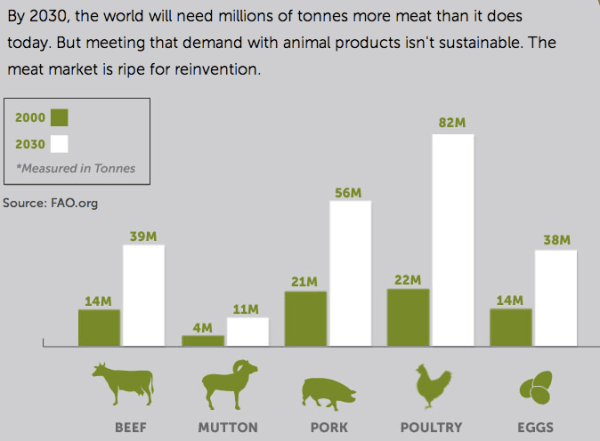


Now, you’ll notice that one of the comparative items in the second and third slides is “Beyond Meat.” That is a meat substitute that Gates seems to be excited about.

His thinking is that we’ll never get the human race to move beyond meat and go vegetarian, so the solution to the impending meat bomb is to develop meat Continue reading “Bill Gates Wants To Reinvent Meat”
Meat Is Killing The Planet (Part 2): The Carbon Chasm
Forget the floating pigs (I know you are eager to forget the floating pigs). Perhaps the most compelling planet-saving rationale for giving up meat is the massive carbon footprint generated by the global meat industry. When people think about reducing their personal carbon footprint (if they think about it), they usually turn their thermostats down, buy fuel-efficient cars, and shut off lights when they are not using them. All good things to do.

But a choice that people don’t usually think about–and that has an outsized impact on their personal carbon footprint–is meat-eating. Numbers are inherently slippery, but one recent study concluded that the contribution to greenhouse gas (GHG) emissions to global warming contributed by a vegan are about 40% less than the GHG contributions of a meat-lover:


So in some ways, choosing to eat meat is like choosing to have a few Hummers in your garage, cranking your heat and AC up, and leaving all your lights on. Most environmentally conscious people would be appalled by a neighbor that lived like that. But somehow meat doesn’t enter into the carbon equation when people are thinking about their personal impact on the planet. And it should because it is such a major factor.
So think about getting rid of those Hummers on your plate. And if you are worried that your friends and family will scorn you for going vegetarian or vegan, I’ve got good news for you. America, despite it’s meat-celebrating culture, is warming up to the meatless:
About half of American voters view vegetarians favorably, and less than a quarter view them unfavorably. Vegans are viewed less positively, but still have significantly more than a third of American voters seeing them favorably. Generally, women, Democrats, and younger respondents have a more positive opinion of vegetarians and vegans. These are among the results of a poll of 500 registered American voters conducted by Public Policy Polling (PPP), a North Carolina-based firm, from February 21st to 24th. The survey asked what respondents like to eat, what they think of fast-food, which chain restaurants they like most, and a number of other food-related issues, as well as key demographic information.
So you can be healthy, planet-friendly, AND popular (though apparently you’ll need to go easy on the vegan righteousness). And there will be fewer dead pigs floating in the rivers.
Meat Is Killing The Planet: A River Full of Pigs

I know, I know. You can’t take any more grotesque meat news. Well, it is what it is, so deal with it next time you are tucking into a pulled pork sandwich.
The latest installment in this cringe-inducing series comes from China, where the public, though it doesn’t mind a few dead pigs floating in Shanghai’s rivers, is not very happy about 6,000 dead pigs floating by. Here’s the Washington Post:
When hundreds of porcine bodies started surfacing this weekend in rivers upstream from the city, it prompted only mild shock, showing perhaps how routine safety scares about food and water have become in China.
But worries turned to panic late Tuesday, when authorities revealed that the number of pigs pulled out of waterways had climbed in the course of three days to an astonishing 5,916.
Shanghai officials pleaded for calm and insisted drinking water for Shanghai’s 23 million residents is still safe. They said there is no disease epidemic at cause. Instead they pointed their fingers at farmers in a nearby city of Jiaxing, who they say are dumping pigs who die in the course of their farming into the Huangpu River instead of properly burying or incinerating them. Local authorities near the pig farms in turn blamed their recent spike in dead pigs on colder temperatures, which they say caused the pigs to freeze or catch colds.
But all such explanations have been met online with equal measures of skepticism, anger and gallows humor, with some residents joking that perhaps the pigs killed themselves after refusing to breathe China’s increasingly polluted air or in protest of being force fed hormones and antibiotics.
Just another indication that of all the meat production industries, pig farming is the worst.
In case the above words don’t adequately convey what is happening, here’s a video report.
 The Earthist Chronicles