Tommy The Chimp Still Not A Person

Screen Shot 2014-12-05 at 9.32.49 AM

Yesterday, a New York State Appellate Division issued its ruling on the Nonhuman Rights Project’s petition to grant Tommy the chimpanzee personhood rights:

Noting that the Nonhuman Rights Project ”requests that this Court enlarge the common-law definition of ‘person’ in order to afford legal rights to an animal,” the Court’s decision was that “We decline to do so, and conclude that a chimpanzee is not a “person” entitled to the rights and protections afforded by the writ of habeas corpus.

NHRP goes on to explain in detail why it disagrees with the decision, and says it will appeal the decision to the New York Court of Appeals.

While it would have been great if the Appellate Court had granted Tommy a writ of habeus corpus, establishing basic personhood rights to an animal for the first time (and, importantly, opening the door to his tiny cage in a trailer park so he could be moved to a sanctuary), the refusal to grant Tommy basic rights was not necessarily a surprise. This has probably always been a question that will be decided at the highest appeals court level (though it would have been nice to go to that level with a positive ruling to defend), and now the argument has just moved one level up the chain.

But the next level, the New York Court of Appeals, is the final level. If NHRP does not win the argument before that court, then that will put an end to its efforts to win personhood rights for a chimp via Tommy. The chance that its arguments for any single animal might fail is the reason NHRP originally launched legal bids on behalf of four chimps, to try to improve the odds of a successful outcome.

So if Tommy’s case doesn’t come to a successful conclusion, the hope is that Kiko, Hercules or Leo will deliver. Stay tuned. This is the long game.

“Kiko, Hercules, Leo, I may need your help.” Photo: Pennebaker Hegedus Films


Another Reason To Put A Camera On Your Bicycle

The LA Times produces a troubling heat-map of hit and runs on cyclists:

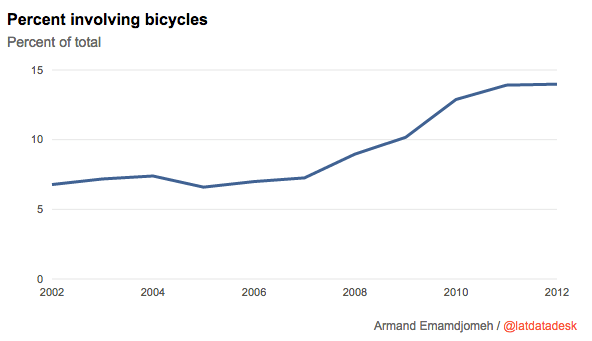
Livingston’s case is part of a troubling trend. Hit-and-run collisions involving bicyclists surged 42% from 2002 to 2012 in Los Angeles County, according to a Times analysis of California Highway Patrol crash data.

The increase came as the overall number of hit-and-runs involving cars, cyclists and pedestrians dropped by 30%. Between 2002 and 2012, the most recent data available, more than 5,600 cyclists were injured and at least 36 died in crashes in which drivers fled the scene.

Here’s another way of looking at the data:

Screen Shot 2014-12-04 at 1.08.26 PM

Screen Shot 2014-12-04 at 1.11.00 PM

These numbers could be explained by the growing number of cyclists on the streets. But it’s also possible that at least part of it is that motorists are being less careful around cyclists, and maybe even targeting them sometimes (I can’t even begin to count the number of times that drivers who are intentionally trying to scare me have come within inches of hitting me).

Either way, the only way to motivate drivers to be more careful (and nail drivers who hit cyclists and flee) is to carry a camera onboard.

Major Misperception On Climate

Perceived contribution (gray bars) versus actual contribution (red dots) of different industries to global carbon emissions.


This has puzzled me for years:

The general public has a major lack of understanding of how eating meat and dairy contributes to climate change, according to a survey of Europe, the Americas, Asia, and Africa by the market research organization Ipsos MORI. Although meat and dairy production accounts for roughly 15 percent of total global carbon emissions — equal to exhaust emissions from the international transportation sector — less than 30 percent of survey respondents identified meat and dairy production as a major contributor to climate change. More than twice as many — 64 percent — said transportation was a major contributor.

Interestingly, many people are aware that deforestation contributes to global warming, but don’t apparently don’t connect deforestation to clearing land to run livestock.

I guess the meat and dairy industry has a better PR team than the oil and gas companies.

Points Worth Noting…

From Anthony Barnosky, who is featured in the new Smithsonian Channel documentary Mass Extinction: Life at the Brink (which aired last night):

“We have killed about 50 percent of the world’s vertebrate wildlife in just the past 40 years,” he says. “We’ve killed half the numbers of individuals. We’ve fished 90 percent of the fish out of the seas. So these are big things we’re doing to the world.”

Yes, very big. Sounds like Barnosky’s book, Dodging Extinction: Power, Food, Money and the Future of Life on Earthis worth a read. (via)

Peek Oil: North Dakota Oil Wells Visualized

Screen Shot 2014-11-26 at 1.19.16 PM

Courtesy of the clever folks at the New York Times:

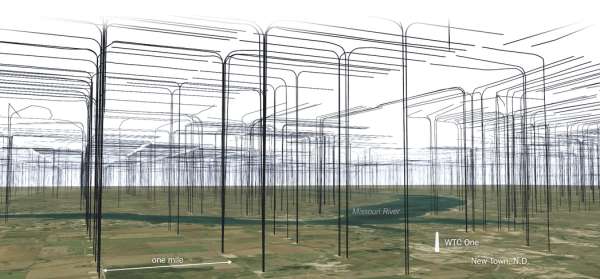
More than 11,000 oil wells have been drilled in North Dakota since 2006, covering the state’s agricultural landscape. In all, almost 40,000 miles of well bores have been drilled underground to connect the fracking operations to surface wells. Laid end to end, they would circle the Earth about one and a half times.

On Sunday, The New York Times published a monthslong investigation by Deborah Sontag and Robert Gebeloff into North Dakota’s conflicted relationship with its booming oil industry. In the process of reporting that article, we obtained the locations of every oil drilling line of every well in the state.

The precise depths and directions of these remain out of sight for a very obvious reason: The drilling lines are underground. Here, we change that.

The illustrations shown here are accurate in every respect except one: We changed the vertical direction of each oil well bore to go above ground instead of below it. Otherwise, every bore line is shown precisely how it’s described by North Dakota’s Department of Mineral Resources.

Gives new (visual) meaning to oil addiction. And very effectively conveys the reality that the business of being human is the business of constantly probing, altering, and wounding the planet.

Cory Booker Takes Out A Trial Membership In The The Vegan Club

Photo: The Daily Beast


A long-time vegetarian, Booker says he’s trying veganism through the end of they year. He tried and failed once before. Hopefully, this time it will stick. Because he knows that vegetarianism doesn’t quite resolve the moral issues involved in animal production:

There’s tension in vegetarianism, though, since many of the reasons we have to give up meat—the animal death and suffering, the negative environmental impact, the health consequences—are still problems when we look at milk or eggs. The milk industry tacitly supports veal production, since lactation requires frequent pregnancies and something has to be done with the calves. The egg industry, too, takes a staggering number of lives—every male chick is killed shortly after it hatches, and egg-laying hens are killed at around a quarter or fifth of their natural lifespan. Even more, animal agriculture produces a startling proportion of our greenhouse gas emissions (by some accounts nearly 20 percent) and consumes ashocking amount of water. The environmental consequences of animal agriculture don’t change whether a cow is grown for dairy or meat nor whether a chicken is raised for poultry or eggs.

Booker also expressed concern about his own health. “African-American males have some of the worst health data out of any sort of gender-race combination in our country,” he said. “Do I want to be an exemplar of good health and health outcomes, or do I want to participate in things that are making me unhealthy?”

Hard to argue with that. And if he sneaks some Ben & Jerry’s every once in a while, no one should think the worse of him.

Veganism: it’s a wave that’s building…

Killer Whale Community

Evidence that killer whales take care of their own, from the Russian Orcas Facebook page:

There have been several reports from around the world about disabled killer whales surviving through the help of their family members. This summer we have encountered this female that obviously had some problems with her back. She was swimming slowly behind the group, and one male always stayed near her. Despite her disability, she did not look skinny, suggesting that she might get food from her family members.

Can SeaWorld Be Saved (cont.)?

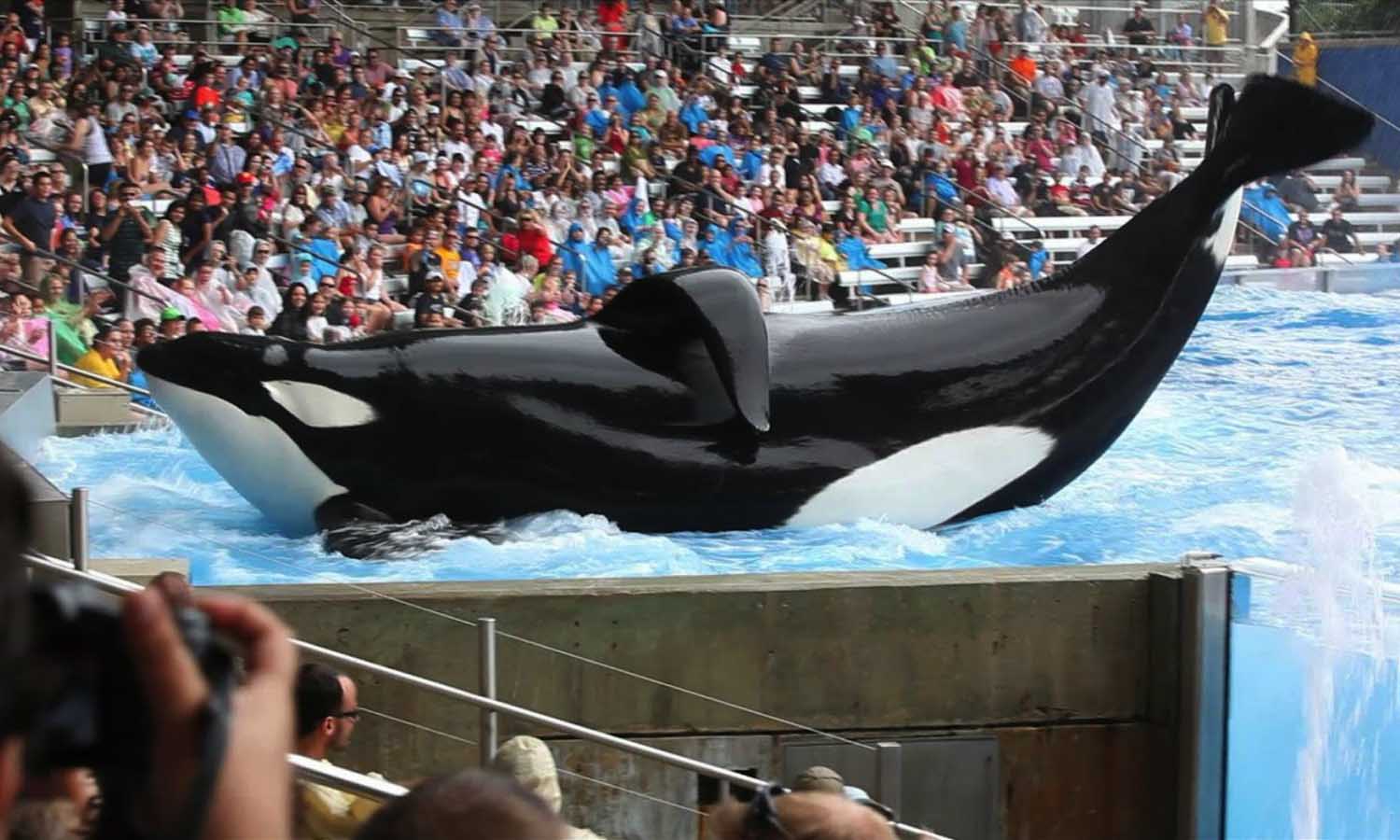
A strong argument in the Orlando Sentinel, from Scott Maxwell, that SeaWorld in fact can’t be saved, unless it comes to grips with the fact that its killer whale shows can no longer be its primary attraction.

Money graphs:

SeaWorld’s problem is that its biggest asset and biggest liability are the same thing — whales.

It needs to evolve and expand.

See, one of the main reasons that Disney and Universal continue to thrive is that they continue to evolve.

Ten years ago, Universal was all about superheroes and roller coasters. Today, it is Harry Potter and high-tech simulators.

Disney has grown and adapted as well. It started with fairy tales and an iconic castle. But Disney then reached out to older adults with Epcot, movie lovers with MGM Studios and animal lovers with Animal Kingdom.

Today — four decades after Disney’s first Orlando park opened — Disney is preparing to cash in on the worldwide phenomenon of a movie that didn’t even exist until last year: “Frozen.”

Meanwhile, SeaWorld’s main theme and attraction is the same as it was when the park opened 41 years ago: killer whales.

And the park is doubling down on that. It’s biggest spending plans involve hundreds of millions of dollars to expand and improve the whale habitats.

Other than that, the park has second-tier additions on the horizons — like a revamped Clyde and Seamore sea lion show, which the company described last week as “a hilarious tale, filled with amazing animal behaviors and splashy audience fun.”

Think about that. Universal has a new Harry Potter attraction that’s garnering worldwide attention. SeaWorld has a paid blogger, a bigger whale pool and a revamped sea lion show.

If Disney needs more than Mickey, SeaWorld has to understand that it needs more than Shamu.

Read the whole thing, and see who you think makes more sense: Atchison in Businessweek? Or Maxwell?

Can SeaWorld Be Saved?

Last week, Karl Taro Greenfeld managed an unusual feat: he was allowed inside SeaWorld’s corporate offices to interview SeaWorld’s leadership and report a Businessweek story called “Saving SeaWorld,” about SeaWorld’s efforts to survive and bounce back from the surprisingly powerful and accelerating #BlackfishEffect (seriously, I think it is fair to say that no one involved with the production fully anticipated the impact that resulted).

Since this is the first real access SeaWorld has given a big-time news organization since Blackfish started cratering SeaWorld’s image, its corporate relationships, and its stock price, it is worth taking a close look at what Greenfeld reported.

First up, Greenfeld gets SeaWorld CEO Jim Atchison to comment on SeaWorld’s PR strategy:

“There is no recipe to follow. There’s very little intuitive about it,” says Atchison. “Do I wish we would have taken a more aggressive action earlier? On an emotional level I do, because I was offended by it personally. … One of the things we had to measure early on was, how do we engage in it? We don’t want to aid the marketing of the film by engaging too openly, too aggressively, too early. We didn’t want to turn it into the film SeaWorld doesn’t want you to see. And the film didn’t really gain any kind of notable momentum until CNN started airing it. Repeatedly.”

I have to admit that I am sympathetic to SeaWorld on this point. SeaWorld had a long history of keeping its head down when bad things happen at its parks, and the bad news always blew away over time and allowed SeaWorld to get back to business. It is completely understandable that SeaWorld did not want to make a big deal out of Blackfish before Blackfish was, indeed, a big deal. Why help the public take notice of a film that will harm your business?

And Atchison is correct, I think, that the CNN airings are what blew Blackfish up into a public phenomenon (an important lesson to all film-makers who want their work to have impact). Following Sundance, and through the film’s theatrical run, there was just not that much public awareness about Blackfish. I have never been in the loop on the theatrical numbers, but I don’t think Blackfish was packing the movie houses. It wasn’t until Blackfish hit cable television, on CNN in late October (along with a pretty good CNN-designed social media plan) that lots and lots of people saw Blackfish and started telling others about it.

Continue reading “Can SeaWorld Be Saved?”

Chris Christie Weighs Morality Against His Political Ambitions

“Yo, Chris. I know I don’t have a vote in Iowa, or a Super Pac. But sure would be nice to be able to move around a bit.”


The legislators of New Jersey have seen fit to ban cruel gestation crates for pigs, and the pig industry of Iowa demands a Christie vet. Its presidential ambition versus basic compassion and morality, with a deadline of Dec. 1, and I suspect I will not be surprised by which way Christie will go.

But Matthew Scully, a lonely and articulate voice on the right calling for compassion, weighs in with a plea for Christie to ignore the lies and spin he is being fed from Iowa and do the right thing:

Being immobilized for all of their existence, lying and living in their own urine and excrement, the sows are sick, sore, atrophied, usually lame, crazed or broken in spirit, and kept alive in these torments only by a massive and reckless use of steroids. The confinement of the sows, presented in terms of solicitude for the piglets, is among the causes of the welfare problem it purports to solve. And the piglets in any case are taken from their mothers in short order to begin their own lives of merciless confinement, mutilation, privation, and fear, in a process, from birth to slaughter, utterly devoid of human compassion.

I saw all of this myself once on a visit to a mass-confinement hog farm in North Carolina, the kind of investigative tour that would now be a crime in Iowa, taking in scenes that anyone not numbed to the sight of animal suffering would find abhorrent and deeply disturbing. (Let’s just say that Joni Ernst’s celebrated campaign ad, shot in a sunny, straw-filled showcase instead of a typical industrial hog farm, would have lost its sassy charm had the backdrop been the real thing.) The particular issue of the crates may seem a small matter, these extra few inches for a lowly pig, so miserable already and doomed to a nightmarish end. But that’s not a thought I’d stress if I were one of those guys from the National Pork Producers Council talking to Governor Christie. It only draws attention to the sheer pettiness, the unfeeling, unyielding, unchristian spirit, of anyone who would refuse so minimal a comfort to an afflicted animal.

If you and I made a living doing things like this to weak and defenseless creatures, we’d want to steer clear of legal scrutiny too, protesting against intrusions into our private commercial pursuits. But the argument that the bill on Governor Christie’s desk would constitute an undue regulatory burden on hog farmers, by directing the state board of agriculture to write new rules forbidding gestation crates, falls apart the moment you pause to think about it.

Yes, yes it does. And the unspeakable cruelty of industrial pig farming is not an issue that should be ignored for any political purpose.

PS: Here’s Jon Stewart’s take: