Whale Wars-Again

Last year, the Japanese whaling fleet, harassed constantly by the Sea Shepherds, went home early, and without killing as many whales as they had planned. Many people took that as a good sign for the future. Apparently, not. The Japanese whaling fleet is gearing up for another Southern Ocean season, and the Japanese government is planning to spend $10 million to send an escort vessel to help fend off Paul Watson and the Steve Irwin. So the stage is set for more confrontation.

The Japanese are saying that they need to continue their “research” whaling in order to make it possible to resume commercial whaling in the future, despite widespread condemnation from countries in the region. The economics of whaling just don’t add up, so it’s hard to avoid the conclusion that cultural stubbornness, and narcissistic preoccupations with the importance of human “face,” is driving the ongoing whale slaughter, rather than any concept or morality, or even economic rationality. The result is sure to help Whale Wars score great ratings. And while I am all in favor of Watson and his team doing everything they can to stop the whale killing, and appreciate the public awareness Whale Wars delivers, I wonder how much of the profits Animal Planet puts into whale conservation.

Weekly Adventure Fix

The latest edition of my Adventure Fix newsletter is out. This week I’ve got some harrowing tornado tales, Walter Cronkite on the America’s Cup, and more, including this gem:

Adventure Fix costs just $1.99 a month for weekly links to great online adventure content. You can sign up here.

Think Different

Yes, I am typing this on a Mac, and I recently got an iPhone. But the message of this ad (narrated by Jobs), is perhaps Jobs’ most important legacy.

Think different. Which is an echo of Lincoln’s great–and ever more pertinent–exhortation:

The dogmas of the quiet past, are inadequate to the stormy present. The occasion is piled high with difficulty, and we must rise — with the occasion. As our case is new, so we must think anew, and act anew. We must disenthrall ourselves, and then we shall save our country.

Think Different
Image by secretagent007 via Flickr

Ironically, the next rebellion, the next paradigm shift in thinking we really need, is not about engineering cool, new stuff, that will make our lives easier or more amusing. It will instead take us away from a lifestyle built around acquiring exactly that sort of stuff.

But it is a testament to Jobs, and the fact that his engineering does so much more than divert and amuse, that if I had to make a list of 100 things to keep, his technology would definitely be on it.

PS: The quote above was from Lincoln’s Annual Message To Congress, Dec. 1, 1862, as he tried to lay the ground for the Emancipation Proclamation. He also said, and I add this because it resonates so powerfully in a time in which Congress knows what to do but won’t act, for partisan political reasons:

Fellow-citizens, we cannot escape history. We of this Congress and this administration, will be remembered in spite of ourselves. No personal significance, or insignificance, can spare one or another of us. The fiery trial through which we pass, will light us down, in honor or dishonor, to the latest generation. We say we are for the Union. The world will not forget that we say this. We know how to save the Union. The world knows we do know how to save it.

Enhanced by Zemanta

Edit Your Life

Less is more, which should be the essential mantra of this century. Here’s one take on it:

Editing isn’t that easy. But good editing always results in a better story.

SeaWorld Spare Air Update

Shamu at SeaWorld Orlando lifting a trainer ou...
Image via Wikipedia

Earlier this month I wrote about two safety upgrades SeaWorld is working on to try and reduce the risks of working in the water with killer whales: a fast-rising pool floor, and a small, emergency air supply for trainers to wear in their work.

Since then I’ve picked up a few more details on the emergency air supply. One of the concerns some trainers have with it is that the killer whales might grab the equipment, so the equipment itself could become a source of risk. SeaWorld is hoping to minimize this risk by sewing the rescue scuba tank Buoyancy Compensator (BC) as tightly as possible onto the wetsuit, so there is nothing left hanging for killer whales to latch onto. And, as mentioned before, the plan is to then wear the tight overlays the trainers don for show branding purposes on top of the rig (though some trainers are worried that putting the overlay on top will be dangerous because they won’t be able to dump the scuba gear if a killer whale does latch onto it).

SeaWorld has experimented with personal air systems before, and  some trainers feel that this new rig–which is based on a military design–is much easier to use. However, the previous system SeaWorld experimented with–which was based on something like this NOAH design, and consisted of a canteen-sized air bottle located at the small of the back, with a hose running up inside the wetsuit, where it could be accessed via a velcro opening at the chest–was much less bulky. The new emergency air supply is more like a full-up scuba rig (with tank, BC, regulator and hose), and so wearing it many hours over the course of a day isn’t as comfortable or easy.

One of the purposes of a more full-up scuba rig, presumably, is to provide more air capacity, which is important. Trainer Ken Peters, for example, who was dragged underwater multiple times by Kasatka in 2006 (a video that was shown at the Seaworld/OSHA appeal), spent a minute or more at a time underwater. (Though I doubt that spare air would have been much help to Dawn Brancheau or Alexis Martinez, given the severity of their internal injuries).

Alexis Martinez and Dawn Brancheau

SeaWorld management believes that the new scuba design should give trainers about five minutes of air capacity, which certainly could have helped Peters (who survived even without the air). But in practice sessions trainers are finding it only delivers a couple of minutes of air (which would not be a huge jump over the old NOAH system).

Another feature of the new design–which also helps account for the increased bulk–is a separate air cannister that is reserved exclusively for emergency inflation of the BC, for rapid ascent in a dire situation. As any scuba diver knows, rapid ascent is always a risky proposition because rapidly expanding air in the lungs can force dangerous, or even deadly, air embolisms through the lining of the lungs and into the bloodstream. For this reason, scuba divers ascend slowly and make sure that they exhale air from their lungs as they rise through the water column. The emergency inflation of the trainer BC, however, will cause a trainer on the bottom of the pool to ascend to the surface (some 40 feet) in about 3 seconds. Any compressed air in the trainer’s lungs from the spare air system  (and remember, this step will only be taken in a chaotic, stressful situation), would likely result in severe embolism injury (former trainers tagged this danger when the idea of “spare air” first came up after Dawn Brancheau’s death).

This video of trainers swimming and diving in the SeaWorld Florida “Dine With Shamu” pool gives you a sense of the depth and scale of a SeaWorld pool.

This danger of embolism is serious enough that SeaWorld management has been nervous about having trainers practice emergency ascents with the equipment.

The final issue I have been hearing about with regard to the new emergency air equipment is a more mundane problem: the placement of the air cannisters. The location of the breathing bottle and the emergency ascent air supply on the rig place both bottles against the trainer’s lower spine. Trainers do a lot of running around the wet pool decks during training and shows. Sometimes they slip and fall on their backs, and some trainers are concerned that a similar fall with the new gear could result in serous lower spine injury.

So there are real dilemmas and trade-offs on implementing the new gear, which is not surprising. Killer whale training and interactions are intensely complex. Any new piece of equipment, and any change in practices, will always raise any number of issues that could impact both the trainers and the killer whales. SeaWorld had been hard at work getting the new air system ready for prime time: trainers were wearing and experimenting with the gear (behind the scenes, out of sight of the public), and the killer whales were being desensitized to it (though the trainers stayed out of the water, as they have been since Dawn Brancheau was killed). That work stopped with the onset of the OSHA hearings, which have now been extended to a second session that will start in November. But SeaWorld seems poised to deploy the equipment–with all its trade-offs–if and when they ever send trainers back into the water.

Enhanced by Zemanta

The Trials Of Tekoa

While “Blood In The Water” focused most on the killer whale Keto, it also detailed a serious incident in which Tekoa, a young male, went after a trainer called Claudia Volhardt, and put her in the hospital.

During my reporting, I was told that Tekoa has a tough time at Loro Parque, and is frequently harassed by the other killer whales there. Now I want to dig a bit deeper into Tekoa’s experience at Loro Parque, because recently some pictures of him have surfaced which show very serious scars and rake marks, underscoring the difficult social order among the killer whales at Loro Parque, and Tekoa’s plight.

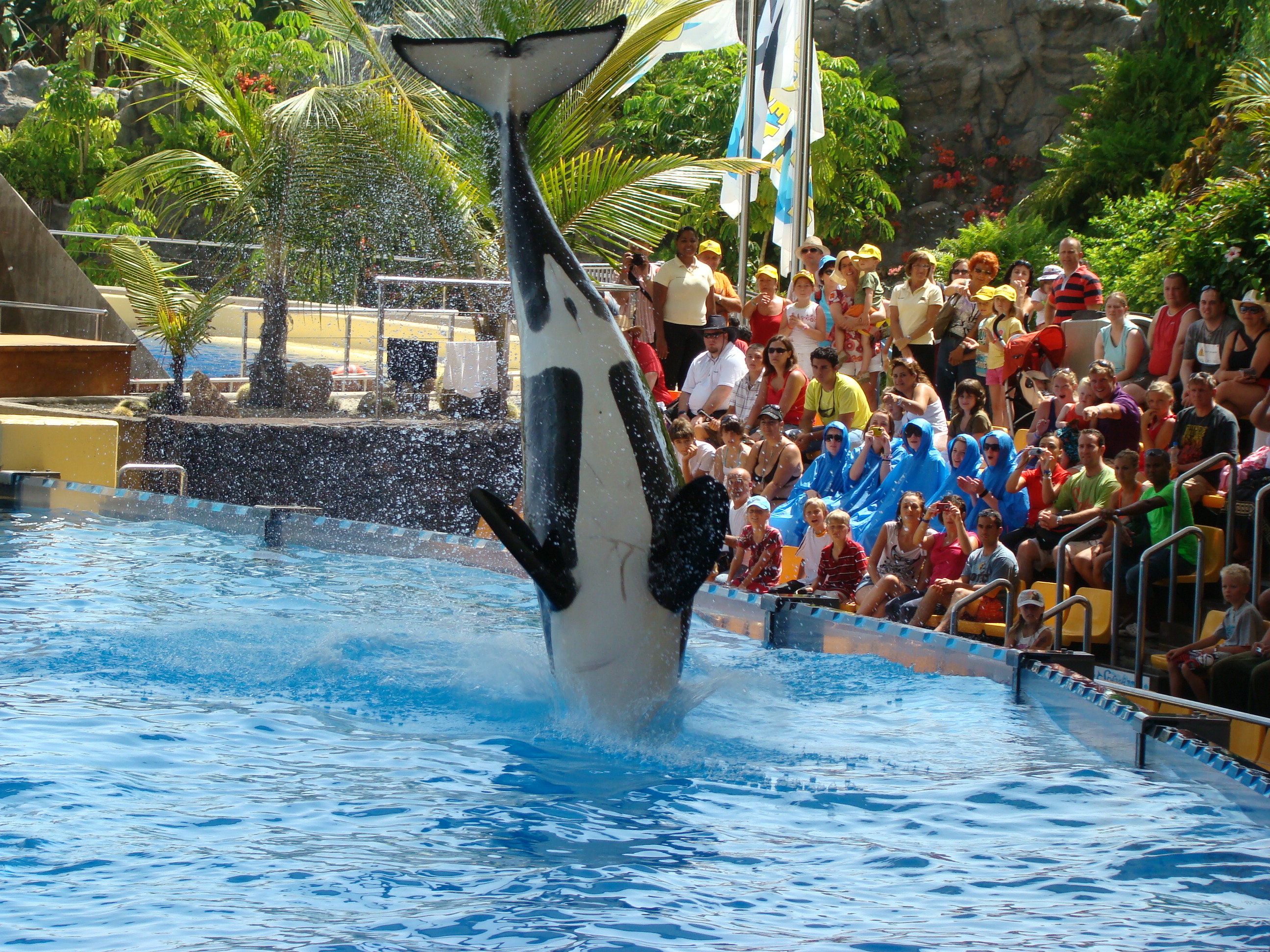
When SeaWorld first sent four killer whales to Loro Parque, some SeaWorld trainers, as well as other experts, worried that the group did not include a mature, dominant female to establish a clear and stable social order (the two females were Kohana, 3 at the time, and Skyla, 2).  And those concerns seem valid, given that the Loro Parque’s killer whales, according to many people I spoke with, were often more interested in chasing after each other than performing in shows. And, of course, there were two serious attacks at Loro Parque, one resulting in the death of a trainer. But now we can also see visual evidence of how the unstable situation is affecting Tekoa.

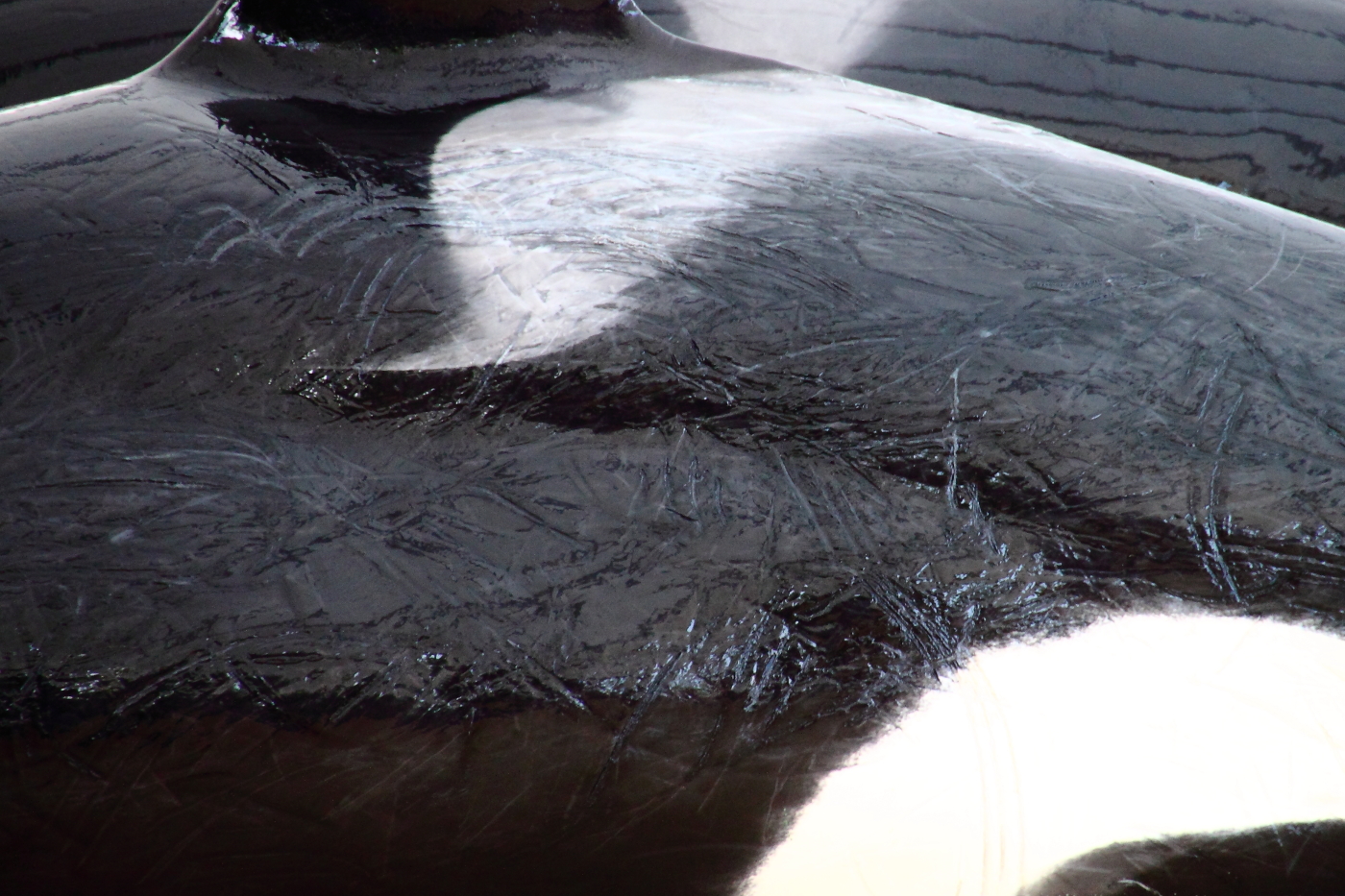
Here is a close-up of Tekoa taken in April 2011 (click the image for full-size, to see full detail):

(Credit: MonchoParis)

This is a second photo MonchoParis sent me, after I asked if I could use his photos (click for full size):

I also have more recent pictures of Tekoa, taken in September and sent to me, which I’ve put into a slideshow:

A number of experts have told me that these rake marks are about as bad as any they have ever seen on a marine park killer whale, and people are taking notice. Even fervent fans of marine parks have been visiting Loro Parque and, after seeing Tekoa’s condition, have been posting critical reports about Loro Parque and the troubled social dynamic among the killer whales online. They have posted accounts of seeing Skyla and Kohana, in particular, abuse Tekoa for hours without any intervention from the Loro Parque training staff. Many express the belief that Tekoa should be moved back to a SeaWorld park.

This echoed something I had been told while reporting “Blood In The Water.” One source told me that in 2009, Brian Rokeach, then SeaWorld’s supervising trainer on site at Loro Parque, had become concerned enough about Tekoa that he urged SeaWorld management to consider bringing Tekoa back to the United States. I asked Loro Parque about it, and they responded: “We do not have any information about the request of Brian Rokeach to return Tekoa to a SeaWorld facility. If it happened SeaWorld Zoological Department should know.” SeaWorld has denied that any of their employees have ever recommended moving any of the Loro Parque Killer whales. So I left it out of the article.

Since then, however, I have heard more about Tekoa’s experience at Loro Parque. And regardless of whether there was ever any formal discussion of moving him, it seems clear that there were issues that might justify concern about his well-being. What I have been told is that in late summer 2009 Tekoa injured his belly by trying to slide over a safety bar placed between the pools to prevent the orcas from freely going up and over the slideover from one pool to another.

Here is a picture, taken in August 2008, of what the safety bar looked like before 2009 (provided by a friend, who follows marine parks very closely, and is an expert at finding photos! More photos here and here):

You can see that the safety bar discouraging the killer whales from going between the pools via the slideover is smooth. You can also see some chains (they are easier to see in the other photos I linked to above), which are in place, I am told, to discourage the orcas from bellying up to the bars and testing them.

At some point in 2009 the safety bars for the slideover were modified, and hexagonal nuts were welded on to them, to deter the orcas from sliding over them. This slideshow shows in close-up detail what the modifications look like:

So I went back to my source with this picture and was told that these hexagonal nuts were what injured Tekoa. The source said that the Loro Parque orcas spent a lot of time spy-hopping and leaning on the safety bars, and that the spikes were added to the bars to discourage the orcas from sliding from one pool into the other (the bars at SeaWorld California have also been retrofitted; apparently Orkid was one orca known to slide over the bars before the retrofit). Part of the backstory, I was told, is that the Loro Parque trainers used to remove the safety bars as part of playtime with the orcas, so they could slide back and forth between the pools. The injury to Tekoa, I was told, occurred when the safety bars were replaced one day, but the chains used to help keep the orcas way from the bars, were forgotten. And Tekoa tried to go over the bar, which now had the nuts on them. Another source told me that he was trying to escape aggression when he went over the bar.

These sorts of accounts are always complex, and difficult to completely nail down. But here is what the source says: “Definite facts are that those projections were first put on in late summer/early fall 2009, the trainers forgot to replace the chains, and Tekoa injured himself trying to slideover.”

Without knowing exactly when Tekoa was injured it is hard to know for sure whether photos of him show the injury to his belly. But this photo of Tekoa, taken in late July, appears to show at least some sort of scarring on his underside (click image for full size):

I don’t know whether SeaWorld ever seriously considered moving Tekoa or not, though I do know trainers back at SeaWorld were aware of his injuries and his troubled life there. But I am digging into this to illustrate how complex the interactions between marine park killer whales are, and how there are sometimes situations which are very difficult for an individual whale (like a kid at school who, for many subtle reasons, ends up being the kid the bullies always pick on).

That was part of Tilikum’s story, in fact. And it is worth considering how being the killer whale that gets picked on in a social group might affect that killer whale’s mentality. Some trainers did not believe Tekoa would ever be a reliable waterwork killer whale because of his tendency to get picked on in any social grouping he was placed in. There was always a concern, when getting in the water with him, that some fight or social issue with the other killer whales might have been missed, and Tekoa might take his frustrations out on a trainer.

So experience in whatever group a killer whale happens to be in is a serious issue. Most people go to a marine park show and see killer whales who all look the same to the casual eye. It is not easy for most members of the audience to pick up on all the details, interactions, and body language which help reveal what sort of experience a particular whale is having in the marine park environment. But in Tekoa’s case, the signs of his troubles are all over his body.
Enhanced by Zemanta

SeaWorld Safety Upgrades Running Into Problems

Shamu at SeaWorld Orlando lifting a trainer ou...
Image via Wikipedia

Following the death of Dawn Brancheau, OSHA investigated SeaWorld’s killer whale training and show practices, and concluded SeaWorld trainers were endangered by the work. OSHA cited SeaWorld for unsafe practices, and offered SeaWorld a choice: stop working with killer whales in the water, and in close contact with them out of the water on slideouts and the pool decks, or implement safety innovations that would “mitigate” the dangers that OSHA believes to exist. (The citation, and how the death of Alexis Martinez at Loro Parque in the Canary Islands relates to it, is discussed in detail here).

SeaWorld is appealing OSHA’s citation before a judge next week. But even as it has been preparing its appeal strategy, SeaWorld’s parks have quietly been working on two major safety innovations. The first is to equip trainers with personal scuba sets, so that if a trainer is dragged beneath the surface, they will have access to air and hopefully more time for the whale to calm or for a rescue to succeed. The second is developing fast-rising floor technology, so that if a killer whale goes after a trainer the pool floor can be quickly raised up to lift the trainer and whale out of the water, where presumably the trainer could be more easily separated from the whale.

Anything that might help keep trainers safe is obviously worth applauding. No matter what SeaWorld says, the long list of trainer injuries (some very serious), and the handful of trainer deaths, pretty much make clear that working closely with killer whales in marine parks (especially in their watery element) can be risky. But as with everything to do with a complex, powerful and intelligent animal in a closed environment, any innovation has complexities.

Take the personal scuba systems, for example. Some of the former SeaWorld trainers I have interviewed in the past have raised questions about the efficacy of so-called “spare air,” and you can get a great summary of their arguments here.

Now I am hearing that current trainers who are experimenting with the systems also have some questions. Here’s what I have been told about the personal scuba system itself: it is like a normal scuba set-up, only streamlined. There is a Buoyancy Compensator (BC) backpack that can be rapidly inflated to shoot a trainer in trouble toward the surface, and a small air bottle that is positioned across the trainer’s lower back. There is a regulator hose and mouthpiece, and the mouthpiece is attached to the upper left of the backpack. If the trainer, all they have to do is grab the mouthpiece, pull it free, and put it in the mouth.

A SeaWorld trainer (possibly Dawn Brancheau) a...
Image via Wikipedia

Pretty simple, no? But one of the main concerns of the former trainers is that killer whales, being very tactile and infinitely curious, might grab ahold of the scuba gear, which could create a dangerous situation in itself. Apparently, SeaWorld California’s killer whales were introduced to scuba gear on trainers at some point, and there were some problems with the whales grabbing the gear. Plus, there is a history of killer whales going after trainer’s socks and sometimes using the socks to pull trainers under (something Dawn Brancheau had experienced, I am told). So killer whales like to pull on stuff, and scuba gear potentially gives them more stuff to pull on, particularly if they get upset or go after a trainer.

One possible solution is for the trainers to wear their “cover-ups” on top of the scuba gear. The cover-ups are stretchy, leotard-like overlays that zip up in the back and can be branded with whatever show-related colors and designs the SeaWorld entertainment department wants on the trainers for any given show. They allow SeaWorld to change the trainers’ look without requiring the purchase of brand new wetsuits every time a show changes. For example, the cover-ups allow SeaWorld to put the branding for the new “One Ocean” show on trainers while also allowing them to wear their old “Believe” wetsuits.

The One Ocean look.

Putting the cover-ups on top of the scuba gear might make it less likely for a whale to grab at the gear, and presumably makes the entertainment department happy because the gear won’t be on top of, and obscuring, the One Ocean branding. It also means the scuba gear, and its suggestion that killer whale/trainer trouble is possible, won’t be as visible to the audience in the stands. But there is also a risk with this set-up, because if a killer whale does go after a trainer, and drags the trainer under by the scuba gear and won’t let go, having the cover-up on top of the scuba gear will make it impossible for the trainer to yank on a release and quickly dump the gear. Maybe the solution to that problem is tear-away cover-ups (but no doubt the whales would figure out a way to mess with that, too).

The point is that there is risk no matter how you approach personal scuba gear, and weighing all the risks against each other to figure out what will really reduce risk for trainers is a pretty complex, and subjective, process. It’s hard to know where SeaWorld will end up on this. For now, it is mostly trying to keep the new scuba gear out of the public eye, while having trainers do what they can to wear it when they are around the whales to start trying to get the whales desensitized to it.

There are similar challenges with the fast-rising floor idea. That concept is being tested in the SeaWorld Florida G pool, which has underwater viewing windows and is the Dine With Shamu pool where Tilikum grabbed Dawn Brancheau, pulled her under, and killed her. I am told that this is a picture of the floor being installed, though I am unable to verify it:

You can imagine how complex an engineering problem this is, in that the floor has to come up fast, displacing tons of water. I’m told that SeaWorld’s hope was to perfect the concept in G pool, and then install fast-rising floors in the main show pools at its three parks in Florida, Texas, and California. The hope was to have them ready to go in January 2012, but I am also told that in preliminary testing the floor failed. I don’t know how, or why, only that it was a serious failure, and that plans for installing lift floors at SeaWorld’s parks are now on hold while the engineering and concept is being re-evaluated.

It’s not at all surprising that there are problems and issues related to implementing complicated safety upgrades, particularly with regard to the fast-rising floors. And the challenges SeaWorld faces as it tries to address the safety issues OSHA raised, on top of uncertainty about how the appeal of OSHA’s citation will fare, only complicate SeaWorld’s plans and hopes to get trainers back into the water with its killer whales.

The truth is that there is probably no way to fully mitigate the risks that naturally come along with swimming with captive killer whales. And it has never been clear to me why SeaWorld doesn’t simply publicly acknowledge that it is risky, while making clear it does its best to control the risks as well as make sure that trainers are fully aware of them, so trainers can make informed choices about whether it is work they want to do. If it did that, SeaWorld could stop tying itself in knots denying the dangers and trying to maintain that killer whale shows are not inherently risky.

Alexis Martinez and Dawn Brancheau

Maybe it is a liability thing, or a belief that the public won’t love Shamu if it knows that Shamu sometimes goes rogue. As I say, I don’t know. Perhaps someone can explain it to me in the comments.

Enhanced by Zemanta

A Close-Up Look At Loro Parque

Orcas at Loro Parque.
Image via Wikipedia

In my recent story, “Blood In The Water,” I told the story of the tragic death of Alexis Martinez at a marine park in the Canary Islands, drowned by a killer whale called Keto on December 24, 2009. One of the key sources for that story was a woman named Suzanne Allee, who supervised the audio-visual department of Orca Ocean, the killer whale complex at Loro Parque, from early 2006 into the summer of 2009.

After Suzanne heard about the death of Martinez, whom she knew quite well, she was moved to write up a report on what she had witnessed at Loro Parque, believing that Loro Parque was not a safe environment for the four killer whales there (on loan from SeaWorld), or for the trainers who continue to work there. I highlighted the key elements of Suzanne’s testimony in my article, but her report has much more detail than I could include. With her permission, I am posting the full report here, as it is of great interest and importance to anyone who would like to know more about Loro Parque, and the events that led up to the death of Alexis Martinez.

Loro Parque’s response to Suzanne’s report and her interviews with me was included in Blood In The Water. In upcoming posts I will dig deeper into some of the issues Suzanne raises, and what my reporting and dialogue with SeaWorld and Loro Parque uncovered beyond what I wrote in Blood In The Water. I also want to get into greater detail about the condition and experience of Tekoa, another killer whale at Loro Parque.

But as a start, here is Suzanne’s full report (some names have been redacted for privacy reasons):

Enhanced by Zemanta

In Search Of The Wetass Gene

[Cross-posted from SailingWorld.com]

“Hey, Dad, are we winning?” my 6-year-old son, Jamie, asked me quietly, his face conspiratorial and hopeful in equal measure. We were sailing a small dinghy called a Topaz in the beautiful harbor of a small fishing village in Ireland called Glandore. I looked around. We were inside boat in a leading group of three headed toward the leeward mark, so it looked pretty good. “We might be,” I answered. “But you never know what might happen in a sailboat race.” As it turned out, we managed to hang on and crossed the line first. It was his first victory, and also his first race. He was thrilled—in part because I’d told him we could capsize the boat on the way into the harbor if we won a race. I was happy, too. I want him to love sailing, and figure it can’t hurt to experience the suspense and excitement of doing well in a sailboat race.


http://www.glandoreyc.com

Of course, it’s not always possible to do well. Or sail in fair winds, or in the sun. So as much as we may try to instill a love of the water in our kids through good times on the water, you also have to hope that they simply have a Wetass gene—that no matter how wet and cold they get, or what sort of bad luck the gods of sailboat racing might try to inflict on them, something inside them makes them want to get out there for more. Parents who sail put a lot of pressure on themselves to introduce their kids to boating, trying to make each experience on the water a perfect combination of fun and excitement. But being on the water is partly about weathering the hard times and figuring stuff out for yourself, and maybe parents should simply stop worrying so much, chuck their kids in a boat whenever they can, and walk away. If there’s a Wetass gene, that’s the way to cultivate it.


Jamie at the helm

Forcing a kid into an intensive sailing program and then hovering endlessly in a Mommy boat—you know who you are!—can only turn a kid off over the long run. But beyond avoiding that obvious mistake, I’m mostly banking on something innate within my two kids (I also have a 9-year-old daughter, Natasha) to connect them with the water. If I get at least one full-fledged Wetass out of the two, I’ll be happy. But it’s a bit of a gamble, because I’m acutely aware that their Brazilian mother has infused them with genes that strongly prefer warm temperatures and sun.

Still, I’m hopeful. Both my kids are pretty adventurous, and the genetics seem to be kicking my way. My son has spent plenty of time this misty Irish vacation messing around in a kayak and jumping off the harbor wall. And the other day, when I suggested that it might be more fun to go crabbing on a day that wasn’t wet and chilly (I was also thinking how nice a pint of Guinness in a cozy pub would be—but didn’t actually mention that), he looked at me with disdain and said, “Dad, don’t be such a wimp.” If anything, the genetics might be a bit too strong in the boy. He insisted we go out dinghy racing again a few days after our victory, but halfway through a race in which we were lying perhaps fourth, he seemed a bit glum that we weren’t out front. I asked him what the matter was. “You’re not trying your hardest,” he charged. I was touched that his faith in my amateurish sailing skills led him to believe that we would always be out front if I would only try hard, but opted instead to explain that no one can win every race, and that the idea is to have fun and compete no matter where you are in the fleet. After that, with the possibility of parental sabotage cleared from his mind, he seemed to start enjoying himself again, as most kids do when let loose around water.

Still, regardless of the strength of any kid’s Wetass gene, what we do can have an impact at the margins. I took Natasha J/22 racing when she was about four. She was having a great time as the designated yeller of “Starboard!” (she particularly enjoyed calling for starboard rights even when we were on port, much to the amusement of my local fleet) until we laid the boat on its side during a windy and chaotic spinnaker takedown. On the way into the dock she ventured to say that she would sail with me in the future, but only after she turned 13. For now, I have turned her over to the capable hands of the sailing school here in Glandore, and they seem to be doing a pretty good job of undoing whatever damage I did in the J/22, even though there hasn’t been much sun this week. And it doesn’t hurt that whenever we go out sailing in my mother’s little gaff-rigged Cornish Shrimper, I authorize all children, no matter what age, to yell “Hike, Bitches!” whenever we settle in on a new tack. They definitely love that part of sailing.

So far, this combo of having fun together when possible, plus underlying DNA, seems to be working out. It’s pissing with rain today, and Jamie asked if we could go sailing. And when I asked him whether he wanted to go racing again on Saturday, he looked at me with a grin, and said “Oh, yeah!” I think the kid just might be a Wetass.

Enhanced by Zemanta

The Tragedy Of Loro Parque

Dawn Brancheau was the first SeaWorld trainer killed by a killer whale. But she wasn’t the first trainer killed by a SeaWorld killer whale.

Exactly two months before she died, on February 24, 2010, a SeaWorld killer whale on loan to Loro Parque in the Canary Islands killed trainer Alexis Martinez. I explored Dawn Brancheau’s death in an Outside story called The Killer In The Pool. And now, in a story at Outside Online, I dig deep into the death of Martinez, using extensive interviews with his fiance and family, and information from confidential documents, to explore the tragedy.

Alexis Martinez and Keto, the SeaWorld whale that would eventually kill him.

I came away understanding much better the inherent dangers of being in the water with killer whales at marine parks, how hard it is to expect that trainers will always make the correct decision given the myriad subjective decisions they must make when they are working with highly intelligent, and highly variable, marine mammals, and how dire the consequences are once a killer whale decides it has had enough.

I also came away thinking that the death of Alexis Martinez is directly relevant to the current dispute between SeaWorld and OSHA regarding the safety of killer whale entertainment.

I look forward to hearing your comments and feedback on the story, and to following up on some of the issues raised in the story here on my blog.

Here’s the intro:

AT 11:25 A.M. ON DECEMBER 24, 2009, Estefanía Luis Rodriguez’s cell phone rang. Rodriguez, 25, is an earnest, friendly young woman who works as a pharmacy technician near the coastal town of Puerto de la Cruz, on the north coast of Tenerife in Spain’s Canary Islands. She glanced at the caller ID and saw that it was her fiancé, Alexis Martínez, a killer whale trainer at a nearby zoological park called Loro Parque, one of the largest tourist attractions in the islands. Loro Parque displays everything from birds and dolphins to sea lions and, as of 2006, four orcas it had been loaned by SeaWorld.

Rodriguez and Martínez, 29, had been together seven years, after meeting at a friend’s party, and had moved into an apartment together three months earlier. She adored Martínez, who was handsome, generous, funny, and, in his spare time, played guitar in a band, Inerte. He’d been working nonstop with the killer whales at Loro Parque’s Orca Ocean to prepare for a special Christmas show. 

When Rodriguez answered, however, it wasn’t Martínez on the phone. The caller was Orca Ocean supervisor Miguel Diaz, using Martínez’s phone. He told Rodriguez that Martínez had been involved in an incident with a killer whale but that he would be fine, that he was being taken to the University Hospital in San Cristóbal de La Laguna, about 20 miles away. Rodriguez immediately called Martínez’s family and then joined his mother, Mercedes, to rush to the hospital. 

In the car, Rodriguez was deeply apprehensive. For months, Martínez had been telling her that all was not well at Orca Ocean, that there was a lot of aggression between the killer whales and that they sometimes refused to obey commands, disrupting training and the shows. After starting in Loro Parque’s penguin and dolphin displays, Martínez had begun as a killer whale trainer in 2006. As he gained experience, according to Rodriguez, he began to fret about safety, and he twice contemplated leaving the job. Preparing for the Christmas show only added to the stress. “I’m so tired,” Rodriguez recalls Martínez telling her. “That’s OK, everyone is tired from work,” she’d responded. He shook his head. “My job is especially risky, and I really need to be well rested and ready. With everything that is going on, something could happen at any time.”

You can read the whole story, and watch some exclusive behind-the-scenes video from Loro Parque, here.

Enhanced by Zemanta