A killer whale at Sea World was injured while swimming with two other whales during a night performance last week, park officials said Thursday.
The injury to Nakai, an 11-year-old whale, is believed to have occurred when he came into contact with a portion of the pool on Sept. 20, said Sea World spokesman Dave Koontz.
The whale was treated by veterinarians. Park officials did not disclose details of the injury.
“Nakai is currently receiving antibiotics and the veterinarians are pleased with the healing progress of his wound,” Koontz said.
Nakai is “swimming comfortably and interacting with other killer whales” at the park, Koontz said.
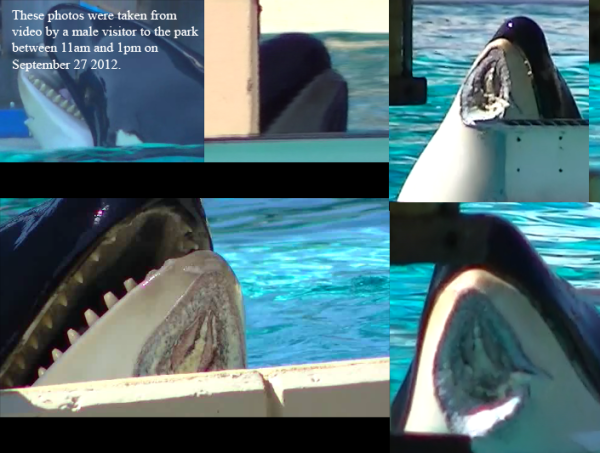
It’s hard to look at that wound and be confident that all is as well as Koontz suggests. The big challenge with an injury like this is infection. And Nakai, as Koontz indicates, is being pumped full of antibiotics in the hopes of staving off any bacteria.
Knowing that the chunk of Nakai’s chin that was sheared off was retrieved from the bottom of the pool, I wondered whether there might be some way to try and reattach it, or graft it back on. I was told, by someone who knows, that it is very difficult to sew or staple killer whale parts back on due to the force of water constantly rushing past the skin. Apparently, something like that was tried (and failed) with Splash after he injured his jaw.
Instead, I was told, SeaWorld sometimes uses an interesting and surprising remedy to try and protect open wounds: honey, which is used as a topical wound treatment.
Honey is an ancient remedy for the treatment of infected wounds, which has recently been ‘rediscovered’ by the medical profession, particularly where conventional modern therapeutic agents are failing. There are now many published reports describing the effectiveness of honey in rapidly clearing infection from wounds, with no adverse effects to slow the healing process; there is also some evidence to suggest that honey may actively promote healing. In laboratory studies, it has been shown to have an antimicrobial action against a broad spectrum of bacteria and fungi. However, further research is needed to optimise the effective use of this agent in clinical practice.
I was told that honey is sometimes used on abrasions on Tilikum’s flukes.
So there you have it: antibiotics and honey. Hope that works. Judging from these photos, Nakai is going to need all the help he can get.
Okay, here’s what I have been told about Nakai’s injury at SeaWorld California.
First: it is a serious injury, with a dinner plate-sized chunk of his lower mandible sheared off, exposing underlying tissues, and bone. The most serious concern, I think, is the possibility of a bad, possibly even life-threatening, infection.
Second: It happened last week during a night show, seemingly during a major altercation involving Nakai, Keet, and Ike. It’s not clear if there was an aggressor or instigator, or if they all suddenly went after each other. In response to the altercation, Nakai split to the back pool. The onstage trainers, not realizing how badly injured he was, continued the show with the other whales. It was only when they called Nakai over later that night that they realized he was seriously hurt.
Third: SW is not sure how the injury happened. Right now they believe it was due to blunt force trauma, but I’m not sure how that squares with the description of the injury in which a sizable piece of flesh on Nakai’s lower jaw was, in essence, sliced off. The piece was big enough and intact enough for SeaWorld to retrieve it from the bottom of the pool.
After Ike was brought into SeaWorld California from Marineland in Ontario, many people felt–particularly with Kasatka due to produce a calf–that SeaWorld would be wise to move Nakai elsewhere. Obviously, in retrospect that looks like it would have been a smart move. But the fact is, controlling the social aggression between the killer whales in SeaWorld’s pools appears to be a very delicate and difficult challenge no matter what SeaWorld facility you are talking about, and what whales you are trying to mix together (see here, and here).
Nakai’s injury is just the latest reminder of that difficult fact.
If I get more details I will post them over on my Facebook page.
Just received the following report that Nakai (photo above via) might have been injured:
“We’ve just heard a rumour that Nakai (male , captive born at SeaWorld 1 Sept 2011 – mother Kasatka, father Tilikum by AI), currently held at San Diego SeaWorld, today hurt himself badly on his lower jaw. I’ve seen on a TINY thumb nail (as the original photo on ‘photobucket’ has been pulled).
The rumour suggests that he may have been trying to get over the chains that SeaWorld has erected and has ripped the tissue down to the bone – it appears from the thumbnail that the lower edge of both mandibles has been stripped back to the bone. It seems that a chunk of tissue the size of a dinner plate is gone – from a side profile it looks like the orca has a bottlenose dolphin profile on the lower jaw.”
Here is what I have learned so far, and maybe all you smart people out there–regardless of your views on captivity–can help figure out the strategy.
Waterwork desense will officially begin today (Monday) in the med pool at SeaWorld California. I don’t know if the other parks also have whales and trainers lined up to begin desense work, and are also starting today, but it seems likely, given that the SeaWorld parks tend to work in synch with one another on major program changes like this.
Apparently, this commencement of waterwork desense (the first step toward getting trainers and orcas back on track toward full waterwork capability in the big show pools) follows a tour of the parks that SeaWorld’s chief zoological honcho, Brad Andrews, conducted earlier this year. Andrews and a SeaWorld management team met with the Shamu trainers, and showed them a video of the prototype fast-rising floor that has been installed in SeaWorld Florida’s G pool (the Dine With Shamu pool in which Dawn Brancheau was killed). The floor took just under a minute to surface, and Andrews told the trainers that similar rising floors would be installed in the show pools at all the SeaWorld parks, a major construction program that could take something like 12 to 18 months.
In the meantime, Andrews said, waterwork desense would start up in the med pools. Normally, waterwork desense (for an animal that has been removed from waterwork, say for being too aggressive) is initiated in the med pool with the floor raised up high. Trainers work with the animal through a series of behaviors, and with each successful evolution the floor is lowered a bit, until the waterwork is in fact taking place in the water. From there, the desense moves into one of the smaller back pools alongside the med pool. That way, if anything goes wrong nets can be used to try and corral the orca back into the med pool, where the floor can be raised. And if the back pool desense regimen is successful, and the orca consistently executes the behaviors asked, the desense program moves back into the show pool. This process can take a number of months.
With the current desense program, however, Andrews told Shamu trainers that no waterwork would be performed in a pool that does not have a fast-rising floor. So desense will be conducted in the med pool, and then jump directly to the show pools once the floors are installed there (though Florida, with the G pool floor, will presumably have the option of using G pool as a bridge to the show pool). That means that the desense work with the whales and trainers selected, will progress very slowly and carefully in the med pools for a year or more, so that the orcas and trainers are ready to move into the show pools when they have fast-rising floors.
The big question, assuming my information is solid, is what SeaWorld’s waterwork gameplan is. Unless SeaWorld successfully appeals the OSHA ruling (the next step would be to file an appeal with the US Circuit Court Of Appeals), Judge Welsch’s decision means that waterwork is effectively banned from performances at SeaWorld Florida (the park cited by OSHA following Brancheau’s death). If they are successful, then all of SeaWorld’s parks, having desensed selected orcas, will be in a position to resume waterwork.
If the appeal fails (or is not filed), then it gets more complicated. The OSHA ruling applies only to performance waterwork, so SeaWorld is in theory free to resume training waterwork in all its parks whenever it likes. OSHA could, however, conduct a follow-up inspection and try to get the ban on waterwork applied to training as well. That would, no doubt, be a similarly contentious and drawn-out legal process.
But training waterwork does not really get SeaWorld back into show waterwork, which presumably is the goal. So another possibility is that SeaWorld finishes installing the fast-rising floors, and whatever other safety measures SeaWorld hopes will protect trainers (like spare air systems), and then goes before OSHA to argue that these safety innovations “mitigate” the dangers that OSHA identified. The mitigation measures have to provide protection that is equal or greater than maintaining distance between trainers and orcas, or the use of physical barriers between trainers and orcas. So that might be a hard case to make. But just because it is hard does not mean that it is unwinnable. And if SeaWorld succeeds in winning a decision that says the floors, spare air, and any other safety measures, mitigate the dangers, then they are back in the waterwork business.
The final, seemingly problematic, scenario that I can come up with, addresses what happens if SeaWorld DOES NOT win either an appeal, or succeed in an effort to mitigate the dangers with the floors and spare air. In that scenario, SeaWorld could, in theory, simply resume waterwork at the SeaWorld Texas and SeaWorld California parks, since they were not cited by OSHA. That would obviously open SeaWorld up to a massive liability and PR hit if another trainer was injured or killed during waterwork. And OSHA could, and likely would(?), move to try and cite those parks for exposing tariners to dangers as well. So this scenario has lots of problems and risks for SeaWorld, and seems unlikely. But it is at least in theory possible.
So, that’s all my thinking on where this med pool desense work could go. Anyone else out there have thoughts, insights or comments on how this could all play out?
Been getting word that at least one SeaWorld Shamu stadium has called a meeting for Monday to discuss beginning waterwork desensitization in the medical pool. That’s the first step to resuming waterwork with SeaWorld’s killer whales, which was stopped in the aftermath of Dawn Brancheau’s and stayed on hold through SeaWorld’s appeal of OSHA’s citation of SeaWorld Florida for exposing trainers to injury from orcas.
I don’t know if all of SeaWorld’s parks are planning to begin waterwork desense training, or whether the training will lead to the resumption of waterwork outside of shows (which Judge Ken Welsch’s OSHA ruling allows) or even in shows that either take place outside of Florida (which was the only park OSHA cited) or in shows everywhere based on a claim that fast-rising floors and other safety measures mitigate the dangers OSHA cited.
But I do know that SeaWorld management, including Brad Andrews and Jim Atchison, have for a while been telling trainers–many of whom have been discouraged by the lack of waterwork and considering moving on from Shamu Stadium–that, despite OSHA, waterwork will be back. And also that plans to install fast-rising pool floors will continue.
SeaWorld management has also been telling trainers that Judge Welsch erred in his ruling, so it seems likely that SeaWorld will appeal his ruling further (it has 60 days to file). In the meantime, SeaWorld is within days of having to demonstrate to OSHA the steps it will take to mitigate the dangers to trainers OSHA identified.
So lots of pieces are in movement, and only SeaWorld knows where it hopes to take them. But a plan to begin waterwork desense shows that waterwork in some form is still very much part of SeaWorld’s plan.
SeaWorld Parks And Entertainment President and CEO Jim Atchison
Wow, that was fast. The trainer comment on the OSHA ruling I just posted made mention of an e-mail to employees from SeaWorld Parks & Entertainment President and CEO Jim Atchison. And, poof, someone sent me an e-mail to employees from Jim Atchison.
This is not the original e-mail in response to Judge Welsch’s OSHA ruling, mentioned by the current trainer in the previous post, but apparently a follow-up e-mail Atchison sent employees regarding news coverage of the OSHA ruling. If the tone of the original e-mail was similar, you can see why some employees might have got the impression that the OSHA ruling was favorable to SeaWorld. (Side question: Was Atchison simply counting on them not to read Judge Welsch’s decision, or believe the news coverage because he says different?]
As I wrote at Outside Online, Judge Welsch’s decision could sharply limit SeaWorld’s famed Shamu Show by preventing SeaWorld from returning to its most famous show practice: swimming and performing in the water with its killer whales, or waterwork. The decision also limits drywork contact with Tilikum, who was always subject to a waterwork ban due to his involvement in previous deaths, but was a popular star in side shows, such as the Dine With Shamu show which got Brancheau killed. And it similarly restricts close contact with the rest of SeaWorld Florida’s killer whales, even when trainers are on shallow ledges or at poolside, i.e. “drywork.”
But the language of the OSHA citation, which was issued in August 2010, for some reason references “waterwork” and “drywork” performances, as opposed to simply applying to any and all waterwork and drywork killer whale interactions involving close contact. Non-performance waterwork and drywork that occurs during training, exercise and (to an extent) animal care is virtually identical to that which is performed in the shows. And Atchison’s e-mail to SeaWorld employees suggests that SeaWorld may try to exploit that distinction.
Here is the text of Atchison’s internal e-mail (emphasis added):
To: All SeaWorld Parks & Entertainment Team Members
You may have seen news coverage over the last 24 hours concerning a ruling on OSHA’s citations against SeaWorld. While there has been much discussion of the implications of the decision, we view it as a positive that both the citation and the related fine were reduced substantially.
It is important to note that the judge agreed that caring for these animals requires contact between trainers and whales. As the judge indicates in his decision, the ruling applies only to show performances, and not to husbandry, exercise, learning, play and relationship activities.
While we view the overall decision as positive for us, we do disagree with some of the judge’s interpretations. We have every confidence in the safety of our extraordinary killer whale training program. Protecting the safety of our team members is a core commitment for SeaWorld, and our record in this area is exemplary.
The current show already includes many of the safety enhancements noted in the judge’s report. When we introduced the new “One Ocean” killer whale show, we voluntarily incorporated additional safety enhancements, such as barriers and proximity changes, which have now been in place for more than a year.
Our killer whale program is a model for marine zoological facilities around the world, and the additions we have made in the areas of personal safety, facility design and communication have enhanced this program further still. In addition to these existing safety measures, we also continue to progress on the development of prototypes such as a lifting pool floor.
I am extremely proud of the many men and women throughout our company who have represented and assisted us in this matter. They have demonstrated an unwavering dedication to safety, animal welfare and upholding our company’s long-standing reputation for excellence.
Jim Atchison
Dawn Brancheau and Alexis Martinez
Apart from the oddity of describing the “overall decision,” which was in essence a denial of the key elements of SeaWorld’s appeal, as “positive for us,” what stands out is Atchison’s language regarding the scope of Welsch’s ruling.
Since Brancheau’s death, and during the lengthy process of appealing the OSHA citation, SeaWorld ceased waterwork at all its parks, and also changed how close trainers could get to killer whales, and how they would interact with them, during drywork (the “barriers” and “proximity changes” that Atchison mentions). But as Atchison notes, Welsch’s decision applies only to performances (following the language of the citation). So SeaWorld could in theory resume waterwork and close contact drywork with its killer whales outside of performances, and be in compliance with Judge Welsch’s decision.
If SeaWorld goes this route, which would help SeaWorld maintain its waterwork training even as it continues to hope to find a way to return waterwork to its shows, there will be risks. While Brancheau was killed while performing with Tilikum, Alexis Martinez was killed by a SeaWorld killer whale at Loro Parque two months earlier during a waterwork training session. So the same risks and dangers to trainers apply regardless of whether there is an audience or not. All that really matters is proximity. And the liability exposure if SeaWorld resumed non-performance waterwork and/or close contact drywork, and another trainer was injured or killed by a killer whale, would presumably be very high.
In addition, OSHA would be very unlikely to stand by if SeaWorld resumed the very practices–albeit not during performances–that OSHA deemed dangerous when it cited SeaWorld Florida in the first place. Les Grove, Area Director of OSHA’s Tampa Area Office, which issued the original citation, addressed this potential performance loophole during the hearings before Judge Welsch, when pressed by SeaWorld’s lawyer on whether the citation applied to non-performance waterwork and drywork, or just performances. Grove said that the citation applied only to performances, and added “But as a responsible employer, if you are aware of other interactions, where they’re exposed to the hazard, you should look at that and take action to materially reduce the hazard.”
In other words, if SeaWorld resumed waterwork and close contact drywork in exercise, play, and relationship-buuilding sessions that take place outside of performances, OSHA would view that as a danger to employees, and would almost certainly conduct a follow-up inspection that could result in another round of citations for endangerment of employees. SeaWorld, of course, could appeal those citations as well, which presumably would mean another lengthy legal proceeding.
It will be interesting to see how this all plays out, and how SeaWorld in the end chooses to address Judge Welsch’s decision. Atchison also mentions safety enhancements, including the fast-lifting pool floor that SeaWorld Florida is prototyping (which in theory could be used to beach a killer whale acting aggressively or attacking a trainer). The OSHA citation says that SeaWorld can abate the dangers cited through safety modifications, as long as the modifications “provide the same or a greater level of portection for the trainers” as avoiding close contact or staying out of the water. That is a very high standard, but SeaWorld has invested millions in developing the lifting pool floor, and has also been working on, and practicing with, personal air supply systems that trainers could wear in the pools. Making those investments doesn’t make much sense if SeaWorld doesn’t have plans to try and put trainers back in the water one way or another.
To close, here’s Atchison discussing SeaWorld’s plans, and press coverage, in the immediate aftermath of Dawn Brancheau’s death, just as the OSHA investigation was about to start. Amazing what a long and winding road has been traveled since then:
Over the weekend I opened my e-mail to find this reaction to Judge Welsch’s OSHA ruling from a current SeaWorld trainer with many years of experience. It has always been clear that some (though not all) trainers have to deal with a number of contradictory feelings about working with orcas in captivity. But I thought this revealed the bitter honesty of at least one person’s mindset, and I wonder how many other trainers think like this:
I read the 47 page ruling and thought his sharp criticism of the culture and upper management was awesome. And to be honest with you, it made me sick to my stomach. I have known these abuses for years but to see it in affirmed in black and white was sickening. I’m a little ashamed that I allowed this company to take advantage of and abuse me (and the whales) for years because of my own selfishness to want these experiences. It reminded me of how an abused person behaves and justifies the actions of their abusers. Even the fact that SeaWorld testified that they had no knowledge that it was dangerous for us to work with the whales. I love that the judge pointed out how ridiculous it was for them to say that. But all of us trainers sat back and allowed them to say such disgusting things because we wanted to swim, we wanted to keep our jobs, etc.
His ruling finally called bullshit on this cult-like atmosphere we live in and ultimately support as killer whale trainers for SeaWorld. Even the spin machine that has begun is mind blowing. Jim Atchison’s email to all employees is unbelievable. Trainers at the killer whale stadium who had not seen the news yet and only had information from his email actually believed we had won! Some trainers found a lot to be concerned about in the ruling, but aren’t getting many answers from upper management. A Curator even said that this doesn’t mean anything and that they would continue on as they have been and continue to progress as they see fit. And some trainers didn’t even want to know any details because they love the job so much they didn’t want to hear bad news. Some are senior people and supervisors, which just shows how incredibly brainwashed many still are.
I’ve long felt that trainers at SeaWorld have to be able to achieve a certain degree of cognitive dissonance to be able to say on the one hand that they love the
Or this?
killer whales, and on the other hand be witness to the early deaths, the tooth drilling, the sunburnt skin, the social instability and aggression. and all the other chronic effects of captivity. And I have always suspected that many were able to achieve this cognitive dissonance because what killer whale training is really about for them is the sheer exhilaration of experiencing, bonding with, and swimming with, one of the planet’s most extraordinary animals. In other words, it was about the trainers’ fantasies and trainers’ desires–no matter how much spin and PR would try to convince you otherwise–not the needs and well-being of the killer whales in their care.
If Welsch’s ruling stands, perhaps it will be harder to maintain this cognitive dissonance, because the ultimate experience of working with a killer whale–waterwork–could be gone. So maybe the reality will start to trump the fantasy for more trainers. Already I am hearing lots of noise about trainers moving out of various Shamu stadiums, to stadiums such as Whale and Dolphin where there continues to be waterwork. Though I don’t know the motivation or reasons for any trainer movement, I have had some people tell me that work at Shamu Stadium without waterwork can be kind of a grind. So maybe more trainers will seek work away from Shamu Stadium, or even start thinking about moving on from SeaWorld altogether.
One more note: Last Friday I was on the Sam Simon show, which is always an interesting discussion because Simon (follow him on Twitter here) is passionate about the topic of orcas. Former SeaWorld trainer Jeff Ventre, over at Voice Of the Orcas, posted the audio.
As a follow-up to my Outside post, I want to call out Judge Welsch’s decision, and urge you to read it. I don’t want it to get lost in all the back and forth over SeaWorld and the future of waterwork, and whether SeaWorld can successfully appeal or implement sufficient safety measures to allow trainers back in the water.
It is 47 pages, and in my view a relentless and powerfully argued deconstruction of SeaWorld’s corporate culture, training regime, and safety strategy. And because, for the first time, SeaWorld was compelled to put on the record its personnel and its internal documents, it is one of the most revealing looks inside killer whale captivity that you can read. If you have any interest in this topic you will find it a fascinating document.
Administrative Law Judge Kenneth Welsch released his decision in SeaWorld’s appeal of OSHA’s 2010 citations regarding the safety of SeaWorld’s killer whale program.
A decision released yesterday by Administrative Law Judge Kenneth Welsch in Florida will fundamentally change SeaWorld’s killer whale shows. In a landmark case, Judge Welsch ruled in favor of the Occupational Safety and Health Administration (OSHA), concluding that the only way to keep Seaworld trainers safe is to either keep them away from close contact with the killer whales (which means no waterwork in the pools with them during shows), or to use physical barriers or other safety modifications to provide the same level of protection. Unless SeaWorld appeals Welsch’s ruling and manages to win, the Shamu Shows as we know them likely just came to an end.
OSHA’s case was prompted by the death of SeaWorld trainer Dawn Brancheau, who, on February 24, 2010, was pulled into the water and brutally killed by SeaWorld’s largest killer whale, a male called Tilikum who weighs about 12,000 pounds. After Brancheau’s death, OSHA took a hard look at the safety of SeaWorld’s killer whale training methods and high-intensity killer whale shows, which feature trainers swimming with, riding, and leaping off whales. Following a detailed investigation, OSHA hit SeaWorld with a series of safety citations, the most serious of which said SeaWorld knowingly exposed killer whale trainers to being struck or drowned by killer whales when it had them work closely with Tilikum and other killer whales. The only way to abate the dangers, OSHA said, was to either stop working in close contact with the killer whales, or keep physical barriers (or equivalent measures) between trainers and killer whales. In short, OSHA said that SeaWorld’s killer whale program was dangerous and needed radical changes.
SeaWorld hotly contested OSHA’s conclusions, which it called “unfounded,” and launched an appeal. After a series of hearings that took place last fall, Judge Welsch issued his ruling this week. The verdict: OSHA’s conclusions stand. In his decision (available here), Welsch systematically picked apart SeaWorld’s arguments that its training methods, and ability to predict dangerous or aggressive killer whale behavior, are protection enough for trainers.
Welsch reduced the nature of the OSHA’s citation from “willful” (the most severe) to “serious,” and reduced Seaworld’s fine for the critical citation from $70,000 to $7,000. Then he set about sytematically dismantling SeaWorld’s arguments. Read the whole thing…
Bonus: Here’s a video, shot by a Shamu Stadium audience member, which shows SeaWorld raising the fast-rising floor in the Orlando G Pool. This floor design is one of the innovations that SeaWorld is developing, and could be used to try and convince OSHA that it is safe to put trainers back in the water. The challenge is that such measures have to provide an equal or better level of protection for trainers than simply keeping them away from close contact with killer whales. And that’s a pretty hard case to make.
At the risk of over-exciting all my skeptics, who think I pull SeaWorld orca pregnancies out of my ass, I have been getting word that SeaWorld Texas’ Takara is not pregnant. Takara was one of a number of SeaWorld pregnancies that I wrote about last November. All seemed normal, and SeaWorld considered Takara to be pregnant, but in March her progesterone levels dropped below a level consistent with pregnancy. An investigatory sonogram did not reveal a fetus, but it was not clear whether she had lost the fetus (though she had not passed one) or simply had experienced a false pregnancy.
The failure of Takara’s pregnancy raised a question about the sperm of Kshamenk, the male from Argentina’s Mundo Marino, which had been used in Artificial Insemination (AI) procedures on both Takara and Kasatka. Kshamenk’s sperm is one way for SeaWorld’s captive breeding program to get beyond a preponderance of Tilikum genes, so it is important to the future of orca breeding at SeaWorld. But Kasatka’s pregnancy is progressing, with a fetus visible on sonograms, so Kshamenk’s sperm is at least viable.
So Takara will not be giving birth along with Kasatka and Kohana. However, she seems healthy despite the false or failed pregnancy, and SeaWorld plans to try and inseminate her again by mid-summer. Not sure whether they will use Kshamenk’s sperm again. But SeaWorld also has an AI and sperm collection arrangement with Marineland Antibes in France, which used sperm from SeaWorld California’s Ulises to impregnate their younger female, Wikie. That led to the birth of a calf called Moana last year. Marineland Antibes has two males, Valentin and Inouk, who are sexually mature and presumably could also be used as sperm donors for SeaWorld’s breeding program.
SeaWorld Florida also has plans to AI Kayla sometime soon (in March I mentioned she was next on the AI list), though apparently she does not cycle normally, so the timing is a bit tricky.
That’s all the orca pregnancy news I have for the moment. So let the skeptics have at it…

 Since hearing
  pools at all the SeaWorld parks, a major construction program that could take something like 12 to 18 months.
 But training waterwork does not really get SeaWorld back into show waterwork, which presumably is the goal. So another possibility is that SeaWorld finishes installing the fast-rising floors, and whatever other safety measures SeaWorld hopes will protect trainers (like spare air systems), and then goes before OSHA to argue that these safety innovations “mitigate” the dangers that OSHA identified. The mitigation measures have to provide protection that is equal or greater than maintaining distance between trainers and orcas, or the use of physical barriers between trainers and orcas. So that might be a hard case to make. But just because it is hard does not mean that it is unwinnable. And if SeaWorld succeeds in winning a decision that says the floors, spare air, and any other safety measures, mitigate the dangers, then they are back in the waterwork business.


 At the risk of over-exciting all my skeptics, who think I pull SeaWorld orca pregnancies out of my ass, I have been getting word that SeaWorld Texas’ Takara is not pregnant. Takara was one of a number of SeaWorld pregnancies that
  SeaWorld Florida also has plans to AI Kayla sometime soon (in March
  The Earthist Chronicles