Lots of dolphin and orca news in the past week. And National Geographic online has been deep into the Taiji part of it.
Here’s my look at the changing financial incentives for the dolphin drives. Bottom line: over the past ten years the average annual number of dolphins slaughtered for meat has roughly been halved. And the average annual number of dolphins selected from the hunt for captivity has roughly doubled. The captive display industry, in all its forms and no matter what protestations it issues regarding drive hunts, is driving the demand for dolphins that drives the fishermen of Taiji to hunt them. Show the world that you can make a lot of money with dolphin shows and by letting park guests jump in a pool with them, and parks around the world (both existing and abuilding) will want dolphins. Fact.
NatGeo saw impressive traffic and social media sharing for its Taiji coverage, so followed up with the sort of media NatGeo does so well: a photo gallery. The interest that readers showed drove home the point that more and more people deeply care about how humans are treating the dolphins of this world, a point dramatized by the fact that Caroline Kennedy, newly installed as the U.S. Ambassador, had the undiplomatic temerity to voice, er tweet, opposition to the Taiji drive hunt. She explained why in this interview:
Q: Your tweet regarding the drive dolphin hunt in Taiji, Wakayama Prefecture, drew a lot of attention in Japan. Why did you make that comment?
A: Well, you know, people had been writing to me and tweeting and emailing and calling the United States–calling the embassy here. Hundreds and hundreds of people have been doing this for the last few weeks. And so I thought it was really important to make our policy known, and we have a longstanding policy of protecting these mammals, since 1972, in the United States. And the U.S. government has a policy on this: Drive hunt fisheries are unsustainable and inhumane. So I thought it was important to clarify that and put that out there.
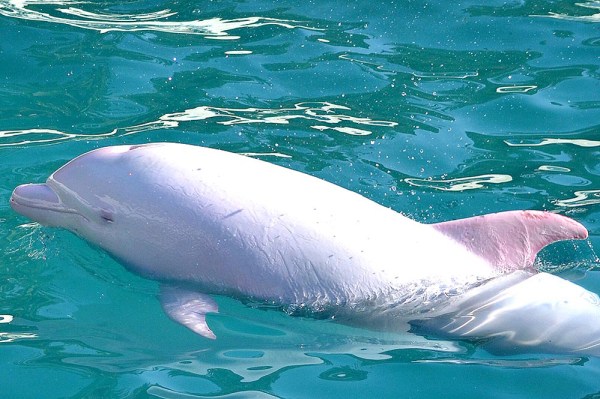
Finally, I checked in on the albino dolphin calf that was taken from the Taiji drive hunt to the Taiji Whale Museum. Melissa Sehgal, the lead Cove Monitor for Sea Shepherd told me that the calf was the first dolphin selected for captivity, and that there appeared to be a good bargaining session by Taiji’s dolphin brokers under the tarps on the beach before the calf was finally trucked to the Whale Museum. (You can read an interview that I did with Melissa, about what it takes to be a Cove Monitor, here).
An albino bottlenose dolphin is extremely rare. In fact, no authority I spoke with had ever heard of one. That no doubt made the calf seem extremely valuable to the brokers and the captive industry. But the rarity of the calf also drew the attention of the world media. So the race to capture, select, and display the calf, could in the end backfire on the Taiji Whale Musuem. The calf may be a public draw. But it is also extremely young, likely stressed by the capture and its new environment, and without its mother. If it dies, it will not go unnoticed by the world and the media, and in the heat of the condemnation that will follow the Taiji Whale Museum could well end up regretting that they ever grabbed it.
No dolphin calf should ever be put in a position to be martyred. But if “Angel” as she has been dubbed becomes a victim of the hunts and the captive display industry, her memory will matter.
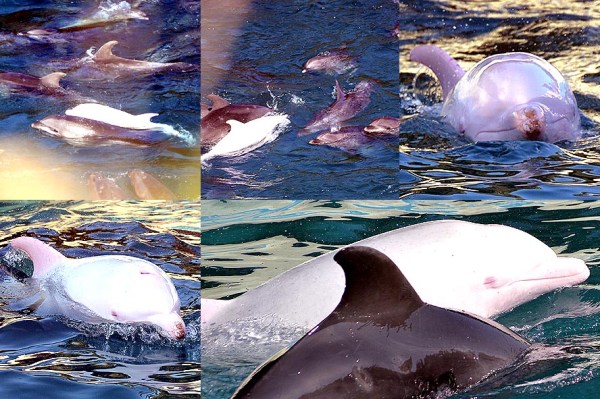
I hope to have more information to share about the status of the calf soon. The picture above was sent to me by Satoshi Komiyama. Here is another set of photos Satoshi took, and was kind enough to share:
It is hard not to feel for the albino calf, and the dramatic turn her life has taken. The life of Lolita, the killer whale who was captured at Penn Cove and has been performing at the Miami Seaquarium for more than 40 years, evokes all the same emotions.
We featured the capture operation that sent Lolita to Miami in Blackfish, and people often tell me it was one of the most moving sequences in the film.
A number of groups and individuals, most notably Howard Garrett and the Orca Network, have been fighting for Lolita’s freedom for almost two decades. Last week, after years of frustration in that quest, Lolita finally caught a potential break. I explain what happened over at Outside Online.
If Lolita does get listed with her family under the Endangered Species Act, then it will be very difficult for Miami Seaquarium to hold onto her. But, I learned, there is a note of caution that needs to be kept in mind. NOAA has already expressed some skepticism about returning Lolita to the wild. So, absent a very convincing and well-funded plan to take her to a sea pen in her home waters, there could be a scenario in which U.S. Fish And Wildlife (which would be responsible for enforcing the Endangered Species Act), would remove Lolita from Miami Seaquarium, but decide that it is less risky to place her in a better facility than it is to transport her across the country and drop her into the Haro Strait.

Yep, SeaWorld could come into the Lolita scenario. Not saying it will happen, or that it is even likely to happen. But I am saying that if even if she is listed under the Endangered Species Act it will still be a fight to get her to a sea pen.

 Sorry. Not that it’s a surprise, but Tili isn’t going anywhere.


 Late last week I published


 The Earthist Chronicles