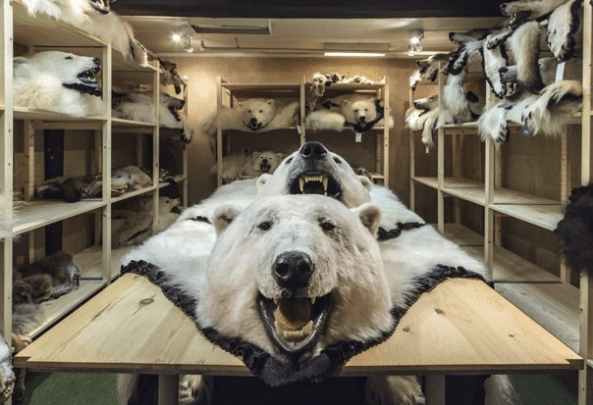
Bearing Witness

Seeing the truth, and communicating the truth, are antidotes to ignorance and apathy. So the idea of bearing witness is a powerful strategy for change, and for mobilizing action. That makes sense for any crime, especially epic crimes like genocide. It also makes sense when it comes to trying to turn the tide against the ongoing global extinction of cultures and species due to the way in which humans live. And that is the idea behind this very interesting, art-based project, Extinction Witness:

As artists, we translate the truth of feeling this world in all its frustrations of contrast and contradiction. Our creations speak the unspeakable. They move the dialogue beyond politics to the seeds of belief.

Art invokes feeling. Art is love in action.

Much more here:

http://vimeo.com/61216977

CITES Schizophrenia: Sharks And Rays Vs. Polar Bears

CITES giveth (to some sharks and manta rays), and CITES taketh away (or doesn’t giveth, for polar bears).

Screen Shot 2013-03-12 at 9.33.22 AM


(via Washington Post)

This news came out last week, but it illustrates perfectly the imperfections of the CITES regime and its inscrutable byzantine politics:

An international meeting of government wildlife officials rejected a U.S. proposal to ban the global trade of polar bear parts Thursday, following an impassioned appeal by Canadian Inuits to preserve polar bear hunting in their communities.

There are between 20,000 to 25,000 polar bears living in the wild in Canada, the United States, Russia, Denmark and Norway, according to the most recent analysis, which was conducted in the early 1990s. Scientists project that as Arctic summer sea ice shrinks, many polar bear populations could decline by 66 percent by mid-century.

I still haven’t seen an account which explains what actually went on behind the scenes to kill this proposal. But all sorts of vote-trading and vote-buying is the norm at CITES. And often enough protecting endangered species is not, in fact, the priority.

Because it’s not like the evidence of climate change, and the rate at which it is occurring, is diminishing. In fact, a recent study only makes it look more dramatic in the context of the past 11,000 years of earth history.

Carbon Math

You may think that all that driving you do, or air conditioning your house, is your biggest contribution you make to global warming. But how about all those air miles?

For many people reading this, air travel is their most serious environmental sin. One round-trip flight from New York to Europe or to San Francisco creates about 2 or 3 tons of carbon dioxide per person. The average American generates about 19 tons of carbon dioxide a year; the average European, 10.

So if you take five long flights a year, they may well account for three-quarters of the emissions you create. “For many people in New York City, who don’t drive much and live in apartments, this is probably going to be by far the largest part of their carbon footprint,” says Anja Kollmuss, a Zurich-based environmental consultant.

It is for me. And for people like Al Gore or Richard Branson who crisscross the world, often by private jet, proclaiming their devotion to the environment.

Though air travel emissions now account for only about 5 percent of warming, that fraction is projected to rise significantly, since the volume of air travel is increasing much faster than gains in flight fuel efficiency. (Also, emissions from most other sectors are falling.)

Tax carbon at $20 a ton, which is roughly the tax that many economists believe would be required to have an impact on human behavior adequate to slow warming, and suddenly you will understand how big a climate change driver air travel is. And you will also think more carefully about how often, and how far, you fly.

Another alternative is to sell carbon offsets along with air travel tickets.

Clothing That Doesn’t Suck (At All)

Last month Greenpeace threw my minimal-impact (minimal shopping, minimal fashion, minimal thinking) clothing strategy into chaos by calling Levis out regarding hazardous chemicals.

This was a problem, because until then my entire wardrobe was based on Levis jeans, hand-me down clothing from various relatives, and free sailing apparel (which is one of the many perks of writing about the sailing world–though my wife does get embarrassed that most of my shirts that have boat names like “Tsunami” stitched on them).

I didn’t have to think about what to buy or wear. I was happy. But if I couldn’t wear my jeans in good conscience, what could I wear? Happily, the folks at Repair The World, which makes Earth-friendly clothing from recycled cotton scraps and recycled plastic bottles, stepped forward to help me resolve my clothing crisis. (You can read more about Repair The World here).

They took pity on me, and offered to send me one of their shirts, for a test run. So I selected a long sleeve t-shirt, not really knowing what to expect.  I was fully prepared for a scratchy, ill-fitting, shirt that might melt if I got too near a lamp. Instead, I opened the mailer to find a shockingly soft, well-made, long-sleeve shirt. Exactly the sort of thing a lazy environmentally conscious person could rely on day after day.

shirt


I’ve been wearing it for a week now, and it even (unintentionally) went through a full wash and high heat dryer cycle. Came out fine. (No, I haven’t grown a tail as a result of wearing the shirt; I guess the dog didn’t want to be left out of the photoshoot).

The material is quite thin, so it will be interesting to see how long the shirt lasts. As you can, see I am sticking with my Levis down below (no Anthony Weiner pictures for me; and Levis has agreed to address the problem of chemical release). But it seems that there just might be an ethical clothing solution for those in search of one. And you have to admire the ingenious effort to come up with a clothing fabric that tries to address the environmental shortcomings of cotton (even organic cotton), which takes huge inputs of water and energy to produce and process.

I don’t know if it is something that the mass market will go for (because the mass market is not really that concerned about the future). For anyone who thinks about what they eat, and what they wear, though, Repair The World just might have some clothing for you. If necessary, you can stitch boat names on it yourself.

Just The Facts: Hot, Hot, Hot

According to NOAA, 2012 was the hottest year EVER for the lower 48 US states. More here and here.

This isn’t shocking news for most people, who understand that the climate is warming. We get these sorts of stories all the time now (just like we seem to get school shootings; be nice if political leaders would at least think about climate action, too). What most people don’t really understand, though, is the magnitude of change required in the pricing of carbon, and in their lives, to address this threat (which along with nuclear proliferation is clearly the greatest threat facing not just the United States, but humanity). I’m going to try to look into that question in more detail this year.

For now, though, some graphic illustrations of just how far off the charts we are going:

Average annual temperatures for contiguous U.S. Data from NOAA.
The Climate Extremes Index in the contiguous U.S. over time. 2012 ranked second highest on record (NOAA NCDC)
Difference from average annual temperature in 2012 compared to the 1981-2010 average. (NOAA)


Is There Such A Thing As A Sustainably Farmed Fish?

I have long doubted it, but this guy thinks he may have cracked the code:

Goldman chose barramundi because their personalities are “tame, gregarious, and kind of patient” — well-suited to life in tanks. And, unlike most fish, which only obtain omega-3s from the plankton and algae — or other fish — that they eat, barramundi can actually synthesize them on their own. “They spend a lot of their early life cycle in freshwater, so they’re not exposed to the long-chain fatty acids,” explains Goldman. “They actually develop the ability to build omega-3s without necessarily having to consume them.”

This is key to the barramundi’s claims to sustainability. One pound of farmed bluefin tuna can require as much as 20 pounds of wild fish as feed; for farmed salmon, the ratio is often well above 3 to 1. That means a host of problems: depleting the biomass of the oceans at a faster pace, decimating so-called “forage fish” that serve as a staple in poor countries, and, since some estimates say aquaculture demands will outpace fish meal production within decades, undermining the industry itself.

“Everybody on the marine side is really focused on reducing fish meal and oil” in fish feed, says Goldman. “There’s a consensus on that — that it’s really, really important.”

It’s hard to say what the animal and environmental impacts of scaling this sort of operation to real significance will be. But my guess is that any flaws would begin to become pronounced at that stage. And like all industrial food farming operations it has a bit too much of a Sorcerer’s Apprentice feel to me.

Give Goldman credit for trying to address the very real problems of overfishing and environmentally destructive aquaculture. But maybe we should all just start coming to grips with the fact that our animal-eating tastes are overtaxing the planet and its other species, and start learning to love tofu.

Ozymandias Award: Shell Oil Kulluck

Look on my works, ye mighty, and despair!’
Nothing beside remains. Round the decay
Of that colossal wreck, boundless and bare,
The lone and level sands stretch far away”.

[Backstory is here].

We’re Fracked (Again)!

Pennsylvania officials are caught omitting evidence of toxic substances in a report on well water near a natural gas site:

In a deposition, a scientist for the Pennsylvania Department of Environmental Protection testified that her laboratory tested for a range of metals but reported results for only some of them because the department’s oil and gas division had not requested results from the full range of tests.

The scientist, Taru Upadhyay, the technical director of the department’s Bureau of Laboratories, said the metals found in the water sample but not reported to either the oil and gas division or to the homeowner who requested the tests, included copper, nickel, zinc and titanium, all of which may damage the health of people exposed to them, according to the federal Agency for Toxic Substances and Disease Registry.

Ms. Upadhyay said that the bureau did not arbitrarily decide to withhold those results. “It was not requested by our client for that particular test, so we did — it is not on our final report,” she said in a deposition on Sept. 26.

Ah, that explains everything. Why would you include notification of dangerous metals if no one had asked you for it?

This is a perfect example of all the lying and obfuscation that goes on around fracking, as corporations and governments race to cash in on the natural gas boom. Never was an industrial process so perfectly named.


Levis To Detoxify

Maybe the system works (at least sometimes). And my ass is grateful.

As a follow-up to my lamentations about Greenpeace’s exposure of Levis for the release of hazardous chemicals in their supply chain, Myriam Fallon of Greenpeace just sent me the news release below.

Note: Levis agrees to eliminate the release of chemicals, as opposed to the use of hazardous chemicals, but you have to start somewhere. In the meantime, I am hoping to test drive some sample clothing made from recycled cotton and plastic soda bottles (seriously).

Another note: Not Gore-Tex too! Maybe Adam and Eve had it right that a few strategically placed leaves is the way to go.

Finally, Greenpeace’s news:

Levi’s bows to global people power: bans toxic fashion

World’s largest denim retailer commits to going toxic free and ensuring transparency in its supply chain

San Francisco, December 13th, 2012 – Levi’s, the world’s largest denim brand, has committed to eliminate all releases of hazardous chemicals throughout its entire supply chain and products by 2020, following public pressure in response to Greenpeace’s global Detox campaign.

“Now more than ever, we are seeing brands such as Levi’s listen to the groundswell of support for toxic-free fashion,” said Greenpeace Toxics Campaigner John Deans. “Now it’s  time for other brands such as Calvin Klein, Gap, and Victoria’s Secret to  follow Levi’s lead and end their toxic addiction. We’ll continue to expose brands until the use – and abuse – of hazardous substances is totally eliminated.”

As part of its commitment, Levi’s will begin requiring 15 of its largest suppliers (each with multiple facilities) in China, Mexico and elsewhere in the Global South to disclose pollution data as early as the end of June 2013. This will be followed up with a further 25 major suppliers by the end of 2013, meaning those living near all these facilities gain crucial access to information about discharges into their local environment.

Levi’s commitment comes just eight days after Greenpeace launched its report “Toxic Threads: Under Wraps” in Mexico City on December 5th. Since then, over 210,000 people joined the campaign calling on Levi’s to Detox, with tens of thousands taking action on Facebook and Twitter. Over 700 people have protested outside Levi’s shop fronts in over 80 cities worldwide, including a demonstration yesterday in front of the company’s headquarters in San Francisco.

“Levi’s has become a global Detox leader now that it has promised to use alternatives to hazardous chemicals and make its supply chain transparent. This is a milestone in the way clothes are manufactured and a victory for people in Mexico and elsewhere who are affected by toxic water pollution every day,” added Greenpeace Mexico Toxics campaigner, Pierre Terras.

Levi’s becomes the eleventh brand to make a credible commitment to eliminate releases of all hazardous chemicals throughout its supply chains and products since Greenpeace launched its Detox campaign in 2011. A key part of the commitment is Levi’s elimination of all PFCs by the end of 2015, and a promise to lead on the adoption of PFC-free alternatives and non-hazardous chemicals by 2015.

Greenpeace’s Detox campaign demands fashion brands commit to zero discharge of all hazardous chemicals by 2020 and requires their suppliers to disclose all releases of toxic chemicals from their facilities to communities at the site of the water pollution.

MEDIA CONTACT:

Myriam Fallon, Media Officer, mfallon@greenpeace.org, 708.546.9001

Notes:

1) Link to Levi’s Zero Discharge Commitment: http://levistrauss.com/sites/levistrauss.com/files/librarydocument/2012/12/levi-strauss-greenpeace-detox-solution-commitment-12-dec-2012.pdf

2) Released 5 December, Greenpeace International’s investigatory report, “Toxic Threads: Under Wraps” exposes dumping of industrial wastewater containing toxic and hazardous chemicals from two of Mexico’s biggest textile manufacturing facilities with links to brands including Levi’s. Little transparency and weak laws allow these facilities to avoid scrutiny of their manufacturing processes and documents some of the worst water pollution Greenpeace has investigated in Mexico. View report here: www.greenpeace.org/international/under-wraps

Photo and Video

Video from various Levi’s protests available here: http://comms.greenpeaceusa.org/20121206_Detox_Levis

Photos of Levi’s protests throughout the world available here:

Background on the campaign can be found here: http://www.greenpeace.org/international/en/campaigns/toxics/detox/

http://photo.greenpeace.org/C.aspx?VP3=ViewBox_VPage&ALID=27MZIFVO6AOI&CT=Album

 

Our Food Supply Is Fracked

This was so frustratingly predictable. There is evidence that fracking contamination is starting to poison nearby farms and livestock:

Earlier this year, Michelle Bamberger, an Ithaca, New York, veterinarian, and Robert Oswald, a professor of molecular medicine at Cornell’s College of Veterinary Medicine, published the first and only peer-reviewed report to suggest a link between fracking and illness in food animals.

The authors compiled 24 case studies of farmers in six shale-gas states whose livestock experienced neurological, reproductive, and acute gastrointestinal problems after being exposed — either accidentally or incidentally — to fracking chemicals in the water or air. The article, published in New Solutions: A Journal of Environmental and Occupational Health Policy, describes how scores of animals died over the course of several years.

The death toll is insignificant when measured against the nation’s livestock population (some 97 million beef cattle go to market each year), but environmental advocates believe these animals constitute an early warning.

Exposed livestock “are making their way into the food system, and it’s very worrisome to us,” Bamberger says. “They live in areas that have tested positive for air, water, and soil contamination. Some of these chemicals could appear in milk and meat products made from these animals.”

In Louisiana, 17 cows died after an hour’s exposure to spilled fracking fluid, which is injected miles underground to crack open and release pockets of natural gas. The most likely cause of death: respiratory failure.

In New Mexico, hair testing of sick cattle that grazed near well pads found petroleum residues in 54 of 56 animals.

In northern central Pennsylvania, 140 cattle were exposed to fracking wastewater when an impoundment was breached. Approximately 70 cows died, and the remainder produced only 11 calves, of which three survived.

In western Pennsylvania, an overflowing wastewater pit sent fracking chemicals into a pond and a pasture where pregnant cows grazed: Half their calves were born dead. Dairy operators in shale-gas areas of Colorado, Pennsylvania, West Virginia, and Texas have also reported the death of goats.

Just one more reason to not eat animals. But more important, fracking, its lack of transparency, the way it is (not) being regulated, and the extraordinary rush to buy into the idea that natural gas will save the American economy, has the feel of a gold rush that fifty years from now will leave a poisonous, toxic legacy that will have everyone shaking their heads and wondering what we were thinking.