Overexploitation Watch: Antarctic Krill

Sea Shepherd has a pretty depressing report on the factory ships they have seen plying Antarctic waters and scooping up krill:

The area where we found the krill fishing vessels was incredibly close to the Antarctic Peninsula and the South Shetland Islands that are dotted with penguin rookeries and fur seal haul-outs. This gives a full overlap between the fishery and the foraging ranges of land-based predators like the penguins (Gentoo, Chinstrap, Adelie and Macaroni), which cannot move to other locations. Even if there is still plenty of Krill around, both predators and fishing vessels will concentrate on the highest densities and therefore directly compete. The surrounding waters are cruised by seven species of Baleen whales. The ice floes in these waters function as resting places for Crabeater and Leopard seals. All these animals depend directly or indirectly on Krill as their food source. The true seals have flourished and the fur seals were able to bounce back from near-extinction when the Antarctic waters were emptied of the Krill-gorging baleen whales during the whaling era (early 1900s until the 1980s). The competition eliminated, more food became available for them, but a decline in Krill will eventually hit all animals in the Antarctic, even flying birds and fish, and will prevent the great whales from returning to pre-exploitation numbers.

Krill is called the single largest under-utilized commercial marine resource remaining, because the global quota set is not yet reached, but expansion of the fishery seems inevitable. The fishery was kept in check by the distance and inhospitality of Antarctica’s waters, the fact that Krill are highly perishable once killed and that consumer interest was limited. Aquaculture feed demand is on the rise however, rapid on-board processing techniques have dealt with the quick spoiling and new products are being developed. The Krill fishery is the continuation of a trend in the history of fishing. We fish further and further away from home and we fish further and further down the food chain. You can’t get much further away as Antarctica and you can’t get much further down the food web than Krill. We are reaching the end.

Worth thinking about the next time someone tells you that fish farming is sustainable. Everywhere you look, new species, and new resources, are being exploited for commercial purposes. Each one is unique, and each one has its own special role in the ecosystem, and it seems impossible to keep up with, and blunt or even slow the insatiable grind of industry and its quest for new profits.

How is it that we have created an international system of politics and economics that completely fails to value and protect these resources?


The only way, really, to address these endless and destructive forays into nature’s delicate balance, the only way to imagine that all these extraordinary natural resources can be defended, is to change the culture that lies behind them.  That is the only global solution, but it will take a revolution in thinking and values.

What Is The True Value Of The Oceans?

Mission Blue takes a stab at adding it all up.

The video totally nails the problem that traditional economics does not value or account for “natural capital,” the single greatest (and most catastrophic) flaw in the way we humans conduct our lives, cultures and economies. So thanks for getting that key point out.

But the video also irks me slightly because:

1) No value is placed on preserving the oceans simply because they are the most spectacular, beautiful, awesome, and life-nurturing resource on the planet (what I would call “existential capital”). Sure, those are intangibles, but not all value attached to the ocean can be expressed in dollars and cents, or benefits to the human race. And the lives of all the myriad species that live in the ocean are invaluable, even if they don’t directly benefit humans (or contribute to our cosmetics!). Even if the oceans didn’t protect our beach homes, provide us with a tourist destination, or regulate the climate so we don’t all overheat, I’d be in favor of protecting and defending the oceans. The oceans are the heart and soul of the planet.

2) The remedies are sorta lame. Go to a green resort? Buy “sustainable” fish, whatever that is? That won’t save the oceans. Saving the oceans, and stopping ocean acidification will require much more dramatic shifts in our behavior and culture. How about urging people to stop eating meat (the single greatest step any human can take to protect the planet)? And stop eating fish, period? Or stop living in humungous houses that are heated and cooled to ridiculous temperatures? Or to reduce their driving, and travel by airplane (the carbon emissions of that trip to the beach are significant)? Or stop using so much plastic? Or any number of the other 3,546 things that modern humans do that impact the oceans?

Maybe people should watch this video (and movie) instead, because Revolution really is the right response to the crisis of the oceans:

Ozymandias Watch: Southampton Edition

If you are a billionaire Master Of The Universe of course you believe you can hold back the sea:

SOUTHAMPTON, N.Y. — Soon after Hurricane Sandy hit last fall, Joshua Harris, a billionaire hedge fund founder and an owner of the Philadelphia 76ers, began to fear that his $25 million home on the water here might fall victim to the next major storm. So he installed a costly defense against incoming waves: a shield of large metal plates on the beach, camouflaged by sand.

His neighbor, Mark Rachesky, another billionaire hedge fund founder, put up similar fortifications between his home and the surf. Chris Shumway, who closed his $8 billion hedge fund two years ago, trucked in boulders the size of Volkswagens.

Across a section of this wealthy town, some residents, accustomed to having their way in the business world, are now trying to hold back the ocean.

But the flurry of construction on beachfront residences since the hurricane is touching off bitter disputes over the environment, real estate and class.

Some local officials said they were worried that the owners were engaging in an arms race with nature, installing higher and higher barricades that could rapidly hasten erosion — essentially sacrificing public beaches to save private homes.

Good luck, fellas.

Annals Of Global Warming: The Imminent Arctic Fishery

Arctic Cod: “Hey, what’s that funny net surrounding me? Never seen anything like it before.”

On the one hand, it is encouraging that the five nations that encircle Arctic waters that are increasingly ice free are moving to try and figure out how to manage the Arctic fishery before the trawler fleets move in and strip mine it:

The governments of the five countries with coastline on the Arctic have concluded that enough of the polar ice cap now melts regularly in the summertime that an agreement regulating commercial fishing near the North Pole is warranted.

Talks are scheduled for later this month among diplomats and fisheries officials from NorwayDenmarkCanada, the United States and Russia. Most concern is focused on newly ice-free waters above the Bering Strait, above the exclusive economic zones of Russia and the United States, and now accessible to trawler fleets from hungry Pacific Ocean nations like China and Japan.

An accord would protect the open water until the fish stocks there can be more fully studied.

On the other hand, the intention is not to fully protect the Arctic fishery as the ice cap has been protecting it, but only to try to protect it from catastrophic overfishing:

The fishing accord would regulate commercial harvests in an area farther offshore — in the so-called doughnut hole of the Arctic Ocean. This is a Texas-size area of international water that includes the North Pole and is encircled by the exclusive economic zones of the coastal countries.

That the center of the Arctic Ocean was unregulated was hardly a concern when it was an icebound backwater. That is changing. Last summer, 40 percent of the central Arctic Ocean melted…

…Dmitry M. Glazov, a whale biologist at the Severtsov Institute of Ecology and Evolution and an authority on the marine ecosystem of the ice floes, said the waters teem with cod, herring, Greenland sharks, whales, walruses, seals and polar bears. It is unclear, though, whether the fish stocks are large enough to support a commercial fishery.

Even if the five countries agree on a fishery management plan, which is a big if, who believes it will be conservative enough, and enforced well enough, to truly conserve and sustain abundant fish stocks? I thought so.

The reality of global warming is that new ecosystems are opening up to human exploitation. The tragedy is that the possibility of preserving and NOT exploiting is somehow never part of the conversation (except on crazy blogs like this one). The Arctic is the biggest, richest ecosystem that is letting down its natural defenses. It would be inspiring if it became a test case in how nations can work together to avoid the plundering and destruction of yet another area of the planet. But fisheries management around the rest of the globe doesn’t offer much cause for optimism.

Moment Of Zen: Manta Fly-By

(via)

Deepwater Horizon And Marine Life

It could be years before we know the full impact of the Deepwater Horizon oil spill on the marine life of the Gulf Of Mexico. But an initial study is   pretty devastating:

The Deepwater Horizon oil spill happened in the Gulf of Mexico nearly three years ago, but the estimated 4.9 million barrels of oil that it released are still killing dolphins, sea turtles and other marine life in record numbers, according to new research.

The report, “Restoring a Degraded Gulf of Mexico: Wildlife and Wetlands Three Years into the Gulf Oil Disaster,” found that dolphins were among the hardest hit animals. As of just earlier this year, infant dolphins were dying six times faster than they did before the spill. Scientists aren’t even yet sure of the extent of the massive spill, given that it was impossible to fully clean up the chemical-laden, carcinogenic oil.

“Three years after the initial explosion, the impacts of the disaster continue to unfold,” Doug Inkley, senior scientist for the National Wildlife Federation and lead author of the report, said in a press release. “Dolphins are still dying in high numbers in the areas affected by oil. These ongoing deaths — particularly in an apex predator like the dolphin — are a strong indication that there is something amiss with the Gulf ecosystem.”


Here are some of the key findings:

  • The National Oceanic and Atmospheric Administration (NOAA) called the dolphin die-off “unprecedented” a year ago.
  • More than 1,700 sea turtles were found stranded between May 2010 and November 2012 — the last date for which information is available. For comparison, on average about 240 sea turtles are stranded annually.
  • A coral colony seven miles from the wellhead was badly damaged by oil. A recent laboratory study found that a mixture of oil and dispersant affected the ability of some coral species to build new parts of a reef.
  • Scientists found that the oil disaster affected the cellular function of the killifish, a common baitfish at the base of the food web. A recent laboratory study found that oil exposure can also harm the development of larger fish such as mahi mahi.

The BP spill is one of the most dramatic and damaging reminders in recent history of one of the major external costs (pollution) attached to reliance on oil, and we’ve seen plenty of indications that dolphins are paying a price. I don’t think you can ever create a system of production and use that would eliminate pollution (or health costs; and greenhouse warming is permanently embedded in oil use). But if you price oil to include these costs you can reduce the amount of oil we use, and reduce the external costs. Yes, there is a gas tax to help pay for roads and highways, but that tax doesn’t even pretend to help cover health and pollution costs. And a carbon tax would need to be perhaps $80 a ton (which would add about 80 cents to a gallon of gas) to really start addressing the impact of oil and carbon on the climate.

Manatees Just Can’t Catch A Break

If it’s not overly-friendly tourists, and speeding powerboats, it’s the red tide:

Florida’s endangered manatees, already reeling from an unexplained string of deaths in the state’s east coast rivers, have died in record numbers from a toxic red algae bloom that appears each year off the state’s west coast, state officials and wildlife experts say.

The tide has killed 241 of Florida’s roughly 5,000 manatees, according to the state Fish and Wildlife Research Institute, and the toll appears certain to rise.

The number of deaths from the tide far exceeds the previous annual record of 151. Most occurred along the lower west coast of Florida near Fort Myers, where an algae bloom that began last fall was especially severe and long-lasting.

More on Florida’s red tide from Mote Marine Laboratory.

Moment Of Zen (2): Whale Eye

Photographer Bryant Austin is out with a beautiful new book, “Beautiful Whale.”

From the publisher:

Photographer and conservationist Bryant Austin’s breathtaking photographic projectBeautiful Whale is the first of its kind: It chronicles his fearless attempts to reach out to whales as fellow sentient beings. Featuring Austin’s intimate images—some as detailed as a single haunting eye—that result from encounters based on mutual trust, Beautiful Whalecaptures the grace and intelligence of these magnificent creatures. Austin spent days at a time submerged, motionless, in the waters of remote spawning grounds waiting for humpback, sperm, and minke whales to seek him out. As oceanographer Sylvia A. Earle says in her foreword to the book, “As an ambassador from the ocean—and to the ocean—Bryant Austin is not only a source of inspiration. He is cause for hope.”

More on Austin and his work, here and here.

Moment Of Zen: Swimming With Manatees

Spectacular and moving:

The Downside Of Tagging Great Whites

The research about their migrations is valuable. But knowing that they are along your coast or beach could create dilemmas.

Lesley likes the beach, too.

Pete Thomas reports on a tagged great white that has been hanging around close inshore along South Africa:

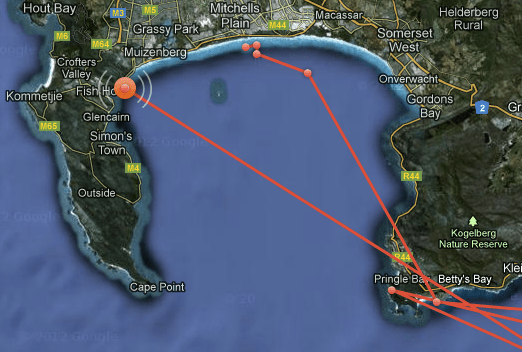
Shark spotters were put on alert Saturday in the Fish Hoek/Kalk Bay area in South Africa after a tagged great white shark was tracked swimming along the coast (see graphic).

The female shark, one of several great whites tagged by the nonprofit group OCEARCH, is named Lesley. She measured 13 feet, 8 inches and weighed 1,742 pounds when she was tagged off False Bay on April 15, 2012.

Knowing a great white is there is bound to make authorities nervous (they know they are generally there, but it is different when you have a position and track).

How long will it be before someone suggests preemptively capturing or killing Lesley? This is scientific research that aims to HELP sharks, but here’s what public safety officials are thinking about: the public outcry if a shark whose presence and whereabouts were known  injures or kills a swimmer. For that reason, OCEARCH is potentially putting the great whites it tags into danger.

I’m sure OCEARCH has thought about this dilemma. I wonder how they plan to handle it, and whether it has already come up.