Breaking: Ocean Trash Cleanup Solved?

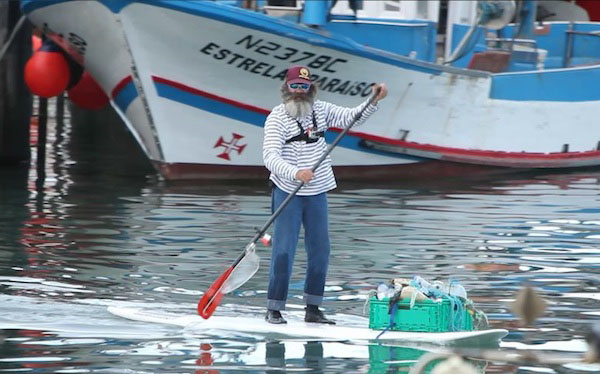
Who says humans can’t come up with a workable device for cleaning plastic and garbage from the ocean? I’d say this dude, who has affixed a net to his SUP paddle, has nailed it, no?

Explanation:

The EnviroNet is about 10 inches long and six inches wide and temporarily attaches to any paddle using a bungee cord. It’s easy to use and doesn’t interfere with paddling. All paddleboarders have to do is fasten the net to the paddle, put a basket on their board to put the trash in and they are all set to clean up the coast.

Since inventing the EnviroNet, Captain Macias has made it his mission to pick up more trash and recruit others to help him. He even made a pledge not to cut his beard until he collected 2,200 pounds of ocean trash! Nine-inches of facial hair later (about a year in real time), he made his goal.

Just need a few million SUP-ers to adopt this thing and we might see a dent in the problem. And a lot of long beards.

“Those Crazy Plastic Cleaning Machines”

I expressed some skepticism that a teenager’s oceanic plastic hoover concept could easily make the jump to the real oceanic world.

Manuel Maqueda at KUMU, is a little more blunt:

If I had a dime for each brilliant idea to “clean up the “Garbage Patch” that has been forwarded to me over the last few years I would be a millionaire.

These gyre cleanup machines, devices and foundations that emerge periodically are not going to happen. However they are likely to get lots of media attention –and distract from the real solutions.

These more or less sophisticated delusions and fantasies of massive offshore cleanups testify to how misunderstood our plastic pollution problem is, and how disconnected we are from nature in general, and from our oceans in particular.

Apart from Maqueda’s justified skepticism about how far it is from the drawing board to the restless, relentless, inhospitable oceans, he argues that our main focus should be on keeping plastic from getting into the ocean in the first place:

Another key detail that seems to be consistently forgotten is that millions of tons of new plastic trash are entering the ocean as we speak. A fairly old and conservative study estimated that 6.4 million tons of plastic waste enter the ocean every year –adding up to over 100 million tons of plastic already polluting our oceans.

Trying to clean this spiraling mess with ships or machines would be like trying to bail out a bathtub with a tea spoon… while the faucet is running! [snip]…

…The inconvenient truth is that we are using plastic, a toxic and very durable material that lasts centuries,for packaging and single use applications, that is to create things are designed to become garbage after a short use. And we are doing this at a massive scale to the benefit of a few corporations, to the detriment of all.

We have created a spiraling consumer culture and then turned it into a throwaway culture. Unless you stop this first, “cleanups” are futile.

That’s all very true, and I wouldn’t hesitate to support a worldwide ban on plastic bags (which are pernicious, and constantly being found en masse in the stomachs of dead sea creatures). Or a worldwide ban on plastic bottles. Or gratuitous plastic packaging (and here comes my usual, increasingly plaintive pitch: just price in the environmental and health impacts, and presto, people change their behavior!).

But still. These are times to think big. To take on the impossible. To look for silver bullets. So at the same time we are working to keep plastic out of the oceans, I am all in favor of garage nerds tinkering and dreaming about ways to remove some of the plastic that is already IN the ocean. Maybe there is some teen out there thinking up some crazy bioengineering or genetic engineering solution that Maqueda cannot even yet imagine. You never know.

(Thanks to Jordan Waltz for flagging Maqueda’s pushback).

Sweeping The Oceans Clean

So a teenager has designed a system to hoover up large amounts of plastic pollution from the ocean:

19-year-old Boyan Slat has unveiled plans to create an Ocean Cleanup Array that could remove 7,250,000 tons of plastic waste from the world’s oceans. The device consists of an anchored network of floating booms and processing platforms that could be dispatched to garbage patches around the world. Instead of moving through the ocean, the array would span the radius of a garbage patch, acting as a giant funnel. The angle of the booms would force plastic in the direction of the platforms, where it would be separated from plankton, filtered and stored for recycling.

This is exactly the sort of ambitious, creative, silver-bullet thinking that I believe is one of our only hopes to try and slow or reverse the growing and regrettable impact humans are having everywhere on the planet.

There is, of course, a huge difference between design and execution, and I know enough about the sea, and the law of unintended consequences, to know that successful operation of something like this is far from certain. Still, nicely done and we can only hope that the ranks of technology entrepreneurs aiming to protect the planet keep growing.

Here’s the non-profit Slat founded to try and make his idea a reality.And here is Slat explaining his concept at TedX:

Media Failure And The Dying Oceans

CNN takes detailed note of the grim future of oceans, and the fish and mammals that live in them:

Remoteness, however, has not left the oceans and their inhabitants unaffected by humans, with overfishing, climate change and pollution destabilizing marine environments across the world.

Many marine scientists consider overfishing to be the greatest of these threats. The Census of Marine Life, a decade-long international survey of ocean life completed in 2010, estimated that 90% of the big fish had disappeared from the world’s oceans, victims primarily of overfishing.

Tens of thousands of bluefin tuna were caught every year in the North Sea in the 1930s and 1940s. Today, they have disappeared across the seas of Northern Europe. Halibut has suffered a similar fate, largely vanishing from the North Atlantic in the 19th century.

In some cases, the collapse has spread to entire fisheries. The remaining fishing trawlers in the Irish Sea, for example, bring back nothing more than prawns and scallops, says marine biologist Callum Roberts, from the UK’s York University.

“Is a smear of protein the sort of marine environment we want or need? No, we need one with a variety of species, that is going to be more resistant to the conditions we can expect from climate change,” Roberts said.

The situation is even worse in Southeast Asia. In Indonesia, people are now fishing for juvenile fish and protein that they can grind into fishmeal and use as feed for coastal prawn farms. “It’s heading towards an end game,” laments Roberts.

It’s as dismal a picture as you can imagine, and the collapse of fisheries and acidification of the ocean, apart from the moral failures involved, will have profound effects on humanity’s future. Usually, if self-interest is at stake, people care.

So here is my question: why are these global threats–to the climate, to the oceans, to other species–not front page news each and every day on every media platform modern man has devised? They are existential threats, threats that dwarf the issues and problems that regularly get coverage, threats that dwarf most challenges we have ever faced because they are truly global and go to the core of how we live.

I am sure that media companies would answer that the public doesn’t want to read or hear about the scale of the problem, and the role of humanity and its hyper-materialistic culture in creating the problem. Doesn’t want to hear about sacrifice and the need for change. Covering that stuff is a money-loser.

But if Hitler or Dr. Evil, or an alien invader was threatening to heat up the planet, acidify the oceans, and force mass extinctions, I assume mainstream media would think that was newsworthy, and the public would agree. The occasional due diligence report, like this one, just doesn’t cut it. We need to be going to Defcon 1, and instead we are being hypnotized by the modern opiate of the masses, celebrity worship and endless and feckless video distractions.

Here is one point of agreement I have with Sarah Palin. Mainstream media = Lamestream media. And its failures, like ours, will seem criminal and shockingly blind to future generations trying to cope with the compromised planet we have bequeathed them.

Shell: Not Really Ready For Arctic Prime Time

That seemed pretty obvious as Shell suffered one setback after another in the Arctic over the past 6 months. But it’s nice to know the Interior Department noticed, as well:

U.S. Secretary of the Interior Ken Salazar on Thursday released the findings of a Departmental review of Shell’s troubled 2012 Arctic operations, painting a scathing picture of Shell and its inability to oversee and manage key components of its arctic program…

…The assessment found that Shell entered the 2012 drilling season without having finalized key components of its program, including its Arctic Challenger containment system, which put pressure on Shell’s operations and schedule and limited Shell from drilling into oil-bearing zones last summer. Weaknesses in Shell’s management of contractors on whom they relied for many critical aspects of its program – including development of its containment system, emission controls to comply with air permits, and maritime operations – led to many of the problems that the company experienced, the report found.

Well, yeah. Plus, it’s the, um, Arctic.

You might think that Shell’s failures would cause a re-think of the Obama Administration’s “”all-of-the-above” energy strategy, of which Arctic resource exploitation is a prominent component. But you’d be wrong. Apparently, it will take some sort of spill or oil drilling disaster to cause a re-think of the idea that the climate-warmed Arctic is there for the drilling (and mining, and fishing, and…).

Who Owns The Fish?

The whole concept that humans “own” the fish in the sea is objectionable, but that is the system that humanity has created to try and regulate fishing. And it’s a system that does not work very well, or protect small fishermen.

Here’s an interesting take on the failed system, by the Center For Investigative Reporting (via GOOD):

I would prefer that we figure out an alternative food source to fish, and let the oceans be. But if we are to fish, it needs to be globally managed on the basis of the principle that all earth’s resources should be shared sustainably by all earth’s people–and not according to who has coastline–and quotas should be drastically reduced according to the most conservative scientific evidence regarding what annual take any given fish stock can handle.

Moment Of Zen: Cuttlefish Close-up

The cunning, beauty, and deadliness of a cuttlefish revealed, thanks to super slo-mo.

Forget Godzilla. What About Japanese Tsunami Debris?

Already on Hawaiian beaches, and in Hawaiian ocean life. And coming soon to a west coast beach near you. It’s like a malign Butterfly effect.

Here’s CNN:

In her lab, Jantz sliced open the stomach of a lancetfish for CNN. You may never have heard of the lancetfish, a sometimes 4- to 6-foot long fish with enormous teeth. But bigeye and yellow fin tuna eat lancetfish. Tuna ends up on our plates.

Jantz pulled out a 12 by 12 piece of indigestible black plastic. “It would be difficult to pass through the system,” said Jantz. “I’ve found several fish with the same black plastic bag, just like this, even larger. If it gets to a certain size, the fish is going to feel like it’s full.”

Jantz conducted a study that included 64 fish of varying species. Twelve percent of them, she said, contained plastic. When she looked just at lancetfish, 45% had plastic. “One concern that we have and don’t know is if any chemicals from the plastic are absorbed into the tissue of the fish, which is a problem if consumed by a fish that we consume. That’s definitely the next step, what is the impact?”

Across the island in David Hyrenbach’s lab, the impact of plastic debris is apparent among the animal species he studies: birds. Hyrenbach cut open the bellies of some albatross for CNN. Plastic pieces spilled out of the belly of a 2-month-old albatross. Eighty percent of the stomach was packed with plastic.

Hyrenbach, an assistant professor of oceanography at Hawaii Pacific University, pulled out a small bottle top. “Toothpaste top?” he said. “No, cap of a medicine tube.” He reached into the stomach again. “Oh, it’s a brush, you see?” There were the unmistakable bristles of a hairbrush.

“Morally, this is terrible. How is this possible? Majestic, far ranging, beautiful birds, in a pristine place of the pacific, the northwest Hawaiian islands, you open them up and this is what you find,” said Hyrenbach.

He grabbed a box, packed with toy soldiers, lighters and brushes. He explained that he pulled all the items out of albatross from Hawaii. “Every bird I looked at had plastic. Some had a little bit. Some had a lot. Everybody we looked at had plastic.”

Screen Shot 2013-03-13 at 5.03.22 PM

How The Giant Squid Was Found

A fascinating TED tale by oceanographer Edith Widder that begins:

The Kraken, a beast so terrifying it was said to devour men and ships and whales, and so enormous it could be mistaken for an island. In assessing the merits of such tales, it’s probably wise to keep in mind that old sailor’s saw that the only difference between a fairytale and a sea story is a fairytale begins, “Once upon a time,” and a sea story begins, “This ain’t no shit.”

Robots And Right Whales

After using cutting-edge technology (for the time) to hunt and slaughter North Atlantic right whales to the brink of extinction, humans are using cutting edge technology to try and save them.

The latest tool in the game is an underwater robot that can hear and find whales, and then transmit their positions in near-real time:

Last month, two 6-foot-long (1.8-meter-long), torpedo-shaped robots from theWoods Hole Oceanographic Institution (WHOI) in Massachusetts used digital acoustic monitoring equipment to detect 9 North Atlantic right whales(Eubalaena glacialis) in the Gulf of Maine—the first-ever detection of baleen whales from these types of autonomous vehicles.

“Recording the sound creates a spectrogram, which to a scientist is almost like a sheet of music that visually represents the sounds you’re hearing,” explained WHOI researcher Mark Baumgartner.

The gliders process and classify these acoustic signatures, then surface every two hours and transmit evidence of whale calls to shore-based computers while the animals are still nearby. “We can use this information to very quickly draw a circle on the map and say, hey, we know there are whales in this area, let’s be careful about our activities here. The government can then alert mariners and ask them to reduce their speed and post a lookout.”

The effort to save right whales is a battle that pits scientists and conservation groups against all the oceanic intrusions of modern human culture, with its shipping, fishing, and pollution. It is an incredibly close battle, in which single lives count. So every technological wrinkle can make a difference.