Superstorm Sandy And Global Warming

Did climate change influence the power and impact of Hurricane Sandy?

Of course, that’s the $60-plus billion question, and Jeff Masters at Wunderground is just the meteorologist to dig into the answer.

Here’s his very detailed and well-organized answer, in which he concludes:

Global warming theory (Emanuel, 2005) predicts that a 2°C (3.6°F) increase in ocean temperatures should cause an increase in the peak winds of the strongest hurricanes of about about 10%. Furthermore, warmer ocean temperatures are expected to cause hurricanes to dump 20% more rain in their cores by the year 2100, according to computer modeling studies (Knutson et al., 2010). However, there has been no published work describing how hurricane size may change with warmer oceans in a future climate. We’ve seen an unusual number of Atlantic hurricanes with large size in recent years, but we currently have no theoretical or computer modeling simulations that can explain why this is so, or if we might see more storms like this in the future. However, we’ve seen significant and unprecedented changes to our atmosphere in recent decades, due to our emissions of heat-trapping gases like carbon dioxide. The laws of physics demand that the atmosphere must respond. Atmospheric circulation patterns that control extreme weather events must change, and we should expect extreme storms to change in character, frequency, and intensity as a result–and not always in the ways our computer models may predict. We have pushed our climate system to a fundamentally new, higher-energy state where more heat and moisture is available to power stronger storms, and we should be concerned about the possibility that Hurricane Sandy’s freak size and power were partially due to human-caused climate change.

It seems self-evident that if we change the climate we change the weather. But apparently this point can’t be made enough given the resistance out thereto this reality and its implications.

Non-trivial digression: One other thing caught my attention in this analysis. According to Masters…

Most incredibly, ten hours before landfall (9:30 am EDT October 30), the total energy of Sandy’s winds of tropical storm-force and higher peaked at 329 Terra Joules–the highest value for any Atlantic hurricane since at least 1969. This is 2.7 times higher than Katrina’s peak energy, and is equivalent to five Hiroshima-sized atomic bombs.

All that energy was equivalent to just five World War II era atomic bombs? That says a lot, not about the power of Sandy, but about the power of nuclear weapons. Today we are used to living with thousands of nuclear weapons (in other words, hundreds of potential Sandys), and the possibility of a nuclear exchange, say, between India and Pakistan. But Sandy is a reminder that we should not be at all casual about this danger. And that efforts to eliminate nuclear weapons should be a top priority for all of us.

Post-Election Fun Facts: Money, Money, Money!

I don’t buy that all the SuperPac spending didn’t make a difference just because Romney lost. In any case, the money will only get smarter and find better leverage with each electoral cycle.

Which is why it’s worth a reminder of of how money played this year, and how much has changed since 2008:

1. Estimated amount of disclosed spending in the 2012 election: $6 billion

2. Amount of dark money (money with no donor disclosure) spent in the 2008 election:$70 million

Minimum amount of dark money known to have been spent on the 2012 election: $213 million

3. Amount super-PACs, dark money groups, and other outside groups spent in October: $526 million

4. Percentage of all super-PAC money from just 163 people who gave $500,000 or more: 70 percent

5. Percentage of outside spending coming from disclosed donors in 2004: 96.5 percent

Percentage in 2012: 40.5 percent

6. Amount the Koch brothers are known to have donated to candidates and parties in 2012: $411,000

Amount of dark money they have pledged to spent to defeat Barack Obama: $60 milion

7. Percentage of dark money spent on federal elections that went to electing Republicans and defeating Democrats: 80 percent

8. Percentage of the 1 million-plus ads run by the Obama and Romney campaigns and their allies between April and October that were negative: 87 percent

Lots more from Mother Jones on Dark Money here. And if it makes you want to do something about it, here’s the best place to go.

Sea Shepherd Goes To Sea

Whatever you think of Sea Shepherd’s Paul Watson, and Sea Shepherd’s confrontational anti-whaling strategy, you have to consider this: in an international whale management regime that seems custom-designed for gridlock and delay, Sea Shepherd is taking action.

Call it uncivil disobedience, and maybe that is an idea whose time has come. Increasingly, domestic politics and international diplomacy work at a pace that is insufficient to match the rapid pace of environmental change and destruction occurring around the globe. So we can rely entirely on the usual channels for resolving problems, and feel good about that, but watch whales die, seas rise, forests disappear, and extinction rates accelerate. Or we can continue with those channels but at the same time take more direct action to shock and galvanize the system to respond more quickly.

I’d argue that is what Sea Shepherd is doing with regard to whaling, and once again the Sea Shepherd fleet is headed to sea to confront the Japanese Antarctic whaling fleet:

Captain of the SSS Bob Barker, Captain Peter Hammarstedt stated, “The plan is for our fleet to meet the whaling fleet in the North Pacific off Japan. We are planning to take the battle pretty much up to Japan itself. We are keeping the location and identity of our new vessel, the SSS Sam Simon, a secret in the hope that the first time the whalers see the Sam, is when she comes into view on the slipway of the factory processing ship, the Nisshin Maru, effectively shutting down their illegal whaling operations.”

Currently docked in Marina del Rey, California on its very first trip to the mainland U.S., the fast scout vessel, the SSS Brigitte Bardot, will depart on November 11 and quickly meet up with the rest of the Sea Shepherd fleet.

Hammarstedt also went on to say “it is expected Sea Shepherd Founder and President Captain Paul Watson will appear in command of one of the vessels when the action begins.” Captain Watson has been in an undisclosed location since July 22 when he forfeited his bail and departed house arrest in Germany to avoid being extradited on bogus charges to Costa Rica and Japan.

Australian Director Jeff Hansen stated, “This is our strongest fleet to date, with four ships and more than 100 international crew representing 23 nations to defend the Southern Ocean Whale Sanctuary. Operation Zero Tolerance will be Sea Shepherd’s best-equipped and most effective campaign to date. This is a defining moment in Sea Shepherd’s history; we have no tolerance for whale poachers. Our objective this year is 100%. We are going to try and intercept them as quickly as possible, and try to make this the first year they get zero kills.”

I’m excited that dedicated animal rights defender Sam Simon will have a ship out there, and I’m sure it will get into some crazy trouble. But lest you are tempted to dismiss the Sea Shepherd campaign as trivial or a sideshow, please note the fact that Sea Shepherd has likely saved the lives of thousands of whales (they claim more than 3,600).

If you don’t think that really matters, then watch the death of just a single whale (dramatized as it is for Whale Wars). It will make you want to sign on as Sea Shepherd crew.

Seeing Is Important: The Alberta Tar Sands

We hear a lot of debate about the Keystone Pipeline and the future of oil extraction from tar sands as part of the global energy future. Fron the comfort and isolation of our modern lives it all sounds pretty abstract–with lots of numbers and projections getting thrown around.

But no matter whether you are for or against the big move into tar sands as a next phase of the energy economy (though you should read NASA scientist James Hanson’s take if you think oil from tar sands sounds like a good idea), it’s useful to actually see what tar sand oil extraction is all about, and what it means for a natural landscpe. Thankfully, photographer Ashley Cooper has been documenting exactly that.

Does this–transforming, so far, 725 140,000 of a potential 4,800 square kilometers of Alberta from forest to something otherworldly–look like humanity living in harmony with the earth (full slide show is here)? Isn’t there something intrinsic to this vision that screams out: “STOP! THINK!”

That changes the oil sands debate a lot, no?

You can see more of Cooper’s work documenting climate change here.

Ocean Policy Is A No-Brainer

“Dude, would it be too much to ask you humans to have a national ocean policy?”

It seems so obvious to me that humans (and the subset known as Americans) need to see and treat the oceans, the lands, and the atmosphere as integrated ecosystems. What you do in one place, affects life (either human or non-) and resources in another place. So when you make choices about commerce, recreation, energy, whatever, it makes sense to think through the ripples those choices send through the system.

So I am always caught by surprise when such an obvious reality turns out to be controversial. Take ocean policy. To his credit, Barack Obama saw the interconnectedness of things, and the confusing disconnnectedness of federal agencies and polices, and decided to create a national ocean policy that actually considers the implications for the oceans off the United States of the decisions made by the federal government.

Yet considering the borader implications of any single decision for the oceans as a whole is apparently a controversial idea. According to the Washington Post:

Conservative Republicans warn that the administration is determined to expand its regulatory reach and curb the extraction of valuable energy resources, while many Democrats, and their environmentalist allies, argue that the policy will keep the ocean healthy and reduce conflicts over its use.

The wrangling threatens to overshadow a fundamental issue — the country’s patchwork approach to managing offshore waters. Twenty-seven federal agencies, representing interests as diverse as farmers and shippers, have some role in governing the oceans. Obama’s July 2010 executive order set up a National Ocean Council, based at the White House, that is designed to reconcile the competing interests of different agencies and ocean users.

The policy is already having an impact. The council, for example, is trying to broker a compromise among six federal agencies over the fate of defunct offshore oil rigs in the Gulf of Mexico. Recreational fishermen want the rigs, which attract fish, to stay, but some operators of commercial fishing trawlers consider them a hazard and want them removed.

The article goes on to detail debates over vessel speeds through national marine sanctuaries, the impact of wind farms on local fisheries, and river runoff. What is particularly striking to me is that all these debates are over competing human commercial interests. The impact on ocean health and ocean dwellers rarely seems to figure. So not only do you have controversy over the blindingly sensible idea of considering the broader impact of decisionmaking related to oceans. The idea doesn’t even really incorporate the basic health of the ecosystem (beyond what happens to commercial or sportfishing fish stocks) as a fundamental goal or interest.

Throw in the fact that the oceans really need international coordination and management, and this controversy over simply managing the oceans off our coasts in a sensible way makes you realize just how far we have to go to get where we need to be on global oceans policy. It’s not just about human interests (though it is in the largest sense, because we need a healthy planet and healthy oceans to thrive). Why is that controversial or so hard to see?

Shark Sanctuary

Sometimes the simplest ideas are the most powerful. If you want to stop shark fishing and finning, don’t muck around with caps, fisheries management, and licenses. Address the problam directly and ban commercial fishing.

That’s the approach the Marshall islands took when they created the world’s largest shark sanctuary. Almost two million square kilometers of protected waters and reefs, WITH (and this is key, obviously) enforcement.

But there’s always a difference between the vision and the implementation. So it’s worth checking in on how the sanctuary is working out one year in. So the Pew Environment Group, which has been intimately involved in this effort, takes a look.

I’d love to believe things are going so well. And I love the fact that some people are now calling for a Pacific Ocean sanctuary. But I wonder what is happening with poaching. And “non-commercial” shark fishing. And commercial fishing of other species and bycatch. There is so much money in shark finning that there is always the danger that it will find a way to overcome, evade, or sneak through loopholes, in any sanctuary.

But those are challenges of implementation, and can be addressed with greater vigilance and funding. The essential point remains: sanctuaries are an immensely simple and powerful idea. And can do more to preserve and steward fish populations than any other approach.

What Is NOC, The “Talking” Beluga, Really Saying?

NPR jumps in with a nicely done story that includes more detail on NOC’s history, and how researchers came to believe he was mimicking human speech (the audio version of the story is here).

Here’s some useful backstory:

But a white whale at San Diego’s National Marine Mammal Foundation did something very different. NOC (pronounced Nocee), as he was called, lived in an enclosure in the San Diego Bay. Biologist Sam Ridgway was there one day when divers were swimming nearby. “This one diver surfaced next to the whale pen and said, ‘Who told me to get out?’ And the supervisor said, ‘Nobody said anything.’ ”

A curious Ridgway started recording NOC. And what he heard was quite strange: It had the cadence and rhythm of human speech. No words were distinguishable, but the sounds were eerily “right.” Ridgway laid out audiograms of NOC’s chatter, and they showed that the rhythm and pitch were different from NOC’s normal sounds: They were, in fact, very similar to human speech. NOC had lowered the pitch of his sounds several octaves below normal, into the range of human speech at 300-400 hertz.

Ridgway says there’s no reason to think NOC understood speech; he was just mimicking humans he’d heard. From where? “I think it was from divers using underwater communication equipment,” he says.

The story (scroll down) also includes audio links that let you listen to an ordinary beluga vocalization, and then compare it to a recording of NOC. There is a striking difference.

Here is the same audio, released by the National Marine Mammal Foundation:

And you can watch NMMF’s Sam Ridgway appearance on The Today Show here.

The more I think about this, the more I think the excitement and interest over NOC is emblematic of what troubles me about marine mammal captivity and research.

First: NOC’s vocalizations are like ear candy to humans, who love the idea that any animal might mimic a human (see endless YouTube videos). But what educational or research value do the recordings of NOC really hold? If it was important research or information you would presume Ridgway would have published it before decades had passed.

Second: If NOC was truly mimicking humans (maybe he was psychotic; maybe he was ill; maybe he was just bored and messing around with his vocalizations to distract himself; who really knows?) it’s important to remember that he was doing so only because he was in a situation where he was spending his life in their company. It would be far more interesting, and meaningful, if wild cetaceans adapted their vocalizations for human consumption, which is what Denise Herzing and her Wild Dolphin Project are hoping to see. In any case, I’d much rather see research on real wild beluga vocalizations. That would teach us something about belugas as they really are. And that is the sort of knowledge that is important it we really care about beluga populations and their future.

Third, the media splash, and the publication of this research is really another form of beluga exploitation. Do any of the media outlets really care about NOC and belugas? Did anyone ask serious questions about Ridgway’s research program, and history with the Navy? Not really. It was a 5-minute distraction for people driving home in traffic or sitting around with the television on.

There is an upside, though, I think. For better or worse, humans aren’t very good at stepping outside their own lives and human frame of reference. They care about things they can connect with. So hearing NOC vocalizing in a pattern that sort of sounds like it has human rhythm probably had millions of people thinking of belugas in a positive way.

Now, I know this is basically the core of the marine park argument in favor of captivity, and marine mammal shows. And I hasten to add that I don’t think that it–or NOC’s media splash–justifies captivity. You can achieve a lot, if not more, of that sort of connection through seeing and hearing wild animals, whether in nature or on film. And there’s no real justification for taking away an intelligent, social animal’s freedom, no matter what good you claim you are achieving. But it’s just to say that NOC’s unusual vocalizations, whatever they were when he made them all those years ago, at least cry out for a serious evaluation of the human relationship to marine mammals, and the issue of marine mammal research and captivity. And that would be a good thing.

Climate Lies (And What’s Behind Them)

I’m not sure I can watch this, because it will only remind me of how corrupted our politics and media are. And I already know that there has been a consistent and cynically self-interested campaign to create doubt about climate change in a sadly gullible public.
Given that success, I can see why Gov. Romney and President Obama were too pusillanimous to raise climate change during their debates (though I can’t applaud them for political cowardice). But what excuse do moderators Jim Lehrer, Candy Crowley, and Bob Schieffer have for never raising the single most important threat on the planet?

Anyhow, maybe a President Romney shouldn’t try to kill Big Bird. Because PBS’s Frontline has done what always has to be done: laid out the detailed narrative of how climate change deniers have succeeded (probably beyond their most hopeful dreams) in confusing and delaying action on global warming. Here’s the teaser:

And here’s the whole thing. You can also watch the it on PBS’ website, which has lots of other related videos and articles.

See it and weep. And then get mad. And then take action.

Mid-Day Infographic Interlude

Thought-provoking graphic showing what parts of earth will be submerged by rising sea levels, according to timing and global warming milestone (click image for full-size):

Sea level rise

The Future Of Fish

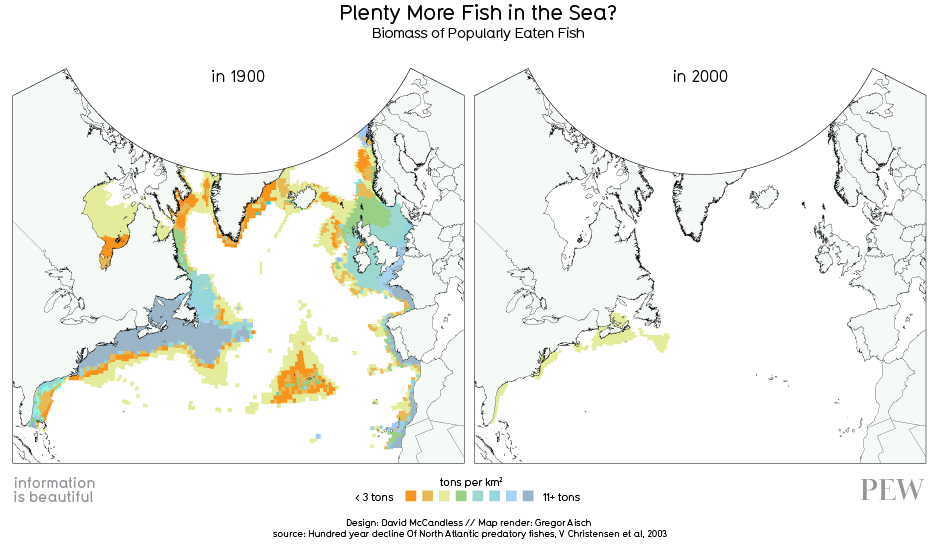
Any discussion of human fishing practices has to start with this chart (you know how I love infographics). Click image for full size:

The data presented here is damning on two levels. First, as a perfect visualization of the Tragedy Of The Commons, in which we don’t have the will or the wisdom to steward resources on a global scale, instead just seeking profit wherever it can be found, nevermind the fact that over time we are destroying the very stocks we seek profit from.

And second, because lots of the earth’s population relies on dwindling stocks of fish. This is a problem that Carl Safina and Brett Jenks focus on in a recent op-ed that argues for turning over fishing rights to local communities:

The journal Science recently published the first comprehensive analysis of more than 10,000 fisheries — roughly 80 percent of our global fish catch. The conclusion: fish populations worldwide are swiftly declining. This global analysis paints a stark new picture of a global ocean fished to exhaustion in an increasingly hungry world.

So, why are we hopeful? It’s because the analysis of global fisheries has a silver lining. We have not reached a point of no return. We have time. Solutions exist.

The good news is that many large commercial fisheries are already benefiting from the improved management of the last decade. The harder problem is with smaller-scale fisheries that local communities rely on for food and income. The fact is that small-scale fishers — who fish within 10 miles of their coast — account for nearly half of the world’s global catch and employ 33 million of the world’s 36 million fishermen, while also creating jobs for 107 million people in fish processing and selling [pdf]. Mostly poor, they live mainly in areas lacking fisheries management, monitoring and enforcement. No one is in a position to formally declare their fisheries “disasters.” They must just endure their situation. Or — take control of it.

Safina and Jenks propose a hyper-local approach to managing fisheries, called Territorial Use Rights, or TURF. Here’s how it would work:

In exchange for the privilege of exclusivity, local fishermen agree to establish and protect no-take zones. Results include increased fish populations, richer marine habitats, and coastlines less vulnerable to climate change — and more food for people.

Unleashing the self-interest of local fishermen to advance both conservation and economic development can create one of those rare win-win scenarios.

A growing body of research shows that fish populations inside a no-take zone can more than quadruple. Fish numbers outside the reserve can double. And, exclusive access enables investment and better management, increasing the catch’s value.

That feels right. No one cares more about managing stocks than the very people whose lives and livelihood depend on the stocks surviving. The challenge is that thousands of TURF zones would have to be created (and enforced) around the globe.

Traditional Fishing

That’s really just another way of saying that we have created a big problem so we need a dramatic solution. And I wish humanity had a better record of tackling big challenges by putting long term interests on a par with short term interests.

But the basic theme of localism is a very powerful one. And there is plenty of evidence that fishing’s emphasis on industrial practices and international fleets has been an accelerating disaster. So, sure, if we are going to do anything we should go local–and encourage traditional fishing practices that don’t strip mine the seas.

It would also help if the billions of people who don’t NEED to eat fish to survive would start laying off the tuna, Chilean Sea Bass, shrimp, shark fin soup, and every other fish our lust for high-end, boutique, food is destroying.