
I believe in the power of film, and “The Circular Glance” is an award-winning short film that makes the powerful and important connection between how we live, and the implications for animals. It turns a perfect day into a perfect nightmare and will make you think.
Category: Tales From The Factory Farm
Seeing Is Important: Slaughterhouse Transparency Trending

The New York Times catches up with the Ag-Gag problem:
But a dozen or so state legislatures have had a different reaction: They proposed or enacted bills that would make it illegal to covertly videotape livestock farms, or apply for a job at one without disclosing ties to animal rights groups. They have also drafted measures to require such videos to be given to the authorities almost immediately, which activists say would thwart any meaningful undercover investigation of large factory farms.
Critics call them “Ag-Gag” bills.
Some of the legislation appears inspired by the American Legislative Exchange Council, a business advocacy group with hundreds of state representatives from farm states as members. The group creates model bills, drafted by lobbyists and lawmakers, that in the past have included such things as “stand your ground” gun laws and tighter voter identification rules.
One of the group’s model bills, “The Animal and Ecological Terrorism Act,” prohibits filming or taking pictures on livestock farms to “defame the facility or its owner.” Violators would be placed on a “terrorist registry.”
Officials from the group did not respond to a request for comment.
Mercy For Animals argues that this sort of exposure is an example of how the factory farm industry’s pursuit of ag-gag laws is an over-reach that is backfiring by drawing MORE attention to the conditions of slaughterhouses (one can hope, I guess):
In response to a spate of undercover investigations that have uncovered horrific animal abuse and shocking food safety problems in meat, dairy, and egg production, the factory farming industry has been furiously lobbying to pass “ag-gag” laws designed to keep its cruel and unsanitary practices hidden from public view. But that effort seems to be backfiring, as scores of media outlets nationwide are throwing back the curtain on Big Ag and shining a bright light on the industry’s sickening practices…[snip]
…Here is just a sample of the ag-gag news coverage in only the last few weeks:
Associated Press: Bills Seek End To Farm Animal Abuse Videos
Mother Jones: Flies, Maggots, Rats, and Lots of Poop: What Big Ag Doesn’t Want You To See
Nightline: ‘Ag Gag’ Bills Target Hidden Cameras
Raw Story: Business Lobby Moves to Criminalize Filming Animal Abuse on Factory Farms
Bakersfield Californian: Cattle Industry Must Rethink ‘Ag-Gag’ Bill
Food Safety News: “Ag-Gag” Bills Getting Hearings Today in Nebraska, Arkansas and Tennessee
Salon: States Seek “Ag-Gag” Laws to Silence Farm Whistleblowers
Vice: Beat Your Meat: Factory Farmers Want to Choke Their Chickens in Private
Huffington Post: Why Everyone Should Be Angry About Factory Farming
Lowell Sun: Agri-farm Bills Would Weaken Oversight
The Daily Aztec: Only We Can Stop Inhumane Factory Farming
Herald Times: Bill would shield farms, factories from cameras
Public Source: Bill would limit whistleblower activities on PA farms
Ironically, as the factory farming industry more desperately tries to hide its cruel practices, the more they are exposed.
You can see why a farm owner might prefer that this sort of imagery be criminalized (instead of the behavior it shows).
But if this op-ed contributor to the Times got his way, I think we could definitely conclude that the ag-gag initiative backfired. He calls for a Continue reading “Seeing Is Important: Slaughterhouse Transparency Trending”
Meat Culture: Americans Eating Less Meat, The World Eating More

Americans still eat a lot of meat, but it is starting to look like they are eating less:
WASHINGTON — For the first time on record, U.S. per-capita meat consumption has declined for four consecutive years, according to the most recent figures from the U.S. Department of Agriculture.
The six percent drop between 2006 and 2010 is the largest sustained decline since recordkeeping began in 1970.
Reasons for the decline are at least partly economic: rising prices and a bad U.S. economy have made meat less affordable for American consumers.
But there are intriguing signs that a cultural shift may be underway, as well…[snip]
…While about seven percent of Americans identify themselves as vegetarians, it’s the “flexitarians” – people who eat occasional meatless meals – that market research firms have just begun to explore.
One such firm, Packaged Facts, found that eating along the “meatless spectrum” is popular among college students, who will carry those eating habits into their adult years.
“Young people today are just not so meat-and-potatoes oriented as earlier generations were,” said environmental researcher Lester Brown at the Washington-based Earth Policy Institute.

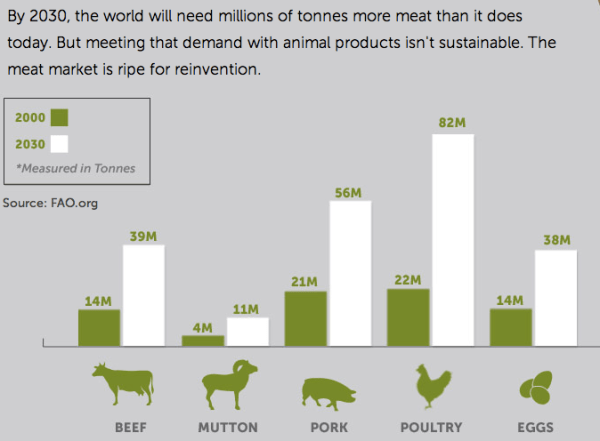
That’s encouraging, because sometimes cultural changes can hit a tipping point that creates a true shift. But according to Lester Brown we’d still need two or three Earths to meet the demand for grain and water if the rest of the world ate meat like Americans. So this chart is important to keep in mind, too:
H7N9 Avian Flu “Contagion” Threat Level: Orange

Initially, worries about deaths from H7N9 in China were dismissed as paranoid. But now H979 is at starting to live up to the hype:
Six people are dead from the H7N9 strain of avian flu. The number of infected has grown to to 14. A new scare just hit Hong Kong. The United States has begun early research for a vaccine. And now China has slaughtered 20,000 chickens, ducks, geese, and pigeons — and shut down its live poultry markets — to try and cut off the health risk at the source. So: Is it time to panic yet?
Well, not exactly.
We’re not doctors, obviously, but the people at the World Health Organization said on Friday that they still haven’t found proof of “sustained human-to-human transmission” of [H7N9], reports Reuters. That’s the key difference between this latest scare going from a relatively isolated virus incident into full-fledged Contagion panic. In Hollywood terms, we’re about at the stage where the pig has left the farm but not yet arrived at the table with Gwyneth Paltrow. And while [H7N9] isn’t thought to be quite horror-movie bad, we might be at the point where Kate Winslet is about to get called in: The Centers for Disease Control in Atlanta is already working to develop a vaccine, CNN reports, although U.S. and Chinese scientists still haven’t exactly accounted for how humans developed the virus.
In order to stem the tide, China has culled tens of thousands of birds along with a poultry-market shutdown. And while 20,000 animals might seem a lot of stock, well, Mexico had bird flu fears of their own last year and killed 8 million chickens in August as a precaution. So, that’s another good takeaway — provided you are not a duck, goose, or chicken hanging out in Shanghai.
I’d rather see “proof” that there isn’t “sustained human-to-human transmission.” Because absence of proof does not mean absence of transmission, which presumably why the CDC is going all Kate Winslet and thinking about a vaccine.
Again, whether this plays out as feared or not, get used to this sort of scare. We’ll see it again and again because our livestock practices are nicely set up to create it. Is meat really worth it?
Meat And Antibiotics (Round 646)
Whenever an industry resists disclosing pertinent information about how its practices impact public health, it seems likely that those practices are problematic.

And when it comes to the rampant use of antibiotics in meat production, even former FDA Commissioner David Kessler is fed up (no pun intended):
In 2011, drugmakers sold nearly 30 million pounds of antibiotics for livestock — the largest amount yet recorded and about 80 percent of all reported antibiotic sales that year. The rest was for human health care. We don’t know much more except that, rather than healing sick animals, these drugs are often fed to animals at low levels to make them grow faster and to suppress diseases that arise because they live in dangerously close quarters on top of one another’s waste.
It may sound counterintuitive, but feeding antibiotics to livestock at low levels may do the most harm. When he accepted the Nobel Prize in 1945 for his discovery of penicillin, Alexander Fleming warned that “there is the danger that the ignorant man may easily underdose himself and by exposing his microbes to nonlethal quantities of the drug make them resistant.” He probably could not have imagined that, one day, we would be doing this to billions of animals in factorylike facilities….[snip]
…It was not until 2008, however, that Congress required companies to tell the F.D.A. the quantity of antibiotics they sold for use in agriculture. The agency’s latest report, on 2011 sales and also released in February, was just four pages long — including the cover and two pages of boilerplate. There was no information on how these drugs were administered or to which animals and why.
We have more than enough scientific evidence to justify curbing the rampant use of antibiotics for livestock, yet the food and drug industries are not only fighting proposed legislation to reduce these practices, they also oppose collecting the data. Unfortunately, the Senate Committee on Health, Education, Labor and Pensions, as well as the F.D.A., is aiding and abetting them.
The Senate committee recently approved the Animal Drug User Fee Act, a bill that would authorize the F.D.A. to collect fees from veterinary-drug makers to finance the agency’s review of their products. Public health experts had urged the committee to require drug companies to provide more detailed antibiotic sales data to the agency. Yet the F.D.A. stood by silently as the committee declined to act, rejecting a modest proposal from Senators Kirsten E. Gillibrand of New York and Dianne Feinstein of California, both Democrats, that required the agency to report data it already collects but does not disclose.
Kessler should be very familiar with this problem. The FDA has been intimidated into inaction an antibiotics for decades, according to this excellent timeline.
Just another day in the life of a corporate democracy. I mean, what could go wrong?
The McVegans Are Coming

According to Mark Bittman, there are vegetables afoot in the fast food industry:
Twelve years after the publication of “Fast Food Nation” and nearly as long since Morgan Spurlock almost ate himself to death, our relationship with fast food has changed. We’ve gone from the whistle-blowing stage to the higher-expectations stage, and some of those expectations are being met. Various states have passed measures to limit the confinement of farm animals. In-N-Out Burger has demonstrated that you don’t have to underpay your employees to be profitable. There are dozens of plant-based alternatives to meat, with more on the way; increasingly, they’re pretty good.
The fulfillment of these expectations has led to higher ones. My experience at the airport only confirmed what I’d been hearing for years from analysts in the fast-food industry. After the success of companies like Whole Foods, and healthful (or theoretically healthful) brands like Annie’s and Kashi, there’s now a market for a fast-food chain that’s not only healthful itself, but vegetarian-friendly, sustainable and even humane. And, this being fast food: cheap. “It is significant, and I do believe it is coming from consumer desire to have choices and more balance,” says Andy Barish, a restaurant analyst at Jefferies LLC, the investment bank. “And it’s not just the coasts anymore.” [snip]
…When I first entered a Veggie Grill [founded by two vegans], I expected a room full of skinny vegans talking about their vegan-ness. Instead, at locations in Hollywood, El Segundo and Westwood, the lines could have been anywhere, even an airport Taco Bell. The diners appeared mixed by class and weight, and sure looked like omnivores, which they mostly are. The company’s research shows that about 70 percent of its customers eat meat or fish, a fact that seems both reflected in its menu and its instant success. Veggie Grill won best American restaurant in the 2012 Los Angeles Times readers’ poll, and sales are up 16 percent in existing stores compared with last year. The plan is to double those 18 locations every 18 months for the foreseeable future — “fast enough to stay ahead of competitors, but not so fast as to lose our cultural DNA,” Boylan said. In 2011, the founders brought in a new C.E.O., Greg Dollarhyde, who helped Baja Fresh become a national chain before its sale to Wendy’s for nearly $300 million.
Sure hope Bittman is right, because vegan and vegetarian penetration of the fast-food market would be the most encouraging sign of a real cultural shift I’ve seen yet. In the meantime, here’s hoping Veggie Grill comes to Washington, DC soon.
Did China’s Meat Production Practices Create The Possibility Of A New Pandemic?

Laurie Garrett (free sign-up required) at Foreign Policy thinks the answer may be, “yes”:
Here’s how it would happen. Children playing along an urban river bank would spot hundreds of grotesque, bloated pig carcasses bobbing downstream. Hundreds of miles away, angry citizens would protest the rising stench from piles of dead ducks and swans, their rotting bodies collecting by the thousands along river banks. And three unrelated individuals would stagger into three different hospitals, gasping for air. Two would quickly die of severe pneumonia and the third would lay in critical condition in an intensive care unit for many days. Government officials would announce that a previously unknown virus had sickened three people, at least, and killed two of them. And while the world was left to wonder how the pigs, ducks, swans, and people might be connected, the World Health Organization would release deliberately terse statements, offering little insight.
Or this could be how pandemics begin.
We all know (or at least by now should know) about the cruelty and environmental impact of industrial meat production. And we know that there are personal health implications related to heart disease. What most people don’t know is that factory farms and modern livestock practices create ripe scenarios for new viruses and antibiotic resistant bacteria. The H7N9 virus may turn out not to be the pandemic health experts have feared might emanate from livestock. But even if it is not, it is a reminder that we have knowingly created conditions which probably will at some point produce a deadly pandemic. A definite “reap what you sow” situation, and an example of a modern threat that is much more worrisome than all the traditional threats (terrorism, for example) that we tend to spend time and money on.
This is yet another powerful reason that vegetarian and vegan practices would make for a lot safer, more inhabitable, planet in the future. (h/t Earth In Transition, for flagging Garrett’s piece).

Just one more environmental note on China, and an example of why China might end up wondering whether it was really so wise to try and emulate the western development and consumption model. Air Pollution Linked to 1.2 Million Premature Deaths in China:
Outdoor air pollution contributed to 1.2 million premature deaths in China in 2010, nearly 40 percent of the global total, according to a new summary of data from a scientific study on leading causes of death worldwide.
Figured another way, the researchers said, China’s toll from pollution was the loss of 25 million healthy years of life from the population.
That’s a big price to pay, no matter how you look at it.
PETA’s Ingrid Newkirk Sits For A Profile

And explains what she is all about:
My favourite story about Ingrid Newkirk, the founder and head of Peta, the animal-rights organisation, involves her storming the dining room of the Four Seasons hotel in New York, depositing a dead raccoon onAnna Wintour‘s dinner plate and calling the veteran editor of American Vogue a “fur hag”. Wintour, a long-time Peta hate figure for her support of the fur industry, calmly covered it with a napkin and then ordered coffee…[snip]
Is it Peta’s strategy to upset everyone, I ask Newkirk. “No,” she says. “Our mission is to provoke thought. People have been taught to disregard what happens to pigs or chickens, to not think about the suffering they go through. Our job is to make them think. We’re not out to be popular.”
No matter what you think of PETA and its tactics, they have helped supercharge animal rights, and done some good undercover work:
Rise Of The Vegans
At least according to this cool Google Trends analysis of searches using the word “vegan” 2008 to the present. It was created by Compassion Over Killing, and, yes, it starts on the coasts (especially the PNW and the NE), but watch as it slowly spreads into the heartland.
There are holdout states, of course (I’m looking at you, Wyoming), but if Google searches are destiny then veganism is an idea and way of life whose time is arriving.

There’s A New Milkman In Town
…”and he’s got some serious nuts.”
A pretty funny commercial for Silk Almond Milk (for me, almond milk was the key discovery that helped me ditch dairy. It’s tasty enough to drink plain, and good (enough) in coffee).
Silk Milk from CINEMA SCOTT on Vimeo.
 The Earthist Chronicles