I don’t know if this is the start of a regular feature here, but it could be.
The Kansas City Star (in the heart of Big Beef-country) shows courage by digging deep into a processing technology, “mechanical tenderizing,” that is rarely labeled and makes it (even) more likely that you can get e-coli poisoning from industrial beef:
An estimate by the Center for Science in the Public Interest, an advocacy group, suggests that mechanically tenderized beef could have been the source of as many as 100 outbreaks of E. coli and other illnesses in the United States in recent years.
Those cases affected more than 3,100 people who ate contaminated meat at wedding receptions, churches, banquet facilities, restaurants, schools and in their own homes, the center said.
But that’s just one of the key findings from The Star’s investigation, which examined Big Beef’s processing methods and the hazards they can pose for human health.
The Star examined the largest beef packers including the big four— Tyson Foods of Arkansas, Cargill Meat Solutions of Wichita, National Beef of Kansas City and JBS USA Beef of Greeley, Colo. — as well as the network of feedlots, processing plants, animal drug companies and lobbyists who make up the behemoth known as Big Beef.
What The Star found is an increasingly concentrated industry that mass-produces beef at high speeds in mega-factories that dot the Midwest, where Kansas City serves as the “buckle” of the beef belt. It’s a factory food process churning out cheaper and some say tougher cuts of meat that can cause health problems. The Star’s other key findings:
• Large beef plants, based on volume alone, contribute disproportionately to the incidence of meat-borne pathogens.
• Big Beef and other processors are co-mingling ground beef from many different cattle, some from outside the United States, adding to the difficulty for health officials to track contaminated products to their source. The industry also has resisted labeling some products, including mechanically tenderized meat, to warn consumers and restaurants to cook it thoroughly.
• Big Beef is injecting millions of dollars of growth hormones and antibiotics into cattle, partly to fatten them quickly for market. But many experts believe that years of overuse and misuse of such drugs contributes to antibiotic-resistant pathogens in humans, meaning illnesses once treated with a regimen of antibiotics are much harder to control.
• Big Beef is using its political pull, public relations campaigns and the supportive science it sponsors to influence federal dietary guidelines and recast steaks and burgers as health foods people can eat every day. It even persuaded the American Heart Association to certify beef as “heart healthy.”
It’s a fascinating and devastating look into modern beef packing (I smell a Pulitzer), and opens with the painful story of Margaret Lamkin, an 87-year old woman who almost died, and lost her colon, after contracting a virulent pathogen from an Applebee’s steak (“Eating Good In the Neighborhood”!).
“You trust people, trust that nothing is going to happen,” Lamkin is quoted as saying. “But they (beef companies) are mass-producing this and shoveling it into us.”
I feel terrible for Lamkin and no one should have to endure what she did (and wouldn’t if the Congress and regulators did their jobs instead of buckraking from beef industry lobbyists). But if we have learned anything about Big Meat it is that you should not trust it, or trust that nothing bad is going to happen.
I would also note that it is not Big Meat that is shoveling their product into Americans. Lamkin and others are doing that all by themselves.
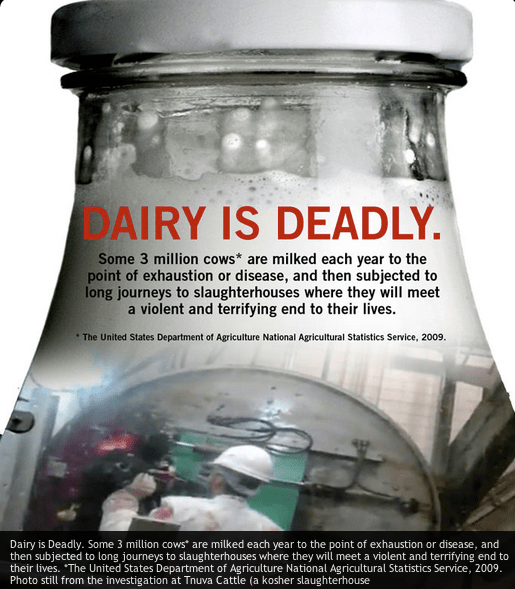
Following yesterday’s discussion of whether “humane” meat, dairy and eggs are possible, Free From Harm sent me (and everyone else on their mailing list) a slideshow on the dairy industry. Granted, this focuses on factory-farm dairies. But some things are inevitable in the dairy industry, whether the cows are factory-farmed or family-farmed in the most humane way possible (like the slaughter of male calves).
Anyhow, here is the slideshow, which only helps get me past my desire for Half And Half in my coffee.
“Surely,” they ask, hopefully, “if I buy organic, humanely raised or free-range, that’s all good, isn’t it?”
Well, actually, no. You are just kidding yourself, I am obliged to tell them, and the animals you are trying not to hurt would tell you if they could that your valiant effort is not enough. I’m not just saying that because I object in toto to the willful consumption of meat, milk and eggs. I’m saying it because labels lie.
First, there’s no getting around the fact that, no matter whether the hen was fed pesticides or not, or whether she was given another 2 inches of space or not, she will still come to a painful and terrifying end. And her death will pretty much be a blessing, considering how distressing her daily life was before meeting the man with the knife. The labels will not mention any of that because they are a big fat fraud, as evidenced by yet another exposé that hit the news last week, this one courtesy of PETA Germany. This latest case was about “bio” foods, labeled as coming from humanely raised, “free range” chickens and revealed the hell that can lurk behind the shell.
Actually, meat consumption is destroying the planet, and so no meat, even humanely farmed meat, can truly be considered “ok.” Sorry, America (and the rest of the world that wants to eat–and die–like America).
But I completely agree with Newkirk that the labels used on our foods are a scam to try and fool us into thinking an animal has been raised on a bucolic small farm, with lots of fresh air, pasture to roam, and love. The labels have been completely corrupted by Big Food, and its army of lobbyists waving fistfuls of cash. So anyone who thinks “cage free” or “free range” or “organic” means you are dealing with a happy, humanely treated animal, better wake up. Those are just labels which indicate a slightly different form of factory farm torture.
That, however, doesn’t mean that all labels are misleading or unreliable. I think about this question of “humane” farming quite a lot, because while I am a vegetarian I am not a vegan. I could almost get there, but I can’t stand to drink coffee without a splash of Half And Half (I’ve tried every soy and almond milk alternative, believe me, and it is horrible in comparison). And I eat eggs for protein. (I also eat cheese and butter, but I could give those up easily).
So I have looked into labels and whether there are any that can be trusted to help me find eggs and dairy from humanely treated animals. After researching the question (and discovering that there are multiple contradictory and confusing standards) I have come to rely on one that I trust: Certified Humane (argh, website appears to be down for the moment). The eggs that I eat, for example, are “Certified Humane,” which basically means that the chicken lives like you would expect a chicken on a mythical fram to live–free of preventive antibiotics, and with acces sto plenty of light, chicken entertainment, and pasture. Yes, they cost a little more, but $3.50 a dozen seems a reasonable price for what in my house we call “non-torture” eggs.
Finding “non-torture” milk is a little harder. Happily, “Certified Humane” has just produced an app that you can use to find where you can buy Certified Humane products near you. You will see that its main limitation is that there just aren’t that many products, or choices (Whole Foods looms large). But this is a process, and we are dealing with a food production system, as Newkirk points out, in which 95 percent of the products sold to Americans come from tortured animals. Certified Humane is slowly but surely adding farms and their products to the Certified Humane label, but farmers and producers need to know there is a market out there for Certified Humane food. So it never hurts to let your grocery store manager know that you would like to see “non-torture” products on the shelves, though feel free to use other language.
One last note about this dilemma. I actually quizzed some PETA employees on this last summer. I wanted to know whether there was a moral problem eating an egg from a happy chicken that wasn’t on hormones or antibiotics, and spent its days running around like normal chickens do. At first they explained that as vegans, and as PETA employees, they don’t believe that humans should be exploiting animals, or using animals for human purposes. Fine, I said, but pressed them to identify a moral problem with a “happy” egg. There really isn’t one, they conceded.
Reassured, I moved on to milk, and asked about the moral questions around consuming milk or cheese from a dairy cow that was treated to a normal life in a pasture and was producing milk as a result of pregnancy, and not as a result of artificial hormones. The cow gets pregnant, gives birth to a calf, and the milk flows. “Ah,” they responded. “That’s fine when the calf is a female and can grow up to be a dairy cow. But what do you think they do with the male calves?”
Damn, I hadn’t thought about that. Of course, they end up being sold for slaughter. So even if the cows are treated humanely, and the milk production is natural, the process doesn’t work out so well, or humanely, for the male calves.
That sticks with me as I splash Half And Half into my coffee every morning. And I’ll keep trying to develop a taste for black coffee (or, more likely, I’ll make a switch to black and green tea). But for anyone who is not (yet) vegan, the least you (and I) can do is take the trouble, and pay the extra costs required, to find products from humanely treated animals. Laziness or saving a few cents on a gallon of milk or a dozen eggs can never justify the extreme cruelty of industrial farming.
At least these cattle from North Woods ranch look like they are enjoying life.
In the end–for health, environmental, and moral reasons–I think Newkirk is entirely correct that humanity should move toward learning to feed itself without exploiting animals. But that is a huge leap, and it is probably counterproductive to tell people that there are no humane alternatives to veganism when there are.
They aren’t perfectly “humane,” as I discovered, which is why I’ll keep trying to make that final leap to veganism. But anyone who adopts a Certified Humane Standard for whatever animal products they happen to eat will be doing a lot to relieve some of the simply incomprehensible suffering that human food production (and consumption) inflicts on animals.
Sorry to start your week off with such a stark, brutal look at pig farming in America. But it is what it is, and anyone who raves about bacon and pork should at least have the courage to know what it takes to put those things on their plate.
The finding is just one in a series of recent discoveries from the nascent study of pig cognition. Other researchers have found that pigs are brilliant at remembering where food stores are cached and how big each stash is relative to the rest. They’ve shown that Pig A can almost instantly learn to follow Pig B when the second pig shows signs of knowing where good food is stored, and that Pig B will try to deceive the pursuing pig and throw it off the trail so that Pig B can hog its food in peace.
They’ve found that pigs are among the quickest of animals to learn a new routine, and pigs can do a circus’s worth of tricks: jump hoops, bow and stand, spin and make wordlike sounds on command, roll out rugs, herd sheep, close and open cages, play videogames with joysticks, and more. For better or worse, pigs are also slow to forget. “They can learn something on the first try, but then it’s difficult for them to unlearn it,” said Suzanne Held of the University of Bristol. “They may get scared once and then have trouble getting over it.”
Researchers have also found that no matter what new detail they unearth about pig acumen, the public reaction is the same. “People say, ‘Oh yes, pigs really are rather clever, aren’t they?’ ” said Richard W. Byrne, a professor of evolutionary psychology at the University of St. Andrews. “I would recommend that somebody study sheep or goats rather than pigs, so that people would be suitably impressed to find out your animal is clever.” His feigned frustration notwithstanding, he added, “if you want to understand the evolution of intelligence and social behaviors, it’s important to work on animals like pigs that are not at all closely related to us” but rather are cousins of whales and hippos.
And here is how we treat them. How can this in any way be morally acceptable?
I know it must seem obvious already, but it’s hard to resist posting research that details the impact of red meat consumption on mortality. I always tell my kids that beef is killing the planet. But no one seems to care that much. What people do respond to is research which shows that beef is killing them, so here’s a study report that I’ve had sitting around since March:
Eating red meat is associated with a sharply increased risk of death from cancer and heart disease, according to a new study, and the more of it you eat, the greater the risk.
The analysis, published online Monday in Archives of Internal Medicine, used data from two studies that involved 121,342 men and women who filled out questionnaires about health and diet from 1980 through 2006. There were 23,926 deaths in the group, including 5,910 from cardiovascular disease and 9,464 from cancer.
People who ate more red meat were less physically active and more likely to smoke and had a higher body mass index, researchers found. Still, after controlling for those and other variables, they found that each daily increase of three ounces of red meat was associated with a 12 percent greater risk of dying over all, including a 16 percent greater risk of cardiovascular death and a 10 percent greater risk of cancer death.
The increased risks linked to processed meat, like bacon, were even greater: 20 percent over all, 21 percent for cardiovascular disease and 16 percent for cancer.
Of course, you can earn all about the ways in which red meat will shorten your life in the excellent documentary “Forks Over Knives.”
And you can watch CNN’s Sanjay Gupta (with an assist from Bill Clinton) make the case here.
It’s a good reminder that even labels like “free-range” do not at all mean the animal you are intending to eat has been running around in a grassy field.
The reason the planet and all of its inhabitants are in such a desperate state is because our species has continued to exploit everyone and everything without compassion. Killing other animals reinforces that insensitivity and the very attitudes that have led to global destruction. We are currently facing the sixth mass extinction event, human overpopulation and starvation, and devastating planetary destruction from rampant ecological exploitation and climate change. The same insensitivity that leads to lack of concern for Bill and Lou as individuals has led us to the brink of global devastation. They are intimately related and anyone who claims otherwise is being disingenuous. Every individual currently in factory farms is Bill and Lou and factory farms are not only engines of unspeakable suffering for the luxury wants of our species but are contributing substantially to global warming.
Check out the Kimmela Center’s Facebook page here. And blog here.
Amidst groans about being more stuffed than the bird itself, Americans will toss a whopping $282 million worth of uneaten turkey into the trash this Thanksgiving, contributing to the $165 billion in uneaten food Americans waste every year. Along with trashing uneaten turkey, they’ll be wasting the resources necessary for its production — meaning 105 billion gallons of water (enough to supply New York City for over 100 days) and greenhouse gas emissions equivalent to 800,000 car trips from New York to San Francisco. That’s enough turkey to provide each American household that is food insecure with more than 11 additional servings (17.9 million American households suffer from food insecurity).
Nationwide, consumers will purchase around 736 million pounds of turkey this Thanksgiving, of which about 581 million pounds will be actual meat. The USDA reports that 35 percent of perfectly good turkey meat in the U.S. does not get eaten after it is purchased by consumers (and that’s not including bones). This compares with only 15 percent for chicken. Why the disparity? “Possibly because turkey is more often eaten during holidays when consumers may tend to discard relatively more uneaten food than on other days,” the USDA writes.
And unless we take action to prove the USDA wrong, we’ll be throwing away about 204 million pounds of that meat and about 1 million tons of CO2 with it. Per pound, the resources needed to produce that turkey are equivalent to driving your car 11 miles and taking a 130-minute shower (at four gallons/minute).* And that’s to say nothing of the vast amounts of antibiotics used to produce turkey meat, leading to antibiotic resistance, which you can read more about here.
In October of 2012, an MFA investigator documented a pattern of shocking abuse and neglect at numerous Butterball turkey operations in North Carolina, including:
workers kicking and stomping on birds, dragging them by their fragile wings and necks, and maliciously throwing turkeys onto the ground or on top of other birds;
birds suffering from serious untreated illnesses and injuries, including open sores, infections, and broken bones; and
workers grabbing birds by their wings or necks and violently slamming them into tiny transport crates with no regard for their welfare.
Worse, these are exactly the same sorts of things that Mercy For Animals found at a Butterball plant last year (an investigation which led to criminal animal abuse charges against plant workers). So I guess humanely producing a Thanksgiving turkey is not really in our culture despite how much we revere Thanksgiving and turkeys.
Here’s what Mercy For Animals says about what it did with its footage, and why the practices shown are so cruel:
Following the investigation, MFA immediately went to law enforcement with extensive video footage and a detailed legal complaint outlining the culture of cruelty at Butterball. Law enforcement is investigating.
Unfortunately, the lives of turkeys in Butterball’s factory farms are short, brutal, and filled with fear, violence, and constant suffering. While wild turkeys are sleek, agile, and able to fly, Butterball’s turkeys have been selectively bred to grow so large, so quickly, that many of them suffer from painful bone defects, hip joint lesions, crippling foot and leg deformities, and fatal heart attacks.
Even though domestic turkeys have been genetically manipulated for enormous growth, these birds still retain their gentle, inquisitive, and social natures. Oregon State University poultry scientist Dr. Tom Savage says that turkeys are “smart animals with personality and character, and keen awareness of their surroundings.”
In fact, animal behaviorists, veterinarians, and scientists agree that turkeys are sensitive and intelligent animals with their own unique personalities, much like the dogs and cats we all know and love.
As the world’s largest producer of turkey meat, Butterball is responsible for 20 percent of the 252 million turkeys raised and killed for food each year in the United States, and 30 percent of the 46 million turkeys who are killed for Thanksgiving.
Even if you want to eat a cruelty-free turkey for Thanksgiving, there are only a handful of farms left in America that raise turkeys which live normal turkey lives and haven’t been genetically modified in painful ways.
Anyhow, for all these reasons, we’re going for a turkey-free Thanksgiving this year, even though there will be some meat-eaters around our table (one of the perks of doing the cooking!). And if you want to give it a shot, here’s a bunch of good recipe ideas.
You can’t know too much about food production, and this film looks as if it goes deep into the the milk business and family farming.
Here’s a description:
A group of Maine dairy farmers—dropped by their national milk company—launch their own milk company in a bid to save their farms. Owned by the farmers and committed to paying a sustainable price for their milk, the company offers hope for the future of small farming. But faced with slow sales and mounting bills, can the farmers hang together long enough for the gamble to pay off?
BETTING THE FARM is a verité documentary that follows three farmers—Aaron Bell, Vaughn Chase, and Richard Lary—and their families through the tumultuous first two years of MOO Milk. With intimate access to their triumphs and disappointments, the film gives audiences a rare glimpse at the real lives of American farmers at a crossroads.
It doesn’t appear to get into the issues of whether we should even be drinking milk or animal welfare. But you’ll learn more about milk production than you know now, and that can only inform the welfare issues.



 So I have looked into labels and whether there are any that can be trusted to help me find eggs and dairy from humanely treated animals. After researching the question (and discovering that there are
  One last note about this dilemma. I actually quizzed some PETA employees on this last summer. I wanted to know whether there was a moral problem eating an egg from a happy chicken that wasn’t on hormones or antibiotics, and spent its days running around like normal chickens do. At first they explained that as vegans, and as PETA employees, they don’t believe that humans should be exploiting animals, or using animals for human purposes. Fine, I said, but pressed them to identify a moral problem with a “happy” egg. There really isn’t one, they conceded.
 Sorry to start your week off with such a stark, brutal look at pig farming in America. But it is what it is, and anyone who raves about bacon and pork should at least have the courage to know what it takes to put those things on their plate.
 I know it must seem obvious already, but it’s hard to resist posting research that details the impact of red meat consumption on mortality. I always tell my kids that beef is killing the planet. But no one seems to care that much. What people do respond to is research which shows that beef is killing them, so
 This is very well said. From Dr. Lori Marino, of the
  We’re not having a turkey (or any meat) at our Thanksgiving table this year. And that was a pretty non-controversial decision in my family.
 Is it even possible to take an undercover camera into a meat production facility and NOT find abuse? Apparently not.
 You can’t know too much about food production, and
  The Earthist Chronicles