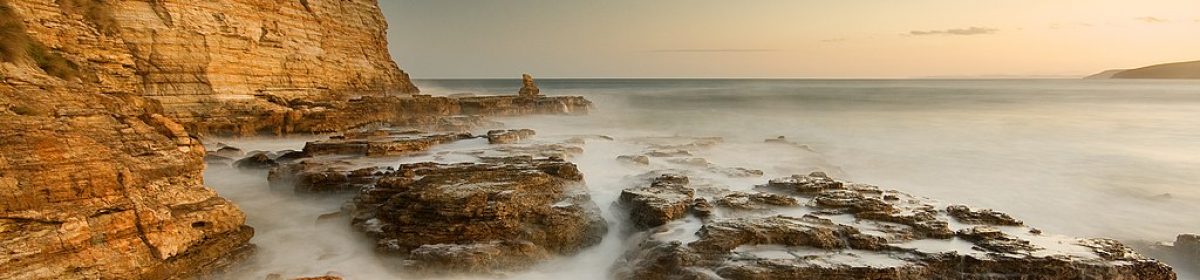
I’m Outa Here…: Off to Glandore, Ireland until August 20, so TWC is hereby on sabbatical. What’s in Glandore? A choice of Guinness or Murphy’s in every pub, sweet sailing, great paddling, hilly biking, the odd rain shower, and emerald fields that stretch to the horizon. My ass is sure to get wet…

Glandore Harbor

West Cork
Category: Uncategorized
SailDog–I Mean Rocket–Update: No one ever said building an otherworldy multihull to sail through the 50-knot barrier would be easy. And Paul Larson and his SailRocket team are finding that out. The thing just does not want to get up on a plane and sail fast, particularly after Larson modified the sail to make it flatter and less powerful. In the latest outing, the experimental TinkerToy was plowing a hole in the water, while windsurfers were ripping it up on a plane all around them:
“The rig was noticeably less powerful than the week before but then this is to be expected as we are targeting stronger conditions. We figured that the reason that we were performing beyond expectations last week was because the sail was so full and had little leech tension. Basically it was a good light wind setup. The new rig seemed to lose flow very quickly if you over sheeted. The boat is very strange to sail as it just has absolutely no heeling reaction to powering up which is unlike any boat I have ever sailed before. You just don’t feel anything load up. The only thing that happens is that the boat accelerates. All the sailboards were sailing around us with their big rigs all loose and twisted on their big wide boards. every time there was a little gust they would pump up onto the plane and go tearing off. A luxury we didn’t have but then that is not what we are here for,
A good friend had lent us a GPS to read speed off but today the figures were just nudging over ten knots at best. We decided to make the best of the day and do some other things… like giving Helena her first sail seeing as she is the backup driver. It is an imposing boat to sit in for the first time. I explained to her how you can sail the boat down the course just steering by the mainsheet alone. Sheet in and she bares away and sheet out to head up. Combine this with the rudder and she is pretty maneuverable. One thing we noticed as Helena headed down the outside course was that when she got a gust that the back lifted before the front once again. It shouldn’t still be doing this.
As we towed back up the course the wind increased with a large high-level cloud bank that was coming in. We got up to 15 knots of wind as we set up for the next run and thought that we might be in for some speed but alas the boat just didn’t lift out and we were left with only 15 knots as a top speed as I hunted around looking for a way to break free from the waters drag. A sailboard went tearing by whooping away… as I would if I was on the board. Something was not right. YELLOW PAGES ENDEAVOUR would have been doing 35 knots in these conditions and we were still mushing along. We headed for the shore.
Basically there is an equation that SAILROCKET needs to effectively hook into and it is this- by going fast we make wind, which makes power, which makes more wind which makes more power etc. The boat is designed to feed off this like no other boat but it seems that we can’t quite get the equation started. Of course a stronger wind would help and slightly depowering the rig wouldn’t help but it still felt lacking. We agreed that a much bigger forward planing surface was needed. Bigger shoes. This would help the nose of SAILROCKET lift out sooner which will greatly reduce the drag as well as serve to help the transom lift also.
We noticed how slowly water drained out of the centreboard cavity when we raised the boat out of the water. The venturi effect was supposed to suck this large area dry when SAILROCKET started moving but the seal seemed to be too effective which left us thinking that we may be carrying as much as twenty-five kilos of water around with us up front. When the new planing surface is built we will remedy this by making a complete watertight seal around the centre-board so it should be a double bonus.”
So, back to the drawing board, or the workshop, to build a new front end. Just to keep your hopes alive, here’s a video (from the Daily Sail–the best online sailing magazine in the game) of SailRocket’s first test sail, where she’s putting up a lot of spray but at least looks like she could eventually be fast…

Slow Boat: “Hmm, I wonder if this thing would make a good front yard planter…”
Shark Stories I–“I do…Glub-Glub”: There are lots of weird places to get married. But donning dive gear, and saying your vows in a tank with fourteen sharks has to be one of the more creative. So give credit to Daniela Consolaro, 31, and Maurizio Andreosi, 40, the Italian couple who did just that.
“Fourteen sharks swam around looking bored as the couple — his nickname is Bull Shark and hers is Nurse Shark — responded “I do” to Mayor Pietro Pazzaglini, communicating via a phone link.”
They don’t get a perfect Wetass score, however. The two newlyweds–who said they were trying to draw attention to the destructive practice of shark finning (where fisherman catch sharks and cut their fins off to make soup and other pharmaceuticals for markets across Aisa)–were in a cage, protected from the toothy audience, who had obviously already gorged on the reception canapes and weren’t hungry in any case…

Shark Tank Nuptials: “Hey, guys. Are you going to comsummate this thing underwater, too? Because if so, I gotta ask to get moved to another tank…”
(Photo: Stefano Rellandini/Reuters)
Shark Stories II–“Open Water”: This movie is setting up to be the Blair Witch Project of the aquatic world. It’s about a scuba-diving couple who were left behind by their dive boat, and it was made on a shoestring budget by a semi-amateur couple who love to dive. The New York Times has two great stories about this movie. The first recounts the six years it took Chris Kentis and Laura Lau to make the movie (which cost $130,000 and got picked up at Sundance for $2.5 million). From the beginning it wasn’t a normal project:
“Mr. Kentis and Ms. Lau cautioned casting agents that some nudity would be required for the pre-dive scenes and that, once in the water, actors would have to get super-close to some very big sharks — no mechanical or computer-generated jaws in this movie.”
And they ended up with a lead actress who was scared to death of sharks (but didn’t tell anyone until it was mostly over), and a lead actor who blew out his knee halfway through the project.
The second NYT piece probes the mystery of the real-life story which Open Water is based on:
“The real-life couple, Thomas and Eileen Lonergan, traveled to Australia after three years as Peace Corps teachers on the islands of Fiji and Tuvalu. Thomas was 33, Eileen 28; both were experienced divers. Australia was the first stop of a planned round-the-world trip before returning home to Louisiana.
Early on Jan. 25, 1998, the Lonergans rode a shuttle bus to a marina in Port Douglas, Queensland, where a company called Outer Edge Dive carried them and 24 others to the rim of the Great Barrier Reef, 40 miles offshore. The day’s last dive was at a coral formation called “Fish City” because of its abundant marine life. While others followed a dive master, the Lonergans toured the site on their own.
At the end of the 40-minute dive, the crew was supposed to log each person’s dive and count heads before the boat left. But several crew members were inexperienced and uncertain of their responsibilities. Amid this confusion, the Lonergans’ dives weren’t recorded and the head count was botched. The captain, believing he had all passengers aboard, motored back to Port Douglas.”
Oops. The Lonergans were never seen again, and assumed to be victims of shark attack. But questions quickly arose as to whether they had truly been the victims of an accident, or whether they had perpetrated a bizarre suicide pact. None of their equipment, which washed up in various places, showed any sign of shark bite. Thomas Lonergan’s diary, left in his hotel room, contained references to being ready to die. And they had deliberately separated from their dive group and stayed down beyond the agreed dive time. In the end, authorities concluded that it was not a suicide pact, or an attempt to disappear together. But the tale is so bizarre that Kentis and Lau had to tone it down for fear that no one in a theater would believe the true story. The last trace of the Lonergan’s turned up six months after their disappearance:
“In a coastal mangrove swamp, fishermen found a dive slate, designed for underwater writing. On it was a message from the Lonergans saying they’d been abandoned on the reef by Outer Edge. “Please help us,” it said. “Find us soon before we die.” They also scribbled the time and date: 8 a.m., Jan. 26, the morning after they had been left behind.”
The movie opens Friday. Wonder whether the scuba dive industry is worried whether it will have a Jaws-like impact on dive tours…

Filming “Open Water”: “Well, I’m having no trouble acting scared…”
(Photo: Lions Gate Films)
Have A Wetass Weekend (And Stay Away From Grates)…

The Mountain Of Mountains: Explorer’s Web has been running a fascinating series on K2, and how it is slowly changing. It is far more remote than Everest, and more difficult to climb (just over 200 summits, as opposed to more than 2000 on Everest), so it has long been the preserve of serious–and high level–climbers, as opposed to the tour groups who trek up Everest. The latest installment looks at the astonishing fact that on K2 about 65 percent of the summits are achieved without supplemental oxygen (only 7 percent of Everest summits are au naturel). This is one indication of the fact that K2 is a climbing purist’s climb. But there is a massive price. Of the 52 deaths on K2, 22 have occured on the way down. And every single one the 22 descenders who died was climbing without oxygen:
“K2’s summit day is very long. Yesterday’s summits came late in the afternoon after a 14 hr push. By the time climbers are headed down, they are exhausted. Add in descending in the dark and a possible turn of weather to the worse, you have a recipe for disaster – no wonder nearly half the death on K2 are during descent.”
So if you want risk, and you want displays of courage, look not to the world’s tallest mountain, look to K2. The rest of the ExWeb series looks at the debates over fixed ropes on K2, the appearance of guided expeditions on a mountain that has long been the preserve of professionals because it is so dangerous, the problems of weather forecasting, the growing crowds, and the lack of good climbing sherpas in the K2 region. If I was ever to get off my ass to try and climb a big mountain, K2 would be the one. No question…

K2 Tent City: More like a tent village, for now…
(Photo: Explorer’s Web)
Mallory And Irvine Expedition Summary: Everest News, the group behind this year’s expedition on Everest to find the body of Sandy Irvine (George Mallory’s climbing partner on the day they died trying to summit), has posted a description of how they decided to try and locate Irvine’s body and the competition with the BBC that resulted. Here’s why they went:
“Back in 2002 and 2003 climbers kept talking to us about bodies they had seen over the years on Everest. After compiling these locations, we came down to three locations that seemed very interesting, two at which climbers have claimed to seen old dead bodies on Everest and the third location was interesting because of other clues. In the first case, it was hard not to conclude that one of our sources saw Sandy Irvine. In the other case a climber saw “something.” Therefore, in Spring of 2003, we asked some expeditions/climbers if they would be interested in having a “look” at these locations. Surprisingly, there was little real interest. We noticed that some people just did not wish to get involved in this controversial undertaking…During 2003, we finally decided that having the other expeditions do the job wasn’t going to work; we decided to do the job ourselves.”
It’s a fascinating historical project, and hopefully efforts will continue next year. This is still the greatest unresolved mountain climbing mystery…

Where’s Irvine?: Somewhere on this cold, lonely mountain…
(Photo: Everest News)
Annals of Adventure–The Atlantic 1000: “Iron Men In Plastic Boats.” That was the motto of the Worrell 1000, a 1000 mile pain-fest that had catamaran sailors in 20-foot boats racing from Florida to Virginia. They did it in stages, every day launching and then eventually sailing back through some big surf. Sunburn. Seasickness. Blisters. Peeing in wetsuits. Broken boats. The Worrell had it all. But the Worrell is no more, and this summer it was replaced by the Atlantic 1000. What’s it like? Well, two of the sailors, Duncan Ross (RSA) and Roberto Pandiani (BRA)–TWC featured them last year when they sailed a Hobie Cat to Antarctica–have posted an inside account at Sailing Anarchy. Ross and Pandiani finished second, but it wasn’t easy:
“The breeze goes from 10 knots to 25 knot in a few minutes. The sea is still flat and we take off on a huge double trapeze reach – probably the fastest I have ever been on a small catamaran. Roberto and I are both on trapeze and the boat is just flying. We start to drive in underneath Team Oz. I am nervous as there are shallows closer to the coast. I shudder to think what would happen to us (and the boat) if we were to hit a sand bank at 25 knots. The first few miles are adrenalin pumped – after that – all we want to do is finish. My hands are killing me. Sometimes the waves wash my feet off the boat and I am upside down with my head dragging in the water. We are on the absolute limit – it’s all or nothing. Any mistake and we would be upside down and the race would be over for us.”
Harken, one of the race sponsors, also has some good coverage and pictures. And a video, which is cool despite the repetetive porno music soundtrack. Whatever the name, Worrell 1000 or Atlantic 1000, this is one of the great Wetass races…

“Hey man, you’re not puking already, are you…?”
(Photo: Edge Ventures)
Feeding Time!: Last May, authorities on Oahu towed a dead sperm whale carcass 35 miles out to sea. Professional photographer Ken Howard went in search of the rotting corpse:
“We go out and Jimmy finds it immediately, with a bunch of tiger sharks feeding on it. Naturally, after a few surface shots we go in and snorkel with them.
Jimmy tied the boat up on one of the exposed ribs of the sperm whale carcass. The tiger sharks did not seem to pose a threat, as they had been gorging on the carcass for some time.”
I can just imagine Howard in the water, telling himself, “They’re not hungry anymore…They’re not hungry anymore.” Well, apparently he was right, because he lived to tell the tale and got some great shots. Underwater Times has the full story, as well as a great gallery. Here are just a few of the resulting pictures:

“Ummm, rotting whale meat…”

“Hey Barbara. There’s a guy with a snorkel over here. Would he be good to eat…?

“So what if he looks scrawny. I’m going to check him out. Maybe he’ll make a good toothpick…”
“Mekong” Mick’s Wildass Adventure–Chapter 8: On Tuesday we left the Australian adventurer clinging to a boulder in the river, half dead. Here’s the last installment of Mick’s incredible tale…
I have never been so beat in my life. I laid there in the freezing water for several minutes before noticing I was dizzy and shaking then started to worry that I might pass out in the water. I stood up and staggered on slippery river rocks to shore falling over twice. I could see some Tibetan houses just upstream and made for them. As I walked I could hear that my breaths were short and gasping and my lungs felt like they were getting burnt with each breath I was no longer shaking. I had hypothermia. I was so tired that for a moment I considered crawling into the space blanked I carried along with a sat ph and first aid kit in my PFD but sense got the better of me and I pushed on towards the mud walled homes.
I made my way up to a big old Tibetan house and knocked heavily at the door. No response. I wondered if I had the energy to make it to the next house when a sweet old Tibetan granny opened the door. As one would expect, she was a little shocked to see a swaying foreigner with hypothermia leaning against the door frame but within moments in true Tibetan style she had me warming by a fire sipping yak butter tea. It was the best cuppa I ever had. Dry clothes and blankets appeared, I was lucky to be so close to help. Such wonderful people.
I really did not expect to find my kayak and equipment again as the nature of such gorges is that there are few natural eddies and such for floating boats to get stuck in and the flow rate is at around 6 kilometers an hour so by the next day it could be anywhere within the next 100km and many stretches had no roads alongside. We had a replacement set of basically everything in case this happened but both my cameras were in the boat and I felt very disappointed to lose photos of such an incredible area that had never been visited by outsiders before.
I hailed a passing car the next day and headed for Zongdjian to meet up with our new director Brian Eustis and my fiancé, Yutah. I anxiously scanned the river below at every opportunity as we drove along the bumpy dirt road yet it was only visible about 30% of the time and with each passing kilometer the chances of finding the boat diminished. More than 40 kilometers downstream from where I took the swim I spotted a tiny red dot on some rocks above a set of rapids some 200 meters below us. I stopped the car and to my utter delight identified the boat. A stiff 2 hr hike down and back up a steep avalanche ensued and with the assistance of a Tibetan passenger I retrieved the boat. I was surprised to see that nearly everything was still inside although totally waterlogged. Out of 5 rolls of film and 60 digital photos shot, only one roll of film was not destroyed by the water. Fortunately it contained several key land marks in the heart of the gorges so I could at least prove that I have paddled the section (There is no other way in or out to get photos) but it seems that the Mekong wanted to keep some of the most amazing sites in its most turbulent inner sanctums a secret from the outside world for a little while longer.
Navigating the Mekong gorges of the Kham has been without doubt one of the most challenging, dangerous and rewarding experiences of my life. I have never experienced another environment more hostile or unforgiving nor more magnificent and beautiful. One of the last great wilderness areas in China lies between Chamdo and Northern Yunnan and it has been my great privilege to be the first person to experience it. With expressways and sealed roads being cut along much of the Mekong’s course north and south of this section, one hopes that the Authorities might see the value in leaving just a few islands of unhindered natural beauty to the earth and out of the relentlessly grinding wheels of “development’. Until now the extremely inaccessible nature of the gorges has provided effective protection against most human folly yet this could all change with just a few simple road network planning decisions. If there is one thing I learnt while traveling through Kham Tibet it is that there is no gorge or environment through which man cannot cut a road and his ambitions.
Thus ends the story of Mekong Mick’s battle with the Mekong Gorges. This was probably the hardest, most dangerous part of his First Descent expedition. But we’ll keep checking in on Mick, as he wends his way slowly to the South China Sea…

Mekong Mick, Self-Portrait: “Heh-heh. I made it…”
(Photo: Courtesy Lynley O’Shea)
 The Earthist Chronicles