A Bogus Beluga Rationale

Nicely detailed piece on Wired.com about Georgia Aquarium’s application (on its own behalf, but also fronting for SeaWorld, Shedd, Mystic) to import 18 wild-caught beluga whales from Russia.

Here’s the set-up:

Controversy is brewing over the Georgia Aquarium’s plan to import 18 beluga whales captured off the coast of Russia. If the U.S. government approves the plan, it will mark the first time in nearly two decades that wild-caught cetaceans have been imported into an aquarium in the United States.

According to the aquarium, the whales are needed for research and education. According to animal welfare advocates, that doesn’t justify the trauma inflicted on intelligent, emotional creatures that suffer in captivity.

“If we let them in, it means we’re going to have this issue all the time. It will open up the floodgates,” said Lori Marino, a neurobiologist at Emory University and prominent cetacean rights activist.

Georgia Aquarium trots out the shopworn argument that the belugas will be ambassadors for their species, which is the core rationale marine parks use to justify keeping marine mammals in captivity.

But it’s an analogy that has some problems, I think. Most important, ambassadors are not normally forced into service. My father was an ambassador and he was sent abroad because the United States wanted a representative in the countries he served. In contrast, ambassador to the human world is not a choice any belugas are making. It is a choice humans (profit-seeking humans, I might add) are making FOR the belugas.

Russian Belugas

The Russian Belugas in Ambassador School

Now, you could say belugas need ambassadors because humans are trashing the oceans, and putting the future of wild beluga populations at risk. I think that Continue reading “A Bogus Beluga Rationale”

Was Nakai Bitten? Analysis From Ingrid Visser

Ingrid Visser of the Orca Reasearch Trust, has spent twenty years studying and observing orcas in the wild.

Ingrid Visser

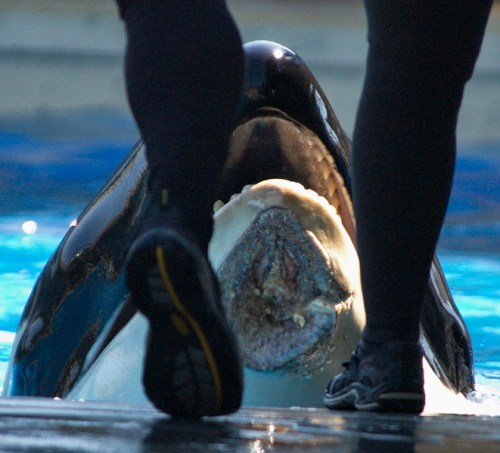
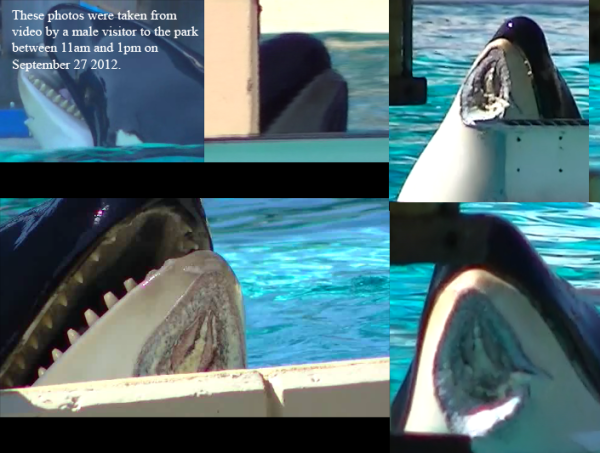
And she was responsible for taking this highly detailed picture of Nakai’s wound:

Nakai Wound

Perhaps the most important detail in this picture is the puncture marks which appear on the lower right margin of the wound, opening up the possibility that Nakai’s wound was caused by a bite from another orca, and not a collision with some part of the pool, as SeaWorld has suggested.

Now Visser has sent me a more detailed analysis of Nakai’s wound. Here it is:

The recent wound on the captive orca Nakai remains an enigma as to how it occurred.  When I first viewed (unreleased) photographs taken a week after the graphic injury, I was of the opinion that it was unlikely to have been inflicted by other orca, based on the fact that no orca teeth marks were clearly visible in the photos and the very ‘clean’ edges to the wound.

Regardless of the source of the wound, I didn’t buy the story from SeaWorld that Nakai had ‘come into contact with the pool’ (AP, Sept 28th 2012, press release), as to me such wording implied a light brush past, or perhaps at worst a bump into the side of the tank.  Clearly such a striking wound wasn’t from a light brush or even a ‘bump’. Continue reading “Was Nakai Bitten? Analysis From Ingrid Visser”

Was Nakai Bitten? Another Take

It may be that we never really know how Nakai injured his jaw (though we do know–and SeaWorld has confirmed with their euphemistic language about him having a “normal social interaction” with two other whales immediately prior to the injury–that a fight was involved). For what it is worth, I am told that even SeaWorld San Diego can’t determine exactly how the injury occurred, even though they have reviewed all the video they have of the show.

So we are left trying to pull a CSI-style forensic analysis on the injury photos, like this photo taken by Ingrid Visser of the Orca Research Trust:

(c) Ingrid Visser

As I noted yesterday, Visser said of this photo: “Of note is that in [this photo], at the bottom right of the wound, near the trainers shoe in the photo, there are four puncture marks – and the spacing matches that for orca teeth – as you can see from Nakai’s teeth in this same photo.”

I don’t think this is definitive, but because I posted it a number of readers complained that I was drawing a conclusion without sufficient evidence. I agree that there is no conclusive proof one way or another how the injury occurred, and remain agnostic on the question pending any additional information or evidence (if it ever emerges).

But to balance the scales I thought I would post this counter-analysis of the photo (as well as some other photo evidence I shared but have not posted) from someone who knows a lot about orcas and who is reliably insightful about orca matters:

“There is no way this is a bite. An orca’s jaws just aren’t precise enough to make such a clean cut in such a specific area without leaving trails (rake marks Continue reading “Was Nakai Bitten? Another Take”

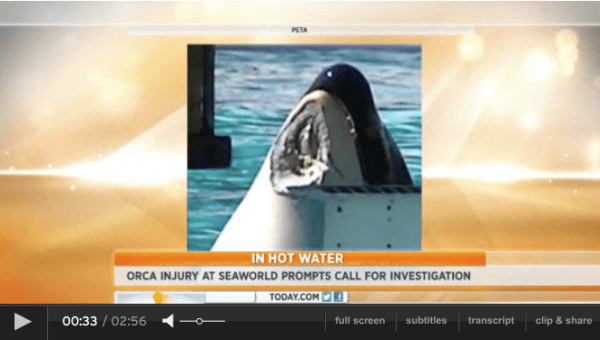
Nakai Makes The Today Show Too

Watch it here.

Just to be clear: SeaWorld’s statement that Nakai was engaged in “normal social behavior” with two other whales immediately prior to the injury is SeaWorld’s way of saying Nakai was in a fight.

Nakai Featured On Good Morning America

I doubt that it was ever one of his life ambitions, and certainly not for the reason he is being featured. But at least tens of millions of Americans just got a glimpse of what can happen at a marine park. Since one of the biggest limitations of WordPress is that you can’t embed many types of video, I can’t embed the vid here (advantage Tumblr!).

But you can watch the ABC segment here.

Nakai Photos and Backstory

Over the weekend I learned a little bit more about the incident that led to Nakai’s injury, and Ingrid Visser of the Orca Research Trust visited SeaWorld in San Diego and took some more pictures of Nakai’s injury. Here is the most detailed photo she took (more photos after the jump):

(c) Ingrid Visser

Regarding the question of whether the injury might come from a bite from another orca, Visser writes: “Of note is that in [this photo], at the bottom right of the wound, near the trainers shoe in the photo, there are four puncture marks – and the spacing matches that for orca teeth – as you can see from Nakai’s teeth in this same photo.”

And here is some additional detail on what happened that night when Nakai was injured. As a number of people have noted, the injury occurred after Sea World San Diego closed to the general public for the evening. Sometimes SeaWorld puts on special shows for corporate groups, and the evening show on the 29th (oope, typo) 20th was such a show.

During the show Nakai, Keet and Ike were all at stage when all three killer whales suddenly took off without warning and and started fighting with one another. SeaWorld’s review of the tapes could not identify an instigator or an aggressor. As I wrote last week, Nakai split into the back pool. Ike and Keet, however, returned to the stage and control, so the trainers continued the show. When trainers finally called Nakai over later that evening for the final feeding and saw that he was injured they were shocked be the severity of the wound. In fact, it is about as bad a wound as most trainers have ever seen. In response, SeaWorld San Diego will henceforth adopt the practice of immediately checking any killer whales involved in similar, high-intensity, melees to try and make sure that injuries are identified right away.

(c) Ingrid Visser

Apart from the death of Kandu V at SeaWorld San Diego in 1989, the only injury many trainers can remember that was even close in severity to Nakai’s was a 1990s injury to Splash, who lost part of his jaw when he was thrown by Takara against a gate while they were messing around. The gate had a chain and Continue reading “Nakai Photos and Backstory”

Nakai’s Injury: Photographs

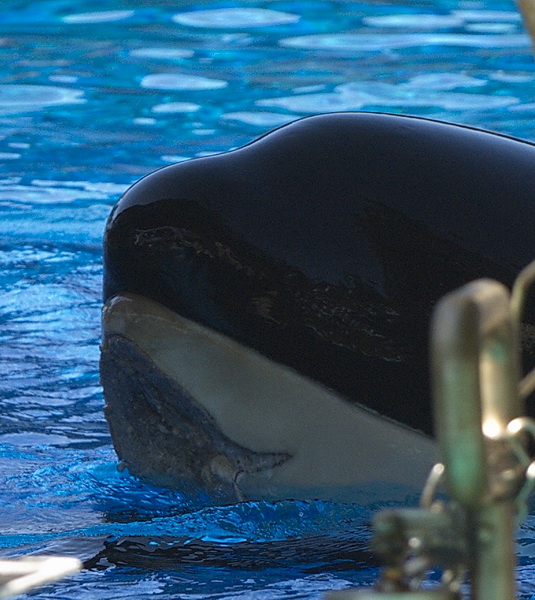
So here is what Nakai’s injury looks like:

As you can see it is very deep and exposes both underlying tissue and bone.

SeaWorld finally released a statement about the injury:

A killer whale at Sea World was injured while swimming with two other whales during a night performance last week, park officials said Thursday.

The injury to Nakai, an 11-year-old whale, is believed to have occurred when he came into contact with a portion of the pool on Sept. 20, said Sea World spokesman Dave Koontz.

The whale was treated by veterinarians. Park officials did not disclose details of the injury.

“Nakai is currently receiving antibiotics and the veterinarians are pleased with the healing progress of his wound,” Koontz said.

Nakai is “swimming comfortably and interacting with other killer whales” at the park, Koontz said.

It’s hard to look at that wound and be confident that all is as well as Koontz suggests. The big challenge with an injury like this is infection. And Nakai, as Koontz indicates, is being pumped full of antibiotics in the hopes of staving off any bacteria.

Knowing that the chunk of Nakai’s chin that was sheared off was retrieved from the bottom of the pool, I wondered whether there might be some way to try and reattach it, or graft it back on. I was told, by someone who knows, that it is very difficult to sew or staple killer whale parts back on due to the force of water constantly rushing past the skin. Apparently, something like that was tried (and failed) with Splash after he injured his jaw.

Instead, I was told, SeaWorld sometimes uses an interesting and surprising remedy to try and protect open wounds: honey, which is used as a topical wound treatment.

Sounds a little nutty, but give SeaWorld points for creativity. Honey, apparently, is a well-known traditional topical agent:

Honey is an ancient remedy for the treatment of infected wounds, which has recently been ‘rediscovered’ by the medical profession, particularly where conventional modern therapeutic agents are failing. There are now many published reports describing the effectiveness of honey in rapidly clearing infection from wounds, with no adverse effects to slow the healing process; there is also some evidence to suggest that honey may actively promote healing. In laboratory studies, it has been shown to have an antimicrobial action against a broad spectrum of bacteria and fungi. However, further research is needed to optimise the effective use of this agent in clinical practice.

I was told that honey is sometimes used on abrasions on Tilikum’s flukes.

So there you have it: antibiotics and honey. Hope that works. Judging from these photos, Nakai is going to need all the help he can get.

Nakai Injury Update

Okay, here’s what I have been told about Nakai’s injury at SeaWorld California.

First: it is a serious injury, with a dinner plate-sized chunk of his lower mandible sheared off, exposing underlying tissues, and bone. The most serious concern, I think, is the possibility of a bad, possibly even life-threatening, infection.

Second: It happened last week during a night show, seemingly during a major altercation involving Nakai, Keet, and Ike. It’s not clear if there was an aggressor or instigator, or if they all suddenly went after each other. In response to the altercation, Nakai split to the back pool. The onstage trainers, not realizing how badly injured he was, continued the show with the other whales. It was only when they called Nakai over later that night that they realized he was seriously hurt.

Third: SW is not sure how the injury happened. Right now they believe it was due to blunt force trauma, but I’m not sure how that squares with the description of the injury in which a sizable piece of flesh on Nakai’s lower jaw was, in essence, sliced off. The piece was big enough and intact enough for SeaWorld to retrieve it from the bottom of the pool.

After Ike was brought into SeaWorld California from Marineland in Ontario, many people felt–particularly with Kasatka due to produce a calf–that SeaWorld would be wise to move Nakai elsewhere. Obviously, in retrospect that looks like it would have been a smart move. But the fact is, controlling the social aggression between the killer whales in SeaWorld’s pools appears to be a very delicate and difficult challenge no matter what SeaWorld facility you are talking about, and what whales you are trying to mix together (see here, and here).

Nakai’s injury is just the latest reminder of that difficult fact.

If I get more details I will post them over on my Facebook page.

SeaWorld’s Waterwork Timeline

Since hearing that SeaWorld will start waterwork desensitization, I’ve been trying to puzzle out SeaWorld’s waterwork gameplan and timeline.

Here is what I have learned so far, and maybe all you smart people out there–regardless of your views on captivity–can help figure out the strategy.

Waterwork desense will officially begin today (Monday) in the med pool at SeaWorld California. I don’t know if the other parks also have whales and trainers lined up to begin desense work, and are also starting today, but it seems likely, given that the SeaWorld parks tend to work in synch with one another on major program changes like this.

Apparently, this commencement of waterwork desense (the first step toward getting trainers and orcas back on track toward full waterwork capability in the big show pools) follows a tour of the parks that SeaWorld’s chief zoological honcho, Brad Andrews, conducted earlier this year. Andrews and a SeaWorld management team met with the Shamu trainers, and showed them a video of the prototype fast-rising floor that has been installed in SeaWorld Florida’s G pool (the Dine With Shamu pool in which Dawn Brancheau was killed). The floor took just under a minute to surface, and Andrews told the trainers that similar rising floors would be installed in the show pools at all the SeaWorld parks, a major construction program that could take something like 12 to 18 months.

In the meantime, Andrews said, waterwork desense would start up in the med pools. Normally, waterwork desense (for an animal that has been removed from waterwork, say for being too aggressive) is initiated in the med pool with the floor raised up high. Trainers work with the animal through a series of behaviors, and with each successful evolution the floor is lowered a bit, until the waterwork is in fact taking place in the water. From there, the desense moves into one of the smaller back pools alongside the med pool. That way, if anything goes wrong nets can be used to try and corral the orca back into the med pool, where the floor can be raised. And if the back pool desense regimen is successful, and the orca consistently executes the behaviors asked, the desense program moves back into the show pool. This process can take a number of months.

With the current desense program, however, Andrews told Shamu trainers that no waterwork would be performed in a pool that does not have a fast-rising floor. So desense will be conducted in the med pool, and then jump directly to the show pools once the floors are installed there (though Florida, with the G pool floor, will presumably have the option of using G pool as a bridge to the show pool). That means that the desense work with the whales and trainers selected, will progress very slowly and carefully in the med pools for a year or more, so that the orcas and trainers are ready to move into the show pools when they have fast-rising floors.

The big question, assuming my information is solid, is what SeaWorld’s waterwork gameplan is. Unless SeaWorld successfully appeals the OSHA ruling (the next step would be to file an appeal with the US Circuit Court Of Appeals), Judge Welsch’s decision means that waterwork is effectively banned from performances at SeaWorld Florida (the park cited by OSHA following Brancheau’s death). If they are successful, then all of SeaWorld’s parks, having desensed selected orcas, will be in a position to resume waterwork.

If the appeal fails (or is not filed), then it gets more complicated. The OSHA ruling applies only to performance waterwork, so SeaWorld is in theory free to resume training waterwork in all its parks whenever it likes. OSHA could, however, conduct a follow-up inspection and try to get the ban on waterwork applied to training as well. That would, no doubt, be a similarly contentious and drawn-out legal process.

But training waterwork does not really get SeaWorld back into show waterwork, which presumably is the goal. So another possibility is that SeaWorld finishes installing the fast-rising floors, and whatever other safety measures SeaWorld hopes will protect trainers (like spare air systems), and then goes before OSHA to argue that these safety innovations “mitigate” the dangers that OSHA identified. The mitigation measures have to provide protection that is equal or greater than maintaining distance between trainers and orcas, or the use of physical barriers between trainers and orcas. So that might be a hard case to make. But just because it is hard does not mean that it is unwinnable. And if SeaWorld succeeds in winning a decision that says the floors, spare air, and any other safety measures, mitigate the dangers, then they are back in the waterwork business.

The final, seemingly problematic, scenario that I can come up with, addresses what happens if SeaWorld DOES NOT win either an appeal, or succeed in an effort to mitigate the dangers with the floors and spare air. In that scenario, SeaWorld could, in theory, simply resume waterwork at the SeaWorld Texas and SeaWorld California parks, since they were not cited by OSHA. That would obviously open SeaWorld up to a massive liability and PR hit if another trainer was injured  or killed during waterwork. And OSHA could, and likely would(?), move to try and cite those parks for exposing tariners to dangers as well. So this scenario has lots of problems and risks for SeaWorld, and seems unlikely. But it is at least in theory possible.

So, that’s all my thinking on where this med pool desense work could go. Anyone else out there have thoughts, insights or comments on how this could all play out?
SeaWorld Taking Steps To Resume Waterwork

Been getting word that at least one SeaWorld Shamu stadium has called a meeting for Monday to discuss beginning waterwork desensitization in the medical pool. That’s the first step to resuming waterwork with SeaWorld’s killer whales, which was stopped in the aftermath of Dawn Brancheau’s and stayed on hold through SeaWorld’s appeal of OSHA’s citation of SeaWorld Florida for exposing trainers to injury from orcas.

I don’t know if all of SeaWorld’s parks are planning to begin waterwork desense training, or whether the training will lead to the resumption of waterwork outside of shows (which Judge Ken Welsch’s OSHA ruling allows) or even in shows that either take place outside of Florida (which was the only park OSHA cited) or in shows everywhere based on a claim that fast-rising floors and other safety measures mitigate the dangers OSHA cited.

But I do know that SeaWorld management, including Brad Andrews and Jim Atchison, have for a while been telling trainers–many of whom have been discouraged by the lack of waterwork and considering moving on from Shamu Stadium–that, despite OSHA, waterwork will be back. And also that plans to install fast-rising pool floors will continue.

SeaWorld management has also been telling trainers that Judge Welsch erred in his ruling, so it seems likely that SeaWorld will appeal his ruling further (it has 60 days to file). In the meantime, SeaWorld is within days of having to demonstrate to OSHA the steps it will take to mitigate the dangers to trainers OSHA identified.

So lots of pieces are in movement, and only SeaWorld knows where it hopes to take them. But a plan to begin waterwork desense shows that waterwork in some form is still very much part of SeaWorld’s plan.

Stay tuned.