I’ve got a new post up at The Dodo, examining the set of documents from activist Russ Rector’s FOIA haul that relate to SeaWorld’s application to move Tilikum from Sealand to SeaWorld in January 1992 on an emergency basis. The documents (and some additional commentary I solicited from Steve Huxter, who managed SeaWorld’s killer whales at the time) add many troubling details to what we know about Tilikum’s sad experience at Sealand–most notably that before he was shipped to SeaWorld he was confined to Sealand’s tiny module for 17 days, with a noticeable impact on his health and mental attitude.
From the post, here is how Steve Huxter described what he observed:
In all his years at Sealand, I had never seen [Tilikum] so immobile in the module; he was listless at the surface all of the time. He floated for hours on the surface at the gate and facing the pool that held Haida, her calf, and Nootka. He seldom moved around and primarily only when he was offered food. For the first few days he ate well but his appetite seemed to fade and there were times when we would give him food and he would simply let it slide out of his mouth and let it sink to the bottom of the module pool.
Read the full Dodo post here. I’ve embedded the full set of documents below, or you can read them here. They are worth reviewing because they contain lots of additional information about SeaWorld, Sealand and Tilikum.
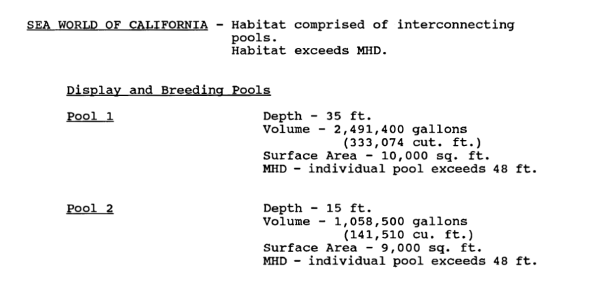
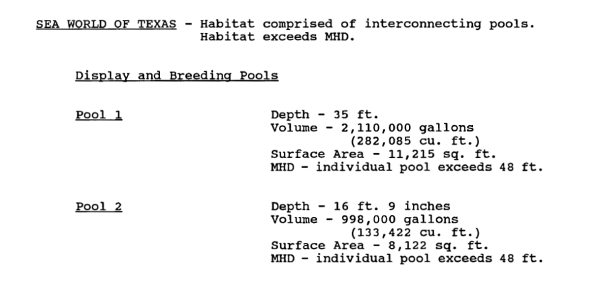
Okay, this is only for people who are deep, deep in the weeds. Every once in a while I get an email asking me for the sizes of SeaWorld’s pools. And I have never really had rock-solid information on the dimensions. So, apart from the insights into SeaWorld’s thinking about Tilikum, Haida, and Nootka contained in Russ Rector’s FOIA’d documents, I was glad to see that SeaWorld’s 1991 application to import and display Tilikum, Haida, and Nootka from Sealand included…..very detailed pool dimensions. So I have posted them below (I have left SeaWorld Ohio out since that is now closed).
One thing that jumped out at me from this section of SeaWorld;’s application is just how few killer whales SeaWorld had in 1991 (12, including Ohio), compared to the 29 they keep today (23 at SeaWorld parks, and 6 at Loro Parque).
So, for the record, here are the sizes of SeaWorld’s pools in 1991:
After years of persistent FOIA appeals, dolphin advocate Russ Rector has managed the very worthwhile feat of getting NOAA to release more than 1000 pages of documents related to SeaWorld’s purchase of Tilikum, Haida, and Nootka from Sealand Of The Pacific. I am going through them and posting some of the details and insights that the documents contain.
My first post, about the back and forth SeaWorld and NOAA had over how SeaWorld planned to deal with the fact that the three killer whales it was purchasing from Sealand had killed a trainer, is up at The Dodo.
SeaWorld’s take on whether Tilikum, Haida and Nootka’s behavior was normal, and whether SeaWorld was set to handle the three whales in the aftermath of Keltie Byrne’s death, doesn’t look so great in light of what followed with Tilikum’s life at SeaWorld. NOAA, which gets credit for pressing SeaWorld on the question of how it might deal with killer whales that had killed, was clearly not that impressed by SeaWorld’s complacency. Nevertheless, they ended up granting the permit.
You can download the full set of permit-related documents here, and I’ve also embedded them below:
Despite insisting that Blackfish is having no impact on its business, SeaWorld continues to invest heavily in a PR counter-attack on Blackfish and the former trainers who appear in the film.
It’s latest minute-by-minute critique of Blackfish was perhaps the most detailed, and most tediously off-base, critique it has issued yet.
Below you will find the Blackfish production team’s rebuttal. What’s notable is that SeaWorld continues to massage and manipulate the facts even as it tries to accuse Blackfish of mis-representing the facts. What’s also notable is that SeaWorld continues to try and distract and divert from the core issues raised in Blackfish about the wisdom and morality of killer whale captivity, without ever directly addressing those issues.
I guess we can keep going round after round on this, but the facts simply are not on SeaWorld’s side. And it seems clear that the public is beginning to understand a very different, more credible, and increasingly troubling version of killer whale captivity than the narrative SeaWorld has been promoting for the past 50 years.
Mucus weep from Morgan’s eye. (Ingrid Visser/Free Morgan Foundation)
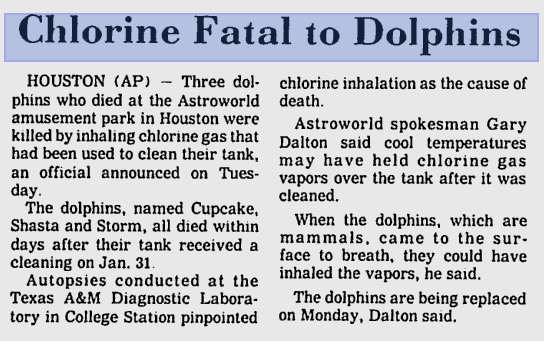
Over the weekend, The Dodo posted a short article I put together on how the effort to maintain sparkly, clear water in SeaWorld’s pools can affect the physical well-being of the animals (and the humans who used to swim with them).
It’s not the biggest issue with captivity, but is a perfect example of how every little thing can impact the lives of the orcas and other marine mammals:
It is indeed true that great effort is made to maintain the water at just the right temperature and salinity for the animals. What is not mentioned is all the chlorine that is used to keep the water clear and sparkling (you can’t see Shamu clearly in a murky pool), and free of algae and bacteria. (Don’t even get a killer whale trainer started on what it looks like after a killer whale defecates in the pool, or produces any other bodily emissions.)
A number of former SeaWorld trainers I have spoken with about water quality have noted that captive killer whales routinely have mucus streaming from their eyes — an apparent protective mechanism that is considered “normal” at SeaWorld.
After the article was posted this story (from 1985) came to me via Ceta-Base:
It has been amazing to see all the Blackfish-inspired efforts to campaign for changes in the way we see and think about SeaWorld and the captive display of orcas. There have been a multitude of grassroots petitions urging musical acts to avoid playing at SeaWorld. There have also been grassroots efforts to inspire SeaWorld’s corporate partners to revisit their relationship with a business that displays orcas. For example, this Change.org petition to Southwest Airlines.
The response from singers and bands has been impressive. But getting corporate partners to move on from longstanding relationships is a bigger challenge, and multiple approaches are possible. That’s why I wanted to flag Kimberly Ventre’s quiet and respectful effort to engage Southwest about its relationship with SeaWorld. Instead of rallying thousands of potential fliers to petition Southwest, it is based on a strategy of trying to engage Southwest’s leadership in a thoughtful conversation about SeaWorld and captivity (and included offers to screen Blackfish and have some of the former SeaWorld trainers who featured in Blackfish meet with Southwest executives; Ventre is former SeaWorld trainer Jeff Ventre’s sister, and a devoted Southwest flier).
Southwest has been open and responsive, but also hasn’t accepted Ventre’s offer for further engagement and discussion. They did send her a Southwest thumb drive, but I suspect that won’t be enough to deter her from her goal of having Southwest revisit its SeaWorld partnership.
It will be interesting to see whether this alternative approach to the Blackfish Effect will succeed. And whether it can be a good model for change. So, for the record, I am posting a summary from Ventre regarding her Southwest campaign, as well as the letters that have gone back and forth.
Here’s Ventre:
When is the last time you wrote an airline and they responded right away? This is why I love Southwest. They are different. They are thoughtful. They listen.
Recently, I sent a letter to Southwest CEO Gary Kelly (and four other executives) expressing my concern over their on-going partnership with SeaWorld. I explained a group of scientists, filmmakers, and authors were willing to come present the facts surrounding orcas and captivity. Shortly thereafter, I received an encouraging response.
Southwest’s leadership team said their eyes and ears are not closed and vowed to “remain transparent and open in their desire to learn and educate (them)selves.” Remarkably, they confirmed they had seen Blackfish and said they would read Death at SeaWorld as well as the other articles I provided.
Their transparency, willingness to engage in dialogue and commitment to do their due diligence are all hallmarks of great global brands. Their partner SeaWorld could learn a lot from them.
Southwest asked for patience as they move through their learning process. As they begin to understand the real story of Shamu, they will reach the same conclusion millions around the globe already have. What was once popular is now seen as an inhumane. I believe Southwest will evolve and choose to be on the right side of history.
It’s no secret that it has been going on. But here are two quick vids, shot by an enthusiastic guest, showing Orkid working with a trainer in the med pool (which has a floor that can be raised).
Orkid, or course, made a particularly dramatic appearance in Blackfish:
Here’s one section of SeaWorld’s investigation into the incident which illustrates how hard it is for SeaWorld to maintain situational control all the time:
Of course, Orkid is no slouch when it comes to doing what she feels like doing, and ignoring protocol, either. Here’s the rap sheet from her SeaWorld profile:
The renewed waterwork desense training is a good reminder that, despite claiming record revenues in 2013, SeaWorld is still determined to bring waterwork back into the show. I’ve always thought it was a long shot, because I always figured it would be hard to get anyone, most of all OSHA, to agree that being in the water with fast-rising floors (or any other safety mechanisms SeaWorld could throw into the mix) would be as safe as simply staying out of the water.
Which is perhaps why SeaWorld’s best hope is winning the federal appeal it argued last November, which in essence argued–to put it into layman’s terms–that OSHA had no right to butt into SeaWorld’s business, and that in any case waterwork was so central to SeaWorld’s brand and business that asking for a ban was akin to asking the NFL to ban tackling. That decision should come down in coming months.
If it doesn’t go SeaWorld’s way I’m not sure what SeaWorld’s options are. Steamroll OSHA into accepting fast-rising floors with some power lobbying and Congressional pressure? Resume waterwork at the California and texas parks, which weren’t cited by OSHA? None of the alternatives seem very good.
I never set out to make this short film. I hadn’t been to Sea World in probably 20 years but decided to give it a shot and take my niece. I tried to see the place through the eyes of young child but logic and my love for wildlife took over. I’ve spent most of my life committed to exploring wild places and observing wild animals. I understand why these places exist but also feel that it’s time we stepped back and reassessed our need to collect and to display conscious, intelligent animals.
“One Ocean,” SeaWorld Orlando‘s iconic killer-whale show, will be taking a break in early 2014.
The theme park will be doing routine maintenance on the main performing pool at Shamu Stadium, a SeaWorld official says. The work will begin in early January. “One Ocean” is currently on the park schedule posted on its website through Jan. 5.
The Dine With Shamu experience will also be suspended for the first part of next year.
During the closures, SeaWorld Orlando will offer “Shamu Up Close,” which will include above-water and underwater interactions and a look at training techniques. It will be held in the Dine With Shamu space and accommodate hundreds of guests at a time, a spokeswoman says.
“One Ocean” and Dine With Shamu will return sometime in the spring, SeaWorld says.
Shutting down the cash-gushing Shamu show for a period of months is not “routine maintenance.” I have no knowledge that a fast-rising floor is on its way (previous on SeaWorld’s fast-rising floor here). But if I was a betting man….
[Also worth noting: this will be a very interesting experiment in how important the Shamu show is to SeaWorld’s gate revenue].
Sorry. Not that it’s a surprise, but Tili isn’t going anywhere.
When Icelandic media started reporting a few days ago that a permit request to return Tilikum to Icelandic waters had been filed with the Fisheries Ministry, it was a puzzler. There is just about zero chance that SeaWorld would ever release Tilikum (or any other killer whale). Yet, the Ministry Of Fisheries seemed to be confirming that at least someone had filed a permit request.
Icelandic media kept churning out stories, with at least one yielding an interesting anecdote about the young Tilikum in captivity. And I kept reading along, until I finally saw a name associated with the permit in this story (via tortured Google translation):
In the register of the Ministry stated that the application was received in August. Appointment of qualit inc., From Tracy ELPoured and copy center Sea World. Requested the Ministry to permit that Tilikum will be transferred to his home after decades stay as gripping performances. “It is not a position has been taken to the communication. But, here might be a new whale-tale coming up, “said an employee of the Ministry. “They want to get rid of him. But, this seems to be financially. “
So a new permit was filed in August. And seemed to come from a person called Tracy EL Poured, of Qualit Inc. The name Tracy Poured sounded very familiar and a quick search of my e-mail revealed she had been in contact with me in August (according to her e-mail signature she is CEO of Qualia Inc.), to express her support, and belief that the world is changing for the better. We also connected on LinkedIn (that’s her profile picture above), so she could share with me her own lengthy analysis of Tilikum and how his life had affected him.
I e-mailed Tracy yesterday to ask her about the Tilikum permit application, and she did not want to respond directly to the question of whether she had filed it (though she did make clear she did not in any way speak for SeaWorld). After some back and forth, here is what she said:
I appreciate your inquiry and desire for clear answers, Tim. I answer what is mine to answer. Some things are not mine to answer.
I pointed out the 1992 application* in response to your statement “SeaWorld would never release Tilikum”.
I’m involved in conversations with Iceland, SeaWorld, scientists and many more involved in the orca Tilikum situation.
The mention of the 1992 application refers to the inquiry SeaWorld made at the time it was trying to import Tilikum from Sealand to its Orlando park on an emergency basis. Part of that process was establishing that there was no good alternative to the import, so SeaWorld needed Iceland to say they didn’t want Tilikum back.
Separately, I learned that Tracy had been in touch with some of the former SeaWorld trainers about the possibility of participating in a rehab and release process for Tilikum.
So I think it is safe to conclude that Tracy filed the permit application, or at least played a role in it, in a well-meaning but quixotic hope that somehow she could help orchestrate Tilikum’s return to Icelandic waters. And the media took it from there.







 Sorry. Not that it’s a surprise, but Tili isn’t going anywhere.
 The Earthist Chronicles