If you want to see it at its most intense, just check out this incredible sequence in which a young iguana races to escape more snakes than you can believe.
Here is the trailer for the full series, which will start airing in the United States on January 28.
Forget Instagram. This is where true meaning lies.
I was recently mocking the Pokemon Go craze, which manifests itself in my local park in the form of dazed-looking teenagers, wandering aimlessly while holding a cell phone at arm’s length. My son, who naturally is familiar with my worldview and knew where this was headed, stopped me and pointed out: “Well, at least it is getting kids outside.”
That is both true, and sad. Sad that it takes Pokemon Go to get kids out in nature more often, and sad that all the indoor devices and distractions are winning over the lure and fun of the outdoors. I used to worry that my generation would be leaving our children an impoverished version of nature (which we will). But I recently also started to think that they might not notice, because they are so disengaged from the unplugged, natural spaces that are all around us.
Timothy Egan took to a raft on the Colorado River with his son to write about this phenomenon and what it portends for our national parks (where visitors are increasingly old and white). And his son, Casey, sort of learns that the world will not stop and he will not disappear into a black hole if he is unplugged for a week (and that the wild offers other distractions and pleasures). But still. The article wasn’t that reassuring, and mainly you get the impression that Casey did not come away from the adventure as an outdoors enthusiast so much as he realized that rafting down the Colorado with no cell service didn’t suck as bad as he thought it might.
The story, which is in Nat Geo, does a good job profiling some groups of young people who actually do love the outdoors and our national parks. But the stats it includes are daunting:
“Young people,” Jonathan Jarvis, director of the National Park Service, told me, “are more separated from the natural world than perhaps any generation before them.” That’s quite an accusation. Jarvis has been saying this for a couple of years, in different forums in the run-up to this year’s Park Service centennial. “There are times when it seems as if the national parks have never been more passé than in the age of the iPhone,” he warned in one speech. “The national parks risk obsolescence in the eyes of an increasingly diverse and distracted demographic.”
Obsolescence? How could that be? Last year national park sites clocked 307 million visits—an all-time record. Fifty-seven locations set high-water marks for attendance. Oh, but don’t be deceived by the numbers, Jarvis advised during an interview in his office, a few blocks from the White House. Take a closer look at who’s going through the gates: people like the silver-haired Jarvis and, well … me. It’s a risky thing, this generalizing about generations. Did our kids fall out of love with America’s Best Idea? Or maybe they never fell in love to begin with. Anecdotally, I have noticed a passion deficit among Casey and his friends. And technology, as a companion, is a must. A large majority of millennials—71 percent—said they would be “very uncomfortable” on a one-week vacation without connectivity, according to a survey by Destination Analysts. For boomers, the figure was 33 percent.
Having been to Yellowstone with my family last summer, and appalled by the crowds, selfie-sticks and traffic, the lack of Millennial interest in the National Parks may become a boon to anyone who does spend time in them. But this would be a collateral benefit in a trend that could have dire long-term implications, which the Guardian’s George Monbiot lays out in a related essay this week, lamenting the removal of children from the outdoors, called “If Children Lose Contact With Nature They Won’t Fight For It“:
We don’t have to disparage the indoor world, which has its own rich ecosystem, to lament children’s disconnection from the outdoor world. But the experiences the two spheres offer are entirely different. There is no substitute for what takes place outdoors; not least because the greatest joys of nature are unscripted. The thought that most of our children will never swim among phosphorescent plankton at night, will never be startled by a salmon leaping, a dolphin breaching, the stoop of a peregrine, or the rustle of a grass snake is almost as sad as the thought that their children might not have the opportunity.
The remarkable collapse of children’s engagement with nature – which is even faster than the collapse of the natural world – is recorded in Richard Louv’s book Last Child in the Woods, and in a report published recently by the National Trust. Since the 1970s the area in which children may roam without supervision has decreased by almost 90%. In one generation the proportion of children regularly playing in wild places in the UK has fallen from more than half to fewer than one in 10. In the US, in just six years (1997-2003) children with particular outdoor hobbies fell by half. Eleven- to 15-year-olds in Britain now spend, on average, half their waking day in front of a screen.
Monbiot points out that not much good will come of this in a world in which Nature and the Planet need mobilization, activism, and committed advocacy (not to mention the fact that more kids are develoing attention deficits, obesity, etc., etc).
I am sympathetic to the teenagers. If I was a 12-year old today I would be similarly entranced by everything going on within the confines of a smartphone, iPad or computer. There is nothing wrong with kids today. They are simply exposed to more temptations than I was. But I have learned that simply saying “go outside” just won’t cut it. Even if they do go outside to the local park, it is often empty. Instead, I have learned that the most effective and rewarding strategy is to invite my children to join me outdoors. It’s a win-win-win: they get outside and off their screens, you get to spend time with them with no electronic distractions, and they (just maybe) will learn to love and appreciate the outdoors.
Yesterday I did just this, and invited my son to ride his bicycle with me to Arlington National cemetery. On the way we stopped at Roosevelt Island. In all, we rode maybe 12 miles on a beautiful Fall day. We talked about lots of things, scoffed at all the people taking endless pictures of themselves or staring down at their phones, and learned some new bike routes. At the end my son looked at me and asked: “can we do this sort of thing more often?”
I may find reasons to doubt the wisdom and future of the human race and the planet it is trashing. But astrobiologist David Grinspoon takes the long view, and sees both opportunity and hope. Fingers crossed he is right.
One of the paradoxes of working on many of the issues I care about is that it is easy to get depressed. The more I learn about any number of topics I write about or would like to write about–climate change, factory farming, our treatment of non-human species, our treatment of one another, species depletion, the list goes on–the more I have to consciously fight against a sense of despair and hopelessness. Because getting from where we are to where I hope we can be seems like such a great distance, and so many people seem disconnected or distracted from what really matters. Over the years, I worry, I have lost some of my joie d’vivre because I am too conscious of the many things wrong with our planet, our politics and our culture.
Of course, the work can be highly rewarding when there is an increment of progress in the right direction. Yet I still find myself wondering how best to try and be a joyful, optimistic person. Because not being that sort of person is not much fun (or very effective).
I don’t have the answer, so this analysis of ways in which you can “train” your brain to be happy naturally caught my attention. Key areas are: 1) Gratitude; 2) A Good Night’s Sleep; 3) Exercise; 4) Meditation; and 5) Doing Deep Work.
I would add 6) Spending Offline Time With Friends and Family. Especially In Nature. But, regardless, I am glad to see that I am at least on the right track in a number of areas (meditation is probably my largest untapped opportunity). What are your keys?
There is no more heartbreaking crisis than the ongoing, relentless slaughter of elephants (except maybe the ongoing, relentless slaughter of rhinoceroses). I’m not very optimistic about the future of African elephant populations, I’m sorry to admit, but when good people fight for a good cause there is always hope. So perhaps this documentary will mobilize lots of people who aren’t already mobilized, to take a stand against poaching and the infuriating, needless, worship of ivory.
Or, “How To Ruin Thanksgiving But Save The Planet.”
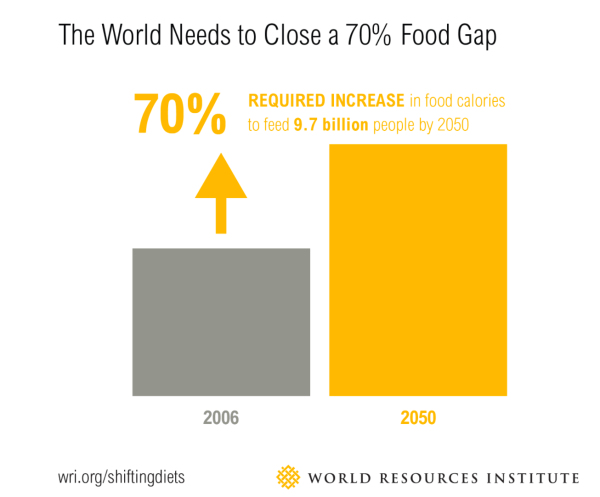
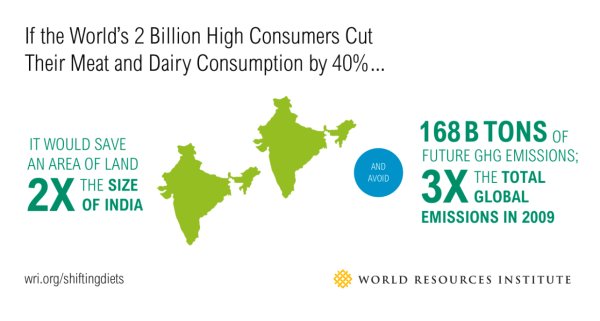
There is no human activity which affects the planet more than what we eat and how we produce it. I’ve long argued that the single biggest thing any individual can do to reduce his or her impact on climate change, land use, water quality, soil loss, and biodiversity is to change what’s on the plate. Fewer calories, less protein, much less or (even better) no meat and animal products, and organic. That’s the simple formula for radically reducing the human footprint and giving the natural world a chance.
Humboldt was born during the era in which human beings stopped fearing nature and began to control it. The steam engine, the smallpox vaccine, and the lightning rod were rapidly redefining man’s relationship with the natural world. Timekeeping and measuring systems became standardized, and the few blank spaces remaining on world maps were quickly filling in. In New England, the colonists spoke of “reclaiming” North America from the wilderness, a project inextricable from the propagation of democracy. The jurist James Kent, seeking a legal basis for seizing land from Native Americans, argued that the continent was “fitted and intended by Providence to be subdued and cultivated, and to become the residence of civilized nations.” Explorers like James Cook and Louis Antoine de Bougainville circumnavigated the globe and published their journals, which Humboldt read avidly as a boy…..
Supported by the windfall of his inheritance, he abandoned his mining career and planned a “great voyage” to a distant location. The destination did not seem to make much difference—he considered the West Indies, Lapland, Greece, and Siberia, before settling on South America, once he was offered a passport to the Spanish colonies from King Carlos IV himself. Nor did he have any specific object of study. He would analyze everything, from wind patterns and cloud structures to insect behavior and soil composition, collecting specimens, making measurements, and taking temperatures. He wanted no less than to discover how “all forces of nature are interlaced and interwoven.” He took as the premise of his expedition that the earth was “one great living organism where everything was connected.” The insights that followed from this premise would be worth more than all of the discoveries he made.
His life and ideas are masterfully chronicled in a biography by Andrea Wulff, and I’ve just started digging into it. It is amazing how relevant his thinking and ideas seem today, in a world in which humanity’s domination of nature is destroying, instead of nurturing, nature.
In England researchers from the University of Exeter Medical School recently analyzed mental health data from 10,000 city dwellers and used high-resolution mapping to track where the subjects had lived over 18 years. They found that people living near more green space reported less mental distress, even after adjusting for income, education, and employment (all of which are also correlated with health). In 2009 a team of Dutch researchers found a lower incidence of 15 diseases—including depression, anxiety, heart disease, diabetes, asthma, and migraines—in people who lived within about a half mile of green space. And in 2015 an international team overlaid health questionnaire responses from more than 31,000 Toronto residents onto a map of the city, block by block. Those living on blocks with more trees showed a boost in heart and metabolic health equivalent to what one would experience from a $20,000 gain in income. Lower mortality and fewer stress hormones circulating in the blood have also been connected to living close to green space.
It’s difficult to tell from these kinds of studies why people feel better. Is it the fresh air? Do certain colors or fractal shapes trigger neurochemicals in our visual cortex? Or is it just that people in greener neighborhoods use the parks to exercise more? That’s what Richard Mitchell, an epidemiologist at the University of Glasgow in Scotland, thought at first. “I was skeptical,” he says. But then he did a large study that found less death and disease in people who lived near parks or other green space—even if they didn’t use them. “Our own studies plus others show these restorative effects whether you’ve gone for walks or not,” Mitchell says. Moreover, the lowest income people seemed to gain the most: In the city, Mitchell found, being close to nature is a social leveler.





 The Earthist Chronicles