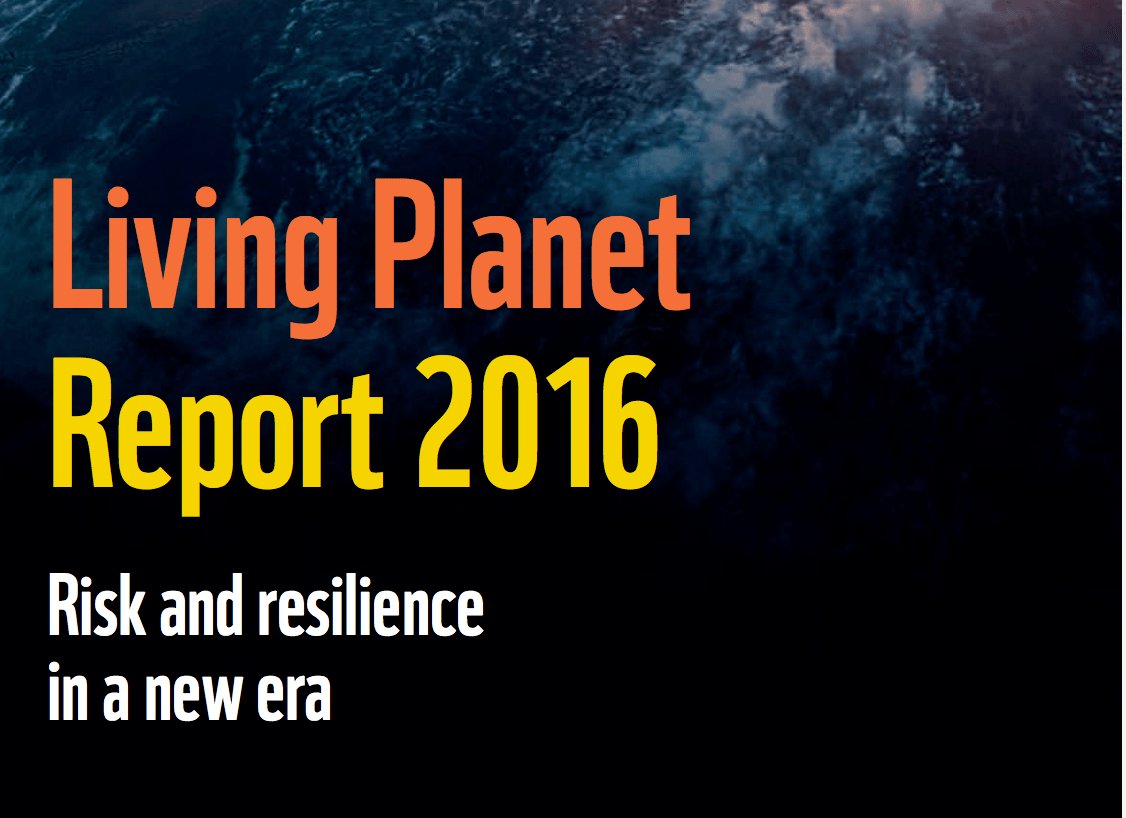
Living (But Dying) Planet Report 2016

I’m just starting to dig into this detailed and compelling analysis of how humanity is affecting the planet, where the status quo will lead, and the magnitude of change required to slow or reverse the damage we are doing. It’s sobering reading, but worth the time and effort because you can’t absorb all the science without coming to the conclusion that you need to change the way you live–that we all need to change the way we live–and fast. And, to me, that is a key point. We are far too complacent, and far too willing to make some changes but not the big changes needed.

Here are some of the key themes and conclusions:

Under the current trajectory, the future of many living organisms in the Anthropocene is uncertain; in fact several indicators give cause for alarm. The Living Planet Index, which measures biodiversity abundance levels based on 14,152 monitored populations of 3,706 vertebrate species, shows a persistent downward trend. On average, monitored species population abundance declined by 58 per cent between 1970 and 2012. Monitored species are increasingly affected by pressures from unsustainable agriculture, fisheries, mining and other human activities that contribute to habitat loss and degradation, overexploitation, climate change and pollution. In a business-as-usual scenario, this downward trend in species populations continues into the future. United Nations targets that aim to halt the loss of biodiversity are designed to be achieved by 2020; but by then species populations may have declined on average by 67 per cent over the last half-century…..

Another way to look at the relationships between our behaviour and the Earth’s carrying capacity is through Ecological Footprint calculations. The Ecological Footprint represents the human demand on the planet’s ability to provide renewable resources and ecological services. Humanity currently needs the regenerative capacity of 1.6 Earths to provide the goods and services we use each year. Furthermore, the per capita Ecological Footprint of highincome nations dwarfs that of low- and middle-income countries (Global Footprint Network, 2016). Consumption patterns in highincome countries result in disproportional demands on Earth’s renewable resources, often at the expense of people and nature elsewhere in the world. If current trends continue, unsustainable consumption and production patterns will likely expand along with human population and economic growth.

The growth of the Ecological Footprint, the violation of Planetary Boundaries and increasing pressure on biodiversity are rooted in systemic failures inherent to the current systems of production, consumption, finance and governance. The behaviours that lead to these patterns are largely determined by the way consumerist societies are organized, and fixed in place through the underlying rules and structures such as values, social norms, laws and policies that govern everyday choices (e.g. Steinberg, 2015). Structural elements of these systems such as the use of gross domestic product (GDP) as a measure of well-being, the pursuit of infinite economic growth on a finite planet, the prevalence of shortterm gain over long-term continuity in many business and political models, and the externalization of ecological and social costs in the current economic system encourage unsustainable choices by individuals, businesses and governments. The impacts of these choices are often felt well beyond the national and regional borders in which the choices originate. This is why the links between drivers, deeper causes and global phenomena like biodiversity loss can often be difficult to grasp.

I’d urge you to read the and study the whole thing. It tells the most important story there is.
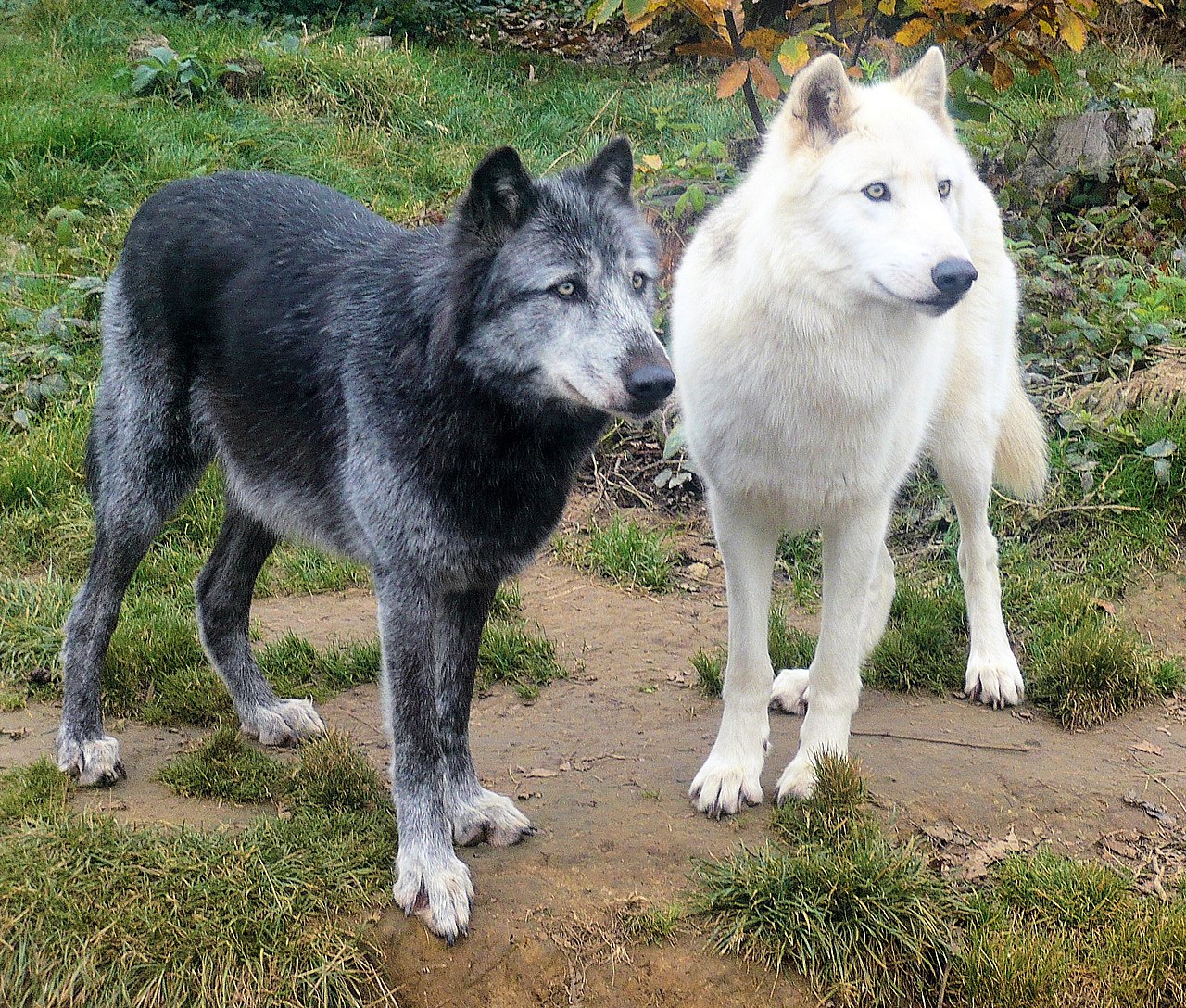
President Trump And Animals

Don't forget us when you vote....
Don’t forget us when you vote….

There are many, many reasons to be wary of a Trump presidency, and hope that one does not come to pass. But concern for animals and animal welfare should not be forgotten. And the tea leaves are not encouraging:

From a four-legged vantage point, a Trump administration would be a disaster. Last month, the Trump campaign floated billionaire Forrest Lucas as the potential secretary of the interior in his administration, a position that oversees vital animal-related programs at the National Park Service and Bureau of Land Management.

Described as “the leading anti-animal advocate in the United States” by the Humane Society Legislative Fund, Lucas has dedicated much of his time and fortune to defending some of the worst animal abuse industries in our country.

Lucas’ anti-animal front organization, Protect the Harvest, spent a quarter of a million dollars to try to block a ballot initiative in North Dakota that would have set felony-level penalties for malicious cruelty to dogs, cats and horses. That’s relevant to Lucas’ potential influence in a Trump administration, given that the Bureau of Land Management manages tens of thousands of wild horses in the West.

Lucas’ political machine has also advanced other anti-animal causes, including so-called “right to farm” legislation in states like North Dakota, Missouri, Indiana and Oklahoma. Such legislation would leave millions of animals suffering in silence on factory farms and slaughterhouses, while undermining the Bureau of Land Management’s role in humanely administering 155 million acres of grazing land for cattle and sheep.

So if you are tempted to try and blow up conventional politics and the status quo (which I would love to blow up, but just in a more hopeful, more productive, and less risky manner), it doesn’t look like the animal world will be grateful.

Full story is here.

Leonardo DiCaprio’s “Before The Flood”

It should perhaps be called “During The Flood” because anthropogenic change is already starting to flood parts of our planet. And giving anyone the sense that climate disaster is out there in the future somewhere instead of right here, right now is probably a bad idea. But credit to Leo for fighting the good fight and pushing on climate issues with persistence and sincerity.

I haven’t seen this new doc yet, but the full version popped up on YouTube, courtesy of National Geographic. So here it is:

A Beautiful Essay On Veganism

Writer David Macfarlane makes a gentle, thoughtful, and deeply persuasive case that veganism is a powerful and undeniable moral imperative.

Once these kinds of ethical arguments began to swirl around in what I like to think of as a reasonably fair-minded brain, and once I took the perilous state of the Earth into account, it became evident to me that eating a hot dog is as much a political act as not eating one. It’s a choice, and what I’m beginning to learn is that it’s a pretty clear one. You can be over there with the interesting looking young people who are enjoying a dinner of lentils, avocado and roasted yams. Or you can be with the multi-billion-dollar industry that pretty consistently put its own interests ahead of health, the environment, social and economic justice — and way, way ahead of the interests of animals.

Macfarlane hopes, riffing on John Stuart Mill (“Every great movement must experience three stages: ridicule, discussion, adoption”), that (at least some segment of) human culture has moved from ridiculing veganism to grappling honestly with it and discussing the arguments. I’m with him on that, and hope that for the animals’ sake, and for the planet’s sake, that the discussion doesn’t last too long before we jump into the adoption phase.

Read the whole thing here.

Dams Are Damning Southern Resident Killer Whales

J28 with “peanut-head” and J54 malnourished Photo by Ken Balcomb, October 2, 2016

The native peoples of the Pacific Northwest understood something important about the relationship between the region’s iconic killer whales and the region’s iconic salmon. The first could not survive without the second. “No fish, no Blackfish” they observed.

That observation is in danger of proving prophetic. As the Center For Whale Research’s Ken Balcomb warns, lack of prey food is threatening the demise of the endangered Southern Resident Killer Whales. The SRKW population is under pressure for a number of reasons–shipping, noise, habitat loss and pollution, among them. But Balcomb is warning that the most clear and present danger is hunger resulting from declines in the Pacific Northwest’s great salmon runs, mainly due to the damming of rivers. Currently, Balcomb and others are calling for breaching four dams on the lower Snake River which have devastated the region’s once-prolific Chinook salmon runs. And for compelling evidence of what is happening he points to the recent deaths of a mother killer whale and her calf, both of whom were evidently malnourished.

For the data-inclined, here is a chart that looks at the correlation of SRKW mortality and Chinook abundance.

The tension between dams and killer whales is just one more reminder of how closely connected different ecosystems can be, and the endless consequences for the natural world of human development. Dams may provide “clean” hydropower, but they do so at the unacceptable cost of destroying and damaging entire river systems and the species that rely on them. Wind and solar have impacts, too, but they are more local and limited.

Removing dams is one of the most promising environmental trends. And when you take dams down and allow rivers to flow freely again, remarkable things happen. Whether the Snake River dams will be breached in time to save Washington state’s killer whales involves an excruciating race against time and hunger. Even the courts are pushing hard on this issue. But Ken Balcomb, who has been studying this population for 40 years and knows more about these killer whales and what they need than anyone on the planet, is pretty clear that if dam breaching is going to happen it better happen very, very soon.

Russian Captive Dolphins Lead Lives Just As Miserable As Other Captive Dolphins

A Russian dolphin trainer, Sergei Kozhemyakin from Moscow, unburdens himself after a lifetime of working with captive dolphins. Not much of what he says is very surprising, but the important thing is that he is adding to a growing wealth of insider testimony regarding the realities for dolphins of life in an entertainment pool.

Morgan In Captivity

I was going through computer files the other day, and I came across an archive of stuff I have on Morgan at Loro Parque. I have always felt a sadness for Morgan, picked up off the Dutch coast in 2010 and now at Loro Parque in the Canary Islands. (I wrote about Loro Parque in 2011, because that is where trainer Alexis Martinez was killed by a SeaWorld killer whale just a few months before Dawn Brancheau was killed in Florida).

You can read all about Morgan, and how she came to be at Loro Parque, here. The story has a lot of twists and turns, but the bottom line is that Morgan is a recently wild killer while who now finds herself owned by SeaWorld, and with her valuable wild DNA likely to become part of SeaWorld’s captive breeding mill.

Anyhow, I started clicking on some of the videos of Morgan (they are from 2013) and for some reason this video perfectly captured for me the banality and tedium of a once wild life that is now experienced in a confined pool, and devoted to entertaining holiday crowds. Teaching Morgan how to wave her tail just seems so pathetic and lame. And her energy level and affect seems to indicate she feels the same way. Good times.

Sustainable Is Also Healthy

In my recent Outside story about sustainable eating I didn’t get into the question of whether foods which are easier on the planet are also healthy (or healthier). So this Washington Post story, which looks at whether there is scientific consensus or disagreement, on a number of dietary choices, caught my eye.

Check out this summary chart. Looks to me as if there is pretty solid scientific consensus on the health benefits of a more plant-based, low environmental footprint diet.

Screen Shot 2016-01-13 at 10.52.26 AM

It reinforces what I believe about plant-based foods. They are a three-fer: 1) Good for you; 2) Good for the planet; and 3) Good for animals.

I find that logic overwhelming, which leaves taste and habit as the only real barriers to a plant-based diet. And good recipes (and chefs like Dan Barber) can easily obliterate those barriers.

Diet And The Planet

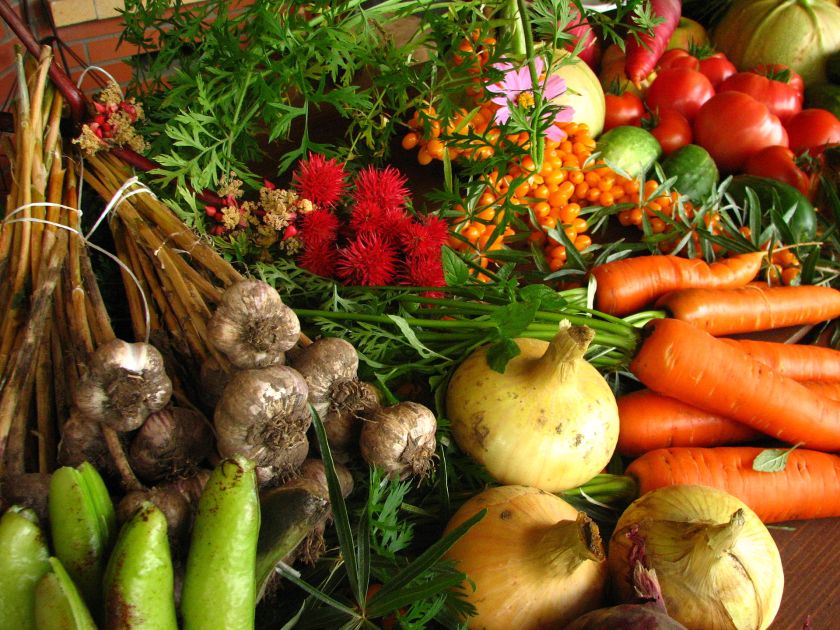
1920px-ecologically_grown_vegetables

After writing about eating seafood more sustainably, my editor at Outside and I figured we might as well go Full Monty and broaden the question to take a hard look at eating more sustainably in general. So I dove into lots of research on how our food choices affect the planet, and you can read the results here.

Key takeaways:

  • your food choices are the easiest way for you to dramatically shrink your environmental footprint
  • eating less or no meat has the biggest impact on dietary sustainability
  • if you want to maximize both your nutrition and the environmental benefits of your diet, eat more pulses/legumes: lentils, beans, etc.
  • we worry way too much about whether we are getting enough protein. We get plenty, even if we are vegetarians, and eating more protein than we need is very costly to the environment
  • going vegetarian can halve your impact on climate, and land and water use; going vegan can reduce it by around three-quarters (I was impressed by the extra environmental bump you get from going from vegetarian to vegan).
  • eating organic has a demonstrable benefit to soils, waterways and climate.
  • one of the biggest environmental tragedies related to diet is food waste–which in the US is a shocking 40%. That also makes reducing food waste in your home a huge opportunity to shrink your environmental impact.

So, to sum up, if you really want to eat more sustainably: Eat less or no meat, and eat  organic and locally whenever possible. Stop eating so much protein, and stop eating so much in general (overeating is costly to the planet and your health). Oh, and stop wasting so much food!

A Guide To Eating Seafood Sustainably

A farmed, vegan, rainbow trout. Really. (Photo is by Andrew Andrew Hetherington, who took great photos to illustrate the story)


Quite apart from now being vegan, I have long been skeptical of all the ways in which humanity catches, farms and eats fish. Species after species seemed to dwindle in number, despite “fisheries management,” and farming fish seemed equally destructive. So when people asked me what fish they should eat, I usually answered “You should eat no fish.”

But my editor at Outside, who loves fish and loves the planet, kept insisting this was the wrong answer. So I researched and reported a story on the question of fish. The answer I came up with is much more useful, interesting and surprising than I expected.

So, for all the seafood lovers out there, here is your guide to eating fish responsibly.

Here’s how it starts (which is already causing me grief from vegan absolutists on Twitter):

I contemplated the simple sandwich on the plate in front of me: a beautiful slab of glistening rainbow trout, crisp lettuce, and a freshly baked French roll. The trout skin was lightly seared and seasoned. The pinkish meat was firm and toothsome. I genuflected briefly, then two-fisted the thing and took a big bite. A slightly smoky, sweet flavor gave my taste buds a sensation long denied. I chased it with a slug of Fort Point ale. Soon, both fish sandwich and beer were gone. I am a vegan, but I was untroubled. Eating the trout seemed like the right thing to do. 

Read the rest here. Hope you enjoy it.

And there is a great photo gallery here. As well as a 6-step Guide To Eating Fish Right.