A View Of Earth

It’s always said that seeing earth from space gives humans a unique perspective that encourages a sense of earth as an integrated and fragile ecosystem. In other words, it helps us see the WHOLE earth.

This narrated video from the international space station achieves exactly that:

Humans tend to see everything from a human-first perspective. We tend to analyze events according to how it impacts humanity. We tend to act in our own interest.

But what if we started to see things from an Earth-first perspective? If we made personal, political, economic, and cultural decisions based on how they impact the Earth and ALL its species, not just the one we happen to belong to? If we acknowledged that we are just one part of a complex ecosystem, and that our cleverness does not necessarily give us the right to compromise the rights and futures of other parts of that ecosystem? If we had the wisdom to recognize that exploiting earth and its inhabitants instead of nurturing them is a way of undermining our own future.

What would happen? Well, everything would change.

Watch the video, see how humanity is visible almost everywhere, and think about that.

A Bogus Beluga Rationale

Nicely detailed piece on Wired.com about Georgia Aquarium’s application (on its own behalf, but also fronting for SeaWorld, Shedd, Mystic) to import 18 wild-caught beluga whales from Russia.

Here’s the set-up:

Controversy is brewing over the Georgia Aquarium’s plan to import 18 beluga whales captured off the coast of Russia. If the U.S. government approves the plan, it will mark the first time in nearly two decades that wild-caught cetaceans have been imported into an aquarium in the United States.

According to the aquarium, the whales are needed for research and education. According to animal welfare advocates, that doesn’t justify the trauma inflicted on intelligent, emotional creatures that suffer in captivity.

“If we let them in, it means we’re going to have this issue all the time. It will open up the floodgates,” said Lori Marino, a neurobiologist at Emory University and prominent cetacean rights activist.

Georgia Aquarium trots out the shopworn argument that the belugas will be ambassadors for their species, which is the core rationale marine parks use to justify keeping marine mammals in captivity.

But it’s an analogy that has some problems, I think. Most important, ambassadors are not normally forced into service. My father was an ambassador and he was sent abroad because the United States wanted a representative in the countries he served. In contrast, ambassador to the human world is not a choice any belugas are making. It is a choice humans (profit-seeking humans, I might add) are making FOR the belugas.

Russian Belugas

The Russian Belugas in Ambassador School

Now, you could say belugas need ambassadors because humans are trashing the oceans, and putting the future of wild beluga populations at risk. I think that Continue reading “A Bogus Beluga Rationale”

Seeing Is Important: The Torture Of Meat “Processing”

Okay, I’ve been sitting on this one a while because it is pretty tough to watch.

But I think it is very important to see and bear witness to reality (previous here and here) because images elicit an emotional and visceral reaction that words sometimes do not.

Here’s the backstory on this video:

Aug. 21, 2012: An undercover video, filmed by a Compassion Over Killing investigator, exposes rampant animal abuse and suffering inside Central Valley Meat Co. (CVM), a slaughterhouse in Hanford, California. CVM is a major supplier to the USDA’s National School Lunch Program and other federal food initiatives.

Like all federally inspected slaughterhouses, CVM is required to comply with federal animal welfare requirements as well as California’s animal protection laws. However, COK’s whistleblowing video uncovers acts of cruelty that appear to violate both state and federal laws.

And you can read more here.

I do not post this lightly, but it IS what we call meat “processing” has come to–which is, to be blunt, animal torture. And it is too easy to just keep slinging hamburgers abetted by willful ignorance of what goes on behind the factory walls.

Do you really have faith that this sort of thing isn’t going on all over the world? Do you really want to keep eating meat that involves this degree of cruelty?

There are so many reasons not to eat meat. This is just one. But it should be all you need.

Money and Politics

Uh-oh.

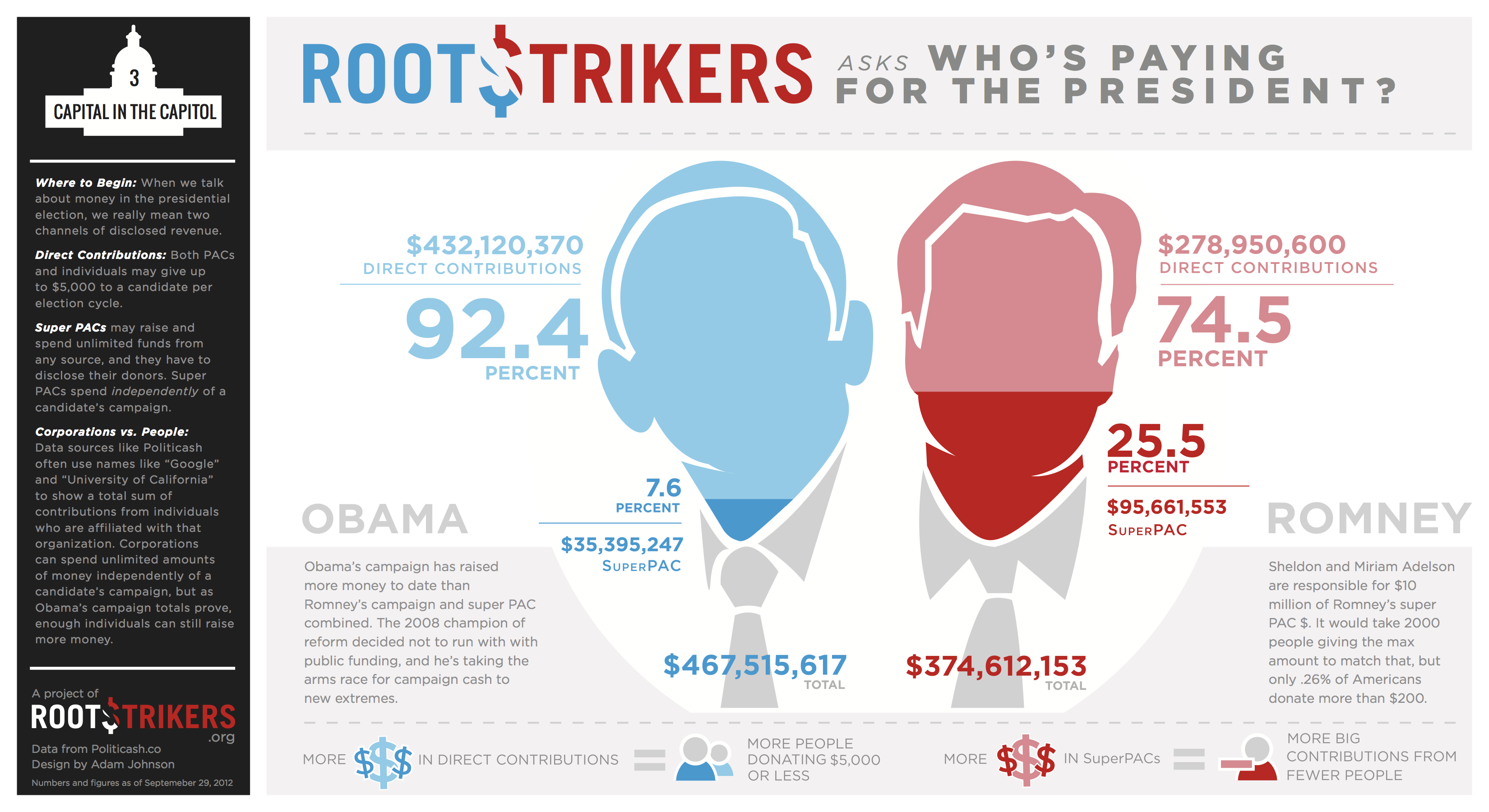
Since we are in the middle of a heated presidential campaign, we might as well have a look at where the money is coming from (click on image for full-size view).

If you don’t like what you see, then support Rootstrikers, which is doing great work to battle the flood of corrupting money into our politics.

Was Nakai Bitten? Analysis From Ingrid Visser

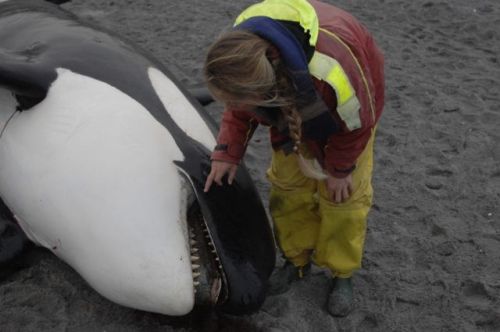
Ingrid Visser of the Orca Reasearch Trust, has spent twenty years studying and observing orcas in the wild.

Ingrid Visser

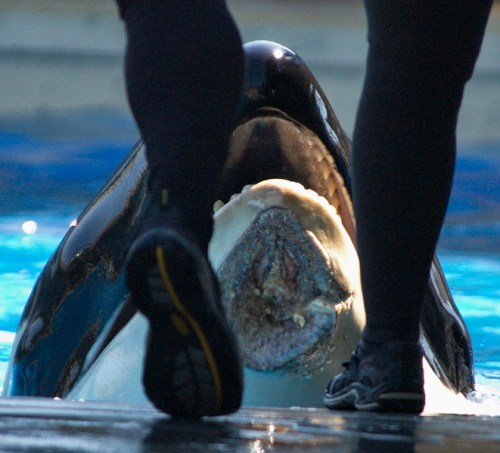
And she was responsible for taking this highly detailed picture of Nakai’s wound:

Nakai Wound

Perhaps the most important detail in this picture is the puncture marks which appear on the lower right margin of the wound, opening up the possibility that Nakai’s wound was caused by a bite from another orca, and not a collision with some part of the pool, as SeaWorld has suggested.

Now Visser has sent me a more detailed analysis of Nakai’s wound. Here it is:

The recent wound on the captive orca Nakai remains an enigma as to how it occurred.  When I first viewed (unreleased) photographs taken a week after the graphic injury, I was of the opinion that it was unlikely to have been inflicted by other orca, based on the fact that no orca teeth marks were clearly visible in the photos and the very ‘clean’ edges to the wound.

Regardless of the source of the wound, I didn’t buy the story from SeaWorld that Nakai had ‘come into contact with the pool’ (AP, Sept 28th 2012, press release), as to me such wording implied a light brush past, or perhaps at worst a bump into the side of the tank.  Clearly such a striking wound wasn’t from a light brush or even a ‘bump’. Continue reading “Was Nakai Bitten? Analysis From Ingrid Visser”

Bridging The Gap Between Human And Leopard Seal

I probably posted this sometime in the distant past, but I can’t resist putting it up again because it is one of the most extraordinary videos you will see (and it just popped up on Upworthy, which is proving to be a very worthy site).

Here’s the backstory:

National Geographic photographer Paul Nicklen shares the incredible story of his personal encounter with a predatory leopard seal in the frigid waters of the Antarctic. These photographs–and many more–appear in his book, Polar Obsession. Available at http://www.nationalgeographic.com/books.

PS: Does Nicklen have the most incredible life, or what?

You can see Nicklen’s TED Talk here.

End Times For Meat?

Asks Time’s Josh Ozersky

Catte Feed Lot CAFOSure hope so. Ozersky explains that the future for meat is looking grim:

But while the bacon panic wasn’t real, there is a crisis in our meat supply and it’s no joke. We produce a lot of meat, but we feed a lot of Americans, and more all the time, thanks to the simple laws of multiplication, along with the simple addition of immigration. There is a drought, so there is less grain and corn for the animals to eat. Most of the producers are marginally profitable at best, and Americans refuse to pay more for meat than they do for Froot Loops, despite the fact that no one has to raise and feed and kill and process Froot Loops. I’m not kidding about this: go to the supermarket and see how much a package of pork chops cost, or half a chicken, and then compare that price to a box of Froot Loops.

All the things that consumers have, rightly, come to fear and distrust about the meat industry are a result of this problem. Hormones, to make the animals grow faster? Check. Antibiotics, to allow animals be cramped and crammed and stressed without dying of infections? Check. Farrowing crates and beak clipping, so as to squeeze more meat more efficiently out of factories? Check. Even the vile pink slime that everyone hates so much is simply a product, literally, of the beef industry’s need to get maximal yield out of each animal. We all love happy animals on small farms, but there’s no way to feed Americans living in or near poverty, as well as having tons of meat to export to China and elsewhere. The result is that producers are bumping off animals as fast as they can and getting out of the business before feed costs get worse and they are forced out. That’s where the bacon shortage comes in. Less pigs, less pork, less pork bellies for yummy, smoky bacon.

To Ozersky, this means a future of expensive, unhealthy meat and abused animals. I would argue we already have two of the three (yes, meat is cheap). He seems to lament the prospect. However, he doesn’t really have much to say on what to do about it.

So I’ll help him out: when a product is getting more expensive, more unhealthy, more ethically execrable, and more environmentally costly (which Ozersky doesn’t really go into), then perhaps the public should stop consuming that product.

I know. Radical idea. But Is it really that hard for Americans and the rest of humanity to imagine a future that isn’t fueled by cheap, factory-farmed meat?
Wild Orca And Dolphin Show

Thanks to the ever vigilant and always interesting Pete Thomas, a great reminder that orcas and dolphins are capable of putting on some pretty impressive spontaneous shows out there in their natural world.

Here’s a dolphin stampede off South Africa filmed by Chase Jarvis from explorer Mike Horn’s sailboat.

And these orcas in the Sea Of Cortez did a nice job of showing some boaters the joy of being a wild orca. Doesn’t get any better than that.

Orca Sea Of Cortez

Orca Sea Of Cortez

Orca Sea Of Cortez

Orca Sea Of Cortez

Was Nakai Bitten? Another Take

It may be that we never really know how Nakai injured his jaw (though we do know–and SeaWorld has confirmed with their euphemistic language about him having a “normal social interaction” with two other whales immediately prior to the injury–that a fight was involved). For what it is worth, I am told that even SeaWorld San Diego can’t determine exactly how the injury occurred, even though they have reviewed all the video they have of the show.

So we are left trying to pull a CSI-style forensic analysis on the injury photos, like this photo taken by Ingrid Visser of the Orca Research Trust:

(c) Ingrid Visser

As I noted yesterday, Visser said of this photo: “Of note is that in [this photo], at the bottom right of the wound, near the trainers shoe in the photo, there are four puncture marks – and the spacing matches that for orca teeth – as you can see from Nakai’s teeth in this same photo.”

I don’t think this is definitive, but because I posted it a number of readers complained that I was drawing a conclusion without sufficient evidence. I agree that there is no conclusive proof one way or another how the injury occurred, and remain agnostic on the question pending any additional information or evidence (if it ever emerges).

But to balance the scales I thought I would post this counter-analysis of the photo (as well as some other photo evidence I shared but have not posted) from someone who knows a lot about orcas and who is reliably insightful about orca matters:

“There is no way this is a bite. An orca’s jaws just aren’t precise enough to make such a clean cut in such a specific area without leaving trails (rake marks Continue reading “Was Nakai Bitten? Another Take”

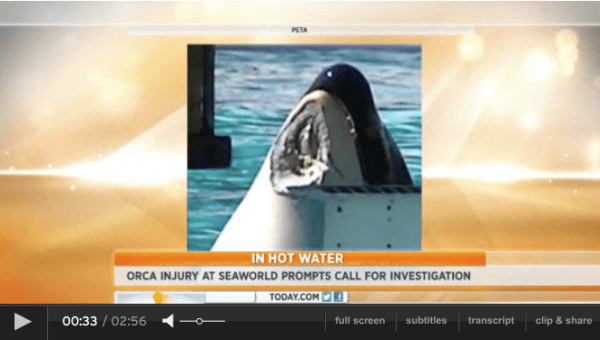
Nakai Makes The Today Show Too

Watch it here.

Just to be clear: SeaWorld’s statement that Nakai was engaged in “normal social behavior” with two other whales immediately prior to the injury is SeaWorld’s way of saying Nakai was in a fight.