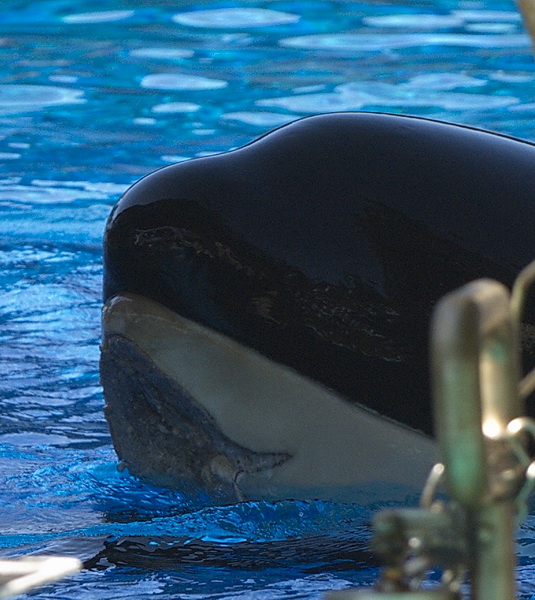
Nakai Featured On Good Morning America

I doubt that it was ever one of his life ambitions, and certainly not for the reason he is being featured. But at least tens of millions of Americans just got a glimpse of what can happen at a marine park. Since one of the biggest limitations of WordPress is that you can’t embed many types of video, I can’t embed the vid here (advantage Tumblr!).

But you can watch the ABC segment here.

Nakai Photos and Backstory

Over the weekend I learned a little bit more about the incident that led to Nakai’s injury, and Ingrid Visser of the Orca Research Trust visited SeaWorld in San Diego and took some more pictures of Nakai’s injury. Here is the most detailed photo she took (more photos after the jump):

(c) Ingrid Visser

Regarding the question of whether the injury might come from a bite from another orca, Visser writes: “Of note is that in [this photo], at the bottom right of the wound, near the trainers shoe in the photo, there are four puncture marks – and the spacing matches that for orca teeth – as you can see from Nakai’s teeth in this same photo.”

And here is some additional detail on what happened that night when Nakai was injured. As a number of people have noted, the injury occurred after Sea World San Diego closed to the general public for the evening. Sometimes SeaWorld puts on special shows for corporate groups, and the evening show on the 29th (oope, typo) 20th was such a show.

During the show Nakai, Keet and Ike were all at stage when all three killer whales suddenly took off without warning and and started fighting with one another. SeaWorld’s review of the tapes could not identify an instigator or an aggressor. As I wrote last week, Nakai split into the back pool. Ike and Keet, however, returned to the stage and control, so the trainers continued the show. When trainers finally called Nakai over later that evening for the final feeding and saw that he was injured they were shocked be the severity of the wound. In fact, it is about as bad a wound as most trainers have ever seen. In response, SeaWorld San Diego will henceforth adopt the practice of immediately checking any killer whales involved in similar, high-intensity, melees to try and make sure that injuries are identified right away.

(c) Ingrid Visser

Apart from the death of Kandu V at SeaWorld San Diego in 1989, the only injury many trainers can remember that was even close in severity to Nakai’s was a 1990s injury to Splash, who lost part of his jaw when he was thrown by Takara against a gate while they were messing around. The gate had a chain and Continue reading “Nakai Photos and Backstory”

Nakai’s Injury: Photographs

So here is what Nakai’s injury looks like:
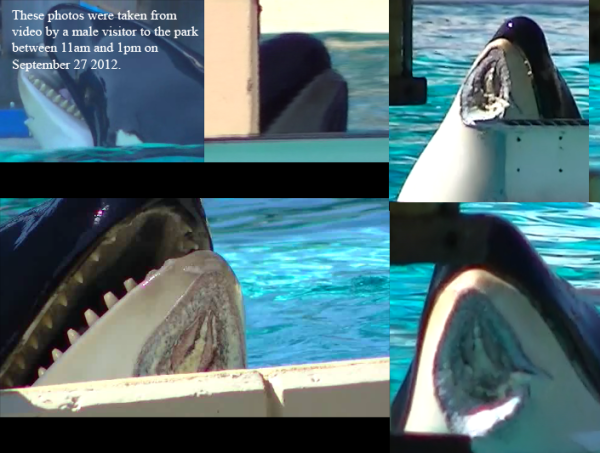
As you can see it is very deep and exposes both underlying tissue and bone.

SeaWorld finally released a statement about the injury:

A killer whale at Sea World was injured while swimming with two other whales during a night performance last week, park officials said Thursday.

The injury to Nakai, an 11-year-old whale, is believed to have occurred when he came into contact with a portion of the pool on Sept. 20, said Sea World spokesman Dave Koontz.

The whale was treated by veterinarians. Park officials did not disclose details of the injury.

“Nakai is currently receiving antibiotics and the veterinarians are pleased with the healing progress of his wound,” Koontz said.

Nakai is “swimming comfortably and interacting with other killer whales” at the park, Koontz said.

It’s hard to look at that wound and be confident that all is as well as Koontz suggests. The big challenge with an injury like this is infection. And Nakai, as Koontz indicates, is being pumped full of antibiotics in the hopes of staving off any bacteria.

Knowing that the chunk of Nakai’s chin that was sheared off was retrieved from the bottom of the pool, I wondered whether there might be some way to try and reattach it, or graft it back on. I was told, by someone who knows, that it is very difficult to sew or staple killer whale parts back on due to the force of water constantly rushing past the skin. Apparently, something like that was tried (and failed) with Splash after he injured his jaw.

Instead, I was told, SeaWorld sometimes uses an interesting and surprising remedy to try and protect open wounds: honey, which is used as a topical wound treatment.

Sounds a little nutty, but give SeaWorld points for creativity. Honey, apparently, is a well-known traditional topical agent:

Honey is an ancient remedy for the treatment of infected wounds, which has recently been ‘rediscovered’ by the medical profession, particularly where conventional modern therapeutic agents are failing. There are now many published reports describing the effectiveness of honey in rapidly clearing infection from wounds, with no adverse effects to slow the healing process; there is also some evidence to suggest that honey may actively promote healing. In laboratory studies, it has been shown to have an antimicrobial action against a broad spectrum of bacteria and fungi. However, further research is needed to optimise the effective use of this agent in clinical practice.

I was told that honey is sometimes used on abrasions on Tilikum’s flukes.

So there you have it: antibiotics and honey. Hope that works. Judging from these photos, Nakai is going to need all the help he can get.
Nakai Injury Update

Okay, here’s what I have been told about Nakai’s injury at SeaWorld California.

First: it is a serious injury, with a dinner plate-sized chunk of his lower mandible sheared off, exposing underlying tissues, and bone. The most serious concern, I think, is the possibility of a bad, possibly even life-threatening, infection.

Second: It happened last week during a night show, seemingly during a major altercation involving Nakai, Keet, and Ike. It’s not clear if there was an aggressor or instigator, or if they all suddenly went after each other. In response to the altercation, Nakai split to the back pool. The onstage trainers, not realizing how badly injured he was, continued the show with the other whales. It was only when they called Nakai over later that night that they realized he was seriously hurt.

Third: SW is not sure how the injury happened. Right now they believe it was due to blunt force trauma, but I’m not sure how that squares with the description of the injury in which a sizable piece of flesh on Nakai’s lower jaw was, in essence, sliced off. The piece was big enough and intact enough for SeaWorld to retrieve it from the bottom of the pool.

After Ike was brought into SeaWorld California from Marineland in Ontario, many people felt–particularly with Kasatka due to produce a calf–that SeaWorld would be wise to move Nakai elsewhere. Obviously, in retrospect that looks like it would have been a smart move. But the fact is, controlling the social aggression between the killer whales in SeaWorld’s pools appears to be a very delicate and difficult challenge no matter what SeaWorld facility you are talking about, and what whales you are trying to mix together (see here, and here).

Nakai’s injury is just the latest reminder of that difficult fact.

If I get more details I will post them over on my Facebook page.

SeaWorld California’s Nakai Injured?

Two of a Kind

Just received the following report that Nakai (photo above via) might have been injured:

“We’ve just heard a rumour that Nakai (male , captive born at SeaWorld 1 Sept 2011 – mother Kasatka, father Tilikum by AI), currently held at San Diego SeaWorld, today hurt himself badly on his lower jaw. I’ve seen on a TINY thumb nail (as the original photo on ‘photobucket’ has been pulled).

The rumour suggests that he may have been trying to get over the chains that SeaWorld has erected and has ripped the tissue down to the bone – it appears from the thumbnail that the lower edge of both mandibles has been stripped back to the bone. It seems that a chunk of tissue the size of a dinner plate is gone – from a side profile it looks like the orca has a bottlenose dolphin profile on the lower jaw.”
 
Trying to get more info, and will post if I do. Anyone else out there know anything about this, or have any pictures?

Mountain Gorillas vs. Poachers

Dian Fossey Trust Rwanda Gorrila

Nat Geo reports that mountain gorilla youngsters have been seen dismantling and destroying poachers’ snares:

On Tuesday tracker John Ndayambaje spotted a trap very close to the Kuryama gorilla clan. He moved in to deactivate the snare, but a silverback named Vubu grunted, cautioning Ndayambaje to stay away, Vecellio said.

Suddenly two juveniles—Rwema, a male; and Dukore, a female; both about four years old—ran toward the trap.

As Ndayambaje and a few tourists watched, Rwema jumped on the bent tree branch and broke it, while Dukore freed the noose.

The pair then spied another snare nearby—one the tracker himself had missed—and raced for it. Joined by a third gorilla, a teenager named Tetero, Rwema and Dukore destroyed that trap as well.

That’s an amazing insight into gorilla intelligence and awareness, and it makes it all the more horrific and tragic that wild gorillas are being driven by humans toward extinction. The gorillas apparently are doing what they can to preserve their young from poachers. But they will need a lot more help to have any hope of surviving.

(via @sam10k)

Food For (Non) Thought

Does junk food = Alzheimer’s?

I guess the link to Type 2 diabetes wasn’t enough to wean Americans from an addiction to planet-destroying, health-destroying, industrialized food.

But maybe the prospect of losing your mind will have an impact:

We used to think there were two types of diabetes: the type you’re born with (Type 1) and the type you “get.” That’s called Type 2, and was called “adult onset” until it started ravaging kids. Type 2 is brought about by a combination of factors, including overeating, American-style.

The idea that Alzheimer’s might be Type 3 diabetes has been around since 2005, but the connection between poor diet and Alzheimer’s is becoming more convincing, as summarized in a cover story in New Scientist entitled “Food for Thought: What You Eat May Be Killing Your Brain.” (The graphic — a chocolate brain with a huge piece missing — is creepy. But for the record: chocolate is not the enemy.)

If it doesn’t, at least Americans will start forgetting where the McDonalds is.

Extraordinary Images

The annual National Geographic Photography contest always delivers. An ocean-themed sampling (click images for full size):

Elephant Seal On South Georgia

Penguins On Antarctic Ice

Atlantic Spotted Dolphins

Of course, the last one is my favorite since it’s a scene I recently witnessed myself.

Forty-seven other photos submitted to National Geographic can be found here.

Wingsuit Wilding

Wow.

Reason #327 To Cycle

(via)