I’ve been a big advocate of using your personal choices to reduce your climate and environmental footprint–because you can and it DOES make a difference. So I am happy to see this sort of research:
Maya Almaraz, a postdoctoral researcher who works with Houlton at UC Davis, said she wishes she had a magic wand that could make everyone understand just how powerful their food choices can be.
“A lot of people feel really helpless when it comes to climate change, like they can’t make a difference,” said Almaraz. “What our research is showing is that your personal decisions really can have a big impact.”
Different foods have vastly different carbon footprints. Swap your steak for fish, for example, and you get an eight-fold reduction in emissions. And if you’re game to switch that to beans or lentils your emissions drop to near zero. It really gets interesting when lots of us start making similar changes.
Go forth, and eat wisely, and maybe others around you will be inspired to do the same…
Authorities in northern Western Australia are warning amateur boaties they are risking their lives by attempting to swim with humpback whales off the Ningaloo Coast.
The coastal town of Exmouth is in its second year of commercial humpback whale swimming trials, but the trials seem to have prompted some people to try to approach humpback whales in dinghies and on jet skis instead of with accredited operators.
That is not really news, or surprising to me. But what caught my eye is the attempt (increasingly common) by the commercial side to claim a clear line between safe, non-invasive, commercial whale-bothering and public whale-bothering. There is no question that commercial outfits on the whole are probably safer, more knowledgeable and less invasive (though their livelihood depends on getting everyone in close) than your average yahoo on a jetski. But the idea that whales are disturbed and disrupted by the public, and not by the commercial operations, is ludicrous.
It’s great that humanity is shifting its entertainment dollars away from captive display. But I am fearful that we are at the beginning of a profit-driven, mass human invasion of the wild. These humpbacks are there to breed, not to have to deal with snorkelers, just as spinner dolphins in Hawaii are inshore to rest (and need to be left alone).
It’s time to start setting some clear guidelines and codes of practice that are much more animal-friendly than those we have now. I’d start with no combustion engines, no large groups, no trace left. The core ethic would emphasize getting out into the wild for the sake of getting out into the wild, with no demands and expectations of what you might see or experience.
It has long seemed that one of the biggest challenges of keeping orcas healthy in captivity is dental care. Many captive orcas wear down and break their teeth by fighting, and chewing on concrete or the gates between pools. If the damage is bad enough SeaWorld and other facilities drill out the teeth and then flush them daily. Even so, the damaged teeth become prone to infection, infections which can lead to serious health problems.
To more fully gauge and understand the extent of this threat, John Jett and Jeff Ventre, two former SeaWorld trainers, along with other researchers, studied dental damage in captive orcas, using photography to catalogue and evaluate the problem. The result, “Tooth Damage In Captive Orcas, which appears in the Archives Of Oral Biology, is a comprehensive, scientific, assessment that reveals how common and extensive tooth damage in captivity really is.
Highlights of the paper include:
Mouth images of 29 orca held in captivity were evaluated for tooth damage. Individual teeth in the mandible and maxilla were scored for coronal wear, wear at or below the gum line, fractures, bore holes and missing.
Dental damage was present in all whales examined, and the various pathologies were observed across animals with different durations of captivity, across both sexes, in captive-born and wild-captured whales as well as whales kept in each facility. Dental pathology was especially prominent for mandibular teeth.
Forty five percent of whales exhibited “moderate” mean mandibular coronal wear, and an additional 24% exhibited “major” to “extreme” wear.
Bore holes were observed primarily within anterior mandibular teeth, with more than 61% of tooth 2 and 3 and 47.27% of tooth 4 bearing evidence of having undergone the modified pulpotomy procedure.
Dental damage begins early in a captive whale’s life.
Both conspecific aggression among captive whales and oral stereotypies such as biting and chewing on concrete and steel tank surfaces likely contributed to the tooth pathology observed.
Keeping any animal captive–especially a highly evolved, free-ranging, top predator–presents unusual health issues, both mental and physical. It is unlikely many marine park visitors suspect that tooth damage is one of the leading health challenges for captive orcas. But this paper makes clear how common the problem is, and how severe the damage can be. That is important, because the more we understand the negative side-effects of keeping animals captive for entertainment, the better we can weigh the ethical question of whether it is justified.
Pilgrim’s: The last truly “woke” restaurant I encountered.
“Woke” is a concise and excellent concept that comes from social and cultural activism. Woke means aware, and motivated to fight…injustice, racism, chauvinism.
Without diminishing the central role of the “woke” concept in social activism (I would argue, in any case, that promoting veganism has important social justice and environmental elements), I now find myself mentally applying the concept to veganism whenever I try a new restaurant. I scan the menu looking for things that I can eat, and even more important things that I can and WANT to eat. If I see plenty of tasty vegan options I know think of a restaurant as “woke vegan.” If I see an endless parade of meat and seafood, and find myself ordering a salad (and asking to hold the cheese; there is always cheese on salads. Why?) then that restaurant ain’t woke.
In DC there are not that many woke vegan restaurants. Yesterday my family went to a local place called Millie’s Spring Valley. I ended up ordering a tomato sandwich, hold the mayo, hold the cheese. Even the salads were almost all meat and seafood adorned. Got a cup of coffee, and asked if they had any non-dairy milks? Nope. Definitely a restaurant that is still slumbering.
In contrast, in Ireland this past summer, there were vegan options everywhere (and the best one came from a mobile lunch cart). Many restaurants say they will cater to vegans, or have vegan food. Sometimes that means they will make you a salad (I’m not sure I would label that “catering”). But sometimes they really mean it. We went to a restaurant in nearby Rosscarberry called Pilgrim’s. They had a diverse and local menu that upon appearance is not very vegan. When I asked them if they had vegan options (thinking I was about to hear: “Sure, we can make you a salad”), the waitress said absolutely, and then spent five minutes explaining how, for vegans, they combine different elements of their menu dishes into real dishes that a vegan could love. And I did. That is seriously woke vegan.
You can also have “woke vegetarian” of course, though I like to set the bar high. Anyhow, I explained the concept to my family as we ate yesterday. It got a good eye roll from my social justice warrior daughter, but no real pushback. It’s an irresistible concept, and works perfectly in the food context too.
So here’s to all the woke restaurants out there now, and planning to be out there in the future.
“Dogs must think we are so stupid because we have to build fences, and can’t just do this, to mark our territory.”
That Stinks: On one level, I think it would come as no surprise to dog owners that dogs recognize the smell of their own urine, and are more interested in urine from other dogs (When my dog works over a scent near our house I can almost see her thinking “Dammit, what was the jerk lab down the street doing up here?”–before she squats and does her best to over-write the scent).
Guppy Medal Of Honor: Nothing really surprises me about research that shows animals are smarter and more complex in their thinking than humans have generally (and arrogantly) assumed. But the details are always interesting. So I am happy to know that guppies have distinctive personalities, and that whether they are brave or cowards can be revealed by (okay, this part I don’t like so much) scaring them:
According to the team’s study, published Monday in the journal Functional Ecology, each fish demonstrated a unique response to stress — which they endured every three days in the form of a pulley-rigged lawn-ornament heron named “Grim,” or a predatory cichlid suddenly revealed on the other side of the glass.
“Some of them go straight to the shelter,” said Houslay, an evolutionary biologist and the study’s lead author. “Some just stop moving, maybe hoping they won’t be seen. Some rush to the side and just swim up and down trying to escape.”…
By measuring how long each guppy stayed hidden, frozen or otherwise panicked, the researchers determined that some fish were naturally cowards, and some were relatively brave.
And that wasn’t a fluke. The guppies kept proving their cowardice or braveness in repeated tests — every three days for four weeks.
“We see quite complex strategies; more complex than we thought,” Houslay said. “The variation isn’t just random. There’s something more meaningful going on.”
I often think that we’d be a lot closer to the truth if our starting assumption about animals was that they have intelligence, cognition and any number of other traits which the human animal likes to think of as unique to humans, and then used applied science to try and disprove it–instead of assuming all animals are stupid and then being surprised when researchers reveal something which seems pretty obvious to anyone who has ever spent any time around that type of animal.
But we have to take what we can get. And the more people recognize that fish have feelings and personalities, too, the more we might treat them with the respect and moral consideration they deserve–by which I first and foremost mean STOP NETTING AND EATING THEM.
If it does, will we finally care about biodiversity and conservation? We should:
Three-quarters of the world’s food today comes from just 12 crops and five animal species and this leaves supplies very vulnerable to disease and pests that can sweep through large areas of monocultures, as happened in the Irish potato famine when a million people starved to death. Reliance on only a few strains also means the world’s fast changing climate will cut yields just as the demand from a growing global population is rising.
There are tens of thousands of wild or rarely cultivated species that could provide a richly varied range of nutritious foods, resistant to disease and tolerant of the changing environment. But the destruction of wild areas, pollution and overhunting has started a mass extinction of species on Earth. The focus to date has been on wild animals – half of which have been lost in the last 40 years – but the new report reveals that the same pressures are endangering humanity’s food supply, with at least 1,000 cultivated species already endangered.
Snow Crab Cocktail: You can’t see it, but there is some dead right whale in there somewhere.
CBC News continues its invaluable and revealing series on the fate of the North Atlantic right whale. According to a post-summer, post-mortem, at least seven right whales got entangled with fishing lines in the Gulf Of St. Lawrence this summer. Two died, two were freed, two have fates unknown, and one freed itself. And this is just part of a devastating tally overall:
At least 14 whales have died in the Atlantic Ocean this summer, including at least 11 in the Gulf of St. Lawrence. No more than 500 of the animals remain.
According to Hamilton’s research, only one in four or five carcasses washes ashore, meaning the true death toll could be much higher.
“If that were the case, then we’ve just lost a big chunk of the population,” said Hamilton, who described the deaths as “profoundly discouraging.”
What the Canadian government won’t do is commit to requiring changes to fishing gear. Or closing the fisheries which are killing whales.
What would work? Consumer (and restaurant) avoidance of snow crabs, which is the fishery that seems to be doing the most damage.
Most people don’t think much about the upstream impacts of their food choices. Even if they wanted to the issues are obscure and complex, especially when it relates to fisheries. That’s why there is only one clear principle you can rely on: giving up all seafood is the only way to guarantee you are not having any upstream impacts that are killing and endangering other wildlife.
“Stop hassling us about population growth. Instead help empower our women and stop consuming so much yourselves!”
Rapid growth in human numbers is a key variable of any equation related to climate, conservation and stress on the planet. But you don’t often hear about it.
Vox writer David Roberts explains why, and argues that it is far more constructive to talk about policies that can help address population and its environmental impact (empowering women and global income inequality) than it is to directly plunge into the morally sticky and inevitably controversial topic of population control:
The first way to look at population is as a pure numbers game. More people means more consumers and more emitters, so the thing to do is slow the rise of population. Specifically, since most of the new people are going to come from poor or developing countries, the question is specifically how to slow population growth there.
Luckily, we know the answer. It is family planning that enables women to have only children they want and choose, and education of girls, giving them access to income opportunities outside the home. We know that women, given the resources and the choice, will opt for smaller families.
Those are the two most powerful levers to bend the population curve. They are also, in and of themselves, an enormously powerful climate policy. When Paul Hawken and his team investigated and ranked carbon-reduction solutions for their Drawdown project, they found that the combination of the two (call it the female-empowerment package) carried the most potential to reduce greenhouse gases later this century, out of any solution. (Together they could prevent 120 gigatons of GHGs by 2050 — more than on- and offshore wind combined.)…
One way to prevent the creation of new high-consumers would be to persuade the wealthy to have fewer babies and to close off the borders of wealthy countries, preventing low-consumers from immigrating and becoming high-consumers. You could try, in short, to engineer population decline in wealthy countries.
That seems … fraught.
For one thing, fertility tends to decline with wealth anyway. For another, any targeted attempt to engineer population decline is going to run into an unholy thicket of moral and political resistance.
Another way to approach the problem would be, rather than prevent the birth of extremely wealthy people, prevent the creation of extremely wealthy people. In other words, prevent the accumulation of massive wealth. You could do that by, for instance, taxing the shit out of wealthy people.
If you approached the problem that way, under the banner of reducing global income inequality, you would find many allies. Income inequality is a top-line concern of people and organizations all over the world, even some conservatives these days.
He’s right. And I’d stress that when wealthy populations preoccupy themselves with the environmental impact of growing developing world populations, instead of their own overconsumption, they are aiming at the wrong target.
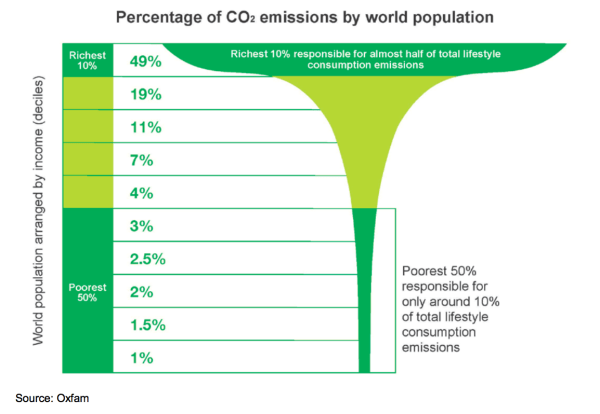
The idea that wealthier people consume more and emit for greenhouse gases won’t surprise you. But the concentration of global emissions among the planet’s wealthiest might.
How much wealth do you need to be in the richest 10%? $68,800. So now we have a very clear picture of where (most of) the problem lies, and who should (mostly) bear the expense and burden of reducing carbon emissions–and it is not the world’s developing populations. Just in case that wasn’t already clear.
It’s hard not love the amazing and sublime depiction of the planet and all its species in David Attenborough‘s work. But the beauty and wonder he depicted rarely had a hint that there was anything going seriously wrong with the planet, that the beauty and wonder was under threat. Too much of a bummer for a TV audience, perhaps.
David Attenborough vividly remembers, nearly 80 years on, his first encounter with one of the worst scourges of the planet. He was a schoolboy. “I remember my headmaster, who was also my science master, saying: ‘Boys, we’ve entered a new era! We’ve entered, we’ll be proud to say, the plastic era. And what is so wonderful about this is we’ve used all our scientific ingenuity to make sure that it’s virtually indestructible. It doesn’t decay, you know, it’s wonderful.’”
Plastics are the latest in a long line of concerns for the 91-year-old naturalist. They are a key theme of his latest work for television, the new series of The Blue Planet, which he will return to writing after our interview. Premiering at the BFI Imax in London this Wednesday – with Prince William as a special guest – the series will focus not only on the marvels of ocean life, but the threats to it, of which plastic is one of the worst. It will also deal with what people can do to help.
It’s often argued that negative news just depresses an audience into helplessness. That has always seemed like a cop out, a plea to be given permission to live as we live, buying every new iPhone, flying frequently to holiday destinations, and chowing down on burgers. Maybe the reality that this lifestyle is killing the planet is depressing. But it is also necessary if there is any hope of mobilizing the human nation into seeking a dramatically different, more planet-friendly, lifestyle. So it is good news that one of the planet’s premier naturalists and film-makers will focus his work on raising these issues and solutions. Finally.


 The Earthist Chronicles